Leonardo da Vinci (1452–1519) · translated by John Francis Rigaud (1802) · 364 chapters · 49 figures · public domain · plain text
The Treatise on Painting is Leonardo’s advice to the young painter, gathered from his notes: how to study, how to see light and shadow, color and distance, the figure in motion, drapery and landscape. This is the first English translation, by John Francis Rigaud (1802), with its copper plates and figures.
The young student should, in the first place, acquire a knowledge of perspective, to enable him to give to every object its proper dimensions: after which, it is requisite that he be under the care of an able master, to accustom him, by degrees, to a good style of drawing the parts. Next, he must study Nature, in order to confirm and fix in his mind the reason of those precepts which he has learnt. He must also bestow some time in viewing the works of various old masters, to form his eyeand judgment, in order that he may be able to put in practice all that he has been taught.
The organ of sight is one of the quickest, and takes in at a single glance an infinite variety of forms; notwithstanding which, it cannot perfectly comprehend more than one object at a time. For example, the reader, at one look over this page, immediately perceives it full of different characters; but he cannot at the same moment distinguish each letter, much less can he comprehend their meaning. He must consider it word by word, and line by line, if he be desirous of forming a just notion of these characters. In like manner, if we wish to ascend to the top of an edifice, we must be content to advance step by step, otherwise we shall never be able to attain it.
A young man, who has a natural inclination to the study of this art, I would advise to act thus: In order to acquire a true notion of the form of things, he must begin by studying the parts which compose them, and not pass to a second till he haswell stored his memory, and sufficiently practised the first; otherwise he loses his time, and will most certainly protract his studies. And let him remember to acquire accuracy before he attempts quickness.
Many are very desirous of learning to draw, and are very fond of it, who are, notwithstanding, void of a proper disposition for it. This may be known by their want of perseverance; like boys, who draw every thing in a hurry, never finishing, or shadowing.
Painting is divided into two principal parts. The first is the figure, that is, the lines which distinguish the forms of bodies, and their component parts. The second is the colour contained within those limits.
The form of bodies is divided into two parts; that is, the proportion of the members to each other, which must correspond with the whole; and the motion, expressive of what passes in the mind of the living figure.
The proportion of members is again divided into two parts, viz. equality, and motion. By equality is meant (besides the measure corresponding with thewhole), that you do not confound the members of a young subject with those of old age, nor plump ones with those that are lean; and that, moreover, you do not blend the robust and firm muscles of man with feminine softness: that the attitudes and motions of old age be not expressed with the quickness and alacrity of youth; nor those of a female figure like those of a vigorous young man. The motions and members of a strong man should be such as to express his perfect state of health.
In general, the dimensions of the human body are to be considered in the length, and not in the breadth; because in the wonderful works of Nature, which we endeavour to imitate, we cannot in any species find any one part in one model precisely similar to the same part in another. Let us be attentive, therefore, to the variation of forms, and avoid all monstrosities of proportion; such as long legs united to short bodies, and narrow chests with long arms. Observe also attentively the measure of joints, in which Nature is apt to vary considerably; and imitate her example by doing the same.
The measures of the human body vary in each member, according as it is more or less bent, or seen in different views, increasing on one side as much as they diminish on the other.
In men and children I find a great difference between the joints of the one and the other in the length of the bones. A man has the length of two heads from the extremity of one shoulder to the other, the same from the shoulder to the elbow, and from the elbow to the fingers; but the child has only one, because Nature gives the proper size first to the seat of the intellect, and afterwards to the other parts.
A man, in his infancy, has the breadth of his shoulders equal to the length of the face, and to the length of the arm from the shoulder to the elbow, when the arm is bent. It is the same again from the lower belly to the knee, and from the knee to the foot. But, when a man is arrived at the period of his full growth, every one of these dimensions becomes double in length, except the face, which, with the top of the head, undergoes but very little alteration in length. A well-proportioned and full-grown man, therefore, is ten times the length of his face; the breadth of his shoulders will be two faces, and in like manner all the above lengths will be double. The rest willbe explained in the general measurement of the human body.
All the parts of any animal whatever must be correspondent with the whole. So that, if the body be short and thick, all the members belonging to it must be the same. One that is long and thin must have its parts of the same kind; and so of the middle size. Something of the same may be observed in plants, when uninjured by men or tempests; for when thus injured they bud and grow again, making young shoots from old plants, and by those means destroying their natural symmetry.
If a man be short and thick, be careful that all his members be of the same nature, viz. short arms and thick, large hands, short fingers, with broad joints; and so of the rest.
Measure upon yourself the proportion of the parts, and, if you find any of them defective, note it down, and be very careful to avoid it in drawing your own compositions. For this is reckoned a common fault in painters, to delight in the imitation of themselves.
If the painter has clumsy hands, he will be apt to introduce them into his works, and so of any other part of his person, which may not happen to be so beautiful as it ought to be. He must, therefore, guard particularly against that self-love, or too good opinion of his own person, and study by every means to acquire the knowledge of what is most beautiful, and of his own defects, that he may adopt the one and avoid the other.
The young painter must, in the first instance, accustom his hand to copying the drawings of good masters; and when his hand is thus formed, and ready, he should, with the advice of his director, use himself also to draw from relievos; according to the rules we shall point out in the treatise on drawing from relievos.
When you draw from relievos, tinge your paper of some darkish demi-tint. And after you have made your outline, put in the darkest shadows, and, last of all, the principal lights, but sparingly, especially the smaller ones; because those are easily lost to the eye at a very moderate distance.
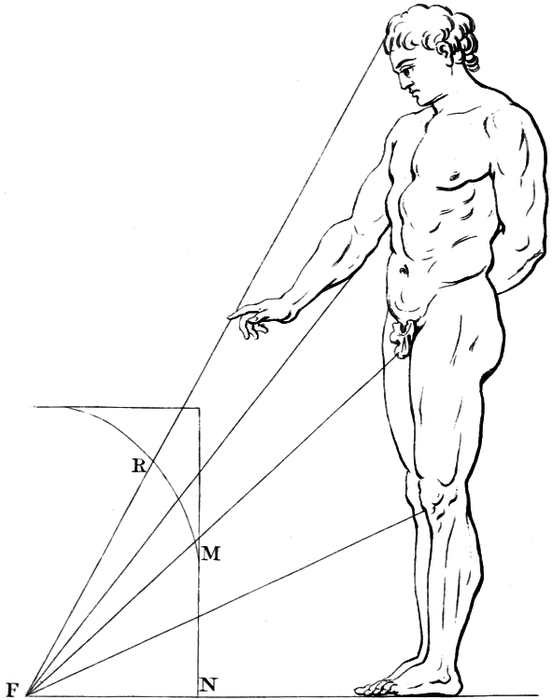
When you draw from Nature, you must be at the distance of three times the height of the object; and when you begin to draw, form in your own mind a certain principal line (suppose a perpendicular); observe well the bearing of the parts towards that line; whether they intersect, are parallel to it, or oblique.
When you draw from a naked model, always sketch in the whole of the figure, suiting all the members well to each other; and though you finish only that part which appears the best, have a regard to the rest, that, whenever you make use of such studies, all the parts may hang together.
In composing your attitudes, take care not to turn the head on the same side as the breast, nor let the arm go in a line with the leg. If the head turn towards the right shoulder, the parts must be lower on the left side than on the other; but if the chest come forward, and the head turn towards the left, the parts on the right side are to be the highest.
I have experienced no small benefit, when in the dark and in bed, by retracing in my mind the outlines of those forms which I had previously studied, particularly such as had appeared the most difficult to comprehend and retain; by this method they will be confirmed and treasured up in the memory.
The cartilage, which raises the nose in the middle of the face, varies in eight different ways. It is equally straight, equally concave, or equally convex, which is the first sort. Or, secondly, unequally straight, concave, or convex. Or, thirdly, straight in the upper part, and concave in the under. Or, fourthly, straight again in the upper part, and convex in those below. Or, fifthly, it may be concave and straight beneath. Or, sixthly, concave above, and convex below. Or, seventhly, it may be convex in the upper part, and straight in the lower. And in the eighth and last place, convex above, and concave beneath.
The uniting of the nose with the brows is in two ways, either it is straight or concave. The forehead has three different forms. It is straight, concave, or round. The first is divided into two parts, viz. it is either convex in the upper part, or in the lower, sometimes both; or else flat above and below.
You must observe and remember well the variations of the four principal features in the profile; the nose, mouth, chin, and forehead. And first of the nose, of which there are three different sorts, straight, concave, and convex. Of the straight there are but four variations, short or long, high at the end, or low. Of the concave there are three sorts; some have the concavity above, some in the middle, and some at the end. The convex noses also vary three ways; some project in the upper part, some in the middle, and others at the bottom. Nature, which seems to delight in infinite variety, gives again three changes to those noses which have a projection in the middle; for some have it straight, some concave, and some convex.
If you wish to retain with facility the general look of a face, you must first learn how to draw well several faces, mouths, eyes, noses, chins, throats, necks, and shoulders; in short, all those principal parts which distinguish one man from another. For instance, noses are often different sorts. Straight,bunched, concave, some raised above, some below the middle, aquiline, flat, round, and sharp. These affect the profile. In the front view there are eleven different sorts. Even, thick in the middle, thin in the middle, thick at the tip, thin at the beginning, thin at the tip, and thick at the beginning. Broad, narrow, high, and low nostrils; some with a large opening, and some more shut towards the tip.
The same variety will be found in the other parts of the face, which must be drawn from Nature, and retained in the memory. Or else, when you mean to draw a likeness from memory, take with you a pocket-book, in which you have marked all these variations of features, and after having given a look at the face you mean to draw, retire a little aside, and note down in your book which of the features are similar to it; that you may put it all together at home.
A painter ought not certainly to refuse listening to the opinion of any one; for we know that, although a man be not a painter, he may have just notions of the forms of men; whether a man has a hump on his back, a thick leg, or a large hand; whether he be lame, or have any other defect. Now, if we know that men are able to judge of the works of Nature, should we not think them more able to detect our errors?
The principal and most important consideration required in drawing figures, is to set the head well upon the shoulders, the chest upon the hips, the hips and shoulders upon the feet.
Study the science first, and then follow the practice which results from that science. Pursue method in your study, and do not quit one part till it be perfectly engraven in the memory; and observe what difference there is between the members of animals and their joints.
It is an easy matter for a man who is well versed in the principles of his art, to become universal in the practice of it, since all animals have a similarity of members, that is, muscles, tendons, bones, &c. These only vary in length or thickness, as will be demonstrated in the Anatomy. As for aquatic animals, of which there is great variety, I shall not persuade the painter to take them as a rule, having no connexion with our purpose.
It reflects no great honour on a painter to be able to execute only one thing well, such as a head, an academy figure, or draperies, animals, landscape, or the like, confining himself to some particular object of study; because there is scarcely a person so void of genius as to fail of success, if he apply earnestly to one branch of study, and practise it continually.
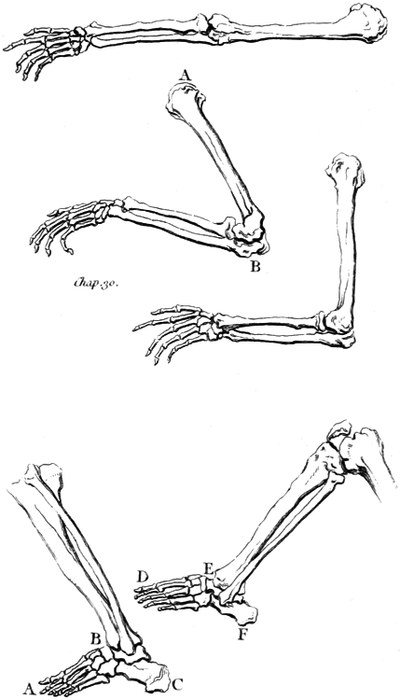
It is very necessary that painters should have a knowledge of the bones which support the flesh by which they are covered, but particularly of the joints, which increase and diminish the length of them in their appearance. As in the arm, which does not measure the same when bent, as when extended; its difference between the greatest extension and bending, is about one eighth of its length. The increase and diminution of the arm is effected by the bone projecting out of its socket at the elbow; which, as is seen in figure A B, Plate I. is lengthened from the shoulder to the elbow; the angle it forms being less than a right angle. It will appear longer as that angle becomes more acute, and will shorten in proportion as it becomes more open or obtuse.
There are in the joints of the human body certain small bones, fixed in the middle of the tendons which connect several of the joints. Such are the patellas of the knees, and the joints of the shoulders, and those of the feet. They are eight in number, one at each shoulder, one at each knee, and two at each foot under the first joint of the great toe towards the heel. These grow extremely hard as a man advances in years.
Note down which muscles and tendons are brought into action by the motion of any member, and when they are hidden. Remember that these remarks are of the greatest importance to painters and sculptors, who profess to study anatomy, and the science of the muscles. Do the same with children, following the different gradations of age from their birth even to decrepitude, describing the changes which the members, and particularly the joints, undergo; which of them grow fat, and which lean.
The joints of the shoulders, and other parts which bend, shall be noticed in their places in the Treatise on Anatomy, where the cause of the motions of all the parts which compose the human body shall be explained.
Young children have all their joints small, but they are thick and plump in the spaces between them; because there is nothing upon the bones at the joints, but some tendons to bind the bones together. The soft flesh, which is full of fluids, is enclosed under the skin in the space between the joints; and as the bones are bigger at the joints than in the space between them, the skin throws off in the progress to manhood that superfluity, and draws nearer to the bones, thinning the whole part together. But upon the joints it does not lessen, as there is nothing but cartilages and tendons. For these reasons children are small in the joints, and plump in the space between, as may be observed in their fingers, arms, and narrow shoulders. Men, on the contrary, are large and full in the joints, in the arms and legs; and where children have hollows, men are knotty and prominent.
The joints of the fingers appear larger on all sides when they bend; the more they bend the larger they appear. The contrary is the case when straight. It is the same in the toes, and it will be more perceptible in proportion to their fleshiness.
The wrist or joint between the hand and arm lessens on closing the hand, and grows larger when it opens. The contrary happens in the arm, in the space between the elbow and the hand, on all sides; because in opening the hand the muscles are extended and thinned in the arm, from the elbow to the wrist; but when the hand is shut, the same muscles swell and shorten. The tendons alone start, being stretched by the clenching of the hand.
The increase and diminution in the joint of the foot is produced on that side where the tendons are seen, as D E F, Plate I. which increases when the angle is acute, and diminishes when it becomes obtuse. It must be understood of the joint in the front part of the foot A B C.
When a figure is to appear nimble and delicate, its muscles must never be too much marked, nor are any of them to be much swelled. Because such figures are expressive of activity and swiftness, and are never loaded with much flesh upon the bones. They are made light by the want of flesh, and where there is but little flesh there cannot be any thickness of muscles.
Muscular men have large bones, and are in general thick and short, with very little fat; because the fleshy muscles in their growth contract closer together, and the fat, which in other instances lodges between them, has no room. The muscles in such thin subjects, not being able to extend, grow in thickness, particularly towards their middle, in the parts most removed from the extremities.
Though fat people have this in common with muscular men, that they are frequently short and thick, they have thin muscles; but their skin contains a great deal of spongy and soft flesh full of air; for that reason they are lighter upon the water, and swim better than muscular people.
In raising or lowering the arm, the pectoral muscles disappear, or acquire a greater relievo. A similar effect is produced by the hips, when they bend either inwards or outwards. It is to be observed, that there is more variety of appearances in the shoulders, hips, and neck, than in any other joint, because they are susceptible of the greatest variety of motions. But of this subject I shall make a separate treatise.
The muscles are not to be scrupulously marked all the way, because it would be disagreeable to the sight, and of very difficult execution. But on that side only where the members are in action, they should be pronounced more strongly; for muscles that are at work naturally collect all their parts together, to gain increase of strength, so that some small parts of those muscles will appear, that were not seen before.
The muscles of young men are not to be marked strongly, nor too much swelled, because that would indicate full strength and vigour of age, which they have not yet attained. Nevertheless they must be more or less expressed, as they are more or less employed. For those which are in motion are always more swelled and thicker than those which remain at rest. The intrinsic and central line of the members which are bent, never retains its natural length.
The muscle at the back part of the thigh shows more variety in its extension and contraction, than any other in the human body; the second, in that respect, are those which compose the buttocks; the third, those of the back; the fourth, those of the neck; the fifth, those of the shoulders; and the sixth, those of the Abdomen, which, taking their rise under the breast, terminate under the lower belly; as I shall explain when I speak of each.
There is a muscle which begins under the breast at the Sternum, and is inserted into, or terminates at the Os pubis, under the lower belly. It is called the Rectus of the Abdomen; it is divided, lengthways, into three principal portions, by transverse tendinous intersections or ligaments, viz. the superior part, and a ligament; the second part, with its ligaments; and the third part, with the third ligament; which last unites by tendons to the Os pubis. These divisions and intersections of the same muscle are intended by nature to facilitate the motion when the body is bent or distended. If it were made of one piece, it would produce too much variety when extended, or contracted, and also would be considerably weaker. When this muscle has but little variety in the motion of the body, it is more beautiful.
The muscles which serve either to straighten or bend the arm, arise from the different processes of the Scapula; some of them from the protuberances of the Humerus, and others about the middle of the Os humeri. The extensors of the arm arise from behind, and the flexors from before.
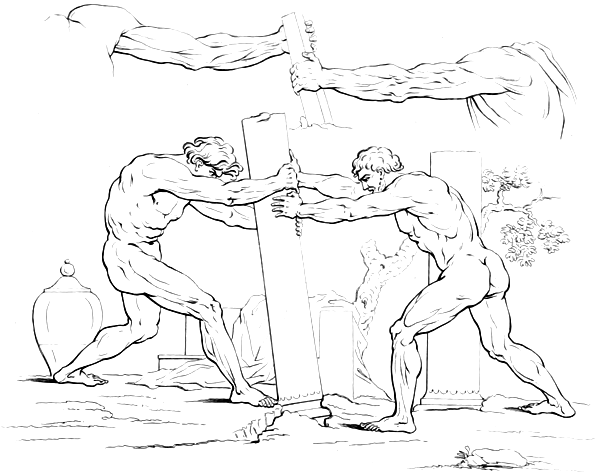
That a man has more power in pulling than in pushing, has been proved by the ninth proposition De Ponderibus, where it is said, that of two equalweights, that will have the greatest power which is farthest removed from the pole or centre of its balance. It follows then of course, that the muscle N B, Plate II. and the muscle N C, being of equal power, the inner muscle N C, will nevertheless be stronger than the outward one N B, because it is inserted into the arm at C, a point farther removed from the centre of the elbow A, than B, which is on the other side of such centre, so that that question is determined. But this is a simple power, and I thought it best to explain it before I mentioned the complex power of the muscles, of which I must now take notice. The complex power, or strength, is, for instance, this, when the arm is going to act, a second power is added to it (such as the weight of the body and the strength of the legs, in pulling or pushing), consisting in the extension of the parts, as when two men attempt to throw down a column; the one by pushing, and the other by pulling.
A man has the greatest power in pulling, for in that action he has the united exertion of all the muscles of the arm, while some of them must be inactive when he is pushing; because when the arm is extended for that purpose, the muscles which move the elbow cannot act, any more than if he pushed with his shoulders against the column he means to throw down; in which case only the muscles that extend the back, the legs under the thigh, and the calves of the legs, would be active. From which we conclude, that in pulling there is added to the power of extension the strength of the arms, of the legs, of the back, and even of the chest, if the oblique motion of the body require it. But in pushing, though all the parts were employed, yet the strength of the muscles of the arms is wanting; for to push with an extended arm without motion does not help more than if a piece of wood were placed from the shoulder to the column meant to be pushed down.
The flesh which covers the bones near and at the joints, swells or diminishes in thickness according to their bending or extension; that is, it increases at the inside of the angle formed by the bending, and grows narrow and lengthened on the outward side of the exterior angle. The middle between the convex and concave angle participates of this increase or diminution, but in a greater or less degree as the parts are nearer to, or farther from, the angles of the bending joints.
The members of naked men who work hard in different attitudes, will shew the muscles more strongly on that side where they act forcibly to bring the part into action; and the other muscles will be more or less marked, in proportion as they co-operate in the same motion.
Where the arm joins with the hand, there is a ligament, the largest in the human body, which is without muscles, and is called the strong ligament of the Carpus; it has a square shape, and serves to bind and keep close together the bones of the arm, and the tendons of the fingers, and prevent their dilating, or starting out.
When the arms are carried behind the back, the elbows can never be brought nearer than the length from the elbow to the end of the longest finger; so that the fingers will not be seen beyond the elbows, and in that situation, the arms with the shoulders form a perfect square. The greatest extension of the arm across the chest is, when the elbow comes over the pit of the stomach; the elbow and the shoulder in this position, will form an equilateral triangle.
A naked figure being strongly marked, so as to give a distinct view of all the muscles, will not express any motion; because it cannot move, if some of its muscles do not relax while the others are pulling. Those which relax cease to appear in proportion as the others pull strongly and become apparent.
The muscles of the human body are to be more or less marked according to their degree of action. Those only which act are to be shewn, and the more forcibly they act, the stronger they should be pronounced. Those that do not act at all must remain soft and flat.
The bodies of men diminish as much on the side which bends, as they increase on the opposite side. That diminution may at last become double, in proportion to the extension on the other side. But of this I shall make a separate treatise.
The painter who has obtained a perfect knowledge of the nature of the tendons and muscles, and of those parts which contain the most of them, will know to a certainty, in giving a particular motion to any part of the body, which, and how many of the muscles give rise and contribute to it; which of them, by swelling, occasion their shortening, and which of the cartilages they surround.
He will not imitate those who, in all the different attitudes they adopt, or invent, make use of the same muscles, in the arms, back, or chest, or any other parts.
Motion is created by the loss of due equipoise, that is, by inequality of weight; for nothing can move of itself, without losing its centre of gravity, and the farther that is removed, the quicker and stronger will be the motion.
The balance or equipoise of parts in the human body is of two sorts, viz. simple, and complex. Simple, when a man stands upon his feet without motion: in that situation, if he extends his arms at different distances from the middle, or stoop, the centre of his weight will always be in a perpendicular line upon the centre of that foot which supports the body; and if he rests equally upon both feet, then the middle of the chest will be perpendicular to the middle of the line which measures the space between the centres of his feet.
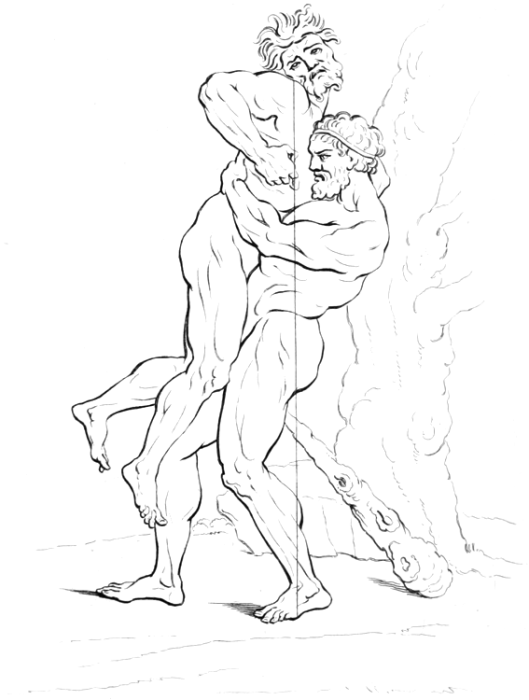
The complex balance is, when a man carries a weight not his own, which he bears by different motions; as in the figure of Hercules stifling Anteus, by pressing him against his breast with his arms, after he has lifted him from the ground. He must have as much of his own weight thrown behind the central line of his feet, as the weight of Anteus adds before.
The pit of the neck, between the two Clavicles, falls perpendicularly with the foot which bears the weight of the body. If one of the arms be thrown forwards, this pit will quit that perpendicular; and if one of the legs goes back, that pit is brought forwards, and so changes its situation at every change of posture.
A figure standing upon its feet without motion, will form an equipoise of all its members round the centre of its support.
If this figure without motion, and resting upon its feet, happens to move one of its arms forwards, it must necessarily throw as much of its weight on the opposite side, as is equal to that of the extended arm and the accidental weight. And the same I say of every part, which is brought out beyond its usual balance.
The weight of a man resting upon one leg will always be equally divided on each side of the central or perpendicular line of gravity, which supports him.
The legs, or centre of support, in men and animals, will approach nearer to the centre of gravity, in proportion to the slowness of their motion; and, on the contrary, when the motion is quicker, they will be farther removed from that perpendicular line.
All bipeds in their motions lower the part immediately over the foot that is raised, more than over that resting on the ground, and the highest parts do just the contrary. This is observable in the hips and shoulders of a man when he walks; and also in birds in the head and rump.
The highest parts of quadrupeds are susceptible of more variation when they walk, than when they are still, in a greater or less degree, in proportion to their size. This proceeds from the oblique position of their legs when they touch the ground, which raise the animal when they become straight and perpendicular upon the ground.
The motion performed by a man, or any other animal whatever, in walking, will have more or less velocity as the centre of their weight is more or less removed from the centre of that foot upon which they are supported.
That figure will appear the swiftest in its course which leans the most forwards.
Any body, moving of itself, will do it with more or less velocity in proportion as the centre of its gravity is more or less removed from the centre of its support. This is mentioned chiefly in regard to the motion of birds, which, without any clapping of their wings, or assistance of wind, move themselves. This happens when the centre of their gravity is out of the centre of their support, viz. out of its usual residence, the middle between the two wings. Because, if the middle of the wings be more backward than the centre of the whole weight, the bird will move forwards and downwards, in a greater or less degree as the centre of its weight is more or less removed from the middle of its wings. From which it follows, that if the centre of gravity be far removed from the other centre, the descent of the bird will be very oblique; but if that centre be near the middle of the wings, the descent will have very little obliquity.
The man who rests upon his feet, either bears the weight of his body upon them equally, or unequally. If equally, it will be with some accidental weight, or simply with his own; if it be with an additional weight, the opposite extremities of his members will not be equally distant from the perpendicular of his feet. But if he simply carries his own weight, the opposite extremities will be equally distant from the perpendicular of his feet: and on this subject of gravity I shall write a separate book.
The navel is always in the central or middle line of the body, which passes through the pit of the stomach to that of the neck, and must have as much weight, either accidental or natural, on one side of the human figure as on the other. This is demonstrated by extending the arm, the wrist of which performsthe office of a weight at the end of a steelyard; and will require some weight to be thrown on the other side of the navel, to counterbalance that of the wrist. It is on that account that the heel is often raised.
After a man, by standing long, has tired the leg upon which he rests, he sends part of his weight upon the other leg. But this kind of posture is to be employed only for old age, infancy, or extreme lassitude, because it expresses weariness, or very little power in the limbs. For that reason, a young man, strong and healthy, will always rest upon one of his legs, and if he removes a little of his weight upon the other, it is only a necessary preparative to motion, without which it is impossible to move; as we have proved before, that motion proceeds from inequality.
If the figure rests upon one foot, the shoulder on that side will always be lower than the other; and the pit of the neck will fall perpendicularly over the middle of that leg which supports the body. The same will happen in whatever other view we see that figure, when it has not the arm much extended, nor any weight on its back, in its hand, or on its shoulder, and when it does not, either behind or before, throw out that leg which does not support the body.
The extending of the arm, which was bent, removes the weight of the figure upon the foot which bears the weight of the whole body: as is observable in rope-dancers, who dance upon the rope with their arms open, without any pole.
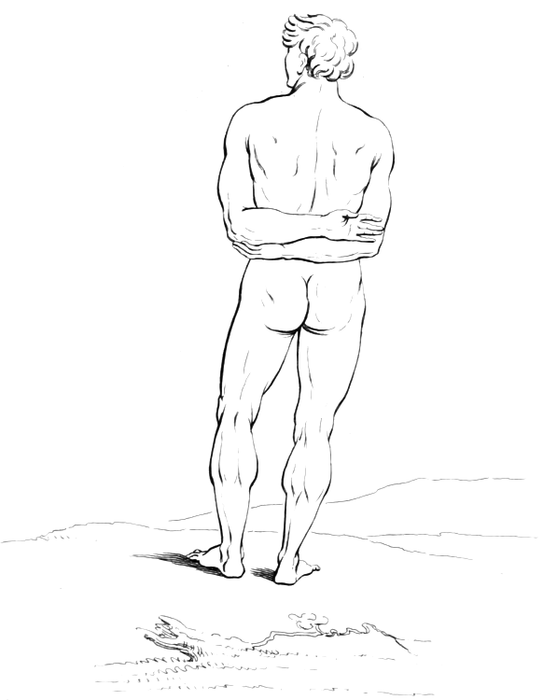
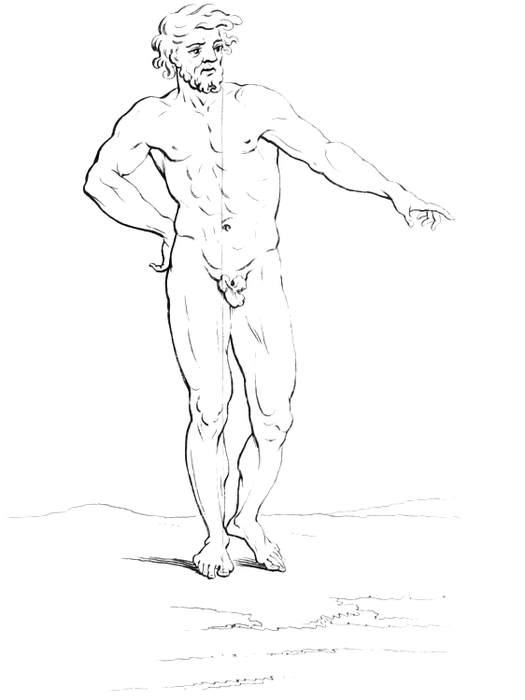
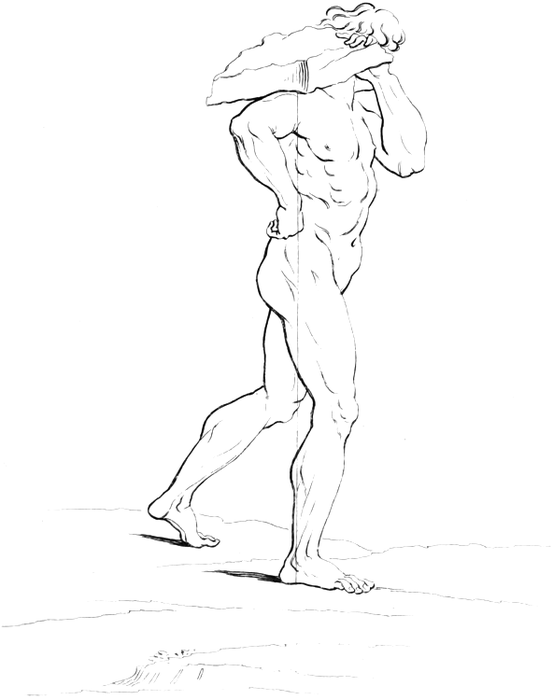
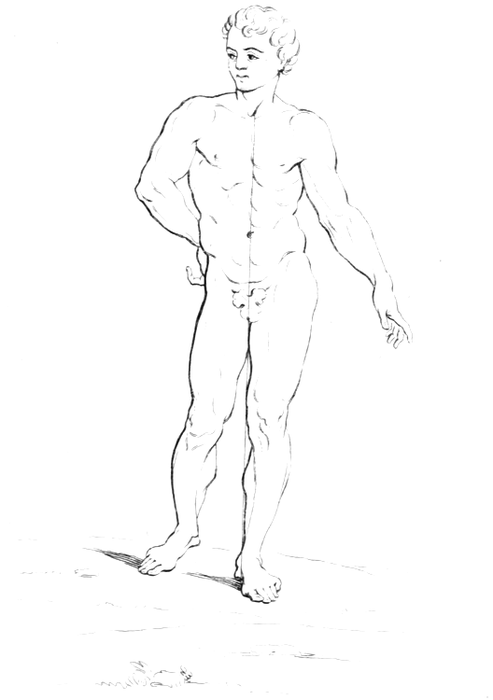
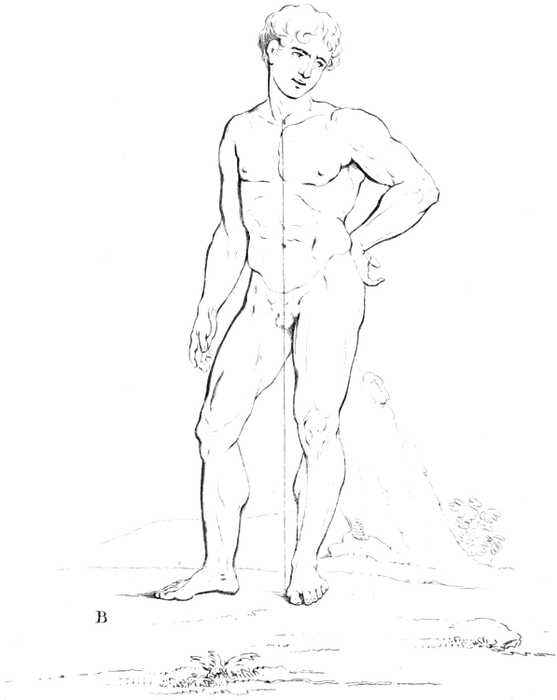
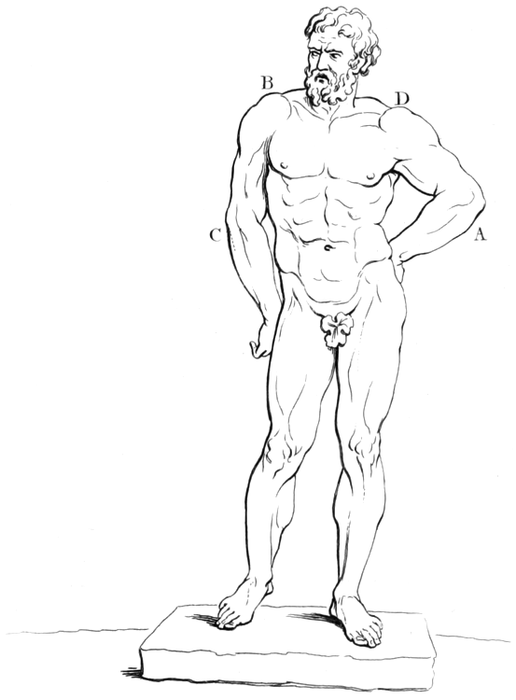
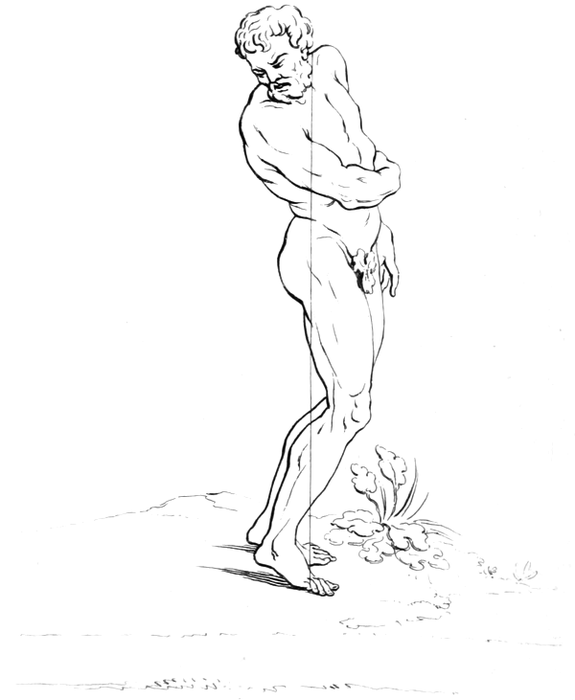
The shoulder which bears the weight is always higher than the other. This is seen in the figure opposite, in which the centre line passes through the whole, with an equal weight on each side, to the leg on which it rests. If the weight were not equally divided on each side of this central line of gravity, the whole would fall to the ground. But Nature has provided, that as much of the natural weight of the man should be thrown on one side, as of accidental weight on the other, to form a counterpoise. This is effected by the man’s bending, and leaning on the side not loaded, so as to form an equilibrium to the accidental weight he carries; and this cannot be done, unless the loaded shoulder be raised, and the other lowered. This is the resource with which Nature has furnished a man on such occasions.
Any figure bearing an additional weight out of the central line, must throw as much natural or accidental weight on the opposite side as is sufficient to form a counterpoise round that line, which passes from the pit of the neck, through the whole mass of weight, to that part of the foot which rests upon the ground. We observe, that when a man lifts a weight with one arm, he naturally throws out the opposite arm; and if that be not enough to form an equipoise, he will add as much of his own weight, by bending his body, as will enable him to resist such accidental load. We see also, that a man ready to fall sideways and backwards at the same time, always throws out the arm on the opposite side.
Whether a man moves with velocity or slowness, the parts above the leg which sustains the weight, will always be lower than the others on the opposite side.
The shoulders or sides of a man, or any other animal, will preserve less of their level, in proportion to the slowness of their motion; and, vice versâ, those parts will lose less of their level when the motion is quicker. This is proved by the ninth proposition, treating of local motions, where it is said, any weight will press in the direction of the line of its motion; therefore the whole moving towards any one point, the parts belonging to it will follow the shortest line of the motion of its whole, without giving any of its weight to the collateral parts of the whole.
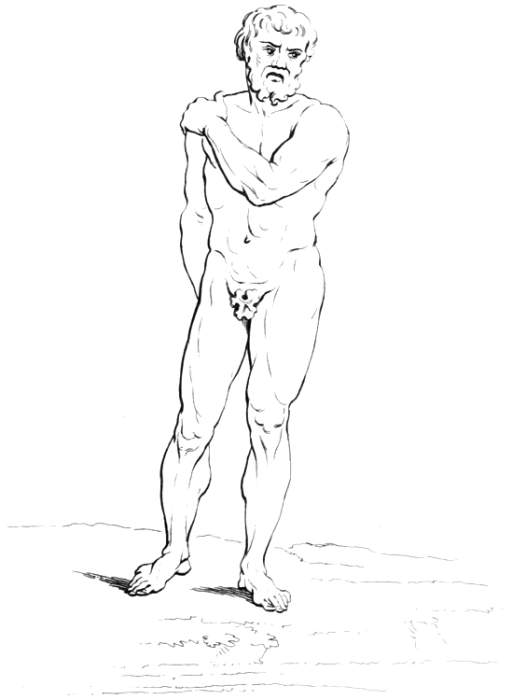
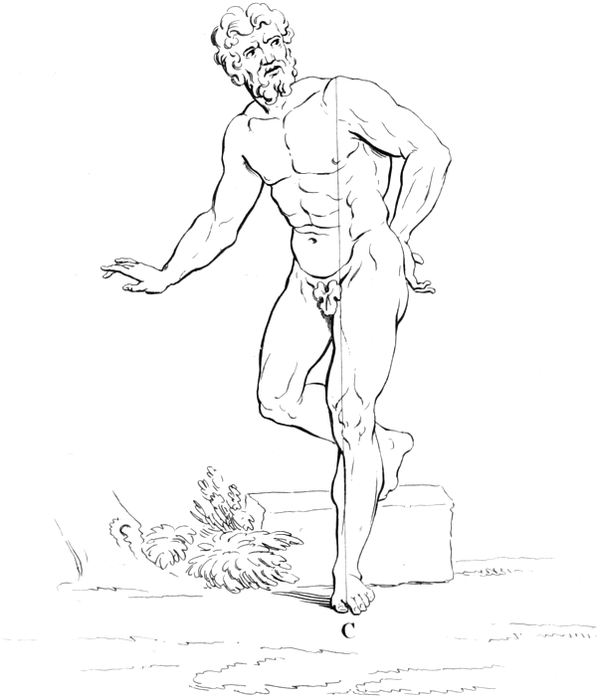
It has been objected, in regard to the first part of the above proposition, that it does not follow that a man standing still, or moving slowly, has his members always in perfect balance upon the centre of gravity; because we do not find that Nature always follows that rule, but, on the contrary, the figure will sometimes bend sideways, standing upon one foot; sometimes it will rest part of its weight upon that leg which is bent at the knee, as is seen in the figures B C. But I shall reply thus, that what is not performed by the shoulders in the figure C, is done by the hip, as is demonstrated in another place.
In the same proportion as that part of the naked figure marked D A, lessens in height from the shoulder to the hip, on account of its position the opposite side increases. And this is the reason: the figure resting upon one (suppose the left) foot, that foot becomes the centre of all the weight above; and the pit of the neck, formed by the junction of the two Clavicles, quits also its natural situation at the upper extremityof the perpendicular line (which passes through the middle surface of the body), to bend over the same foot; and as this line bends with it, it forces the transverse lines, which are always at right angles, to lower their extremities on that side where the foot rests, as appears in A B C. The navel and middle parts always preserve their natural height.
In the bending of the joints it is particularly useful to observe the difference and variety of shape they assume; how the muscles swell on one side, while they flatten on the other; and this is more apparent in the neck, because the motion of it is of three sorts, two of which are simple motions, and the other complex, participating also of the other two.
The simple motions are, first, when the neck bends towards the shoulder, either to the right or left, and when it raises or lowers the head. The second is, when it twists to the right or left, without rising or bending, but straight, with the head turned towards one of the shoulders. The third motion, which is called complex, is, when to the bending of it is added the twisting, as when the ear leans towards one of the shoulders, the head turning the same way, and the face turned upwards.
Of those which the shoulders can perform, simple motions are the principal, such as moving the arm upwards and downwards, backwards and forwards. Though one might almost call those motions infinite, for if the arm can trace a circle upon a wall, it will have performed all the motions belonging to the shoulders. Every continued quantity being divisible ad infinitum, and this circle being a continued quantity, produced by the motion of the arm going through every part of the circumference, it follows, that the motions of the shoulders may also be said to be infinite.
When you mean to represent a man removing a weight, consider that the motions are various, viz. either a simple motion, by bending himself to raise the weight from the ground upwards, or when he drags the weight after him, or pushes it before him, or pulls it down with a rope passing through a pulley. It is to be observed, that the weight of the man’s body pulls the more in proportion as the centre of his gravity is removed from the centre of his support. To this must be added the strength of the effort that the legs and back make when they are bent, to return to their natural straight situation.
A man never ascends or descends, nor walks at all in any direction, without raising the heel of the back foot.
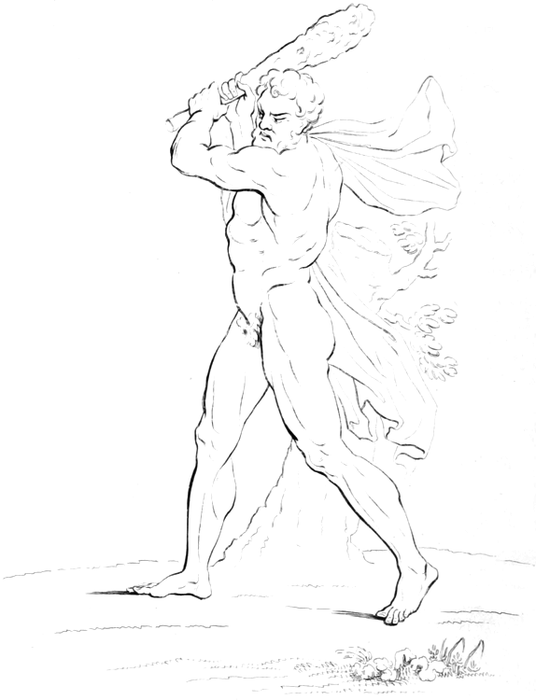
When a man prepares himself to strike a violent blow, he bends and twists his body as far as he canto the side contrary to that which he means to strike, and collecting all his strength, he, by a complex motion, returns and falls upon the point he has in view.
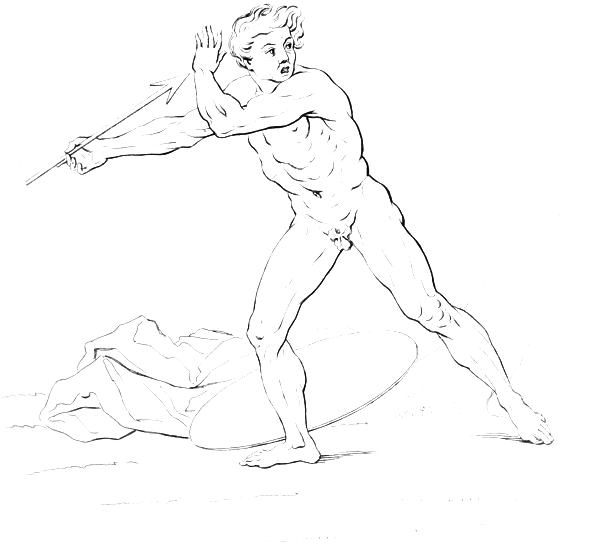
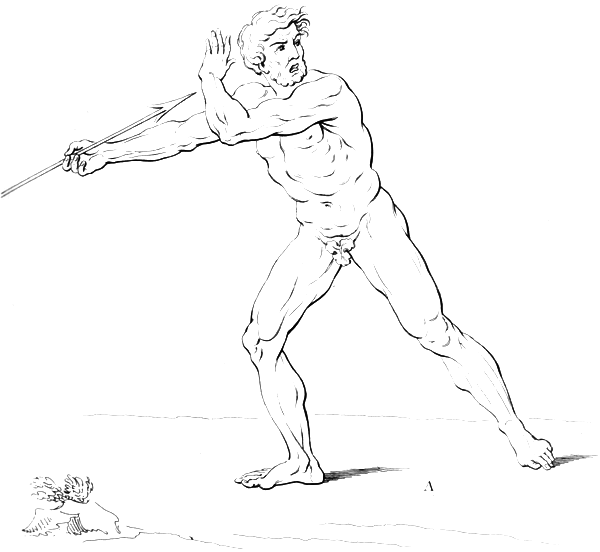
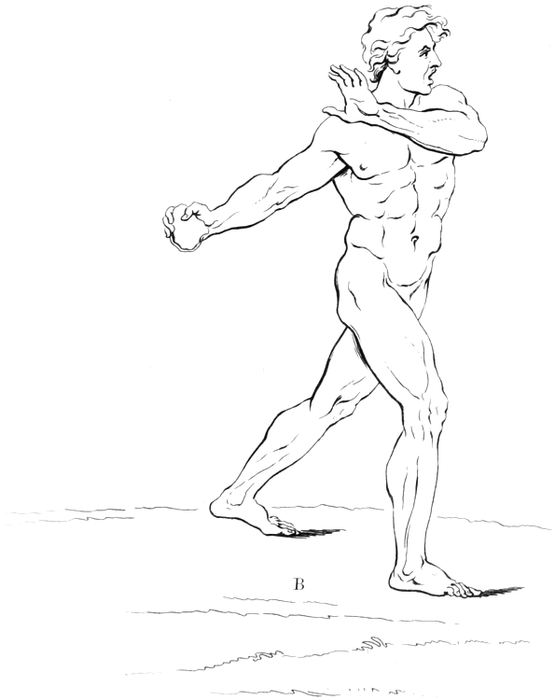
A man throwing a dart, a stone, or any thing else with violence, may be represented, chiefly, two different ways; that is, he may be preparing to do it, or the act may be already performed. If you mean to place him in the act of preparation, the inside of the foot upon which he rests will be under the perpendicular line of the pit of the neck; and if it be the right foot, the left shoulder will be perpendicular over the toes of the same foot.
He who wishes to pitch a pole into the ground, or draw one out of it, will raise the leg and bend the knee opposite to the arm which acts, in order to balance himself upon the foot that rests, without which he could neither drive in, nor pull out any thing.
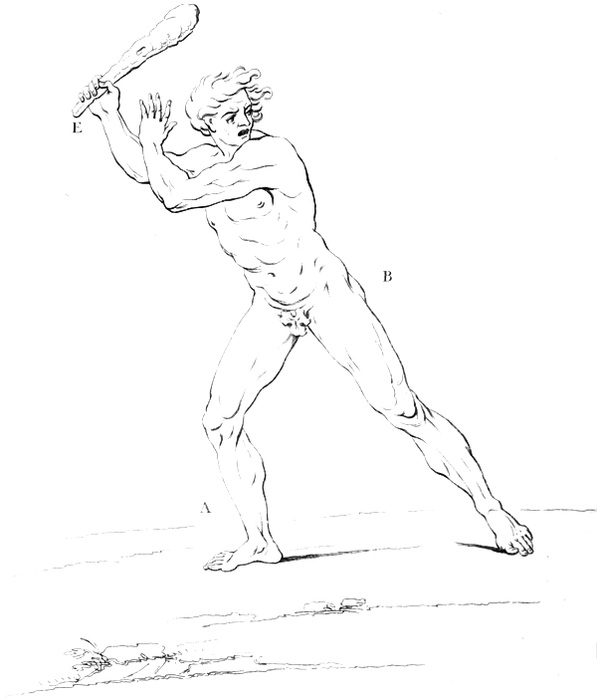
Of the two arms, that will be most powerful in its effort, which, having been farthest removed from its natural situation, is assisted more strongly by the other parts to bring it to the place where it means to go. As the man A, who moves the arm with a club E, and brings it to the opposite side B, assisted by the motion of the whole body.
Nature will of itself, and without any reasoning in the mind of a man going to jump, prompt him to raise his arms and shoulders by a sudden motion, together with a great part of his body, and to lift them up high, till the power of the effort subsides. This impetuous motion is accompanied by an instantaneous extension of the body which had bent itself, like a spring or bow, along the back, the joints of the thighs, knees, and feet, and is let off obliquely, that is, upwards and forwards; so that the disposition of the body tending forwards and upwards, makes it describe a great arch when it springs up, which increases the leap.
When a man jumps upwards, the motion of the head is three times quicker than that of the heel, before the extremity of the foot quits the ground, and twice as quick as that of the hips; because three angles are opened and extended at the same time: the superior one is that formed by the body at its joint with the thigh before, the second is at the joint ofthe thighs and legs behind, and the third is at the instep before.
In regard to the freedom and ease of motions, it is very necessary to observe, that when you mean to represent a figure which has to turn itself a little round, the feet and all the other members are not to move in the same direction as the head. But you will divide that motion among four joints, viz. the feet, the knees, the hips, and the neck. If it rests upon the right leg, the left knee should be a little bent inward, with its foot somewhat raised outward. The left shoulder should be lower than the other, and the nape of the neck turned on the same side as the outward ankle of the left foot, and the left shoulder perpendicular over the great toe of the right foot. And take it as a general maxim, that figures do not turn their heads straight with the chest, Nature having for our convenience formed the neck so as to turn with ease on every side, when the eyes want to look round; and to this the other joints are in some measure subservient. If the figure be sitting, and the arms have some employment across the body, the breast will turn over the joint of the hip.
The greatest twist that the body can perform is when the back of the heels and the front of the face are seen at the same time. It is not done without difficulty, and is effected by bending the leg and lowering the shoulder on that side towards which the head turns. The cause of this motion, and also which of the muscles move first and which last, I shall explain in my treatise on anatomy.
It is impossible to turn the leg inwards or outwards without turning the thigh by the same motion, because the setting in of the bones at the knee is such, that they have no motion but backwards and forwards, and no more than is necessary for walking or kneeling; never sideways, because the form of the bones at the joint of the knee does not allow it.If this joint had been made pliable on all sides, as that of the shoulder, or that of the thigh bone with the hip, a man would have had his legs bent on each side as often as backwards and forwards, and seldom or never straight with the thigh. Besides, this joint can bend only one way, so that in walking it can never go beyond the straight line of the leg; it bends only forwards, for if it could bend backwards, a man could never get up again upon his feet, if once he were kneeling; as when he means to get up from the kneeling posture (on both knees), he gives the whole weight of his body to one of the knees to support, unloading the other, which at that time feels no other weight than its own, and therefore is lifted up with ease, and rests his foot flat upon the ground; then returning the whole weight upon that foot, and leaning his hand upon his knee, he at once extends the other arm, raises his head, and straightening the thigh with the body, he springs up, and rests upon the same foot, while he brings up the other.
Figures that are set in a fixed attitude, are nevertheless to have some contrast of parts. If one arm come before, the other remains still or goes behind. If the figure rest upon one leg, the shoulder on that side will be lower than the other. This is observed by artists of judgment, who always take care to balance the figure well upon its feet, for fear it shouldappear to fall. Because by resting upon one foot, the other leg, being a little bent, does not support the body any more than if it were dead; therefore it is necessary that the parts above that leg should transfer the centre of their weight upon the leg which supports the body.
The members are to be suited to the body in graceful motions, expressive of the meaning which the figure is intended to convey. If it had to give the idea of genteel and agreeable carriage, the members must be slender and well turned, but not lean; the muscles very slightly marked, indicating in a soft manner such as must necessarily appear; the arms, particularly, pliant, and no member in a straight line with any other adjoining member. If it happen, on account of the motion of the figure, that the right hip be higher than the left, make the joint of the shoulder fall perpendicularly on the highest part of that hip; and let that right shoulder be lower than the left. The pit of the neck will always be perpendicular over the middle of the instep of the foot that supports the body. The leg that does not bear will have its knee a little lower than the other, and near the other leg.
In regard to the positions of the head and arms, they are infinite, and for that reason I shall not enter into any detailed rule concerning them; suffice it to say, that they are to be easy and free, graceful, andvaried in their bendings, so that they may not appear stiff like pieces of wood.
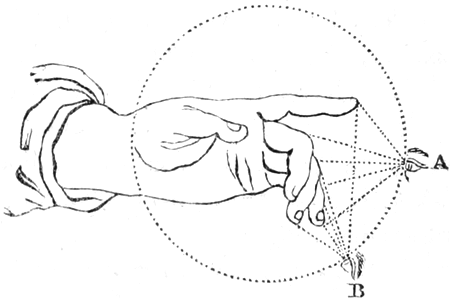
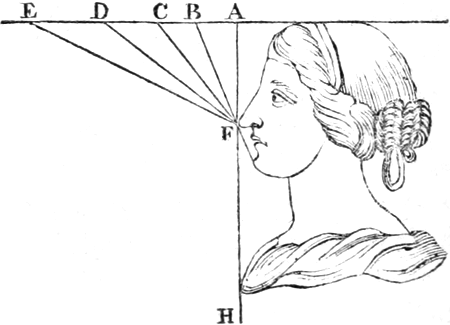
It is impossible that any memory can be able to retain all the aspects or motions of any member of any animal whatever. This case we shall exemplify by the appearance of the hand. And because any continued quantity is divisible ad infinitum, the motion of the eye which looks at the hand, and moves from A to B, moves by a space A B, which is also a continued quantity, and consequently divisible ad infinitum, and in every part of the motion varies to its view the aspect and figure of the hand; and so it will do if it move round the whole circle. The same will the hand do which is raised in its motion, that is, it will pass over a space, which is a continued quantity.
Never put the head straight upon the shoulders, but a little turned sideways to the right or left, even though the figures should be looking up or down, or straight, because it is necessary to give them some motion of life and spirit. Nor ever compose a figure in such a manner, either in a front or back view, as that every part falls straight upon another from the top to the bottom. But if you wish to introduce such a figure, use it for old age. Never repeat the same motion of arms, or of legs, not only not in the same figure, but in those which are standing by, or near; if the necessity of the case, or the expression of the subject you represent, do not oblige you to it.
The variety of motions in man are equal to the variety of accidents or thoughts affecting the mind, and each of these thoughts, or accidents, will operate more or less, according to the temper and age of the subject; for the same cause will in the actions of youth, or of old age, produce very different effects.
Complex motion is that which, to produce some particular action, requires the body to bend downwards and sideways at the same time. The painter must be careful in his compositions to apply these complex motions according to the nature of the subject, and not to weaken or destroy the effect of it by introducing figures with simple motions, without any connexion with the subject.
The motions of your figures are to be expressive of the quantity of strength requisite to the force of the action. Let not the same effort be used to take up a stick as would easily raise a piece of timber. Therefore shew great variety in the expression of strength, according to the quality of the load to be managed.
There are some emotions of the mind which are not expressed by any particular motion of the body, while in others, the expression cannot be shewn without it. In the first, the arms fall down, the hands and all the other parts, which in general are the most active, remain at rest. But such emotions of the soul as produce bodily action, must put the members into such motions as are appropriated to the intention of the mind. This, however, is an ample subject, and we have a great deal to say upon it. There is a third kind of motion, which participates of the two already described; and a fourth, which depends neither on the one nor the other. This last belongs to insensibility, or fury, and should be ranked with madness or stupidity; and so adapted only to grotesque or Moresco work.
It is not becoming in women and young people to have their legs too much asunder, because it denotes boldness; while the legs close together shew modesty.
Let every member be employed in performing its proper functions. For instance, in a dead body, or one asleep, no member should appear alive or awake. A foot bearing the weight of the whole body, should not be playing its toes up and down, but flat upon the ground; except when it rests entirely upon the heel.
A mere thought, or operation of the mind, excites only simple and easy motions of the body; not this way, and that way, because its object is in the mind, which does not affect the senses when it is collected within itself.
When the motion is produced by the presence of some object, either the cause is immediate or not. If it be immediate, the figure will first turn towards it the organs most necessary, the eyes; leaving its feet in the same place; and will only move the thighs, hips, and knees a little towards the same side, to which the eyes are directed.
Those who become enamoured of the practice of the art, without having previously applied to the diligent study of the scientific part of it, may be compared to mariners, who put to sea in a ship without rudder or compass, and therefore cannot be certain of arriving at the wished-for port.
Practice must always be founded on good theory; to this, Perspective is the guide and entrance, without which nothing can be well done.
The outlines or contours of bodies are so little perceivable, that at any small distance between that and the object, the eye will not be able to recognise the features of a friend or relation, if it were not for their clothes and general appearance. So that by the knowledge of the whole it comes to know the parts.
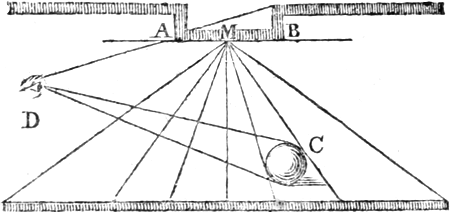
Linear Perspective consists in giving, by established rules, the true dimensions of objects, according to their respective distances; so that the second object be less than the first, the third than the second, and by degrees at last they become invisible. I find by experience, that, if the second object be atthe same distance from the first, as the first is from the eye, though they be of the same size, the second will appear half the size of the first; and, if the third be at the same distance behind the second, it will diminish two thirds; and so on, by degrees, they will, at equal distances, diminish in proportion; provided that the interval be not more than twenty cubits; at which distance it will lose two fourths of its size: at forty it will diminish three fourths; and at sixty it will lose five sixths, and so on progressively. But you must be distant from your picture twice the size of it; for, if you be only once the size, it will make a great difference in the measure from the first to the second.
Those parts which are of less magnitude will first vanish from the sight. This happens, because the shape of small objects, at an equal distance, comes to the eye under a more acute angle than the large ones, and the perception of them is less, in proportion as they are less in magnitude. It follows then, that if the large objects, by being removed to a great distance, and consequently coming to the eye by a small angle, are almost lost to the sight, the small objects will entirely disappear.
The point of sight must be on a level with the eyes of a common-sized man, and placed upon the horizon, which is the line formed by a flat country terminating with the sky. An exception must be made as to mountains, which are above that line.
This will be proved by one single example. If you mean to represent a round ball very high up, on a flat and perpendicular wall, it will be necessary to make it oblong, like the shape of an egg, and to place yourself (that is, the eye, or point of view) so far back, as that its outline or circumference may appear round.
The first figure in your picture will be less than Nature, in proportion as it recedes from the front of the picture, or the bottom line; and by the same rule the others behind it will go on lessening in an equal degree.
The first things that disappear, by being removed to some distance, are the outlines or boundaries of objects. The second, as they remove farther, are the shadows which divide contiguous bodies. The third are the thickness of legs and feet; and so in succession the small parts are lost to the sight, till nothing remains but a confused mass, without any distinct parts.
Supposing this small object to represent a man, or any other animal, although the parts, by being so much diminished or reduced, cannot be executed with the same exactness of proportion, nor finished with the same accuracy, as if on a larger scale, yet on that very account the faults will be less conspicuous. For example, if you look at a man at the distance of two hundred yards, and with all due attention mean to form a judgment, whether he be handsome or ugly, deformed or well made, you will find that, with all your endeavours, you can hardly venture to decide. The reason is, that the man diminishes so much by the distance, that it is impossibleto distinguish the parts minutely. If you wish to know by demonstration the diminution of the above figure, hold your finger up before your eye at about nine inches distance, so that the top of your finger corresponds with the top of the head of the distant figure: you will perceive that your finger covers, not only its head, but part of its body; which is an evident proof of the apparent diminution of that object. Hence it often happens, that we are doubtful, and can scarcely, at some distance, distinguish the form of even a friend.
This custom, which has been generally adopted by painters, on the front and sides of chapels, is much to be condemned. They begin with an historical picture, its landscape and buildings, in one compartment. After which, they raise another compartment, and execute another history with other buildings upon another level; and from thence they proceed to a third and fourth, varying the point of sight, as if the beholder was going up steps, while, in fact, he must look at them all from below, which is very ill judged in those matters.
We know that the point of sight is the eye of the spectator; and if you ask, how is a series of subjects, such as the life of a saint, to be represented, in different compartments on the same wall? I answer, that you are to place the principal event in the largest compartment, and make the point ofsight as high as the eye of the spectator. Begin that subject with large figures; and as you go up, lessen the objects, as well the figures, as buildings, varying the plans according to the effect of perspective; but never varying the point of sight: and so complete the series of subjects, till you come to a certain height, where terrestrial objects can be seen no more, except the tops of trees, or clouds and birds; or if you introduce figures, they must be aerial, such as angels, or saints in glory, or the like, if they suit the purpose of your history. If not, do not undertake this kind of painting, for your work will be faulty, and justly reprehensible.
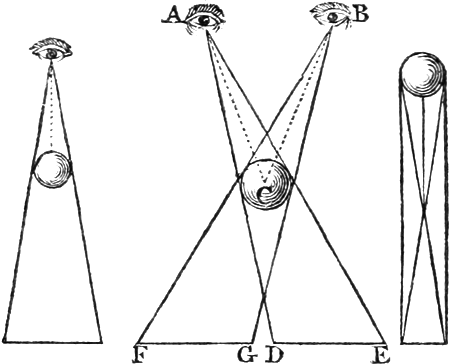
Painters often despair of being able to imitate Nature, from observing, that their pictures have not the same relief, nor the same life, as natural objects have in a looking-glass, though they both appear upon a plain surface. They say, they have colours which surpass in brightness the quality of the lights,and in darkness the quality of the shades of the objects seen in the looking-glass; but attribute this circumstance to their own ignorance, and not to the true cause, because they do not know it. It is impossible that objects in painting should appear with the same relief as those in the looking-glass, unless we look at them with only one eye.
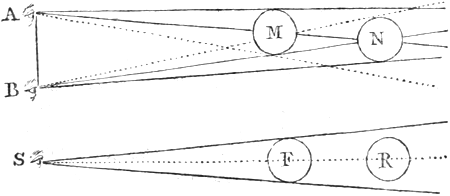
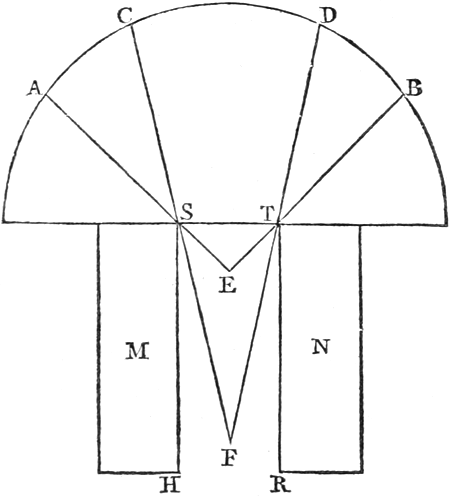
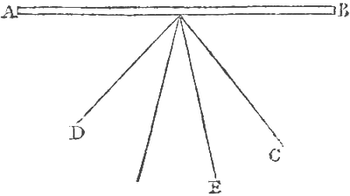
The reason is this. The two eyes A B looking at objects one behind another, as M and N, see them both; because M cannot entirely occupy the space of N, by reason that the base of the visual rays is so broad, that the second object is seen behind the first. But if one eye be shut, and you look with the other S, the body F will entirely cover the body R, because the visual rays beginning at one point, form a triangle, of which the body F is the base, and being prolonged, they form two diverging tangents at the two extremities of F, which cannot touch the body R behind it, therefore can never see it.
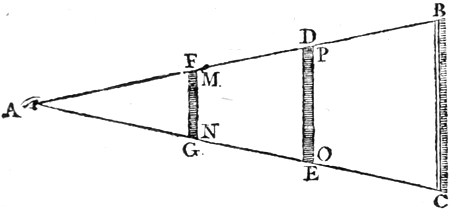
In order to give the appearance of the natural size, if the piece be small (as miniatures), the figures on the fore-ground are to be finished with as much precision as those of any large painting, because being small they are to be brought up close to the eye. But large paintings are seen at some distance; whence it happens, that though the figures in each are so different in size, in appearance they will be the same. This proceeds from the eye receiving those objects under the same angle; and it is proved thus. Let the large painting be B C, the eye A, and D E a pane of glass, through which are seen the figures situated at B C. I say that the eye being fixed, the figures in the copy of the paintings B C are to be smaller, in proportion as the glass D E is nearer the eye A, and are to be as precise and finished. But if you will execute the picture B C upon the glass D E, this ought to be less finished than the picture B C, and more so than the figure M N transferred upon the glass F G; because, supposing the figure P O to be as much finished as the natural one in B C, the perspective of O P would be false, since, though in regard to the diminution of the figure it would be right, B C being diminished in P O, the finishing would notagree with the distance, because in giving it the perfection of the natural B C, B C would appear as near as O P; but, if you search for the diminution of O P, O P will be found at the distance B C, and the diminution of the finishing as at F G.
Take a glass as large as your paper, fasten it well between your eye and the object you mean to draw, and fixing your head in a frame (in such a manner as not to be able to move it) at the distance of two feet from the glass; shut one eye, and draw with a pencil accurately upon the glass all that you see through it. After that, trace upon paper what you have drawn on the glass, which tracing you may paint at pleasure, observing the aerial perspective.
A great fault is committed by many painters, which is highly to be blamed, that is, to represent the habitations of men, and other parts of their compositions, so low, that the doors do not reach as high as the knees of their inhabitants, though, according to their situation, they are nearer to the eye of the spectator, than the men who seem willing toenter them. I have seen some pictures with porticos, supported by columns loaded with figures; one grasping a column against which it leans, as if it were a walking-stick, and other similar errors, which are to be avoided with the greatest care.
The painter ought to form his style upon the most proportionate model in Nature; and after having measured that, he ought to measure himself also, and be perfectly acquainted with his own defects or deficiencies; and having acquired this knowledge, his constant care should be to avoid conveying into his work those defects which he has found in his own person; for these defects, becoming habitual to his observation, mislead his judgment, and he perceives them no longer. We ought, therefore, to struggle against such a prejudice, which grows up with us; for the mind, being fond of its own habitation, is apt to represent it to our imagination as beautiful. From the same motive it may be, that there is not a woman, however plain in her person, who may not find her admirer, if she be not a monster. Against this bent of the mind you ought very cautiously to be on your guard.
A painter ought to aim at universal excellence; for he will be greatly wanting in dignity, if he doone thing well and another badly, as many do, who study only the naked figure, measured and proportioned by a pair of compasses in their hands, and do not seek for variety. A man may be well proportioned, and yet be tall or short, large or lean, or of a middle size; and whoever does not make great use of these varieties, which are all existing in Nature in its most perfect state, will produce figures as if cast in one and the same mould, which is highly reprehensible.
The painter ought always to form in his mind a kind of system of reasoning or discussion within himself on any remarkable object before him. He should stop, take notes, and form some rule upon it; considering the place, the circumstances, the lights and shadows.
Sketches of historical subjects must be slight, attending only to the situation of the figures, without regard to the finishing of particular members, which may be done afterwards at leisure, when the mind is so disposed.
The young student should begin by sketching slightly some single figure, and turn that on all sides, knowing already how to contract, and how to extendthe members; after which, he may put two together in various attitudes, we will suppose in the act of fighting boldly. This composition also he must try on all sides, and in a variety of ways, tending to the same expression. Then he may imagine one of them very courageous, while the other is a coward. Let these attitudes, and many other accidental affections of the mind, be with great care studied, examined, and dwelt upon.
It is necessary to consider well the situation for which the history is to be painted, particularly the height; and let the painter place accordingly the model, from which he means to make his studies for that historical picture; and set himself as much below the object, as the picture is to be above the eye of the spectator, otherwise the work will be faulty.
History painting must exhibit variety in its fullest extent. In temper, size, complexion, actions, plumpness, leanness, thick, thin, large, small, rough, smooth, old age and youth, strong and muscular, weak, with little appearance of muscles, cheerfulness and melancholy. Some should be with curled hair, and some with straight; some short, some long, some quick in their motions, and some slow, with a variety of dresses and colours, according as the subject may require.
A painter should delight in introducing great variety into his compositions, avoiding repetition, that by this fertility of invention he may attract and charm the eye of the beholder. If it be requisite according to the subject meant to be represented, that there should be a mixture of men differing in their faces, ages, and dress, grouped with women, children, dogs, and horses, buildings, hills and flat country; observe dignity and decorum in the principal figure; such as a king, magistrate, or philosopher, separating them from the low classes of the people. Mix not afflicted or weeping figures with joyful and laughing ones; for Nature dictates that the cheerful be attended by others of the same disposition of mind. Laughter is productive of laughter, and vice versâ.
Do not bring together a number of boys with as many old men, nor young men with infants, nor women with men; if the subject you mean to represent does not oblige you to it.
The Italian painters have been accused of a common fault, that is, of introducing into their compositions the faces, and even the whole figures, of Roman emperors, which they take from the antique. To avoid such an error, let no repetition take place, either in parts, or the whole of a figure; nor let there be even the same face in another composition: and the more the figures are contrasted, viz. the deformed opposed to the beautiful, the old to the young, the strong to the feeble, the more the picture will please and be admired. These different characters, contrasted with each other, will increase the beauty of the whole.
It frequently happens that a painter, while he is composing, will use any little sketch or scrap of drawing he has by him, and endeavour to make it serve his purpose; but this is extremely injudicious, because he may very often find that the members he has drawn have not the motion suited to what he means to express; and after he has adopted, accurately drawn, and even well finished them, he will be loth to rub out and change them for others.
It is a very great fault in a painter to repeat the same motions in figures, and the same folds in draperies in the same composition, as also to make all the faces alike.
When you are well instructed in perspective, and know perfectly how to draw the anatomy and forms of different bodies or objects, it should be your delight to observe and consider in your walks the different actions of men, when they are talking, or quarrelling; when they laugh, and when they fight. Attend to their positions, and to those of the spectators; whether they are attempting to separate those who fight, or merely lookers-on. Be quick in sketching these with slight strokes in your pocket-book, which should always be about you, and made of stained paper, as you ought not to rub out. When it is full, take another, for these are not things to be rubbed out, but kept with the greatest care; because forms and motions of bodies are so infinitely various, that the memory is not able to retain them; therefore preserve these sketches as your assistants and masters.
The first requisite towards a perfect acquaintance with the various motions of the human body, is the knowledge of all the parts, particularly the joints, in all the attitudes in which it may be placed. Then make slight sketches in your pocket-book, as opportunities occur, of the actions of men, as they happen to meet your eye, without being perceived by them; because, if they were to observe you, they would be disturbed from that freedom of action, which is prompted by inward feeling; as when two men are quarrelling and angry, each of them seeming to be in the right, and with great vehemence move their eyebrows, arms, and all the other members, using motions appropriated to their words and feelings. This they could not do, if you wanted them to imitate anger, or any other accidental emotion; such as laughter, weeping, pain, admiration, fear, and the like. For that reason, take care never to be without a little book, for the purpose of sketching those various motions, and also groups of people standing by. This will teach you how to compose history. Two things demand the principal attention of a good painter. One is the exact outline and shape of the figure; the other, the true expression of what passes in the mind of that figure, which he must feel, and that is very important.
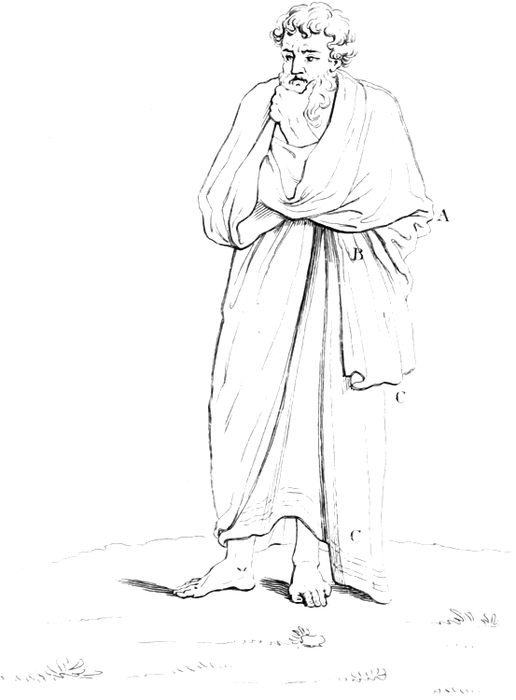
The draperies with which you dress figures ought to have their folds so accommodated as to surround the parts they are intended to cover; that in the mass of light there be not any dark fold, and in the mass of shadows none receiving too great a light. They must go gently over, describing the parts; but not with lines across, cutting the members with hard notches, deeper than the part can possibly be; at the same time, it must fit the body, and not appear like an empty bundle of cloth; a fault of many painters, who, enamoured of the quantity and variety of folds, have encumbered their figures, forgetting the intention of clothes, which is to dress and surround the parts gracefully wherever they touch; and not to be filled with wind, like bladders, puffed up where the parts project. I do not deny that we ought not to neglect introducing some handsome folds among these draperies, but it must be done with great judgment, and suited to the parts, where, by the actions of the limbs and position of the whole body, they gather together. Above all, be careful to vary the quality and quantity of your folds in compositions of many figures; so that, if some have large folds, produced by thick woollen cloth; others, being dressed in thinner stuff, may have them narrower; some sharp and straight, others soft and undulating.
Many painters prefer making the folds of their draperies with acute angles, deep and precise; others with angles hardly perceptible; and some with none at all; but instead of them, certain curved lines.
That part of the drapery, which is the farthest from the place where it is gathered, will appear more approaching its natural state. Every thing naturally inclines to preserve its primitive form. Therefore a stuff or cloth, which is of equal thickness on both sides, will always incline to remain flat. For that reason, when it is constrained by some fold to relinquish its flat situation, it is observed that, at the part of its greatest restraint, it is continually making efforts to return to its natural shape; and the parts most distant from it reassume more of their primitive state by ample and distended folds. For example, let A B C be the drapery mentioned above; A B the place where it is folded or restrained. I have said that the part, which is farthest from the place of its restraint, would return more towards its primitive shape. Therefore C being the farthest, will be broader and more extended than any other part.
Draperies are not to be encumbered with many folds: on the contrary, there ought to be some only where they are held up with the hands or arms of the figures, and the rest left to fall with natural simplicity. They ought to be studied from Nature; that is to say, if a woollen cloth be intended, the folds ought to be drawn after such cloth; if it be of silk, or thin stuff, or else very thick for labourers, let it be distinguished by the nature of the folds. But never copy them, as some do, after models dressed in paper, or thin leather, for it greatly misleads.
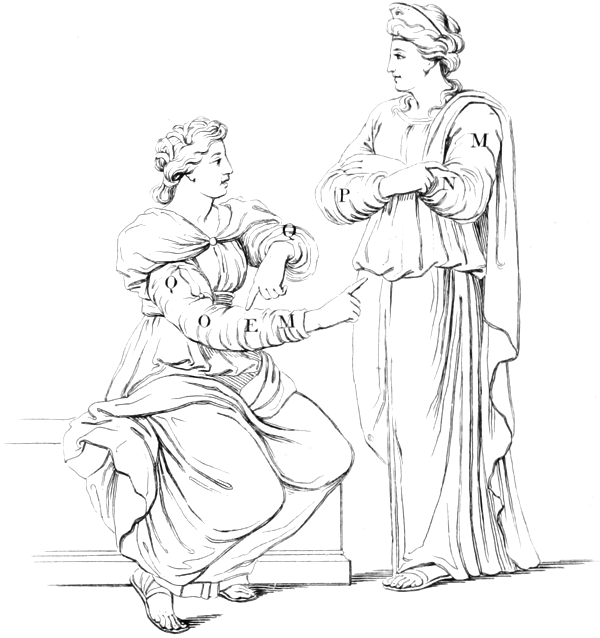
Where the figure is fore-shortened, there ought to appear a greater number of folds, than on the other parts, all surrounding it in a circular manner. Let E be the situation of the eye. M N will have the middle of every circular fold successively removed farther from its outline, in proportion as it is more distant from the eye. In M O of the other figure the outlines of these circular folds will appear almost straight, because it is situated opposite the eye; but in P and Q quite the contrary, as in N and M.
The folds of draperies, whatever be the motion of the figure, ought always to shew, by the formof their outlines, the attitude of such figure; so as to leave, in the mind of the beholder, no doubt or confusion in regard to the true position of the body; and let there be no fold, which, by its shadow, breaks through any of the members; that is to say, appearing to go in deeper than the surface of the part it covers. And if you represent the figure clothed with several garments, one over the other, let it not appear as if the upper one covered only a mere skeleton; but let it express that it is also well furnished with flesh, and a thickness of folds, suitable to the number of its under garments.
The folds surrounding the members ought to diminish in thickness near the extremities of the part they surround.
The length of the folds, which are close to the members, ought to produce other folds on that side where the member is diminished by fore-shortening, and be more extended on the opposite side.
Observe decorum in every thing you represent, that is, fitness of action, dress, and situation, according to the dignity or meanness of the subject to be represented. Be careful that a king, for instance, be grave and majestic in his countenance and dress; that the place be well decorated; and that his attendants, or the by-standers, express reverence and admiration, and appear as noble, in dresses suitable to a royal court.
On the contrary, in the representation of a mean subject, let the figures appear low and despicable; those about them with similar countenances, and actions, denoting base and presumptuous minds, and meanly clad. In short, in both cases, the parts must correspond with the general sentiment of the composition.
The motions of old age should not be similar to those of youth; those of a woman to those of a man; nor should the latter be the same as those of a boy.
In general, the painter ought to introduce very few old men, in the ordinary course of historical subjects, and those few separated from young people; because old people are few, and their habits do not agree with those of youth. Where there is no conformity of custom, there can be no intimacy, and, without it, a company is soon separated. But if the subject require an appearance of gravity, a meeting on important business, as a council, for instance, let there be few young men introduced, for youth willingly avoids such meetings.
A figure, which does not express by its position the sentiments and passions, by which we suppose it animated, will appear to indicate that its muscles are not obedient to its will, and the painter very deficient in judgment. For that reason, a figure is to shew great eagerness and meaning; and its position is to be so well appropriated to that meaning, that it cannot be mistaken, nor made use of for any other.
The painter ought to notice those quick motions, which men are apt to make without thinking, when impelled by strong and powerful affections of the mind. He ought to take memorandums of them, and sketch them in his pocket-book, in order to make use of them when they may answer his purpose; and then to put a living model in the same position, to see the quality and aspect of the muscles which are in action.
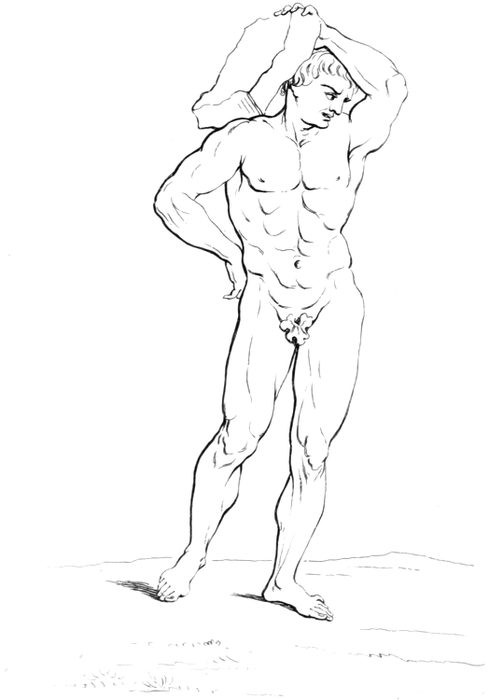
The first and principal part of the art is composition of any sort, or putting things together. The second relates to the expression and motion of the figures, and requires that they be well appropriated, and seeming attentive to what they are about; appearing to move with alacrity and spirit, according to the degree of expression suitable to the occasion; expressing slow and tardy motions, as well as those of eagerness in pursuit: and that quickness and ferocity be expressed with such force as to give an idea of the sensations of the actors. When a figure is to throw a dart, stones, or the like, let it be seen evidently by the attitude and disposition of all the members, that such is its intention; of which there are two examples in the opposite plates, varied both in action and power. The first in point of vigour is A. The second is B. But A will throw his weapon farther than B, because, though they seem desirous of throwing it to the same point, A having turned his feet towards the object, while his body is twisted and bent back the contrary way, to increase his power, returns with more velocity and force to the point to which he means to throw. But the figure B having turned his feet the same way as his body, it returns to its place with great inconvenience, and consequently with weakened powers. For in the expression of great efforts, the preparatory motions of the body must be strong and violent, twisting and bending, so that it may return with convenient ease, and by that means have a great effect. In the same manner, if a cross-bow be not strung with force, the motion of whatever it shoots will be short and without effect; because, where there is no impulse, there can be no motion; and if the impulse be not violent, the motion is but tardy and feeble. So a bow, which is not strong, has no motion; and, if it be strung, it will remain in that state till the impulse be given by another power which puts it in motion, and it will shoot with a violence equal to that which was employed in bending it. In the same manner, the man who does not twist and bend his body will have acquired no power. Therefore, after A has thrown his dart, he will find himself twisted the contrary way, viz. on the side where he has thrown; and he will have acquired only power sufficient to serve him to return to where he was at first.
The same attitude is not to be repeated in the same picture, nor the same motion of members in the same figure, nay, not even in the hands or fingers. And if the history requires a great number of figures, such as a battle, or a massacre of soldiers, in which there are but three ways of striking, viz. thrusting, cutting, or back-handed; in that case you must take care, that all those who are cutting be expressed in different views; some turning their backs, some their sides, and others be seen in front; varying in the same manner the three different ways of fighting, so that all the actions may have a relation to those three principles. In battles, complex motions display great art, giving spirit and animation to the whole. By complex motion is meant, for instance, that of a single figure shewing the front of the legs, and at the same time the profile of the shoulder. But of this I shall treat in another place.
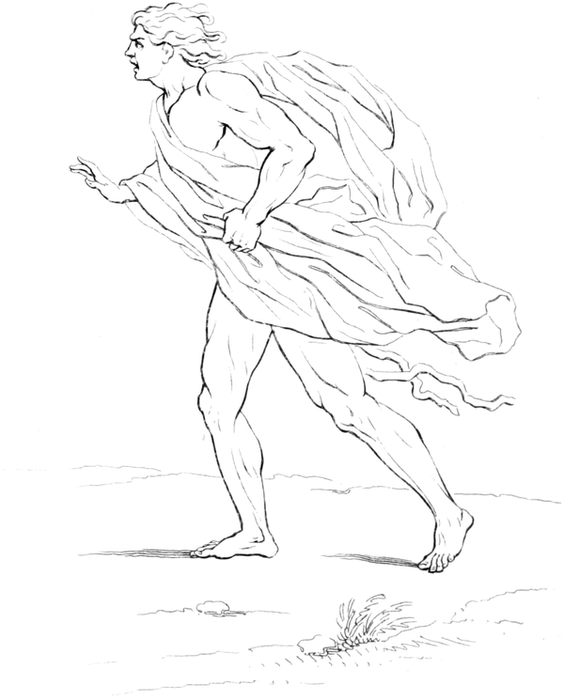
The same motion of members should not be repeated in a figure which you mean to be alone; for instance, if the figure be represented running, it must not throw both hands forward; but one forward and the other backward, or else it cannot run. If the right foot come forward, the right arm mustgo backward and the left forward, because, without such disposition and contraste of parts, it is impossible to run well. If another figure be supposed to follow this, one of its legs should be brought somewhat forward, and the other be perpendicular under the head; the arm on the same side should pass forward. But of this we shall treat more fully in the book on motion.
A painter is to be attentive to the motions and actions of men, occasioned by some sudden accident. He must observe them on the spot, take sketches, and not wait till he wants such expression, and then have it counterfeited for him; for instance, setting a model to weep when there is no cause; such an expression without a cause will be neither quick nor natural. But it will be of great use to have observed every action from nature, as it occurs, and then to have a model set in the same attitude to help the recollection, and find out something to the purpose, according to the subject in hand.
To form a just idea of a storm, you must consider it attentively in its effects. When the wind blows violently over the sea or land, it removes and carries off with it every thing that is not firmly fixed to the general mass. The clouds must appear stragglingand broken, carried according to the direction and the force of the wind, and blended with clouds of dust raised from the sandy shore. Branches and leaves of trees must be represented as carried along by the violence of the storm, and, together with numberless other light substances, scattered in the air. Trees and grass must be bent to the ground, as if yielding to the course of the wind. Boughs must be twisted out of their natural form, with their leaves reversed and entangled. Of the figures dispersed in the picture, some should appear thrown on the ground, so wrapped up in their cloaks and covered with dust, as to be scarcely distinguishable. Of those who remain on their feet, some should be sheltered by and holding fast behind some great trees, to avoid the same fate: others bending to the ground, their hands over their faces to ward off the dust; their hair and their clothes flying straight up at the mercy of the wind.
The high tremendous waves of the stormy sea will be covered with foaming froth; the most subtle parts of which, being raised by the wind, like a thick mist, mix with the air. What vessels are seen should appear with broken cordage, and torn sails, fluttering in the wind; some with broken masts fallen across the hulk, already on its side amidst the tempestuous waves. Some of the crew should be represented as if crying aloud for help, and clinging to the remains of the shattered vessel. Let the clouds appear as driven by tempestuous winds against the summits of lofty mountains, enveloping thosemountains, and breaking and recoiling with redoubled force, like waves against a rocky shore. The air should be rendered awfully dark, by the mist, dust, and thick clouds.
First, let the air exhibit a confused mixture of smoke, arising from the discharge of artillery and musquetry, and the dust raised by the horses of the combatants; and observe, that dust being of an earthy nature, is heavy; but yet, by reason of its minute particles, it is easily impelled upwards, and mixes with the air; nevertheless, it naturally falls downwards again, the most subtle parts of it alone gaining any considerable degree of elevation, and at its utmost height it is so thin and transparent, as to appear nearly of the colour of the air. The smoke, thus mixing with the dusty air, forms a kind of dark cloud, at the top of which it is distinguished from the dust by a blueish cast, the dust retaining more of its natural colour. On that part from which the light proceeds, this mixture of air, smoke, and dust, will appear much brighter than on the opposite side. The more the combatants are involved in this turbulent mist, the less distinctly they will be seen, and the more confused will they be in their lights and shades. Let the faces of the musketeers, their bodies, and every object near them, be tinged with a reddish hue, even the air or cloud of dust; in short, all that surrounds them. This red tinge you will diminish, in proportion to their distance,from the primary cause. The groups of figures, which appear at a distance between the spectator and the light, will form a dark mass upon a light ground; and their legs will be more undetermined and lost as they approach nearer to the ground; because there the dust is heavier and thicker.
If you mean to represent some straggling horses, running out of the main body, introduce also some small clouds of dust, as far distant from each other as the leap of the horse, and these little clouds will become fainter, more scanty, and diffused, in proportion to their distance from the horse. That nearest to his feet will consequently be the most determined, smallest, and the thickest of all.
Let the air be full of arrows, in all directions; some ascending, some falling down, and some darting straight forwards. The bullets of the musketry, though not seen, will be marked in their course by a train of smoke, which breaks through the general confusion. The figures in the fore-ground should have their hair covered with dust, as also their eyebrows, and all parts liable to receive it.
The victorious party will be running forwards, their hair and other light parts flying in the wind, their eyebrows lowered, and the motion of every member properly contrasted; for instance, in moving the right foot forwards, the left arm must be brought forwards also. If you make any of them fallen down, mark the trace of his fall on the slippery, gore-stained dust; and where the ground is less impregnated with blood, let the print of men’s feetand of horses, that have passed that way, be marked. Let there be some horses dragging the bodies of their riders, and leaving behind them a furrow, made by the body thus trailed along.
The countenances of the vanquished will appear pale and dejected. Their eyebrows raised, and much wrinkled about the forehead and cheeks. The tip of their noses somewhat divided from the nostrils by arched wrinkles terminating at the corner of the eyes, those wrinkles being occasioned by the opening and raising of the nostrils; the upper lips turned up, discovering the teeth. Their mouths wide open, and expressive of violent lamentation. One may be seen fallen wounded on the ground, endeavouring with one hand to support his body, and covering his eyes with the other, the palm of which is turned towards the enemy. Others running away, and with open mouths seeming to cry aloud. Between the legs of the combatants let the ground be strewed with all sorts of arms; as broken shields, spears, swords, and the like. Many dead bodies should be introduced, some entirely covered with dust, others in part only; let the blood, which seems to issue immediately from the wound, appear of its natural colour, and running in a winding course, till, mixing with the dust, it forms a reddish kind of mud. Some should be in the agonies of death; their teeth shut, their eyes wildly staring, their fists clenched, and their legs in a distorted position. Some may appear disarmed, and beaten down by the enemy, still fighting with their fists and teeth, and endeavouringto take a passionate, though unavailing revenge. There may be also a straggling horse without a rider, running in wild disorder; his mane flying in the wind, beating down with his feet all before him, and doing a deal of damage. A wounded soldier may also be seen falling to the ground, and attempting to cover himself with his shield, while an enemy bending over him endeavours to give him the finishing stroke. Several dead bodies should be heaped together under a dead horse. Some of the conquerors, as having ceased fighting, may be wiping their faces from the dirt, collected on them by the mixture of dust with the water from their eyes.
The corps de reserve will be seen advancing gaily, but cautiously, their eyebrows directed forwards, shading their eyes with their hands to observe the motions of the enemy, amidst clouds of dust and smoke, and seeming attentive to the orders of their chief. You may also make their commander holding up his staff, pushing forwards, and pointing towards the place where they are wanted. A river may likewise be introduced, with horses fording it, dashing the water about between their legs, and in the air, covering all the adjacent ground with water and foam. Not a spot is to be left without some marks of blood and carnage.
If you have to represent a man who is speaking to a large assembly of people, you are to consider the subject matter of his discourse, and to adapt his attitude to such subject. If he means to persuade, let it be known by his gesture. If he is giving an explanation, deduced from several reasons, let him put two fingers of the right hand within one of the left, having the other two bent close, his face turned towards the audience, with the mouth half open, seeming to speak. If he is sitting, let him appear as going to raise himself up a little, and his head be forward. But if he is represented standing, let him bend his chest and his head forward towards the people.
The auditory are to appear silent and attentive, with their eyes upon the speaker, in the act of admiration. There should be some old men, with their mouths close shut, in token of approbation, and their lips pressed together, so as to form wrinkles at the corners of the mouth, and about the cheeks, and forming others about the forehead, by raising the eyebrows, as if struck with astonishment. Some others of those sitting by, should be seated with their hands within each other, round one of their knees; some with one knee upon the other, and upon that, one hand receiving the elbow, the other supporting the chin, covered with a venerable beard.
The action by which a figure points at any thing near, either in regard to time or situation, is to be expressed by the hand very little removed from the body. But if the same thing is far distant, the hand must also be far removed from the body, and the face of the figure pointing, must be turned towards those to whom he is pointing it out.
All those who are present at some event deserving notice, express their admiration, but in various manners. As when the hand of justice punishes some malefactor. If the subject be an act of devotion, the eyes of all present should be directed towards the object of their adoration, aided by a variety of pious actions with the other members; as at the elevation of the host at mass, and other similar ceremonies. If it be a laughable subject, or one exciting compassion and moving to tears, in those cases it will not be necessary for all to have their eyes turned towards the object, but they will express their feelings by different actions; and let there be several assembled in groups, to rejoice or lament together. If the event be terrific, let the faces of those who run away from the fight, be strongly expressive of fright, with various motions; as shall be described in the tract on Motion.
Those objects which are entirely deprived of light, are lost to the sight, as in the night; therefore if you mean to paint a history under those circumstances, you must suppose a large fire, and those objects that are near it to be tinged with its colour, and the nearer they are the more they will partake of it. The fire being red, all those objects which receive light from it will appear of a reddish colour, and those that are most distant from it will partake of the darkness that surrounds them. The figures which are represented before the fire will appear dark in proportion to the brightness of the fire, because those parts of them which we see, are tinged by that darkness of the night, and not by the light of the fire, which they intercept. Those that are on either side of the fire, will be half in the shade of night, and half in the red light. Those seen beyond the extent of the flames, will be all of a reddish light upon a black ground. In regard to their attitudes, let those who are nearest the fire, make screens of their hands and cloaks, against the scorching heat, with their faces turned on the contrary side, as if ready to run away from it. The most remote will only be shading their eyes with their hands, as if hurt by the too great glare.
I will not omit to introduce among these precepts a new kind of speculative invention, which though apparently trifling, and almost laughable, is nevertheless of great utility in assisting the genius to find variety for composition.
By looking attentively at old and smeared walls, or stones and veined marble of various colours, you may fancy that you see in them several compositions, landscapes, battles, figures in quick motion, strange countenances, and dresses, with an infinity of other objects. By these confused lines the inventive genius is excited to new exertions.
When the painter has only a single figure to represent, he must avoid any shortening whatever, as well of any particular member, as of the whole figure, because he would have to contend with the prejudices of those who have no knowledge in that branch of the art. But in subjects of history, composed of many figures, shortenings may be introduced with great propriety, nay, they are indispensable, and ought to be used without reserve, as the subject may require; particularly in battles, where of course many shortenings and contortions of figures happen, amongst such an enraged multitude of actors, possessed, as it were, of a brutal madness.
Let your figures have actions appropriated to what they are intended to think or say, and these will be well learnt by imitating the deaf, who by the motion of their hands, eyes, eyebrows, and the whole body, endeavour to express the sentiments of their mind. Do not ridicule the thought of a master without a tongue teaching you an art he does not understand; he will do it better by his expressive motions, than all the rest by their words and examples. Let then the painter, of whatever school, attend well to this maxim, and apply it to the different qualities of the figures he represents, and to the nature of the subject in which they are actors.
Old men must have slow and heavy motions; their legs and knees must be bent when they are standing, and their feet placed parallel and wide asunder. Let them be bowed downwards, the head leaning much forward, and their arms very little extended.
Old women, on the contrary, are to be represented bold and quick, with passionate motions, like furies. But the motions are to appear a great deal quicker in their arms than in their legs.
Women are to be represented in modest and reserved attitudes, with their knees rather close, their arms drawing near each other, or folded about the body; their heads looking downwards, and leaning a little on one side.
The countenances of your figures should be expressive of their different situations: men at work, at rest, weeping, laughing, crying out, in fear, or joy, and the like. The attitudes also, and all the members, ought to correspond with the sentiment expressed in the faces.
The motions of the different parts of the face, occasioned by sudden agitations of the mind, aremany. The principal of these are, Laughter, Weeping, Calling out, Singing, either in a high or low pitch, Admiration, Anger, Joy, Sadness, Fear, Pain, and others, of which I propose to treat. First, of Laughing and Weeping, which are very similar in the motion of the mouth, the cheeks, the shutting of the eyebrows, and the space between them; as we shall explain in its place, in treating of the changes which happen in the face, hands, fingers, and all the other parts of the body, as they are affected by the different emotions of the soul; the knowledge of which is absolutely necessary to a painter, or else his figures may be said to be twice dead. But it is very necessary also that he be careful not to fall into the contrary extreme; giving extraordinary motions to his figures, so that in a quiet and peaceable subject, he does not seem to represent a battle, or the revellings of drunken men: but, above all, the actors in any point of history must be attentive to what they are about, or to what is going forward; with actions that denote admiration, respect, pain, suspicion, fear, and joy, according as the occasion, for which they are brought together, may require. Endeavour that different points of history be not placed one above the other on the same canvass, nor walls with different horizons, as if it were a jeweller’s shop, shewing the goods in different square caskets.
Between the expression of laughter and that of weeping there is no difference in the motion of the features either in the eyes, mouth, or cheeks; only in the ruffling of the brows, which is added when weeping, but more elevated and extended in laughing. One may represent the figure weeping as tearing his clothes, or some other expression, as various as the cause of his feeling may be; because some weep for anger, some through fear, others for tenderness and joy, or for suspicion; some for real pain and torment; whilst others weep through compassion, or regret at the loss of some friend and near relation. These different feelings will be expressed by some with marks of despair, by others with moderation; some only shed tears, others cry aloud, while another has his face turned towards heaven, with his hand depressed, and his fingers twisted. Some again will be full of apprehension, with their shoulders raised up to their ears, and so on, according to the above causes.
Those who weep, raise the brows, and bring them close together above the nose, forming many wrinkles on the forehead, and the corners of the mouth are turned downwards. Those who laugh have them turned upwards, and the brows open and extended.
If you represent a man in a violent fit of anger, make him seize another by the hair, holding his head writhed down against the ground, with his knee fixed upon the ribs of his antagonist; his right arm up, and his fist ready to strike; his hair standing on end, his eyebrows low and straight; his teeth close, and seen at the corner of the mouth; his neck swelled, and his body covered in the Abdomen with creases, occasioned by his bending over his enemy, and the excess of his passion.
The last act of despondency is, when a man is in the act of putting a period to his own existence. He should be represented with a knife in one hand, with which he has already inflicted the wound, and tearing it open with the other. His garments and hair should be already torn. He will be standing with his feet asunder, his knees a little bent, and his body leaning forward, as if ready to fall to the ground.
The student who is desirous of making great proficiency in the art of imitating the works of Nature, should not only learn the shape of figures or other objects, and be able to delineate them with truth and precision, but he must also accompany them with their proper lights and shadows, according to the situation in which those objects appear.
The knowledge of the outline is of most consequence, and yet may be acquired to great certainty by dint of study; as the outlines of the different parts of the human figure, particularly those which do not bend, are invariably the same. But the knowledge of the situation, quality, and quantity of shadows, being infinite, requires the most extensive study.
It requires much more observation and study to arrive at perfection in the shadowing of a picture,than in merely drawing the lines of it. The proof of this is, that the lines may be traced upon a veil or a flat glass placed between the eye and the object to be imitated. But that cannot be of any use in shadowing, on account of the infinite gradation of shades, and the blending of them, which does not allow of any precise termination; and most frequently they are confused, as will be demonstrated in another place.
The first object of a painter is to make a simple flat surface appear like a relievo, and some of its parts detached from the ground; he who excels all others in that part of the art, deserves the greatest praise. This perfection of the art depends on the correct distribution of lights and shades, called Chiaro-scuro. If the painter then avoids shadows, he may be said to avoid the glory of the art, and to render his work despicable to real connoisseurs, for the sake of acquiring the esteem of vulgar and ignorant admirers of fine colours, who never have any knowledge of relievo.
Solid bodies are of two sorts: the one has the surface curvilinear, oval, or spherical; the other hasseveral surfaces, or sides producing angles, either regular or irregular. Spherical, or oval bodies, will always appear detached from their ground, though they are exactly of the same colour. Bodies also of different sides and angles will always detach, because they are always disposed so as to produce shades on some of their sides, which cannot happen to a plain superficies.
The painter who wishes to be universal, and please a variety of judges, must unite in the same composition, objects susceptible of great force in the shadows, and great sweetness in the management of them; accounting, however, in every instance, for such boldness and softenings.
If you wish to make good and useful studies, use great deliberation in your drawings, observe well among the lights which, and how many, hold the first rank in point of brightness; and so among the shadows, which are darker than others, and in what manner they blend together; compare the quality and quantity of one with the other, and observe to what part they are directed. Be careful also in your outlines, or divisions of the members. Remark well what quantity of parts are to be on one side, and what on the other; and where they are more or less apparent, or broad, or slender. Lastly, take care that the shadows and lights be united, or lost in each other; without any hard strokes, or lines: as smoke loses itself in the air, so are your lights and shadows to pass from the one to the other, without any apparent separation.
When you have acquired the habit, and formed your hand to accuracy, quickness of execution will come of itself.
Let A B be the window, M the centre of it, C the model. The best situation for the painter will be a little sideways, between the window and his model, as D, so that he may see his object partly in the light and partly in the shadow.
It is a great error in some painters who draw a figure from Nature at home, by any particular light, and afterwards make use of that drawing in a picture representing an open country, which receives the general light of the sky, where the surrounding air gives light on all sides. This painter would put dark shadows, where Nature would either produce none, or, if any, so very faint as to be almost imperceptible; and he would throw reflected lights where it is impossible there should be any.
To paint well from Nature, your window should be to the North, that the lights may not vary. If it be to the South, you must have paper blinds, that the sun, in going round, may not alter the shadows. The situation of the light should be such as to produce upon the ground a shadow from your model as long as that is high.
The figures which receive a particular light shew more relief than those which receive an universal one; because the particular light occasions some reflexes, which proceed from the light of one object upon the shadows of another, and helps to detach it from the dark ground. But a figure placed in front of a dark and large space, and receiving a particular light, can receive no reflexion from any other objects, and nothing is seen of the figure but what the light strikes on, the rest being blended and lost in the darkness of the back ground. This is to be applied only to the imitation of night subjects with very little light.
Be very careful, in painting, to observe, that between the shadows there are other shadows, almost imperceptible, both for darkness and shape; and this is proved by the third proposition, which says, that the surfaces of globular or convex bodies have as great a variety of lights and shadows as the bodies that surround them have.
Those shadows which in Nature are undetermined, and the extremities of which can hardly be perceived, are to be copied in your painting in the same manner, never to be precisely finished, but left confused and blended. This apparent neglect will shew great judgment, and be the ingenious result of your observation of Nature.
Lights separated from the shadows with too much precision, have a very bad effect. In order, therefore, to avoid this inconvenience, if the object be in the open country, you need not let your figures be illumined by the sun; but may suppose some transparent clouds interposed, so that the sun not being visible, the termination of the shadows will be also imperceptible and soft.
The light admitted in front of heads situated opposite to side walls that are dark, will cause them to have great relievo, particularly if the light be placed high; and the reason is, that the most prominent parts of those faces are illumined by the general light striking them in front, which light produces very faint shadows on the part where it strikes; but as it turns towards the sides, it begins to participate of the dark shadows of the room, which grow darker in proportion as it sinks into them. Besides, when the light comes from on high, it does not strike on every part of the face alike, but one part produces great shadows upon another; as the eyebrows, which deprive the whole sockets of the eyes of light. The nose keeps it off from great part of the mouth, and the chin from the neck, and such other parts. This, by concentrating the light upon the most projecting parts, produces a very great relief.
A small light will cast large and determined shadows upon the surrounding bodies. A large light, on the contrary, will cast small shadows on them, and they will be much confused in their termination. When a small but strong light is surrounded by a broad but weaker light, the latter will appear like a demi-tint to the other, as the sky round the sun. And the bodies which receive the light from the one, will serve as demi-tints to those which receive the light from the other.
The lights are to be distributed according to the natural situation you mean your figures should occupy. If you suppose them in sunshine, the shades must be dark, the lights broad and extended, and the shadows of all the surrounding objects distinctly marked upon the ground. If seen in a gloomy day, there will be very little difference between the lights and shades, and no shadows at the feet. If the figures be represented within doors, the lights and shadows will again be distinctly divided, and produce shadows on the ground. But if you suppose a paper blind at the window, and the walls painted white, the effect will be the same as in a gloomy day, when the lights and shadows have little difference. If the figures are enlightened by the fire, the lights must be red and powerful, the shadows dark, and the shadows upon the ground and upon the walls must be precise; observing that they spread wider as they go off from the body. If the figures be enlightened, partly by the sky and partly by the fire, that side which receives the light from the sky will be the brightest, and on the other side it will be reddish, somewhat of the colour of the fire. Above all, contrive, that your figures receive a broad light, and that from above; particularly in portraits, because the people we see in the street receive all the light from above; and it is curious to observe, that there is not a face ever so well known amongst your acquaintance, but would be recognised with difficulty, if it were enlightened from beneath.
You must not mark any muscles with hardness of line, but let the soft light glide upon them, and terminate imperceptibly in delightful shadows: from this will arise grace and beauty to the face.
A face placed in the dark part of a room, acquires great additional grace by means of light and shadow. The shadowed part of the face blends with the darkness of the ground, and the light part receives an increase of brightness from the open air, the shadows on this side becoming almost insensible; and from this augmentation of light and shadow, the face has much relief, and acquires great beauty.
In streets running towards the west, when the sun is in the meridian, and the walls on each side so high that they cast no reflexions on that side of the bodies which is in shade, and the sky is not too bright, we find the most advantageous situation for giving relief and grace to figures, particularly to faces; because both sides of the face will participate of the shadows of the walls. The sides of the nose and the face towards the west, will be light, and the man whom we suppose placed at the entrance, and in the middle of the street, will see all the parts of that face, which are before him, perfectly illumined, while both sides of it, towards the walls, will be in shadow. What gives additional grace is, that these shades do not appear cutting, hard, or dry, but softly blended and lost in each other. The reason of it is, that the light which is spread all over in the air, strikes also the pavement of the street, and reflecting upon the shady part of the face, it tinges that slightly with the same hue: while the great light which comes from above being confined by the tops of houses, strikes on the face from different points, almost to the very beginning of the shadows under the projecting parts of the face. It diminishes by degrees the strength of them, increasing the light till it comes upon the chin, where it terminates, and loses itself, blending softly into the shades on all sides. For instance, if such light were A E, the line F E would give light even to the bottom of the nose. The line C F will give light only to the under lip; but the line A H would extend the shadow to all the under parts of the face, and under the chin.
In this situation the nose receives a very strong light from all the points A B C D E.
When a body, of a cylindrical or convex surface, terminates upon another body of the same colour, it will appear darker on the edge, than the body upon which it terminates. And any flat body, adjacent to a white surface, will appear very dark; but upon a dark ground it will appear lighter than any other part, though the lights be equal.
If your figure be dark, place it on a light ground; if it be light, upon a dark ground; and if it be partly light and partly dark, as is generally the case, contrive that the dark part of the figure be upon the light part of the ground, and the light side of it against the dark.
It is of the greatest importance to consider well the nature of back-grounds, upon which any opake body is to be placed. In order to detach it properly, you should place the light part of such opake body against the dark part of the back-ground, and the dark parts on a light ground; as in the cut.
In compositions of many figures and animals, observe, that the parts of these different objects ought to be darker in proportion as they are lower, and as they are nearer the middle of the groups, though they are all of an uniform colour. This is necessary, because a smaller portion of the sky (from which allbodies are illuminated) can give light to the lower spaces between these different figures, than to the upper parts of the spaces. It is proved thus: A B C D is that portion of the sky which gives light to all the objects beneath; M and N are the bodies which occupy the space S T R H, in which it is evidently perceived, that the point F, receiving the light only from the portion of the sky C D, has a smaller quantity of it than the point E which receives it from the whole space A B (a larger portion than C D); therefore it will be lighter in E than in F.
The neck, or any other part which is raised straight upwards, and has a projection over it, will be darker than the perpendicular front of that projection; and this projecting part will be lighter, in proportion as it presents a larger surface to the light. For instance, the recess A receives no light from any part of the sky G K, but B begins to receive the light from the part of the sky H K, and C from G K; and the point D receives the whole of F K. Therefore the chest will be as light as the forehead, nose, and chin. But what I have particularly to recommend, in regard to faces, is, that you observe well those different qualities of shades which are lost at different distances (while there remain only the first and principal spots or strokes of shades, such as those of the sockets of the eyes, and other similar recesses, which are always dark), and at last the whole face becomes obscured; because the greatest lights (being small in proportion to the demi-tints) are lost. The quality, therefore, and quantity of the principal lights and shades are by means of great distance blended together into a general half-tint; and this is the reason why trees and other objects are found to be in appearance darker at some distance than they are in reality, when nearer to the eye. But then the air, which interposes between the objects and the eye, will render them light again by tinging them with azure, rather in the shades than in the lights; for the lights will preserve the truth of the different colours much longer.
The shadows between the folds of a drapery surrounding the parts of the human body will be darker as the deep hollows where the shadows are generated are more directly opposite the eye. This is to be observed only when the eye is placed between the light and the shady part of the figure.
Any opake body appears less relieved in proportion as it is farther distant from the eye; because the air, interposed between the eye and such body, being lighter than the shadow of it, it tarnishes and weakens that shadow, lessens its power, and consequently lessens also its relief.
The extremities of any object on the side which receives the light, will appear darker if upon a lighter ground, and lighter if seen upon a darker ground. But if such body be flat, and seen upon a ground equal in point of light with itself, and of the same colour, such boundaries, or outlines, will be entirely lost to the sight.
Objects contrasted with a light ground will appear much more detached than those which are placed against a dark one. The reason is, that if you wish to give relief to your figures, you will make those parts which are the farthest from the light, participate the least of it; therefore they will remain the darkest, and every distinction of outline would be lost in the general mass of shadows. But to give it grace, roundness, and effect, those dark shades are always attended by reflexes, or else they would either cut too hard upon the ground, or stick to it, by the similarity of shade, and relieve the less as the ground is darker; for at some distance nothing would be seenbut the light parts, therefore your figures would appear mutilated of all that remains lost in the back-ground.
Figures will have more grace, placed in the open and general light, than in any particular or small one; because the powerful and extended light will surround and embrace the objects: and works done in that kind of light appear pleasant and graceful when placed at a distance, while those which are drawn in a narrow light, will receive great force of shadow, but will never appear at a great distance, but as painted objects.
The greater the transparent interposition is between the eye and the object, the more the colour of that object will participate of, or be changed into that of the transparent medium.
When an opake body is situated between the eye and the luminary, so that the central line of the one passes also through the centre of the other, that object will be entirely deprived of light.
As we find by experience, that all bodies are surrounded by lights and shadows, I would have the painter to accommodate that part which is enlightened, so as to terminate upon something dark; and to manage the dark parts so that they may terminate on a light ground. This will be of great assistance in detaching and bringing out his figures.
To give a great effect to figures, you must oppose to a light one a dark ground, and to a dark figure a light ground, contrasting white with black, and black with white. In general, all contraries give a particular force and brilliancy of effect by their opposition.
When a darkish body terminates upon a light ground, it will appear detached from that ground; because all opake bodies of a curved surface are not only dark on that side which receives no light, and consequently very different from the ground; but even that side of the curved surface which is enlightened, will not carry its principal light to the extremities, but have between the ground and the principal light a certain demi-tint, darker than either the ground or that light.
Any thing white will appear whiter, by being opposed to a dark ground; and, on the contrary, darker upon a light ground. This we learn from observing snow as it falls; while it is descending it appears darker against the sky, than when we see it against an open window, which (owing to the darkness of the inside of the house) makes it appear very white. Observe also, that snow appears to fall very quick and in a great quantity when near the eye; but when at some distance, it seems to come down slowly, and in a smaller quantity.
Reverberations are produced by all bodies of a bright nature, that have a smooth and tolerably hard surface, which, repelling the light it receives, makes it rebound like a foot-ball against the first object opposed to it.
The surfaces of hard bodies are surrounded by various qualities of light and shadow. The lights are of two sorts; one is called original, the other derivative. The original light is that which comes from the sun, or the brightness of fire, or else from the air. The derivative is a reflected light. But to return to our definition, I say, there can be no reflexion on that side which is turned towards any dark body; such as roofs, either high or low, shrubs, grass, wood, either dry or green; because, though every individual part of those objects be turned towards the original light, and struck by it; yet the quantity of shadow which every one of these parts produces upon the others, is so great, that, upon the whole, the light, not forming a compact mass, loses its effect, so that those objects cannot reflect any light upon the opposite bodies.
The reflected lights will be more or less apparent or bright, in proportion as they are seen against a darker or fainter ground; because if the ground be darker than the reflex, then this reflex will appear stronger on account of the great difference of colour. But, on the contrary, if this reflexion has behind it a ground lighter than itself, it will appear dark, in comparison to the brightness which is close to it, and therefore it will be hardly perceptible.
The reflected lights which strike upon the midst of shadows, will brighten up or lessen their obscurity in proportion to the strength of those lights, and their proximity to those shadows. Many painters neglect this observation, while others attend to and deduce their practice from it. This difference of opinion and practice divides the sentiments of artists, so that they blame each other for not thinking and acting as they themselves do. The best way is to steer a middle course, and not to admit of any reflected light, but when the cause of it is evident to every eye; and vice versâ, if you introduce none at all, let it appear evident that there was no reasonable cause for it. In doing so, you will neither be totallyblamed nor praised by the variety of opinion, which, if not proceeding from entire ignorance, will ensure to you the approbation of both parties.
Of all reflected lights, that is to be the most apparent, bold, and precise, which detaches from the darkest ground; and, on the contrary, that which is upon a lighter ground will be less apparent. And this proceeds from the contraste of shades, by which the faintest makes the dark ones appear still darker; so in contrasted lights, the brightest cause the others to appear less bright than they really are.
That part will be the brightest which receives the reflected light between angles the most nearly equal. For example, let N be the luminary, and A B the illuminated part of the object, reflecting the light over all the shady part of the concavity opposite to it. The light which reflects upon F will be placed between equal angles. But E at the base will not be reflected by equal angles, as it is evident that the angle E A B is more obtuse than the angle E B A. The angle A F B however, though it is between angles of less quality than the angle E, and has a common base B A, is between angles more nearly equal than E, therefore it will be lighter in F thanin E; and it will also be brighter, because it is nearer to the part which gives them light. According to the 6th rule, which says, that part of the body is to be the lightest, which is nearest to the luminary.
The termination of a reflected light on a ground lighter than that reflex, will not be perceivable; but if such a reflex terminates upon a ground darker than itself, it will be plainly seen; and the more so in proportion as that ground is darker, and vice versa.
Double reflexes are stronger than single ones, and the shadows which interpose between the commonlight and these reflexes are very faint. For instance, let A be the luminous body, A N, A S, are the direct rays, and S N the parts which receive the light from them. O and E are the places enlightened by the reflexion of that light in those parts. A N E is a single reflex, but A N O, A S O is the double reflex. The single reflex is that which proceeds from a single light, but the double reflexion is produced by two different lights. The single one E is produced by the light striking on B D, while the double one O proceeds from the enlightened bodies B D and D R co-operating together; and the shadows which are between N O and S O will be very faint.
The only portion of air that will be seen reflected in the water, will be that which is reflected by the surface of the water to the eye between equal angles; that is to say, the angle of incidence must be equal to the angle of reflexion.
White is more capable of receiving all sorts of colours, than the surface of any body whatever, that is not transparent. To prove it, we shall say, that any void space is capable of receiving what another space, not void, cannot receive. In the same manner, a white surface, like a void space, being destitute of any colour, will be fittest to receive such as are conveyed to it from any other enlightened body, and will participate more of the colour than black can do; which latter, like a broken vessel, is not able to contain any thing.
Polished and glossy surfaces shew least of their genuine colour. This is exemplified in the grass of the fields, and the leaves of trees, which, being smooth and glossy, will reflect the colour of the sun, and the air, where they strike, so that the parts which receive the light do not shew their natural colour.
Those objects that are the least smooth and polished shew their natural colours best; as we see in cloth, and in the leaves of such grass or trees as are of a woolly nature; which, having no lustre, are exhibited to the eye in their true natural colour; unless that colour happen to be confused by that of another body casting on them reflexions of an opposite colour, such as the redness of the setting sun, when all the clouds are tinged with its colour.
Although the mixture of colours may be extended to an infinite variety, almost impossible to be described, I will not omit touching slightly upon it, setting down at first a certain number of simple colours to serve as a foundation, and with each of these mixing one of the others; one with one, thentwo with two, and three with three, proceeding in this manner to the full mixture of all the colors together: then I would begin again, mixing two of these colours with two others, and three with three, four with four, and so on to the end. To these two colours we shall put three; to these three add three more, and then six, increasing always in the same proportion.
I call those simple colours, which are not composed, and cannot be made or supplied by any mixture of other colours. Black and White are not reckoned among colours; the one is the representative of darkness, the other of light: that is, one is a simple privation of light, the other is light itself. Yet I will not omit mentioning them, because there is nothing in painting more useful and necessary; since painting is but an effect produced by lights and shadows, viz. chiaro-scuro. After Black and White come Blue and Yellow, then Green, and Tawny or Umber, and then Purple and Red. These eight colours are all that Nature produces. With these I begin my mixtures, first Black and White, Black and Yellow, Black and Red; then Yellow and Red: but I shall treat more at length of these mixtures in a separate work, which will be of great utility, nay very necessary. I shall place this subject between theory and practice.
The first of all simple colours is White, though philosophers will not acknowledge either White or Black to be colours; because the first is the cause, or the receiver of colours, the other totally deprived of them. But as painters cannot do without either, we shall place them among the others; and according to this order of things, White will be the first, Yellow the second, Green the third, Blue the fourth, Red the fifth, and Black the sixth. We shall set down White for the representative of light, without which no colour can be seen; Yellow for the earth; Green for water; Blue for air; Red for fire; and Black for total darkness.
If you wish to see by a short process the variety of all the mixed, or composed colours, take some coloured glasses, and, through them, look at all the country round: you will find that the colour of each object will be altered and mixed with the colour of the glass through which it is seen; observe which colour is made better, and which is hurt by the mixture. If the glass be yellow, the colour of the objects may either be improved, or greatly impaired by it. Black and White will be most altered, while Green and Yellow will be meliorated. In the same manner you may go through all the mixtures of colours, which are infinite. Select those which are new and agreeable to the sight; and following thesame method you may go on with two glasses, or three, till you have found what will best answer your purpose.
This green, which is made of copper, though it be mixed with oil, will lose its beauty, if it be not varnished immediately. It not only fades, but, if washed with a sponge and pure water only, it will detach from the ground upon which it is painted, particularly in damp weather; because verdegris is produced by the strength of salts, which easily dissolve in rainy weather, but still more if washed with a wet sponge.
If you mix with the Verdegris some Caballine Aloe, it will add to it a great degree of beauty. It would acquire still more from Saffron, if it did not fade. The quality and goodness of this Aloe will be proved by dissolving it in warm Brandy. Supposing the Verdegris has already been used, and the part finished, you may then glaze it thinly with this dissolved Aloe, and it will produce a very fine colour. This Aloe may be ground also in oil by itself, or with the Verdegris, or any other colour, at pleasure.
After you have made a drawing of your intended picture, prepare a good and thick priming with pitch and brickdust well pounded; after which give it a second coat of white lead and Naples yellow; then, having traced your drawing upon it, and painted your picture, varnish it with clear and thick old oil, and stick it to a flat glass, or crystal, with a clear varnish. Another method, which may be better, is, instead of the priming of pitch and brickdust, take a flat tile well vitrified, then apply the coat of white and Naples yellow, and all the rest as before. But before the glass is applied to it, the painting must be perfectly dried in a stove, and varnished with nut oil and amber, or else with purified nut oil alone, thickened in the sun.
Stretch your canvass upon a frame, then give it a coat of weak size, let it dry, and draw your outlines upon it. Paint the flesh colours first; and while it is still fresh or moist, paint also the shadows, well softened and blended together. The flesh colour may be made with white, lake, and Naples yellow. The shades with black, umber, and a little lake; you may, if you please, use black chalk. After you have softened this first coat, or dead colour, and let it dry, you may retouch over it with lake and other colours, and gum water that has been a long while made and kept liquid, because in that state it becomes better, and does not leave any gloss. Again, to make the shades darker, take the lake and gum as above, and ink; and with this you may shade or glaze many colours, because it is transparent; such as azure, lake, and several others. As for the lights, you may retouch or glaze them slightly with gum water and pure lake, particularly vermilion.
For those colours which you mean should appear beautiful, prepare a ground of pure white. This is meant only for transparent colours: as forthose that have a body, and are opake, it matters not what ground they have, and a white one is of no use. This is exemplified by painted glasses; when placed between the eye and clear air, they exhibit most excellent and beautiful colours, which is not the case, when they have thick air, or some opake body behind them.
When a transparent colour is laid upon another of a different nature, it produces a mixed colour, different from either of the simple ones which compose it. This is observed in the smoke coming out of a chimney, which, when passing before the black soot, appears blueish, but as it ascends against the blue of the sky, it changes its appearance into a reddish brown. So the colour lake laid on blue will turn it to a violet colour; yellow upon blue turns to green; saffron upon white becomes yellow; white scumbled upon a dark ground appears blue, and is more or less beautiful, as the white and the ground are more or less pure.
We are to consider here in what part any colour will shew itself in its most perfect purity; whether in the strongest light or deepest shadow, in the demi-tint, or in the reflex. It would be necessary to determine first, of what colour we mean to treat, because different colours differ materially in that respect.Black is most beautiful in the shades; white in the strongest light; blue and green in the half-tint; yellow and red in the principal light; gold in the reflexes; and lake in the half-tint.
All objects which have no gloss, shew their colours better in the light than in the shadow, because the light vivifies and gives a true knowledge of the nature of the colour, while the shadows lower, and destroy its beauty, preventing the discovery of its nature. If, on the contrary, black be more beautiful in the shadows, it is because black is not a colour.
If A be the light, and B the object receiving it in a direct line, E cannot receive that light, but only the reflexion from B, which we shall suppose to be red. In that case, the light it produces being red, it will tinge with red the object E; and if E happen to be also red before, you will see that colour increase in beauty, and appear redder than B; but if E wereyellow, you will see a new colour, participating of the red and the yellow.
As the quality of colours is discovered to the eye by the light, it is natural to conclude, that where there is most light, there also the true quality of the colour is to be seen; and where there is most shadow the colour will participate of, and be tinged with the colour of that shadow. Remember then to shew the true quality of the colour in the light parts only.
The colour which is between the light and the shadow will not be so beautiful as that which is in the full light. Therefore the chief beauty of colours will be found in the principal lights.
This is very observable in draperies, where the light folds casting a reflexion, and throwing a light on other folds opposite to them, make them appear in their natural colour. The same effect is produced by gold leaves casting their light reciprocally on each other. The effect is quite contrary if the light be received from an object of a different colour.
The colour of the shadows of an object can never be pure if the body which is opposed to these shadows be not of the same colour as that on which they are produced. For instance, if in a room, the walls of which are green, I place a figure clothed in blue, and receiving the light from another blue object, the light part of that figure will be of a beautiful blue, but the shadows of it will become dingy, and not like a true shade of that beautiful blue, because it will be corrupted by the reflexions from the green wall; and it would be still worse if the walls were of a darkish brown.
Colours placed in shadow will preserve more or less of their original beauty, as they are more or less immersed in the shade. But colours situated in a light space will shew their natural beauty in proportion to the brightness of that light. Some say, that there is as great variety in the colours of shadows, as in the colours of objects shaded by them. It may be answered, that colours placed in shadow will shew less variety amongst themselves as the shadows are darker. We shall soon convince ourselves of this truth, if, from a large square, we look through the open door of a church, where pictures, though enriched with a variety of colours, appear all clothed in darkness.
It is very possible that all the different colours may be changed into that of a general shadow; as is manifest in the darkness of a cloudy night, in which neither the shape nor colour of bodies is distinguished. Total darkness being nothing but a privation of the primitive and reflected lights, by which the form and colour of bodies are seen; it is evident, that the cause being removed the effect ceases, and the objects are entirely lost to the sight.
White is not a colour, but has the power of receiving all the other colours. When it is placed in a high situation in the country, all its shades are azure; according to the fourth proposition, whichsays, that the surface of any opake body participates of the colour of any other body sending the light to it. Therefore white being deprived of the light of the sun by the interposition of any other body, will remain white; if exposed to the sun on one side, and to the open air on the other, it will participate both of the colour of the sun and of the air. That side which is not opposed to the sun, will be shaded of the colour of the air. And if this white were not surrounded by green fields all the way to the horizon, nor could receive any light from that horizon, without doubt it would appear of one simple and uniform colour, viz. that of the air.
The light of the fire tinges every thing of a reddish yellow; but this will hardly appear evident, if we do not make the comparison with the daylight. Towards the close of the evening this is easily done; but more certainly after the morning twilight; and the difference will be clearly distinguished in a dark room, when a little glimpse of daylight strikes upon any part of the room, and there still remains a candle burning. Without such a trial the difference is hardly perceivable, particularly in those colours which have most similarity; such as white and yellow, light green and light blue; because the light which strikes the blue, being yellow, will naturallyturn it green; as we have said in another place, that a mixture of blue and yellow produces green. And if to a green colour you add some yellow, it will make it of a more beautiful green.
The painter, who is to represent objects at some distance from the eye, ought merely to convey the idea of general undetermined masses, making choice, for that purpose, of cloudy weather, or towards the evening, and avoiding, as was said before, to mark the lights and shadows too strong on the extremities; because they would in that case appear like spots of difficult execution, and without grace. He ought to remember, that the shadows are never to be of such a quality, as to obliterate the proper colour, in which they originated; if the situation of the coloured body be not in total darkness. He ought to mark no outline, not to make the hair stringy, and not to touch with pure white, any but those things which in themselves are white; in short, the lightest touch upon any particular object ought to denote the beauty of its proper and natural colour.
The painter ought to know, that if any white object is placed between two walls, one of which isalso white, and the other black, there will be found between the shady side of that object and the light side, a similar proportion to that of the two walls; and if that object be blue, the effect will be the same. Having therefore to paint this object, take some black, similar to that of the wall from which the reflexes come; and to proceed by a certain and scientific method, do as follows. When you paint the wall, take a small spoon to measure exactly the quantity of colour you mean to employ in mixing your tints; for instance, if you have put in the shading of this wall three spoonfuls of pure black, and one of white, you have, without any doubt, a mixture of a certain and precise quality. Now having painted one of the walls white, and the other dark, if you mean to place a blue object between them with shades suitable to that colour, place first on your pallet the light blue, such as you mean it to be, without any mixture of shade, and it will do for the lightest part of your object. After which take three spoonfuls of black, and one of this light blue, for your darkest shades. Then observe whether your object be round or square: if it be square, these two extreme tints of light and shade will be close to each other, cutting sharply at the angle; but if it be round, draw lines from the extremities of the walls to the centre of the object, and put the darkest shade between equal angles, where the lines intersect upon the superficies of it; then begin to make them lighter and lighter gradually to the point N O, lessening the strength of the shadows as much as that place participates of the light A D, and mixing that colour with the darkest shade A B, in the same proportion.
Blue and green are not simple colours in their nature, for blue is composed of light and darkness; such is the azure of the sky, viz. perfect black and perfect white. Green is composed of a simple and a mixed colour, being produced by blue and yellow.
Any object seen in a mirror, will participate of the colour of that body which serves as a mirror; and the mirror in its turn is tinged in part by the colour of the object it represents; they partake more or less of each other as the colour of the object seen is more or less strong than the colour of the mirror. That object will appear of the strongest and most lively colour in the mirror, which has the most affinity to the colour of the mirror itself.
Of coloured bodies, the purest white will be seen at the greatest distance, therefore the darker the colour, the less it will bear distance.
Of different bodies equal in whiteness, and in distance from the eye, that which is surrounded by the greatest darkness will appear the whitest; and on the contrary, that shadow will appear the darkest that has the brightest white round it.
Of different colours, equally perfect, that will appear most excellent, which is seen near its direct contrary. A pale colour against red, a black upon white (though neither the one nor the other are colours), blue near a yellow; green near red; because each colour is more distinctly seen, when opposed to its contrary, than to any other similar to it.
Any thing white seen in a dense air full of vapours, will appear larger than it is in reality.
The air, between the eye and the object seen, will change the colour of that object into its own; so will the azure of the air change the distant mountains into blue masses. Through a red glass every thing appears red; the light round the stars is dimmed by the darkness of the air, which fills the space between the eye and the planets.
The true colour of any object whatever will be seen in those parts which are not occupied by any kind of shade, and have not any gloss (if it be a polished surface).
I say, that white terminating abruptly upon a dark ground, will cause that part where it terminates to appear darker, and the white whiter.
Your window must be open to the sky, and the walls painted of a reddish colour. The summertime is the best, when the clouds conceal the sun, or else your walls on the south side of the room must be so high, as that the sun-beams cannot strike on the opposite side, in order that the reflexion of those beams may not destroy the shadows.
The window which gives light to a painting-room, ought to be made of oiled paper, without any cross bar, or projecting edge at the opening, or any sharp angle in the inside of the wall, but should be slanting by degrees the whole thickness of it; and the sides be painted black.
The shadows of any colour whatever must participate of that colour more or less, as it is nearer to,or more remote from the mass of shadows; and also in proportion to its distance from, or proximity to the mass of light.
To any white body receiving the light from the sun, or the air, the shadows should be of a blueish cast; because white is no colour, but a receiver of all colours; and as by the fourth proposition we learn, that the surface of any object participates of the colours of other objects near it, it is evident that a white surface will participate of the colour of the air by which it is surrounded.
That shade will be the darkest which is produced by the whitest surface; this also will have a greater propensity to variety than any other surface; because white is not properly a colour, but a receiver of colours, and its surface will participate strongly of the colour of surrounding objects, but principally of black or any other dark colour, which being the most opposite to its nature, produces the most sensible difference between the shadows and the lights.
When one white body terminates on another of the same colour, the white of these two bodies willbe either alike or not. If they be alike, that object which of the two is nearest to the eye, should be made a little darker than the other, upon the rounding of the outline; but if the object which serves as a ground to the other be not quite so white, the latter will detach of itself, without the help of any darker termination.
Of two objects equally light, one will appear less so if seen upon a whiter ground; and, on the contrary, it will appear a great deal lighter if upon a space of a darker shade. So flesh colour will appear pale upon a red ground, and a pale colour will appear redder upon a yellow ground. In short, colours will appear what they are not, according to the ground which surrounds them.
Amongst the figures which compose an historical picture, those which are meant to appear the nearest to the eye, must have the greatest force; according to the second proposition of the third book, which says, that colour will be seen in the greatest perfection which has less air interposed between it and the eye of the beholder; and for that reason the shadows (by which we express the relievo of bodies) appear darker when near than when at a distance, being then deadened by the air which interposes. This does not happen to those shadows which are near the eye, where they will produce the greatest relievo when they are darkest.
Observe, that where the shadows end, there be always a kind of half-shadow to blend them with the lights. The shadow derived from any object will mix more with the light at its termination, in proportion as it is more distant from that object. But the colour of the shadow will never be simple: this is proved by the ninth proposition, which says, that the superficies of any object participates of the colours of other bodies, by which it is surrounded, although it were transparent, such as water, air, and the like: because the air receives its light from the sun, and darkness is produced by the privation of it. But as the air has no colour in itself any more than water, it receives all the colours that are between the objectand the eye. The vapours mixing with the air in the lower regions near the earth, render it thick, and apt to reflect the sun’s rays on all sides, while the air above remains dark; and because light (that is, white) and darkness (that is, black), mixed together, compose the azure that becomes the colour of the sky, which is lighter or darker in proportion as the air is more or less mixed with damp vapours.
The shadows of bodies produced by the redness of the setting sun, will always be blueish. This is accounted for by the eleventh proposition, which says, that the superficies of any opake body participates of the colour of the object from which it receives the light; therefore the white wall being deprived entirely of colour, is tinged by the colour ofthose bodies from which it receives the light, which in this case are the sun and the sky. But because the sun is red towards the evening, and the sky is blue, the shadow on the wall not being enlightened by the sun, receives only the reflexion of the sky, and therefore will appear blue; and the rest of the wall, receiving light immediately from the sun, will participate of its red colour.
The colour of any object will appear more or less distinct in proportion to the extent of its surface. This proportion is proved, by observing that a face appears dark at a small distance, because, being composed of many small parts, it produces a great number of shadows; and the lights being the smallest part of it, are soonest lost to the sight, leaving only the shadows, which being in a greater quantity, the whole of the face appears dark, and the more so if that face has on the head, or at the back, something whiter.
Where the shadows terminate upon the lights, observe well what parts of them are lighter than the others, and where they are more or less softened and blended; but above all remember, that young people have no sharp shadings: their flesh is transparent, something like what we observe when we put our hand between the sun and eyes; it appears reddish, and of a transparent brightness. If you wish to know what kind of shadow will suit the flesh colour you are painting, place one of your fingers close to your picture, so as to cast a shadow upon it, and according as you wish it either lighter or darker, put it nearer or farther from it, and imitate it.
It happens very often that the shadows of an opake body do not retain the same colour as the lights. Sometimes they will be greenish, while the lights are reddish, although this opake body be all over of one uniform colour. This happens when the light falls upon the object (we will suppose from the East), and tinges that side with its own colour. In the West we will suppose another opake body of a colour different from the first, but receiving the same light. This last will reflect its colour towards the East, and strike the first with its rays on the opposite side, where they will be stopped, and remain with their full colour and brightness. We often see a white object with red lights, and the shades of a blueish cast; this we observe particularly in mountains covered with snow, at sun-set, when the effulgence of its rays makes the horizon appear all on fire.
Whatever object you intend to represent is to be supposed situated in a particular light, and thatentirely of your own choosing. If you imagine such objects to be in the country, and the sun be overcast, they will be surrounded by a great quantity of general light. If the sun strikes upon those objects, then the shadows will be very dark, in proportion to the lights, and will be determined and sharp; the primitive as well as the secondary ones. These shadows will vary from the lights in colour, because on that side the object receives a reflected light hue from the azure of the air, which tinges that part; and this is particularly observable in white objects. That side which receives the light from the sun, participates also of the colour of that. This may be particularly observed in the evening, when the sun is setting between the clouds, which it reddens; those clouds being tinged with the colour of the body illuminating them, the red colour of the clouds, with that of the sun, casts a hue on those parts which receive the light from them. On the contrary, those parts which are not turned towards that side of the sky, remain of the colour of the air, so that the former and the latter are of two different colours. This we must not lose sight of, that, knowing the cause of those lights and shades, it be made apparent in the effect, or else the work will be false and absurd. But if a figure be situated within a house, and seen from without, such figure will have its shadows very soft; and if the beholder stands in the line of the light, it will acquire grace, and do credit to the painter, as it will have great relief in the lights, and soft and well-blended shadows, particularly in those parts where the inside of the room appears less obscure, because there the shadows are almost imperceptible: the cause of which we shall explain in its proper place.
Do not make the boundaries of your figures with any other colour than that of the back-ground, on which they are placed; that is, avoid making dark outlines.
The extremities of objects which are at some distance, are not seen so distinctly as if they were nearer. Therefore the painter ought to regulate the strength of his outlines, or extremities, according to the distance.
The boundaries which separate one body from another, are of the nature of mathematical lines, but not of real lines. The end of any colour is only the beginning of another, and it ought not to be called a line, for nothing interposes between them, except the termination of the one against the other, which being nothing in itself, cannot be perceivable;therefore the painter ought not to pronounce it in distant objects.
One of the principal parts of painting is the nature and quality of back-grounds, upon which the extremities of any convex or solid body will always detach and be distinguished in nature, though the colour of such objects, and that of the ground, be exactly the same. This happens, because the convex sides of solid bodies do not receive the light in the same manner with the ground, for such sides or extremities are often lighter or darker than the ground. But if such extremities were to be of the same colour as the ground, and in the same degree of light, they certainly could not be distinguished. Therefore such a choice in painting ought to be avoided by all intelligent and judicious painters; since the intention is to make the objects appear as it were out of the ground. The above case would produce the contrary effect, not only in painting, but also in objects of real relievo.
All solid bodies will appear to have a greater relief, and to come more out of the canvass, on a ground of an undetermined colour, with the greatest variety of lights and shades against the confines of such bodies (as will be demonstrated in its place), provided a proper diminution of lights in the white tints, and of darkness in the shades, be judiciously observed.
The back-grounds of any flat surfaces which are uniform in colour and quantity of light, will never appear separated from each other; vice versâ, they will appear separated if they are of different colours or lights.
The shadows or lights which surround figures, or any other objects, will help the more to detach them the more they differ from the objects; that is, if a dark colour does not terminate upon another dark colour, but upon a very different one; as white, or partaking of white, but lowered, and approximated to the dark shade.
No colour appears uniform and equal in all its parts unless it terminate on a ground of the same colour. This is very apparent when a black terminates on a white ground, where the contraste of colour gives more strength and richness to the extremities than to the middle.
Contraste, Harmony, and Reflexes, in Regard to Colours
What is fine is not always beautiful and good: I address this to such painters as are so attached to the beauty of colours, that they regret being obliged to give them almost imperceptible shadows, not considering the beautiful relief which figures acquire by a proper gradation and strength of shadows. Such persons may be compared to those speakers who in conversation make use of many fine words without meaning, which altogether scarcely form one good sentence.
If you mean that the proximity of one colour should give beauty to another that terminates near it, observe the rays of the sun in the composition of the rainbow, the colours of which are generated by the falling rain, when each drop in its descent takes every colour of that bow, as is demonstrated in its place.
If you mean to represent great darkness, it must be done by contrasting it with great light; on the contrary, if you want to produce great brightness, you must oppose to it a very dark shade: so a pale yellow will cause red to appear more beautiful than if opposed to a purple colour.
There is another rule, by observing which, though you do not increase the natural beauty of the colours, yet by bringing them together they may give additional grace to each other, as green placed near red, while the effect would be quite the reverse, if placed near blue.
Harmony and grace are also produced by a judicious arrangement of colours, such as blue with pale yellow or white, and the like; as will be noticed in its place.
Let the colours of which the draperies of your figures are composed, be such as to form a pleasing variety, to distinguish one from the other; and although, for the sake of harmony, they should be of the same nature, they must not stick together, but vary in point of light, according to the distance and interposition of the air between them. By the same rule, the outlines are to be more precise, or lost, in proportion to their distance or proximity.
All reflected colours are less brilliant and strong, than those which receive a direct light, in the same proportion as there is between the light of a body and the cause of that light.
An opake surface will partake most of the genuine colour of the body nearest to it, because a great quantity of the species of colour will be conveyed to it; whereas such colour would be broken and disturbed if coming from a more distant object.
Reflexes will partake, more or less, both of the colour of the object which produces them, and of the colour of that object on which they are produced, in proportion as this latter body is of a smoother or more polished surface, than that by which they are produced.
The surface of any opake body placed in shadow, will participate of the colour of any other object which reflects the light upon it. This is very evident; for if such bodies were deprived of light in the space between them and the other bodies, they could not shew either shape or colour. We shall conclude then, that if the opake body be yellow, and that which reflects the light blue, the part reflected will be green, because green is composed of blue and yellow.
No colour reflected upon the surface of another body, will tinge that surface with its own colour alone, but will be mixed by the concurrence of other colours also reflected on the same spot. Let us suppose A to be of a yellow colour, which is reflected on the convex C O E, and that the blue colour B be reflected on the same place. I say that a mixture of the blue and yellow colours will tinge the convex surface; and that, if the ground be white, it will produce a green reflexion, because it is proved that a mixture of blue and yellow produces a very fine green.
When two lights strike upon an opake body, they can vary only in two ways; either they are equal in strength, or they are not. If they be equal, they may still vary in two other ways, that is, by the equality or inequality of their brightness; they will be equal, if their distance be the same; and unequal, if it be otherwise. The object placed at an equal distance, between two equal lights, in point both of colour and brightness, may still be enlightened by them in two different ways, either equally on each side, or unequally. It will be equally enlightened by them, when the space which remains round the lights shall be equal in colour, in degree of shade, and in brightness. It will be unequally enlightened by them when the spaces happen to be of different degrees of darkness.
It happens very seldom that the reflexes are of the same colour with the body from which they proceed, or with that upon which they meet. To exemplify this, let the convex body D F G E be of a yellow colour, and the body B C, which reflects its colour on it, blue; the part of the convex surface which is struck by that reflected light, will take a green tinge, being B C, acted on by the natural light of the air, or the sun.
The lights upon the flesh colours, which are reflected by the light striking upon another flesh-coloured body, are redder and more lively than any other part of the human figure; and that happens according to the third proposition of the second book, which says, the surface of any opake body participates of the colour of the object which reflects the light, in proportion as it is near to or remote from it, and also in proportion to the size of it; because, being large, it prevents the variety of colours in smaller objects round it, from interfering with, and discomposing the principal colour, which is nearer. Nevertheless it does not prevent its participating more of the colour of a small object near it, than of a large one more remote. See the sixth proposition of perspective, which says, that large objects may be situated at such a distance as to appear less than small ones that are near.
Black draperies will make the flesh of the human figure appear whiter than in reality it is; and white draperies, on the contrary, will make it appear darker. Yellow will render it higher coloured, while red will make it pale.
Of all reflexions of the same shape, size, and strength, that will be more or less strong, which terminates on a ground more or less dark.
The surface of those bodies will partake most of the colour of the object that reflects it, which receive that reflexion by the most nearly equal angles.
Of the colours of objects reflected upon any opposite surface by equal angles, that will be the most distinct which has its reflecting ray the shortest.
Of all colours, reflected under equal angles, and at equal distance upon the opposite body, those will be the strongest, which come reflected by the lightest coloured body.
That object will reflect its own colour most precisely on the opposite object, which has not round it any colour that clashes with its own; and consequently that reflected colour will be most confused which takes its origin from a variety of bodies of different colours.
That colour which is nearest the opposed object, will tinge it the most strongly; and vice versâ: let the painter, therefore, in his reflexes on the human body, particularly on the flesh colour, mix some of the colour of the drapery which comes nearest to it; but not pronounce it too distinctly, if there be not good reason for it.
When, on account of some particular quality of the air, you can no longer distinguish the difference between the lights and shadows of objects, you may reject the perspective of shadows, and make use only of the linear perspective, and the diminution of colours, to lessen the knowledge of the objects opposed to the eye; and this, that is to say, the loss of the knowledge of the figure of each object, will make the same object appear more remote.
The eye can never arrive at a perfect knowledge of the interval between two objects variously distant, by means of the linear perspective alone, if not assisted by the perspective of colours.
The air will participate less of the azure of the sky, in proportion as it comes nearer to the horizon, as it is proved by the third and ninth proposition, that pure and subtile bodies (such as compose the air) will be less illuminated by the sun than those of thicker and grosser substance: and as it is certain that the air which is remote from the earth, is thinner than that which is near it, it will follow, that the latter will be more impregnated with the rays of the sun, which giving light at the same time to an infinity of atoms floating in this air, renders it more sensible to the eye. So that the air will appear lighter towards the horizon, and darker as well as bluer in looking up to the sky; because there is more of the thick air between our eyes and the horizon, than between our eyes and that part of the sky above our heads.
For instance: if the eye placed in P, looks through the air along the line P R, and then lowers itself a little along P S, the air will begin to appear a little whiter, because there is more of the thick air in this space than in the first. And if it be still removed lower, so as to look straight at the horizon, no more of that blue sky will be perceived which was observable along the first line P R, because there is a much greater quantity of thick air along the horizontal line P D, than along the oblique P S, or the perpendicular P R.
The natural colour of any visible object will be diminished in proportion to the density of any other substance which interposes between that object and the eye.
The local colour of such objects as are darker than the air, will appear less dark as they are more remote; and, on the contrary, objects lighter than the air will lose their brightness in proportion to their distance from the eye. In general, all objects that are darker or lighter than the air, are discoloured by distance, which changes their quality, so that the lighter appears darker, and the darker lighter.
Local colours are entirely lost at a greater or less distance, according as the eye and the object are more or less elevated from the earth. This is proved by the seventh proposition, which says, the air is more or less pure, as it is near to, or remote from the earth. If the eye then, and the object are near the earth, the thickness of the air which interposes, will in a great measure confuse the colour of that object to the eye. But if the eye and the object are placed high above the earth, the air will disturb the natural colour of that object very little. In short, the various gradations of colour depend not only on the various distances, in which they may be lost; but also on the variety of lights, which change according to the different hours of the day, and the thickness or purity of the air, through which the colour of the object is conveyed to the eye.
Among several colours of the same nature, that which is the nearest to the eye will alter the least; because the air which interposes between the eye and the object seen, envelopes, in some measure, that object. If the air, which interposes, be in great quantity, the object seen will be strongly tinged with the colour of that air; but if the air be thin, then the view of that object, and its colour, will be very little obstructed.
Whatever be the colour of distant objects, the darkest, whether natural or accidental, will appear the most tinged with azure. By the natural darkness is meant the proper colour of the object; the accidental one is produced by the shadow of some other body.
The first part of any colour which is lost by the distance, is the gloss, being the smallest part of it, as a light within a light. The second that diminishes by being farther removed, is the light, because it is less in quantity than the shadow. The third is the principal shadows, nothing remaining at last but a kind of middling obscurity.
The azure of the sky is produced by the transparent body of the air, illumined by the sun, and interposed between the darkness of the expanse above,and the earth below. The air in itself has no quality of smell, taste, or colour, but is easily impregnated with the quality of other matter surrounding it; and will appear bluer in proportion to the darkness of the space behind it, as may be observed against the shady sides of mountains, which are darker than any other object. In this instance the air appears of the most beautiful azure, while on the other side that receives the light, it shews through that more of the natural colour of the mountain.
The same colour being placed at various distances and equal elevation, the force and effect of its colouring will be according to the proportion of the distance which there is from each of these colours to the eye. It is proved thus: let C B E D be one and the same colour. The first, E, is placed at two degrees of distance from the eye A; the second, B, shall be four degrees, the third, C, six degrees, and the fourth, D, eight degrees; as appears by the circles which terminate upon and intersect the line A R. Let us suppose that the space A R, S P, is one degree of thin air, and S P E T another degree of thicker air. It will follow, that the first colour, E, will pass to the eye through one degree of thick air, E S, and through another degree, S A, of thinner air. And B will send its colour to the eye in A, through two degrees of thick air, and through two others of the thinner sort. C will send it through three degreesof the thin, and three of the thick sort, while D goes through four degrees of the one, and four of the other. This demonstrates, that the gradation of colours is in proportion to their distance from the eye. But this happens only to those colours which are on a level with the eye; as for those which happen to be at unequal elevations, we cannot observe the same rule, because they are in that case situated in different qualities of air, which alter and diminish these colours in various manners.
In any place where the light diminishes in a gradual proportion till it terminates in total darkness, the colours also will lose themselves and be dissolved in proportion as they recede from the eye.
The principal colours, or those nearest to the eye, should be pure and simple; and the degree of their diminution should be in proportion to their distance, viz. the nearer they are to the principal point, the more they will possess of the purity of those colours, and they will partake of the colour of the horizon in proportion as they approach to it.
Of all the colours which are not blue, those that are nearest to black will, when distant, partake most of the azure; and, on the contrary, those will preserve their proper colour at the greatest distance, that are most dissimilar to black.
The green therefore of the fields will change sooner into blue than yellow, or white, which will preserve their natural colour at a greater distance than that, or even red.
The colour will not be subject to any alteration when the distance and the quality of air have a reciprocal proportion. What it loses by the distance it regains by the purity of the air, viz. if we suppose the first or lowest air to have four degrees of thickness, and the colour to be at one degree from the eye,and the second air above to have three degrees. The air having lost one degree of thickness, the colour will acquire one degree upon the distance. And when the air still higher shall have lost two degrees of thickness, the colour will acquire as many upon the distance; and in that case the colour will be the same at three degrees as at one. But to be brief, if the colour be raised so high as to enter that quality of air which has lost three degrees of thickness, and acquired three degrees of distance, then you may be certain that that colour which is high and remote, has lost no more than the colour which is below and nearer; because in rising it has acquired those three degrees which it was losing by the same distance from the eye; and this is what was meant to be proved.
It may happen that a colour does not alter, though placed at different distances, when the thickness of the air and the distance are in the same inverse proportion. It is proved thus: let A be the eye, and H any colour whatever, placed at one degree of distance from the eye, in a quality of air of four degrees of thickness; but because the second degree above, A M N L, contains a thinner air by one half, which air conveys this colour, it follows that this colour will appear as if removed double the distance it was at before, viz. at two degrees of distance, A F and F G, from the eye; and it will be placed in G. If that is raised to the second degree of air A M N L, and to the degree O M, P N, it will necessarily be placed at E, and will be removed from the eye the whole length of the line A E, which will be proved in this manner to be equal in thickness to the distance A G. If in the same quality of air the distance A G interposed between the eye and the colour occupies two degrees, and A E occupies two degrees and a half, it is sufficient to preserve the colour G, when raised to E, from any change, because the degree A C and the degree A F being the same in thickness, are equal and alike, and the degree C D, though equal in length to the degree F G, is not alike in point of thickness of air; because half of it is situated in a degree of air of double the thickness of the air above: this half degree of distance occupies as much of the colour as one whole degree of the air above would, which air above is twice as thin as the air below, with which it terminates; so that by calculating the thickness of the air, and the distances, you will find that the colours have changed places without undergoing any alteration in their beauty. And we shall prove it thus: reckoningfirst the thickness of air, the colour H is placed in four degrees of thickness, the colour G in two degrees, and E at one degree. Now let us see whether the distances are in an equal inverse proportion; the colour E is at two degrees and a half of distance, G at two degrees, and H at one degree. But as this distance has not an exact proportion with the thickness of air, it is necessary to make a third calculation in this manner: A C is perfectly like and equal to A F; the half degree, C B, is like but not equal to A F, because it is only half a degree in length, which is equal to a whole degree of the quality of the air above; so that by this calculation we shall solve the question. For A C is equal to two degrees of thickness of the air above, and the half degree C B is equal to a whole degree of the same air above; and one degree more is to be taken in, viz. B E, which makes the fourth. A H has four degrees of thickness of air, A G also four, viz. A F two in value, and F G also two, which taken together make four. A E has also four, because A C contains two, and C D one, which is the half of A C, and in the same quality of air; and there is a whole degree above in the thin air, which all together make four. So that if A E is not double the distance A G, nor four times the distance A H, it is made equivalent by the half degree C B of thick air, which is equal to a whole degree of thin air above. This proves the truth of the proposition, that the colour H G E does not undergo any alteration by these different distances.
Many painters will represent the objects darker, in proportion as they are removed from the eye; but this cannot be true, unless the objects seen be white; as shall be examined in the next chapter.
The air tinges objects with its own colour more or less in proportion to the quantity of intervening air between it and the eye, so that a dark object at the distance of two miles (or a density of air equal to such distance), will be more tinged with its colour than if only one mile distant.
It is said, that, in a landscape, trees of the same species appear darker in the distance than near; this cannot be true, if they be of equal size, and divided by equal spaces. But it will be so if the first trees are scattered, and the light of the fields is seen through and between them, while the others which are farther off, are thick together, as is often the case near some river or other piece of water: in this case no space of light fields can be perceived, but the trees appear thick together, accumulating the shadow on each other. It also happens, that as the shady parts of plants are much broader than the light ones, the colour of the plants becoming darker by the multiplied shadows, is preserved, andconveyed to the eye more strongly than that of the other parts; these masses, therefore, will carry the strongest parts of their colour to a greater distance.
The darker the mountain is in itself, the bluer it will appear at a great distance. The highest part will be the darkest, as being more woody; because woods cover a great many shrubs, and other plants, which never receive any light. The wild plants of those woods are also naturally of a darker hue than cultivated plants; for oak, beech, fir, cypress, and pine trees are much darker than olive and other domestic plants. Near the top of these mountains, where the air is thinner and purer, the darkness of the woods will make it appear of a deeper azure, than at the bottom, where the air is thicker. A plant will detach very little from the ground it stands upon, if that ground be of a colour something similar to its own; and, vice versâ, that part of any white object which is nearest to a dark one, will appear the whitest, and the less so as it is removed from it; and any dark object will appear darker, the nearer it is to a white one; and less so, if removed from it.
There are some situations which, though light, appear dark, and in which objects are deprived bothof form and colour. This is caused by the great light which pervades the intervening air; as is observable by looking in through a window at some distance from the eye, when nothing is seen but an uniform darkish shade; but if we enter the house, we shall find that room to be full of light, and soon distinguish every small object contained within that window. This difference of effect is produced by the great brightness of the air, which contracts considerably the pupil of the eye, and by so doing diminishes its power. But in dark places the pupil is enlarged, and acquires as much in strength, as it increases in size. This is proved in my second proposition of perspective.
The termination and shape of the parts in general are very little seen, either in great masses of light, or of shadows; but those which are situated between the extremes of light and shade are the most distinct.
Perspective, as far as it extends in regard to painting, is divided into three principal parts; the first consists in the diminution of size, according to distance; the second concerns the diminution of colours in such objects; and the third treats of the diminution of the perception altogether of those objects, and of the degree of precision they ought to exhibit at various distances.
The azure of the sky is produced by a mixture composed of light and darkness; I say of light, because of the moist particles floating in the air, which reflect the light. By darkness, I mean the pure air, which has none of these extraneous particles to stop and reflect the rays. Of this we see an example in the air interposed between the eye and some dark mountains, rendered so by the shadows of an innumerable quantity of trees; or else shaded on one side by the natural privation of the rays of the sun; this air becomes azure, but not so on the side of the mountain which is light, particularly when it is covered with snow.
Among objects of equal darkness and equal distance, those will appear darker that terminate upon a lighter ground, and vice versâ.
That object which is painted with the most white and the most black, will shew greater relief than any other; for that reason I would recommend to painters to colour and dress their figures with the brightest and most lively colours; for if they are painted of a dull or obscure colour, they will detach but little, and not be much seen, when the picture is placed at some distance; because the colour of every object is obscured in the shades; and if it be represented as originally so all over, there will be but little difference between the lights and the shades, while lively colours will shew a striking difference.
There is another kind of perspective called aerial, because by the difference of the air it is easy to determine the distance of different objects, though seen on the same line; such, for instance, as buildings behind a wall, and appearing all of the same height above it. If in your picture you want to have one appear more distant than another, you must first suppose the air somewhat thick, because, as we have said before, in such a kind of air the objects seen at a great distance, as mountains are, appear blueish like the air, by means of the great quantity of air that interposes between the eye and such mountains. You will then paint the first building behind that wall of its proper colour; the next in point of distance, less distinct in the outline, and participating, in a greater degree, of the blueish colour of the air; another which you wish to send off as much farther, should be painted as much bluer; and if you wish one of them to appear five times farther removed beyond the wall, it must have five times more of the azure. By this rule these buildings which appeared all of the same size, and upon the same line, will be distinctly perceived to be of different dimensions, and at different distances.
Of objects receding from the eye the smallest will be the first lost to the sight; from which it follows, that the largest will be the last to disappear. The painter, therefore, ought not to finish the parts of those objects which are very far off, but follow the rule given in the sixth book.
How many, in the representation of towns, and other objects remote from the eye, express every part of the buildings in the same manner as if they were very near. It is not so in nature, because there is no sight so powerful as to perceive distinctly at any great distance the precise form of parts or extremities of objects. The painter therefore who pronounces the outlines, and the minute distinction of parts, as several have done, will not give the representation of distant objects, but by this error will make them appear exceedingly near. Again, the angles of buildings in distant towns are not to be expressed (for they cannot be seen), considering that angles are formed by the concurrence of two lines into one point, and that a point has no parts; it is therefore invisible.
Objects appear smaller than they really are when they are distant from the eye, and because there is a great deal of air interposed, which weakens the appearance of forms, and, by a natural consequence, prevents our seeing distinctly the minute parts of such objects. It behoves the painter therefore to touch those parts slightly, in an unfinished manner; otherwise it would be against the effect of Nature, whom he has chosen for his guide. For, as we said before, objects appear small on account of their great distance from the eye; that distance includes a great quantity of air, which, forming a dense body, obstructs the light, and prevents our seeing the minute parts of the objects.
As the air is thicker nearer the earth, and becomes thinner as it rises, look, when the sun is in the east, towards the west, between the north and south, and you will perceive that the thickest and lowest air will receive more light from the sun than the thinner air, because its beams meet with more resistance.
If the sky terminate low, at the end of a plain, that part of it nearest to the horizon, being seen only through the thick air, will alter and break its naturalcolour, and will appear whiter than over your head, where the visual ray does not pass through so much of that gross air, corrupted by earthy vapours. But if you turn towards the east, the air will be darker the nearer it approaches the earth; for the air being thicker, does not admit the light of the sun to pass so freely.
It is evident that the air is in some parts thicker and grosser than in others, particularly that nearest to the earth; and as it rises higher, it becomes thinner and more transparent. The objects which are high and large, from which you are at some distance, will be less apparent in the lower parts; because the visual ray which perceives them, passes through a long space of dense air; and it is easy to prove that the upper parts are seen by a line, which, though on the side of the eye it originates in a thick air, nevertheless, as it ascends to the highest summit of its object, terminates in an air much thinner than that of the lower parts; and for that reason the more that line or visual ray advances from the eye, it becomes, in its progress from one point to another, thinner and thinner, passing from a pure air into another which is purer; so that a painter who has mountains to represent in a landscape, ought to observe, that from one hill to another, the tops will appear always clearer than the bases. In proportion as the distance from one to another is greater, the top will beclearer; and the higher they are, the more they will shew their variety of form and colour.
The parts that are near in the fore-ground should be finished in a bold determined manner; but those in the distance must be unfinished, and confused in their outlines.
That part of any object which is nearest to the luminary from which it receives the light, will be the lightest.
The representation of an object in every degree of distance, loses degrees of its strength; that is, in proportion as the object is more remote from the eye it will be less perceivable through the air in its representation.
That part of a building seen through a thick air, will appear less distinct than another part seen through a thinner air. Therefore the eye, N, looking at thetower A D, will see it more confusedly in the lower degrees, but at the same time lighter; and as it ascends to the other degrees it will appear more distinct, but somewhat darker.
Buildings or towns seen through a fog, or the air made thick by smoke or other vapours, will appear less distinct the lower they are; and, vice versâ, they will be sharper and more visible in proportion as they are higher. We have said, in Chapter cccxxi. that the air is thicker the lower it is, and thinner as it is higher. It is demonstrated also by the cut, where the tower, A F, is seen by the eye N, in a thick air, from B to F, which is divided into four degrees, growing thicker as they are nearer the bottom. The less the quantity of air interposed between the eye and its object is, the less also will the colour of the object participate of the colour of that air. Itfollows, that the greater the quantity of the air interposed between the eye and the object seen, is, the more this object will participate of the colour of the air. It is demonstrated thus: N being the eye looking at the five parts of the tower A F, viz. A B C D E, I say, that if the air were of the same thickness, there would be the same proportion between the colour of the air at the bottom of the tower and the colour of the air that the same tower has at the place B, as there is in length between the line M and F. As, however, we have supposed that the air is not of equal thickness, but, on the contrary, thicker as it is lower, it follows, that the proportion by which the air tinges the different elevations of the tower B C F, exceeds the proportion of the lines; because the line M F, besides its being longer than the line S B, passes by unequal degrees through a quality of air which is unequal in thickness.
The inferior or lower extremities of distant objects are not so apparent as the upper extremities. This is observable in mountains and hills, the tops of which detach from the sides of other mountains behind. We see the tops of these more determined and distinctly than their bases; because the upper extremities are darker, being less encompassed by thick air, which always remains in the lower regions, and makes them appear dim and confused. It is thesame with trees, buildings, and other objects high up. From this effect it often happens that a high tower, seen at a great distance, will appear broad at top, and narrow at bottom; because the thin air towards the top does not prevent the angles on the sides and other different parts of the tower from being seen, as the thick air does at bottom. This is demonstrated by the seventh proposition, which says, that the thick air interposed between the eye and the sun, is lighter below than above, and where the air is whiteish, it confuses the dark objects more than if such air were blueish or thinner, as it is higher up. The battlements of a fortress have the spaces between equal to the breadth of the battlement, and yet the space will appear wider; at a great distance the battlements will appear very much diminished, and being removed still farther, will disappear entirely, and the fort shew only the straight wall, as if there were no battlements.
The smallest parts are those which, by being removed, lose their appearance first; this may be observed in the gloss upon spherical bodies, or columns, and the slender parts of animals; as in a stag, the first sight of which does not discover its legs and horns so soon as its body, which, beingbroader, will be perceived from a greater distance. But the parts which disappear the very first, are the lines which describe the members, and terminate the surface and shape of bodies.
This happens because the smallest parts are lost first; the second, in point of size, are also lost at a somewhat greater distance, and so on successively; the parts by degrees melting away, the perception of the object is diminished; and at last all the parts, and the whole, are entirely lost to the sight. Colours also disappear on account of the density of the air interposed between the eye and the object.
It is evident that the similitude of all objects placed before us, large as well as small, is perceptible to our senses through the iris of the eye. If through so small an entrance the immensity of the sky and of the earth is admitted, the faces of men (which are scarcely any thing in comparison of such large objects), being still diminished by the distance, will occupy so little of the eye, that they become almost imperceptible. Besides, having to pass through a dark medium from the surface to the Retina in theinside, where the impression is made, the colour of faces (not being very strong, and rendered still more obscure by the darkness of the tube) when arrived at the focus appears dark. No other reason can be given on that point, except that the speck in the middle of the apple of the eye is black, and, being full of a transparent fluid like air, performs the same office as a hole in a board, which on looking into it appears black; and that those things which are seen through both a light and dark air, become confused and obscure.
Buildings seen afar off in the morning or in the evening, when there is a fog, or thick air, shew only those parts distinctly which are enlightened by the sun towards the horizon; and the parts of those buildings which are not turned towards the sun remain confused and almost of the colour of the fog.
Of a building near the eye the top parts will appear more confused than the bottom, because there is more fog between the eye and the top than at the base. And a square tower, seen at a great distance through a fog, will appear narrower at the base than at the summit. This is accounted for in Chapter cccxiii. which says, that the fog will appear whiter and thicker as it approaches the ground;and as it is said before, that a dark object will appear smaller in proportion as it is placed on a whiter ground. Therefore the fog being whiter at bottom than at top, it follows that the tower (being darkish) will appear narrower at the base than at the summit.
Amongst objects situated in a fog, thick air, vapour, smoke, or at a distance, the highest will be the most distinctly seen: and amongst objects equal in height, that placed in the darkest fog, will be most confused and dark. As it happens to the eye H, looking at A B C, three towers of equal height; it sees the top C as low as R, in two degrees of thickness; and the top B, in one degree only; therefore the top C will appear darker than the top of the tower B.
Objects seen through a fog will appear larger than they are in reality, because the aerial perspective does not agree with the linear, viz. the colour does not agree with the magnitude of the object; such a fog being similar to the thickness of air interposed between the eye and the horizon in fine weather. But in this case the fog is near the eye, and though the object be also near, it makes it appear as if it were as far off as the horizon; where a great tower would appear no bigger than a man placed near the eye.
The nearer the air is to water, or to the ground, the thicker it becomes. It is proved by the nineteenth proposition of the second book, that bodies rise in proportion to their weight; and it follows, that a light body will rise higher than another which is heavy.
Of different objects equal in magnitude, form, shade, and distance from the eye, those will appear the smaller that are placed on the lighter ground. This is exemplified by observing the sun when seen behind a tree without leaves; all the ramifications seen against that great light are so diminished that they remain almost invisible. The same may be observed of a pole placed between the sun and the eye.
Parallel bodies placed upright, and seen through a fog, will appear larger at top than at bottom. This is proved by the ninth proposition, which says, that a fog, or thick air, penetrated by the rays of the sun, will appear whiter the lower they are.
Things seen afar off will appear out of proportion, because the parts which are the lightest will send their image with stronger rays than the parts which are darkest. I have seen a woman dressed in black, with a white veil over her head, which appeared twice as large as her shoulders covered with black.
Any dark object will appear lighter when removed to some distance from the eye. It follows, by the contrary reason, that a dark object will appear still darker when brought nearer to the eye. Therefore the inferior parts of any object whatever, placed in thick air, will appear farther from the eye at the bottom than at the top; for that reason the lower parts of a mountain appear farther off than its top, which is in reality the farthest.
The eye which, looking downwards, sees a town immersed in very thick air, will perceive the top of the buildings darker, but more distinct than the bottom. The tops detach against a light ground, because they are seen against the low and thick air which is beyond them. This is a consequence of what has been explained in the preceding chapter.
Contrive that the trees in your landscape be half in shadow and half in the light. It is better to represent them as when the sun is veiled with thin clouds, because in that case the trees receive a general light from the sky, and are darkest in those parts which are nearest to the earth.
Of the greens seen in the country, that of trees and other plants will appear darker than that of fields and meadows, though they may happen to be of the same quality.
Those greens will appear to approach nearest to blue which are of the darkest shade when remote. This is proved by the seventh proposition, which says, that blue is composed of black and white seen at a great distance.
When the sea is a little ruffled it has no sameness of colour; for whoever looks at it from the shore, will see it of a dark colour, in a greater degree as itapproaches towards the horizon, and will perceive also certain lights moving slowly on the surface like a flock of sheep. Whoever looks at the sea from on board a ship, at a distance from the land, sees it blue. Near the shore it appears darkish, on account of the colour of the earth reflected by the water, as in a looking-glass; but at sea the azure of the air is reflected to the eye by the waves in the same manner.
Objects in the country appear sometimes larger and sometimes smaller than they actually are, from the circumstance of the air interposed between the eye and the horizon, happening to be either thicker or thinner than usual.
Of two horizons equally distant from the eye, that which is seen through the thicker air will appear farther removed; and the other will seem nearer, being seen through a thinner air.
Objects of unequal size, but equally distant, will appear equal if the air which is between them and the eye be of proportionable inequality of thickness, viz. if the thickest air be interposed between the eye and the smallest of the objects. This is proved by the perspective of colours, which is so deceitful that a mountain which would appear small by the compasses, will seem larger than a small hill near the eye; as a finger placed near the eye will cover a large mountain far off.
Smoke is more transparent, though darker towards the extremities of its waves than in the middle.
It moves in a more oblique direction in proportion to the force of the wind which impels it.
Different kinds of smoke vary in colour, as the causes that produce them are various.
Smoke never produces determined shadows, and the extremities are lost as they recede from their primary cause. Objects behind it are less apparent in proportion to the thickness of the smoke. It is whiter nearer its origin, and bluer towards its termination.
Fire appears darker, the more smoke there is interposed between it and the eye.
Where smoke is farther distant, the objects are less confused by it.
It encumbers and dims all the landscape like a fog. Smoke is seen to issue from different places, with flames at the origin, and the most dense part of it. The tops of mountains will be more seen than the lower parts, as in a fog.
Smoke which is seen between the sun and the eye will be lighter and more transparent than any otherin the landscape. The same is observed of dust, and of fog; while, if you place yourself between the sun and those objects, they will appear dark.
The sun-beams which penetrate the openings interposed between clouds of various density and form, illuminate all the places over which they pass, and tinge with their own colour all the dark places that are behind: which dark places are only seen in the intervals between the rays.
When the rain begins to fall, it tarnishes and darkens the air, giving it a dull colour, but receives still on one side a faint light from the sun, and is shaded on the other side, as we observe in clouds; till at last it darkens also the earth, depriving it entirely of the light of the sun. Objects seen through the rain appear confused and of undetermined shape, but those which are near will be more distinct. It is observable, that on the side where the rain is shaded, objects will be more clearly distinguished than where it receives the light; because on the shady side they lose only their principal lights, whilst on the other they lose both their lights and shadows, the lights mixing with the light part of the rain, and the shadows are also considerably weakened by it.
In Autumn you will represent the objects according as it is more or less advanced. At the beginning of it the leaves of the oldest branches only begin to fade, more or less, however, according as the plant is situated in a fertile or barren country; and do not imitate those who represent trees of every kind (though at equal distance) with the same quality of green. Endeavour to vary the colour of meadows, stones, trunks of trees, and all other objects, as much as possible, for Nature abounds in variety ad infinitum.
Near the sea-shore, and in southern parts, you will be careful not to represent the Winter season by the appearance of trees and fields, as you would do in places more inland, and in northern countries, except when these are covered with ever-greens, which shoot afresh all the year round.
In representing the effect of the wind, besides the bending of trees, and leaves twisting the wrong side upwards, you will also express the small dust whirling upwards till it mixes in a confused manner with the air.
Those trees and shrubs which are by their nature more loaded with small branches, ought to be touched smartly in the shadows, but those which have larger foliage, will cause broader shadows.
By the sixth proposition, the horizon will be seen in the water as in a looking-glass, on that side which is opposite the eye. And if the painter has to represent a spot covered with water, let him remember that the colour of it cannot be either lighter or darker than that of the neighbouring objects.
The shadows of bridges can never be seen on the surface of the water, unless it should have lost its transparent and reflecting quality, and become troubledand muddy; because clear water being polished and smooth on its surface, the image of the bridge is formed in it as in a looking-glass, and reflected in all the points situated between the eye and the bridge at equal angles; and even the air is seen under the arches. These circumstances cannot happen when the water is muddy, because it does not reflect the objects any longer, but receives the shadow of the bridge in the same manner as a dusty road would receive it.
To put in practice that perspective which teaches the alteration, the lessening, and even the entire loss of the very essence of colours, you must take some points in the country at the distance of about sixty-five yards from each other; as trees, men, or some other remarkable objects. In regard to the first tree, you will take a glass, and having fixed that well, and also your eye, draw upon it, with the greatest accuracy, the tree you see through it; then put it a little on one side, and compare it closely with the natural one, and colour it, so that in shape and colour it may resemble the original, and that by shutting one eye they may both appear painted, and at the same distance. The same rule may be applied to the second and third tree at the distance you have fixed. Thesestudies will be very useful if managed with judgment, where they may be wanted in the offscape of a picture. I have observed that the second tree is less by four fifths than the first, at the distance of thirteen yards.
The superficies of any opake body participates of the colour of the transparent medium interposed between the eye and such body, in a greater or less degree, in proportion to the density of such medium and the space it occupies.
The outlines of opake bodies will be less apparent in proportion as those bodies are farther distant from the eye.
That part of the opake body will be the most shaded, or lightest, which is nearest to the body that shades it, or gives it light.
The surface of any opake body participates more or less of the colour of that body which gives it light, in proportion as the latter is more or less remote, or more or less strong.
Objects seen between lights and shadows will appear to have greater relievo than those which are placed wholly in the light, or wholly in shadow.
When you give strength and precision to objects seen at a great distance, they will appear as if they were very near. Endeavour that your imitation be such as to give a just idea of distances. If the objectin nature appear confused in the outlines, let the same be observed in your picture.
The outlines of distant objects appear undetermined and confused, for two reasons: the first is, that they come to the eye by so small an angle, and are therefore so much diminished, that they strike the sight no more than small objects do, which though near can hardly be distinguished, such as the nails of the fingers, insects, and other similar things: the second is, that between the eye and the distant objects there is so much air interposed, that it becomes thick; and, like a veil, tinges the shadows with its own whiteness, and turns them from a dark colour to another between black and white, such as azure.
Although, by reason of the great distance, the appearance of many things is lost, yet those things which receive the light from the sun will be more discernible, while the rest remain enveloped in confused shadows. And because the air is thicker near the ground, the things which are lower will appear confused; and vice versâ.
When the sun tinges the clouds on the horizon with red, those objects which, on account of their distance, appear blueish, will participate of that redness, and will produce a mixture between the azure and red, which renders the prospect lively and pleasant; all the opake bodies which receive that light will appear distinct, and of a reddish colour, and the air, being transparent, will be impregnated with it, and appear of the colour of lilies.
The air which is between the earth and the sun when it rises or sets, will always dim the objects it surrounds, more than the air any where else, because it is whiter.
It is not necessary to mark strongly the outlines of any object which is placed upon another. It ought to detach of itself.
If the outline or extremity of a white and curved surface terminate upon another white body, it will have a shade at that extremity, darker than any part of the light; but if against a dark object, such outline, or extremity, will be lighter than any part of the light.
Those objects which are most different in colour, will appear the most detached from each other.
Those parts of objects which first disappear in the distance, are extremities similar in colour, and ending one upon the other, as the extremities of an oak tree upon another oak similar to it. The next to disappear at a greater distance are, objects of mixed colours, when they terminate one upon the other, as trees, ploughed fields, walls, heaps of rubbish, or of stones. The last extremities of bodies that vanish are those which, being light, terminate upon a dark ground; or being dark, upon a light ground.
Of objects situated above the eye, at equal heights, the farthest removed from the eye will appear the lowest; and if situated below the eye, the nearest to it will appear the lowest. The parallel lines situated sidewise will concur to one point.
Those objects which are near a river, or a lake, in the distant part of a landscape, are less apparent and distinct than those that are remote from them.
Of bodies of equal density, those that are nearest to the eye will appear thinnest, and the most remote thickest.
A large eye-ball will see objects larger than a small one. The experiment may be made by looking at any of the celestial bodies, through a pin-hole, which being capable of admitting but a portion of its light, it seems to diminish and lose of its size in the same proportion as the pin-hole is smaller than the usual apparent size of the object.
A thick air interposed between the eye and any object, will render the outlines of such object undetermined and confused, and make it appear of a larger size than it is in reality; because the linear perspective does not diminish the angle which conveys the object to the eye. The aerial perspective carries it farther off, so that the one removes it from the eye, while the other preserves its magnitude.
When the sun is in the West the vapours of the earth fall down again and thicken the air, so that objects not enlightened by the sun remain dark and confused, but those which receive its light will be tinged yellow and red, according to the sun’s appearance on the horizon. Again, those that receive its light are very distinct, particularly public buildingsand houses in towns and villages, because their shadows are dark, and it seems as if those parts which are plainly seen were coming out of confused and undetermined foundations, because at that time every thing is of one and the same colour, except what is enlightened by the sun.
Any object receiving the light from the sun, receives also the general light; so that two kinds of shadows are produced: the darkest of the two is that which happens to have its central line directed towards the centre of the sun. The central lines of the primitive and secondary lights are the same as the central lines of the primitive and secondary shadows.
The setting sun is a beautiful and magnificent object when it tinges with its colour all the great buildings of towns, villages, and the top of high trees in the country. All below is confused and almost lost in a tender and general mass; for, being only enlightened by the air, the difference between the shadows and the lights is small, and for that reason it is not much detached. But those that are high are touched by the rays of the sun, and, as was said before, are tinged with its colour; the painter therefore ought to take the same colour with which he has painted the sun, and employ it in all those parts of his work which receive its light.
It also happens very often, that a cloud will appear dark without receiving any shadow from a separate cloud, according to the situation of the eye; because it will see only the shady part of the one, while it sees both the enlightened and shady parts of the other.
Of two objects at equal height, that which is the farthest off will appear the lowest. Observe the first cloud in the cut, though it is lower than the second, it appears as if it were higher. This is demonstrated by the section of the pyramidical rays of the low cloud at M A, and the second (which is higher) at N M, below M A. This happens also when, on account of the rays of the setting or rising sun, a dark cloud appears higher than another which is light.
The vivacity and brightness of colours in a landscape will never bear any comparison with a landscape in nature when illumined by the sun, unless the picture be placed so as to receive the same light from the sun itself.
If a house be painted on the pannel B C, at the apparent distance of one mile, and by the side of it a real one be perceived at the true distance of one mile also; which objects are so disposed, that the pannel, or picture, A C, intersects the pyramidical rays with the same opening of angles; yet these two objects will never appear of the same size, nor at the same distance, if seen with both eyes.
In this, as in any other case, the painter is not to mind what kind of surface he has to work upon; particularly if his painting is to be seen from a determined point, such as a window, or any other opening. Because the eye is not to attend to the evenness or roughness of the wall, but only to what is to be represented as beyond that wall; such as a landscape, or any thing else. Nevertheless a curved surface, such as F R G, would be the best, because it has no angles.
Draw upon part of the wall M N, half the figure you mean to represent; and the other half upon the cove above, M R. But before that, it will be necessary to draw upon a flat board, or a paper, the profile of the wall and cove, of the same shape and dimension, as that upon which you are to paint. Then draw also the profile of your figure, of whatever size you please, by the side of it; draw all the lines to the point F, and where they intersect the profile M R, you will have the dimensions of your figure as they ought to be drawn upon the real spot. You will find, that on the straight part of the wall M N, it will come of its proper form, because the going off perpendicularly will diminish it naturally; but that part which comes upon the curve will be diminished upon your drawing. The whole must be traced afterwards upon the real spot, which is similar to M N. This is a good and safe method.
A B is the breadth of the space, or of the head, and it is placed on the paper at the distance C F, where the cheeks are, and it would have to stand back all A C, and then the temples would be carried to the distance O R of the lines A F, B F; so that there is the difference C O and R D. It follows that the line C F, and the line D F, in order to become shorter, have to go and find the paper where the whole height is drawn, that is to say, the lines F A, and F B, where the true size is; and so it makes the difference, as I have said, of C O, and R D.
If nature is seen with two eyes, it will be impossible to imitate it upon a picture so as to appear with the same relief, though the lines, the lights, shades, and colour, be perfectly imitated. It is proved thus: let the eyes A B, look at the object C, with the concurrence of both the central visual rays A Cand B C. I say, that the sides of the visual angles (which contain these central rays) will see the space G D, behind the object C. The eye A will see all the space FD, and the eye B all the space G E. Therefore the two eyes will see behind the object C all the space F E; for which reason that object C becomes as it were transparent, according to the definition of transparent bodies, behind which nothing is hidden. This cannot happen if an object were seen with one eye only, provided it be larger than the eye. From all that has been said, we may conclude, that a painted object, occupying all the space it has behind, leaves no possible way to see any part of the ground, which it covers entirely by its own circumference.
A painter cannot be said to aim at universality in the art, unless he love equally every species of that art. For instance, if he delight only in landscape, his can be esteemed only as a simple investigation; and, as our friend Botticello remarks, is but a vain study; since, by throwing a sponge impregnated with various colours against a wall, it leaves some spots upon it, which may appear like a landscape. It is true also, that a variety of compositions may be seen in such spots, according to the disposition of mind with which they are considered; such as heads of men, various animals, battles, rocky scenes, seas, clouds, woods, and the like. It may be compared to the sound of bells, which may seem to say whatever we choose to imagine. In the same manner also, those spots may furnish hints for compositions, though they do not teach us how to finish any particular part; and the imitators of them are but sorry landscape-painters.
When you wish to know if your picture be like the object you mean to represent, have a flat looking-glass, and place it so as to reflect the object you have imitated, and compare carefully the original with the copy. You see upon a flat mirror the representation of things which appear real; Painting is the same. They are both an even superficies, and both give the idea of something beyond their superficies. Since you are persuaded that the looking-glass, by means of lines and shades, gives you the representation of things as if they were real; you being in possession of colours which in their different lights and shades are stronger than those of the looking-glass, may certainly, if you employ the rules with judgment, give to your picture the same appearance of Nature as you admire in the looking-glass. Or rather, your picture will be like Nature itself seen in a large looking-glass.
This looking-glass (being your master) will shew you the lights and shades of any object whatever. Amongst your colours there are some lighter than the lightest part of your model, and also some darker than the strongest shades; from which it follows, that you ought to represent Nature as seen in your looking-glass, when you look at it with one eye only; because both eyes surround the objects too much, particularly when they are small.
That painting is the most commendable which has the greatest conformity to what is meant to be imitated. This kind of comparison will often put to shame a certain description of painters, who pretend they can mend the works of Nature; as they do, for instance, when they pretend to represent a child twelve months old, giving him eight heads in height, when Nature in its best proportion admits but five. The breadth of the shoulders also, which is equal to the head, they make double, giving to a child a year old, the proportions of a man of thirty. They have so often practised, and seen others practise these errors, that they have converted them into habit, which has taken so deep a root in their corrupted judgment, that they persuade themselves that Nature and her imitators are wrong in not following their own practice.
The first thing to be considered is, whether the figures have their proper relief, according to their respective situations, and the light they are in: that the shadows be not the same at the extremities of the groups, as in the middle; because being surrounded by shadows, or shaded only on one side, produce very different effects. The groups in the middle are surrounded by shadows from the other figures, which are between them and the light. Those which are at the extremities have the shadows only on one side, and receive the light on the other. The strongest and smartest touches of shadows are to be in the interstice between the figures of the principal group where the light cannot penetrate.
Secondly, that by the order and disposition of the figures they appear to be accommodated to the subject, and the true representation of the history in question.
Thirdly, that the figures appear alive to the occasion which brought them together, with expressions suited to their attitudes.
It is evident that it will be impossible to invent any animal without giving it members, and these members must individually resemble those of some known animal.
If you wish, therefore, to make a chimera, or imaginary animal, appear natural (let us suppose a serpent); take the head of a mastiff, the eyes of a cat, the ears of a porcupine, the mouth of a hare, the brows of a lion, the temples of an old cock, and the neck of a sea tortoise.
One painter ought never to imitate the manner of any other; because in that case he cannot be called the child of Nature, but the grandchild. It is always best to have recourse to Nature, which is replete with such abundance of objects, than to the productions of other masters, who learnt every thing from her.
It is an acknowledged fact, that we perceive errors in the works of others more readily than in our own. A painter, therefore, ought to be well instructed in perspective, and acquire a perfect knowledge of the dimensions of the human body; he should also be a good architect, at least as far as concerns the outward shape of buildings, with their different parts; and where he is deficient, he ought not to neglect taking drawings from Nature.
It will be well also to have a looking-glass by him, when he paints, to look often at his work in it, which being seen the contrary way, will appear as the work of another hand, and will better shew his faults. It will be useful also to quit his work often, and take some relaxation, that his judgment may be clearer at his return; for too great application and sitting still is sometimes the cause of many gross errors.
Remember, that when, by the exercise of your own judgment, or the observation of others, you discover any errors in your work, you immediately set about correcting them, lest, in exposing your works to the public, you expose your defects also. Admit not any self-excuse, by persuading yourself that you shall retrieve your character, and that by some succeeding work you shall make amends for your shameful negligence; for your work does not perish as soon as it is out of your hands, like the sound of music, but remains a standing monument of your ignorance. If you excuse yourself by saying that you have not time for the study necessary to form a great painter, having to struggle against necessity, you yourself are only to blame; for the study of what is excellent is food both for mind and body. How many philosophers, born to great riches, have given them away, that they might not be retarded in their pursuits!
Let us suppose, that A B is the picture, receiving the light from D; I say, that whoever is placed between C and E, will see the picture very badly, particularly if it be painted in oil, or varnished; because it will shine, and will appear almost of thenature of a looking-glass. For these reasons, the nearer you go towards C, the less you will be able to see, because of the light from the window upon the picture, sending its reflection to that point. But if you place yourself between E D, you may conveniently see the picture, and the more so as you draw nearer to the point D, because that place is less liable to be struck by the reflected rays.
There is nothing more apt to deceive us than our own judgment, in deciding on our own works; and we should derive more advantage from having our faults pointed out by our enemies, than by hearing the opinions of our friends, because they are too much like ourselves, and may deceive us as much as our own judgment.
And you, painter, who are desirous of great practice, understand, that if you do not rest it on the good foundation of Nature, you will labour with little honour and less profit; and if you do it on a good ground your works will be many and good, to your great honour and advantage.
A painter ought to study universal Nature, and reason much within himself on all he sees, making use of the most excellent parts that compose the species of every object before him. His mind will by this method be like a mirror, reflecting truly every object placed before it, and become, as it were, a second Nature.
To execute a figure in marble, you must first make a model of it in clay, or plaster, and when it is finished, place it in a square case, equally capable of receiving the block of marble intended to be shaped like it. Have some peg-like sticks to pass through holes made in the sides, and all round the case; push them in till every one touches the model, marking what remains of the sticks outwards with ink, and making a countermark to every stick and its hole, so that you may at pleasure replace them again. Then having taken out the model, and placed the block of marble in its stead, take so much out of it, till all the pegs go in at the same holes to the marks you had made. To facilitate the work, contrive your frame so that every part of it, separately, or all together, may be lifted up, except the bottom, which must remain under the marble. By this method you may chop it off with great facility.
The painter who entertains no doubt of his own ability, will attain very little. When the work succeeds beyond the judgment, the artist acquires nothing; but when the judgment is superior to the work, he never ceases improving, if the love of gain do not retard his progress.
When the work is equal to the knowledge and judgment of the painter, it is a bad sign; and when it surpasses the judgment, it is still worse, as is the case with those who wonder at having succeeded so well. But when the judgment surpasses the work, it is a perfectly good sign; and the young painter who possesses that rare disposition, will, no doubt, arrive at great perfection. He will produce few works, but they will be such as to fix the admiration of every beholder.
Whoever flatters himself that he can retain in his memory all the effects of Nature, is deceived, for our memory is not so capacious; therefore consult Nature for every thing.