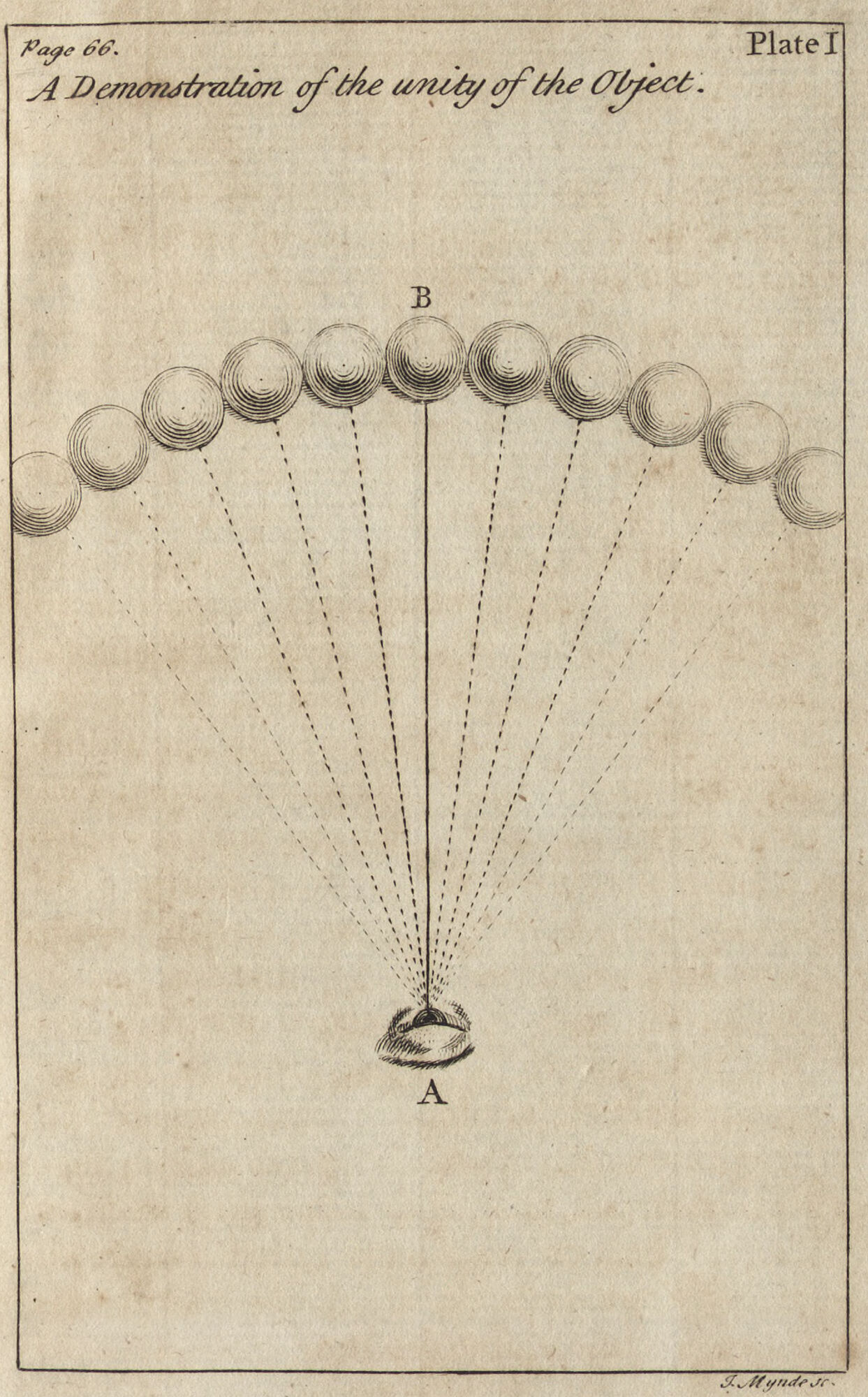
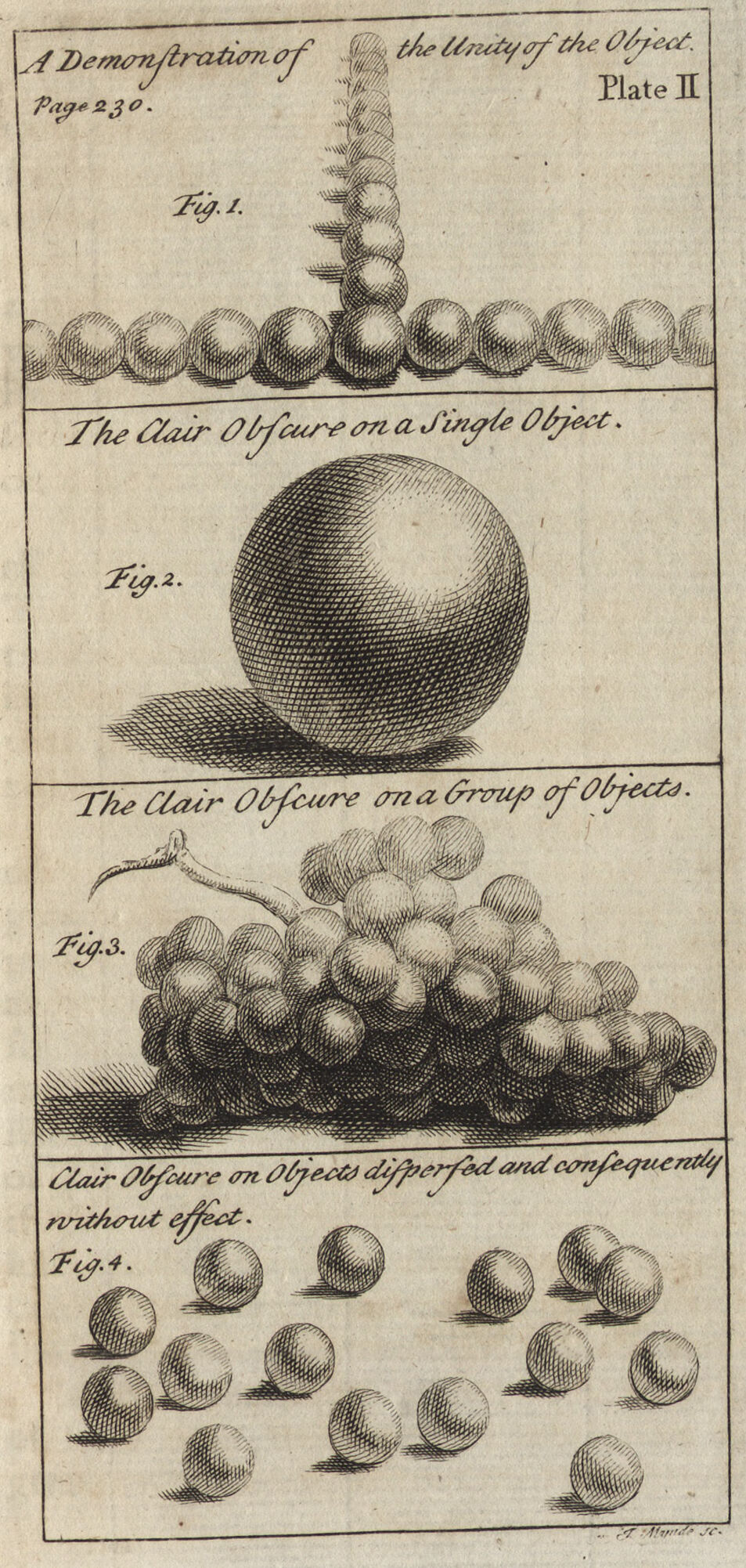
Roger de Piles (1635–1709) · translated by “By a Painter” (not identified) · 16 chapters · 2 figures · public domain · plain text
A French critic sets out what a painter has to master: invention, design, color, light and shade, landscape and portraits. The book also holds a Latin manuscript of Rubens on copying statues and the famous Balance of Painters, which scores the masters out of twenty. The English of 1743, complete, with its two plates.
The author, tho' a man of title and fortune, made painting, for his diversion, both his study and practice; which occasioned his obliging the publick with several useful treatises on this art. In the year 1708, he published the present system, as the result of all his thoughts; and, to make it of more service, has handled it by way of principles; a method, I believe, displeasing to none who desire to know the bottom of the art, or would give reasons for what they do. Accordingly, the reader will find a very learned and natural account of the three capital branches, history, portraiture, and landskip; and of their four chief parts, composition, design, colouring, and expression, and their incidents.
But tho' his home-acquirements were, in all respects, very great, he thought them incomplete without finishing his reflections abroad: For which purpose he travelled into several parts of Europe, to see the finest paintings; whereby he was enabled to make the balance of painters we find in this treatise; an attempt, which, for its novelty, must needs be acceptable to the curious.
His love of painting induced him also to draw up a parallel between it and poesy; wherein, with his usual candour and learning, he shews the excellences and preferences of both arts.
We shall here endeavour to make some remarks on portraiture, as it is the branch of painting chiefly practised among us; and at the same time to shew what may be learned from the following system, by those who study or practise this art.
In the balance aforesaid, Vandyke (whom, for several reasons, we may call ours) stands high; as having fifteen degrees of merit for composition, ten for design, seventeen for colouring, and thirteen for expression: And we accordingly discover in his works such composition, air, grace, and fine penciling, as none of his successors have hitherto attained. His method indeed was pretty singular, (which our author does not wholly agree to) and calculated for dispatch; for he bestowed not above an hour on a sitting; but, being pretty sure of the effects of his colours, he painted without much scumbling; the best way to preserve their purity and vivacity. Rembrant (whom the balance equals with Vandyke for colouring) tho' not a perfect model for an English face-painter, was so careful not to torture his colours, that he chose rather to add fresh ones; and for this reason his works, as well as Vandyke's, maintain to this day an unusual strength and vigour. Now, it may be naturally inferr'd, from the practice of these two painters, that as any colour, any stroke, is to express some drawing, some tendency, towards teint and likeness, so any great disturbance, or wrong colour (too often the case of portraiture) not only spoils drawing, but surprisingly alters and fouls the teint, and makes the painting less like, and less durable.
But, to return to Vandyke: What if we should suppose, that the historical management he was brought up to, under the excellent Rubens, loosened his head, gave him easy penciling, and a noble air, and induced him to express nature with more spirit, even more to improve her, than if his genius and pencil had been always confined to portraiture? It's very probable, that such a genius will never quit historical freedom; and yet, like Vandyke's, it will, on coming to portraiture, be thereby better enabled to exalt nature, and preserve likeness.
But no pains was too great for this artist; who, proposing an exact truth in all things, always sketched, in black and white crayons, the size, attitude, and dress of the person who sat to him, and, from them, painted afterwards his cloaths, which were sent to him for that purpose. This, whatever trouble painters may think it, must needs look more free, natural, and becoming, and tend more to likeness, than any size, posture, or dress, taken from a layman. As for hands, this artist painted them from those of the persons he retained for that purpose.
In speaking of the attitudes, (which, with the face, are the language of portraiture) our author makes them of two kinds; viz. in motion, and at rest: The one for young people only, and the other, for any persons indifferently; yet, allowing the inactive to have some motion. Now, if the attitude be to express, who and what the sitter is, and his very temper, (a very nice historical point) how much does it concern the portraitist to study it, and make the distinctions aforesaid! Whereas the postures of most of our portraits are at rest, and at best taken from the layman.
But, to prove motion, and historical management, in a portrait, I must acquaint the reader, that I have seen a picture drawn in Italy, of an English gentleman, where he is represented in a sitting posture; the ground is a piece of walling, with a window, at the outside of which appears a person holding up a small image of white marble for the gentleman to look at, who, with extended arms, admires its beauty. And tho' his face was, on this account, fore-shortened lengthwise, yet it retained great likeness.
There is yet behind a favourite historical principle of Vandyke and Titian, which face-painters little heed, I mean the claro-obscuro; a compound Italian word, signifying simply, an opposition of light and shade; but, in a more refined sense, any colours, naturally luminous and light in themselves, opposed to others naturally more brown and heavy.
The artifice of the claro-obscuro, of whatever small import painters may think it in a portrait, is certainly practicable in a family-piece; because our author tells us, that every such picture is an history, and becomes a group by the meeting of the figures of different sexes and ages, and in different attitudes and draperies. Now this group must be so managed, that the foremost figures must not only, as being nearest to the eye, receive the greatest light, but also be improved by draperies of natural light colours, (and, in this, white and yellow sattin does wonders) and the off-figures be more brown and heavily coloured, but with discretion; so that the whole group may appear to have one general light opposing one general shade.
In a word: This treatise will appear, as our author would have it be, a palace and bulwark for art, to which both painters, and lovers of painting, may safely retire for instruction and entertainment.
As to the translation; we have endeavoured to make it as acceptable to the English reader as possible, by observing a medium between too wide a paraphrase, and too literal a version; the properest method for a work that treats so learnedly and profoundly of the Art of Painting.
The prize of a race is not to be won; if we have not the goal in our eye; nor is the perfect knowledge of any art or science to be acquired, without having a true idea of it. This idea is our goal or mark, and directs us unerringly to the end of our career; that is, to the possession of the science we desire.
But though there is nothing which does not include in itself and discover its true idea; yet we must not from hence infer, that this idea is so obvious, as not to be mistaken; or that the false idea does not often pass for the true and perfect. There are several ideas of painting, as well as of other arts: The difficulty lies in discovering which of them is the true one. For this purpose, it is necessary to observe, that, in painting, there are two sorts of ideas; a general idea, which is common to all men, and a particular idea, peculiar to painters.
The surest way to know infallibly the true idea of things is, to derive it from the very basis of their essence and definition; for definition was invented for no other purpose than preventing equivocation and ambiguity in ideas, banishing those that are false, and informing the mind of the true end and principal effects of things. Whence it follows, that the more an idea leads us directly and rapidly to the end which its essence points out, the more certain we ought to be, that such an idea is a true one.
The essence and definition of painting is, the imitation of visible objects, by means of form and colours: Wherefore the more forcibly and faithfully painting imitates nature, the more directly and rapidly does it lead us to its end; which is, to deceive the eye; and the surer proofs does it give us of its true idea.
The general idea above-mentioned strikes and attracts every one, the ignorant, the lovers of painting, judges, and even painters themselves. A picture, that bears this character, permits no one to pass by it with indifference; but never fails to surprise us, and to detain us for a while to enjoy the pleasure of our surprize. True painting, therefore, is such as not only surprises, but, as it were, calls to us; and has so powerful an effect, that we cannot help coming near it, as if it had something to tell us. And we no sooner approach it, but we are entertained, not only with fine choice, with the novelty of the things it represents, with the history or fable it puts us in mind of, with ingenious inventions, and with allegories, to give us the pleasure of employing our parts, either in discovering the meaning, or criticising the obscurity of them; but also with that true and faithful imitation, which attracted us at first sight; and afterwards lets us into all the particulars of the piece; and which, according to Aristotle, never fails to divert us; how horrible soever those natural objects may be which it represents.
The other idea, which, as we said, is peculiar to painters, and to which they ought to be perfectly habituated, concerns, in particular, the whole theory of painting; and should be so much at command, that it may seem to cost them no reflection to execute their thoughts: So that after having studied correct design, fine colouring, and all their dependencies, they ought to have those ideas always present and ready, which answer to the several branches of their art.
On the whole, true painting, by the force and great truth of its imitation, ought, as I have observed, to call the spectator, to surprise him, and oblige him to approach it, as if he intended to converse with the figures: In effect, when the piece bears the character of truth, it seems to have drawn us to it, for no other purpose, than to entertain and instruct us.
But here we must observe, that the ideas of painting in general are as different as the manners of the several schools. Not that painters are without those particular ideas, which they ought to possess: But the use they make of them not being at all times just, the habits which this use brings upon them, their attachment to one part more than another, and the affection they preserve for the manner of those masters whom they have imitated, prejudice their choice, and bias them to some favourite branch of the art; though they are under the strictest obligation to make themselves masters of every part of it, in order to contribute to the general idea above-mentioned: For most painters are always divided in their inclinations; some following Raphael, others Michael-Angelo, others the Caracchis, and others the scholars of these masters: Some prefer the whole; others the abundance of thoughts; others the graces; others the expression of the passions of the soul; and there are some who give themselves wholly up to the heat and transport of their genius, tho’ but little improved, either by study or reflection.
But what can be done with all these vague and uncertain ideas? 'Tis certainly dangerous to reject them; we must therefore resolve to prefer to all other things that truth, which we have supposed in the general idea: For, to all painted objects, the appearance of truth is more necessary, than the manner of any master whatever; because truth in painting is the basis of all the parts which heighten the excellence of this art; as the sciences and virtues are the foundation of all those accomplishments, which can either exalt or adorn human nature. For which reason we must suppose truth on the one hand, and virtue and science on the other, to be in perfection, when we talk of those finishings, or accomplishments, of which either painting or human nature is susceptible, and which, without resting upon such a basis, can have no good effect. In short, the spectator is not obliged to seek for truth in a painting; but truth, by its effect, must call to the spectator, and force his attention.
'Tis in vain to adorn a stately palace with the greatest rarities, if we have forgot to make doors to it, or if the entrance be not proportionable to the beauty of the building; so as to raise the passenger's desire to walk in, and gratify his curiosity. All visible objects enter the understanding by the faculty of seeing, as musical sounds do by that of hearing. The eyes and ears are the doors, which admit us to judge of painting and musick: The first care therefore both of the painter and the musician should be, to make these entrances free and agreeable, by the force of their harmony; the one in his colouring conducted by the claro-obscuro, and the other in his accords. The spectator being thus attracted by the force of the performance, his eye discovers in it those particular beauties which are capable of instructing and pleasing; the curious finds in it what suits his taste; and the painter there observes the different branches of his art, in order to improve himself by what is good, and to reject whatever may be vicious. Every thing in a picture is not equally perfect. Some paintings there are, which, with several faults, when minutely consider'd, do not fail, nevertheless, to catch the eye; because of the artist's excellent management in his colouring, and the claro-obscuro.
Rembrant, for instance, diverted himself one day with drawing his maid's picture, in order to set it at his window, and deceive passengers: His project succeeded; for the fallacy was not discover'd till some days after. And yet, as we may justly imagine of Rembrant, this effect was not owing to the beauty of the design, nor to the nobleness of the expression. When I was in Holland, I had the curiosity to see this picture; and, finding it to be well pencil'd, and of great force, I bought it, and it has at this time a considerable place in my cabinet.
Other painters, on the contrary, have shewn in their works a good many perfections in the several parts of the art; yet have not been so happy as Rembrant, to gain, at first sight, such favourable regards: I say; not happy; because, if they have sometimes succeeded, 'twas owing to a chance disposition of objects, which, in the places they filled, required an advantageous claro-obscuro; a perfection which cannot be denied them, but wherein the skill of the painter had very little share; since, if it had been the effect of science, it would have appeared in all his other productions.
Thus nothing is more common, than to see paintings set off a room, purely by the richness of their borderings, whilst the insipidity and coldness of those paintings is such, that people pass unconcernedly by them, without being attracted by that truth which calls to us. Now, to make this point clearer, I must explain it by the example of some skilful painters, who yet have not been masters enough to strike the eye, at first sight, by a faithful imitation, and a truth which ought to deceive, as even excelling nature itself. The most remarkable example I can quote is Raphael, because of his great reputation, and because there was never any painter who possessed so many parts of the art, or possessed them in so high a degree of perfection.
'Tis very certain, by the confession of many, that men of knowledge have often sought for Raphael's works in the midst of them; that is, in the halls of the Vatican, where are his best performances; and have asked their guides to shew them the works of Raphael, without giving the least indication of being struck with them at the first glance of the eye, as they expected to be, from that painter's reputation. The paintings of Raphael did not answer the idea they had conceived of so great a genius, because they measured them by that idea which one ought naturally to have of perfect works. They could not imagine, that the imitation of nature would not, in the works of so wonderful an artist, appear in all its vigour, and all its perfection. This shews, that without the knowledge of the claro-obscuro, and of whatever depends on colouring, the other parts of painting lose much of their merit, even when they are in that degree of perfection to which Raphael carried them.
I shall offer here a late instance of the little effect which Raphael's works produce at first sight: I had it from[1] a friend well known for his genius and knowledge, and who, as it usually happens to persons of his parts, has such an esteem for this famous painter, as comes up to admiration. Being some time ago at Rome, he was very impatient to see Raphael's works; the most admired of which are his Fresco paintings in the halls of the Vatican: He was accordingly carried thither, but happened, with indifference, to cross the halls, without perceiving, that he had before his eyes what he so eagerly sought after. His conductor thereupon stopt him short, and said —— Whither are you going so fast, Sir? There's what you look for, and you do not mind. My curious friend no sooner perceived the beauties which his fine genius pointed out to him in those works, but he resolved to repair thither often, fully to gratify his curiosity, and to form his taste on what he could further discover. But what, if, besides charming with the sight of so many fine things, Raphael had, at first sight, called to him, by the effect of a colouring proper for each object, and supported by an excellent claro-obscuro!
[1] Monsieur de Valincourt.
This gentleman thought he should be extremely surprised at the sight of paintings that had so great reputation; but was not: And, not being a painter, he contented himself with examining and praising the airs of the heads, the expressions, the nobleness of the attitudes, and the graces of the parts he best understood: In other things he had but little curiosity, because they relate to the painter only. This story is often revived, as well by painters who never saw any of Raphael’s works, as by other curious persons, ignorant of painting.
Yet it must be acknowledged, that some of this artist's paintings are well colour'd; but we must not form our judgment of the whole, by the few of this kind; for it is the general run of his, and other painters works, that must determine the extent of their capacities.
Some object, that this great and perfect imitation is not essential to painting; and that, if it were, the effects would appear in most pictures; that a picture may call, and yet not always answer the idea of the person who comes to it; and that it is not necessary for the figures to seem desirous to enter into a conversation with the spectator, because he is already prepossessed with the notion of its being only a painting.
It is certain, that the number of pictures which call the spectator is but few: But that is not the fault of the art; the essential effect of which is to surprise, and deceive the eye: We must only blame the painter's negligence, or rather impute it to his genius, as not being exalted enough, or not sufficiently furnish'd with the principles necessary for compelling, as it were, those who pass by, to stop, and give attention to his pieces.
But further; it argues more genius to make a good use of lights and shades, harmony of colours, and their suitableness to each particular object, than to design a single figure correctly.
Design, which requires much time to learn perfectly, consists of little more than an habit, which is often repeated, of giving measures and outlines; but the claro-obscuro, and harmony of colours, is a continual subject of reasoning, which employs the genius in ways that are as different as the compositions themselves. A moderate genius may, through perseverance, attain correct designing; but the claro-obscuro requires, besides the rules, such a compass of genius, as may incorporate with, and, as it were, diffuse itself through, all the other parts of painting.
'Tis well known, that the works of Titian, and of all the painters of his school, have scarce any other merit than their claro-obscuro, and colouring; and yet they bear a great price, are in great repute, and maintain their posts in the cabinets of the curious, as first-rate pictures.
When I speak of design, I must be understood to mean only that material part, which, by just measures, forms all objects in a regular manner; for I am not ignorant, that in design there is a genius capable to season all sorts of forms by the assistance of taste and elegance; yet it is easy to observe, that the effect, which calls to the spectator, arises principally from the colouring of all the parts; by which we are to understand the claro-obscuro, and the general harmony of colours, as also such as we call local, or colours which faithfully imitate those of any particular object. But all this hinders not the other parts of art from being necessary to help forward the whole work, and from mutually assisting each other; some to form, others to adorn the objects painted, in order to give them a taste and grace that may instruct, respectively, both lovers and painters, and, in a word, may please every one. Thus, as it is the duty of painting, both to call and please; when it has called the spectator, it must necessarily entertain him with all the various beauties of which it is capable.
I must now proceed to set the several parts of painting in their natural order, that I may confirm the reader in the idea I have been endeavouring to establish: And because this idea is founded on truth, I shall begin the following discourses with a treatise on this subject: which I am the more obliged to do, because the subject of truth, and the idea of painting, are so nearly allied, as to be almost the same thing; for all the parts of painting are no further valuable than they bear this character of truth.
After the idea of painting which I have endeavoured to establish, and after the treatise upon truth, I shall speak of the other parts of painting; and if the grounds I go upon are solid, they may possibly screen me as well from the false critick, as from those who are ignorant of the true principles of the art.
Such principles I will endeavour to establish, as may serve to build a rampart and palace for painting, where great painters, true criticks, lovers of painting, and all persons of good taste, may safely retire. Invention will furnish the thought of the structure, and chuse its painter-like situation, which, though fanciful, and sometimes even wild, will, nevertheless, be extremely agreeable. Invention will also prepare the materials, and disposition compart the rooms, for receiving all the solid beauties and ornaments we would place in them. After invention and disposition, design and colouring, and their dependencies, are ready to perform their parts in executing the building. Colouring will visit every thing, and everywhere distribute its gifts, according to the exigence and propriety of the place; and, jointly with design, will chuse the furniture of the palace. Design also will, by way of pre-eminence, have alone the charge of overseeing the architecture, as colouring will have that of chusing the pictures; and both will co-operate to put the finishing hand to the structure.
The situation, to make it commodious for painting, must be diversified with objects produced without art or culture, as rocks, cascades, mountains, rivulets, forests, skies, and fields, all in an uncommon manner, yet keeping within the bounds of probability, and which will be more particularly handled in my discourse on landskip.
Among other inhabitants of this palace, painting will receive poesy with all the marks of distinction she deserves, where they will live together, like two kind sisters, who ought to love one another, without jealousy, and without disputes: It is with a parallel between these two arts I intend to close this system of painting.
Some persons of good sense have blamed me for making use of the defect in Raphael to confirm my sentiment on the idea of painting; Raphael, who ought not to be mentioned, say they, but as the model of all perfection, considering the general and established reputation he has acquired. They own, I have reason in the main; yet say, that I ought to chuse some other example, and join with people of understanding in treating Raphael with more complaisance. They add, that the curious are already set against me, because they have imagined, that I preferr'd Rubens to Raphael; and that the example I make use of to confirm my sentiment, would rather irritate than convince them; and would likewise, with them, very much lessen the opinion which the world entertains of my skill in painting.
I can only answer, that I chose Raphael as an example, that is, what often happens at the first sight of his works, for no other reason, but because he excelled more in all the parts of his art, than any other painter; and because I should reap more advantage, and more certainly establish my sentiment on the idea of painting, if I set it in opposition to all Raphael's perfections. To chuse Raphael, therefore, as an example, because he possessed more excellencies than any other painter, and in order to shew, that all excellencies lose much of their lustre, when they are not accompanied with a colouring which calls the curious to admire them, can never be thought to argue a contempt of him.
My intention is not to write, either for the learned in painting, or the ignorant, but for such as are born with an inclination to this fine art, and may at least have improved it by conversing with able judges, and learned painters: I write, in a word, for young pupils, who may have set out in a right path, and for all those, who, after acquiring some tincture of design and colouring, have impartially examined the best works, and are docile enough to embrace those truths which may be hinted to them.
As for half-learned painters, who have set out in the wrong path, and most of the book-learned, they usually maintain the false ideas which they have hastily embraced; and, tho’ strangers to design or colouring, or Raphael, or Rubens, will talk of those two painters according to an antient tradition, which, though much lessened of late by good reflections, has yet left its impressions on the minds of many.
As for myself, I can say, that having, in my travels, view'd, with great attention, the finest pictures in Europe, I have studied them with fondness; and such parts as nature has bestowed upon me, I have improved and employed this way: I admire every thing that is good in the works of the great masters, without respect to names, or any other complaisance. I value the several celebrated schools: I love Raphael, Titian, and Rubens; and I do my utmost endeavours to dive into the rare accomplishments of those great painters: But, whatever perfections they may have, I love truth better: Truth alone is what should be had in view, especially by one who writes for the publick: This is a respect to which the publick has a right, and therefore I thought I could not excuse myself from paying it.
Man, however much given to lying, hates nothing so much as a lye, and the surest way to gain his confidence is, to treat him with sincerity: 'Tis needless, therefore, to make an encomium here on truth, since every one loves it, and feels the beauties of it; nothing is good, nothing pleases, without truth; 'tis reason, equity, good sense, and the basis of all perfection; 'tis the aim of the sciences; and all the arts, whose object is imitation, have no other tendency than to instruct and direct men, by a faithful imitation of nature: Wherefore those, who either cultivate the sciences, or exercise the arts, cannot say that their endeavours have been crowned with success, if, after all their pains, they have not discovered that truth which they look upon as the reward of their studies.
Besides the general truth, which ought to appear in all things, there is a truth peculiar to each of the fine arts, and to each of the sciences. My present design is, to discover what is truth in painting, and of what importance it is to the painter to express it well.
But before we enter on the subject, it must be premised, with regard to imitation in painting, that though the true object is the natural one, and the feigned object that in the picture, the latter is, nevertheless, called true, when it is a perfect imitation of the former. It is therefore the truth in painting, which I shall endeavour to discover, in order to shew its worth and necessity. I observe, in painting, three kinds of truth, viz.
The simple;
The ideal; and
The compound, or perfect truth.
The simple, which I call the primary truth, is a plain and faithful imitation of the motions that express nature, and of those objects which the painter has chosen for his copies, such as they appear to the eye at first sight; so as the carnations may seem to be real flesh, and the draperies real stuffs, in their several varieties, and each object maintain the true character of its nature, and, by the force of the claro-obsucro, and of the union of colours, the several painted objects may appear to have a relief, and the whole be harmonious.
In all natural things, this simple truth discovers the way by which the painter may gain his end; which is such a strong and lively imitation of nature, that it may seem possible for the figures to come out of the picture, as it were, in order to talk with those who look at them. But let it be here observed, that from this idea of the simple or primary truth I abstract all the beauties that may embellish it, and which either the painter's genius, or the rules of art, may add to it, in order to make the whole perfect.
The ideal truth is a choice of various perfections, not meeting in any single copy, but taken from several, and commonly from those of the antique.
This kind of truth comprehends an abundance of thoughts, a richness of invention, a propriety of attitudes, an elegance of outlines, a choice of fine expressions, an handsome cast of draperies, and, in a word, every thing that can, without altering the primary truth, make it more moving, and more agreeable. But as all these perfections can only subsist in idea, with regard to painting, they have need of a lawful subject, both to preserve and set them off to advantage: And this lawful subject is simple truth, in the same manner as moral virtues are only ideal, if they have not a lawful subject, that is, a subject properly disposed to receive and support them; without which they would be but the shadows of virtue.
Simple truth subsists of itself, and gives both relish and spirit to the perfections which attend it; and if it does not alone lead to an imitation of perfect nature, which depends upon the choice the painter makes of his copy, it leads at least to an imitation of nature, which, in general, is the end of painting. Ideal truth, of itself, must be allowed to lead into a most agreeable path: yet it is such as does not carry the painter to the end of his art, but leaves him short of it; and the only assistance he can expect to come to the end of his career, must proceed from that simple truth. Hence it appears, that the simple and ideal truths together make a perfect compound, and mutually assist each other; with this difference, that the former overpowers and darts its rays through all the perfections that are joined to it.
The third truth, as a compound of the other two, gives the last hand to art, and the perfect imitation of fine nature. It carries so beautiful a probability, as often appears to be more true than truth itself: And the reason is, that, by the aforesaid conjunction, the primary truth seizes the spectator, salves many negligencies, and produces its effect the first, without our attending to it.
This third truth is the mark which hitherto no man has hit; we can only say, that those who have come the nearest to it, are the most accomplished. The simple and ideal truths have been divided according to the genius and education of the painters who possessed them: Giorgione, Titian, Pordenon, old Palma, the Bassans, and all the Venetian school, had no other merit, but that of possessing the primary truth: And Leonardo da Vinci, Raphael, Julio Romano, Polydore da Caravaggio, Poussin, and some others of the Roman school, have gained their greatest reputation by ideal truth; especially Raphael, who, besides the beauties of ideal, was master of a considerable part of the simple truth, by which means he came nearer to that truth which is perfect, than any other Italian: In effect, it appears, that, in order to imitate nature in its variety, this painter usually made use of as many different natural objects, as he had figures to introduce into his pieces; and if, at the same time, he added some things of his own, it was to make his drawings the more regular, and more expressive, but always preserving truth, and the distinguishing character of what he copied. Though he was not thoroughly master of simple truth in the other parts of painting, yet he had such a taste for truth, that in most of the parts of the human body, which he designed after nature, he drew them on paper, as they really were, in order to be testimonies of the most simple truth, and to be joined to the idea he had of the beauty derived from the antique. An admirable conduct! in which no painter has been so successful as Raphael, since the revival of the art.
Now, if perfect truth be composed of the simple and ideal, painters may be said to excel, in proportion to the degree wherein they possess those several truths, and to the happy facility they have acquired of joining them into one compound.
After having settled what truth is in painting, it is proper to inquire, whether those painters, who exaggerate, or overdo the out-lines of their figures, in order to seem learned, have not abandoned truth, by exceeding the bounds of a regular simplicity. In this point, painters use the word charge, to signify any thing that exceeds: Now, as every thing that exceeds, is beyond probability, 'tis certain, that whatever may be said to be charged, is contrary to the truth which we would establish. Yet there are charged out-lines which please, because they are above the lowliness of ordinary nature, and because they carry with them an air of freedom, and a certain idea of a great taste, which deceives most painters, who call these excesses, the grande maniere. But those who have a true idea of correctness, of regular simplicity, and of the elegance of nature, will look upon these excesses as superfluous, since they always adulterate the truth: Yet one cannot help praising some overcharged things in great works, when the distance from whence they must be viewed, softens them to the eye, or when they are used with such discretion, as makes the character of truth more apparent.
Some painters there have been, who, instead of a reasonable moderation in their designs, have affected to express their outlines and muscling with greater exactness than the art of painting requires: Their motive was, to gain to themselves the reputation of being skilful in design and anatomy; but their motive, like their pictures, has a certain air of pedantry, more capable of lessening the beauty of their works, than of increasing their reputation: It must, indeed, be granted, that the artist ought to understand anatomy, and the sharp swells, which are its consequences; because anatomy is the basis of designing, and because these swells may lead those to perfection, who know how to take and to leave as much of them as is necessary to make exactness and simplicity of design agree with good taste: Such things may also be tolerable, and often agreeable, in mere sketches of a picture, and the learned painter may profitably make use of them when he begins and dead-colours; but should cut them off when he would have his work appear in perfection; as the architect strikes his centre as soon as the arch is set.
On the whole, the antique statues, which have passed at all times for the rule of beauty, have nothing charged, nothing affected; nor is there any thing of this kind in the works of those who have always imitated them; as Raphael, Poussin, Dominichino, and some others.
Not only all affectation is displeasing, but nature, besides, is obscured and overcast by a bad habit, which painters call manner.
The better to understand this principle, 'tis proper to know, that there are two sorts of painters: Some, and they are but few, paint according to the principles of art, and make truth so obvious in their works, as to stop and entertain the spectator; others work only practically, by an expeditious habit, which they have either taken up without reason, or learnt of their masters without reflection. Though these sometimes do well, either by chance, or by the help of their memories, yet they always succeed but indifferently when they work on their own bottom; for as they but rarely make use of the natural, or else confine themselves to their habit, they never express that truth, or that probability, which is the sole object of a true painter, and the end of painting.
For the rest, among all the fine arts, there is certainly none, where truth ought to be so conspicuous, as in painting: The other arts do but revive the idea of things absent; whereas this intirely supplies them, and makes them present, by the very essence of it, which consists not only in pleasing, but deceiving, the eye. Apelles drew his portraits so true and like, both in air, and every thing else relating to the face, that a certain horoscope-maker could, on sight of them, tell the temperament or constitution of the person painted, and what would befal him: 'Twas this painter's care, therefore, rather to observe truth in his portraits, than to embellish them with falsities. In effect, truth has, in this case, so many charms, that it ought to be always preferr'd to borrow'd beauty; since, without it, portraits can only preserve a vague and confused idea of our friends, and not the true character of their persons.
What can be inferr'd from all this reasoning, but that there is in painting a primary, an essential truth, which leads the painter directly to his end; an animated truth, which not only subsists and lives of itself, but also gives life to all the embellishments of which it is susceptible, and which ought to be joined with it; and that these perfections are but secondary truths, which, by themselves, have no force to move, but yet do honour to the primary truth, when added to it? Now this primary truth in painting is, as we have said, a simple and faithful imitation of the motions which express nature, and of objects, such as, at first sight, they present themselves to the eye, with all their varieties, and in their true characters.
It appears, therefore, that every painter, who not only neglects the primary truth, but does not take great pains to make himself thoroughly master of it, will only build upon sand, and will never pass for a genuine imitator of nature; and that the whole perfection of painting consists in the three sorts of truth we have endeavoured to establish.
Copy of a Letter from Monsieur Du Guet, to a Lady of Quality, who had sent him the preceding Discourse, and had asked his Opinion of it.
19. March 1704.
The discourse of truth in painting, Madam, has better informed and pleased me, than those other discourses with which you know I was so well satisfied. It appears to me, not only to be a summary of the rules, but also to discover the foundation, and ultimate end of them; and I have there learned, with great pleasure, the secret of reconciling two things, which I took to be opposite; the art of imitating nature, and that of going beyond this imitation, by adding to her beauties, in order to attain them; and of correcting her, to make her more apparent. The simple truth gives life and motion, and the ideal chuses with art every thing that can either adorn or make it moving; yet does not chuse but from the simple truth, which indeed is barren in some parts, but, upon the whole, is rich and fruitful.
Now, if the secondary truth does not support the primary, but rather overpowers it, and hinders it from being more apparent, than any addition from the secondary; art departs in this case from nature; takes her place, instead of representing her; disappoints the spectator's expectation, and not his eye; and warns him of the snare, instead of concealing it from him. If, on the other hand, the primary truth has all the truth of life and motion, and is wanting in that nobleness, exactness, and grace, which sometimes are only to be found elsewhere, if it subsists without any aid from the secondary, which is always great and perfect, it pleases no further than it is agreeable and finish'd, and the copy has nothing that was missed in the original.
The use we are therefore to make of this secondary truth is, to supply every subject with those things which it has not, but might have, and such as nature has distributed among others, and thus to unite those perfections, which nature has commonly separated.
The secondary truth is, strictly speaking, very near as real as the primary; for it does not invent; it chuses from all parts; it studies whatever may please, instruct, or animate. Nothing escapes it, not even what would seem to have escaped it by chance. It catches, by means of design, what does but once appear, and enriches itself with a thousand different beauties, that it may be always uniform, and never fall into repetitions.
'Tis for this reason, methinks, that the union of these two truths has so surprising an effect; for this union produces a perfect imitation of what is most ingenious, most moving, and most perfect in nature. Every thing here is probable, because it is true; but surprising, because it is rare; every thing strikes, because every thing that is capable of striking has been observed; yet nothing appears affected, or overdone, because there is nothing here that is wonderful and perfect, which has not been copied from nature.
'Tis departing from the rules, and the end of painting, to let any one beauty overpower another, or to aim at a reputation for any one part, and not for the whole: Design, skill in anatomy, and even the desire to please, and be approved, should all be subservient to truth. A true painting, in short, ought to transport the spectator from the very first moments he sees it, and not to give him leave, till afterwards, to think of the painter, and admire his art.
Monsieur Du Piles has, very happily, displayed the character of Titian, for the simple truth in its greatest force; and that of Raphael, for ennobling the simple truth with the ideal: And I know not whether any more refined or more universal method could be found for judging of the merit of the greatest painters, than going even beyond their efforts, and their success, and pointing out the union of the two truths which they have endeavoured after, but have not attained, as the utmost stretch of the art.
I know not, Madam, why I say so much on this subject, if not to let you see, how full I am of what I have been reading, and what value I set on such things as I can't help repeating to you, though I am sensible, that in so doing I spoil and weaken them.
I am, Madam, with all imaginable Respect, your most humble, and most obedient Servant.
In order to observe some method in treating of the several parts of painting, we may consider it in two lights; either with regard to the young student, or to the perfect artist: If it is considered according to the method in which it is learned, we must begin with designing, then treat of colouring, and end with composition; because 'tis to no purpose to think what we would imitate, if we know not how to imitate it, and because objects can only be represented by design and colouring. But if we consider this art in its perfection, and according to the order in which it is executed, and if, besides, we suppose the painter to have acquired a perfect habit in the several parts, so as to execute them with facility; the first part that offers itself will be invention; for, before he can represent objects, he must determine which he would represent. 'Tis in this second light I am here to consider painting, that I may give an idea of it suitable to the taste of the greatest number of readers.
Several authors, who treat of painting, make use of the word invention, to express different things: Some would convey such an idea by it, as they take to comprehend the whole composition of a picture; others have ascribed to it fertility of genius, newness of thoughts, and the method of expressing them, and of treating the same subject in different ways. But though these particulars are extremely proper for supporting invention, for ornamenting it, and giving it heat and life, they are neither the ground nor the essence of invention; for a painter, who is not master of all these things, may, nevertheless, do his part in invention, by the justness of his thoughts, the prudence of his choice, and the solidity of his judgment.
Invention, therefore, as it is but a part of composition, cannot give a perfect idea of it; for composition implies both invention and disposition; 'tis one thing to invent objects, and another to place them rightly. I shall not stop here, to refute the other ideas which have been entertained of invention; as I hope to define it in so true and obvious a manner, that I imagine there will be no diversity of opinions on this subject.
I take invention to be a choice of the objects that enter into the composition of the subject which the painter would treat of: I say, a choice; because objects ought not to be brought into a picture inconsiderately, and without contributing to the expression and character of the subject. I say, that these objects ought to enter into the composition, but not wholly compose the picture to the end, that invention may not be confounded with disposition, and may leave it at full liberty to act its part, which consists in placing the aforesaid objects to the best advantage.
Poets, as well as orators, have their different styles to express themselves in, according to the several subjects they treat of; and upon this depends the choice of words, of harmony, and of the turn which they give to their thoughts. 'Tis the same in painting: When the painter has chosen his subject, he must chuse his figures, and their dependencies, accordingly. The painter, as well as the poet, has his sublime style for things that are elevated, his familiar style for common things, his pastoral style for the country, and so forth. Now, though all these various styles fall in with all the parts of painting, they are, nevertheless, in a more particular manner, the province of invention. But this point would require a treatise of itself.
Invention, as it relates to painting, may be considered in three respects; it is either simply historical, or allegorical, or mystical.
Painters, with reason, use the word history, to signify the highest kind of painting, which consists in bringing many figures together. And, 'tis usual to say, Such a painter does history, such a one paints beasts, such a one landskip, such a one flowers, and so forth. But there is a difference between the division of the kinds of painting, and the division of invention. I here take the word history in a large sense, and mean by it, every thing that can either fix the painter's idea, or inform the spectator. I say, therefore, that invention, simply historical, is such a choice of objects as simply of themselves represent a subject. This kind of invention comprises not only all sorts of history, whether true or fabulous, as related by authors, or established by tradition, but also portraiture, views of countries, beasts, and all the productions of art and nature; for in painting a picture, the artist must not only have his pallet and pencils in readiness, but, as we have said, he must, before he begins, resolve upon what he would paint, though but a flower, fruit, plant, or insect; for though the artist may confine his genius to such things, they are often capable of yielding instruction, as they have their particular virtues and proprieties: Those who have written of them, and have set off their works with demonstrative figures, are called historians; and we say, The history of plants, the history of animals, as well as that of Alexander the Great. Invention, simply historical, has therefore its degrees, and is more or less valuable according to the quantity of its matter, the nature of its choice, and the genius with which it is managed.
Allegorical invention is a choice of objects that serve to represent in a piece, either wholly or partly, what in fact they are not. Such, for instance, is the painting of Apelles, representing Slander, as described by Lucian: Such also is the moral painting of Hercules, placed between Venus and Minerva, where those pagan deities are only introduced, to shew the force of virtue. And such is the picture of the School of Athens, in a chamber of the Vatican, where several figures, of different times, countries, and conditions, are brought together to represent Philosophy. The three other pictures in the same chamber are drawn in the same allegorical manner; and, if we consider the transactions recorded in the old testament, they will appear to be partly[1] allegorical, as well as simply historical, because they are the types of what should come to pass under the new law. These are examples of subjects which are wholly allegorical.
[1] 1 Cor. x. 6.
The works, which are but partly allegorical, engage our attention more easily, and more agreeably; because the spectator, being assisted by the mixture of figures purely historical, distinguishes, with pleasure, the allegorical figures that are joined with them. We have an authentick example of this in the bas-reliefs of the Antonine column, where the sculptor, being to express some rain, which the christian army obtained by their prayers,[2] has introduced, among the soldiers, a raining Jupiter, having his beard and hair covered with water, which falls from thence in abundance. Now, Jupiter is not placed there as a God who makes a part of the story, but as a symbol of rain, after the manner of the heathens. Antient authors, speaking of the paintings of their times, relate many examples in allegory: And, since the revival of the art, painters have made frequent use of them; and, if some have abused them, ’twas because they knew not that allegory is a kind of language, which ought to be common among several people, and is founded on a received usage, and the knowledge of books and medals; and chose, rather than consult them, to invent a particular allegory, which, tho' ingenious, could not be understood by any but themselves.
[2] This happened in the reign of the Emperor Marcus Aurelius, who erected the column here mentioned, on which were represented, in bas-relief, the wars he waged with the Germans and Sarmatians; and, in gratitude, placed on it the statue of Antoninus, who had adopted him to the empire.
Mystical invention respects the christian religion. Its end is to instruct us in some mystery, grounded on scripture; which mystery is represented to us by several objects that concur to point out some truth.
Our mysteries, and the points of faith, which the church has injoined, furnish a great many examples. The second council of Nice, having allowed of setting before the eyes of the faithful the mystery of the Trinity, painters represent the Father under the figure of a venerable old man; the Son in his humanity, as he appeared to his disciples after the resurrection; and the Holy Ghost, in the form of a dove. The last judgment, the church triumphant, matters relating to the law, to faith, and the sacrament, come under the same denomination. Among the many examples which able painters have left us, I shall mention a most ingenious one, a colour'd sketch of which I have by me, and prize highly. The subject is, The mystery of the incarnation. Now, had the author of this design been willing to treat the Annunciation historically, he might have only drawn the virgin Mary in a plain room, without other company than the angel; but, being resolved to treat the subject mystically, he has placed her on a kind of throne or half-pace, where, on her knees, she receives humbly, but with dignity, the angel's embassy, whilst God the Father, having settled with his Son the price of man's redemption, assists, as it were, at the performance of the contract. The Father is seated majestically on the globe of the world, encompassed by the celestial choir, and having, at his right hand, Justification and Peace, which it had been agreed to bestow on the whole earth. He sends his Holy Spirit to work this great mystery. The Holy Spirit is surrounded with a circle of angels, holding each others hands, and exulting, because mankind were to fill up the places of the bad angels. Several angels, terminating this celestial part of the piece, have in their hands different attributes, which the church ascribes to the holy virgin, to shew, that of all mankind she was the worthiest of the grace with which she was filled. All this great sight takes up the upper part of the piece. Beneath are the Patriarchs, who longed for the coming of the Messiah; the Prophets who foretold it, the Sibyls who spoke of it, and the little Genii, reconciling the passages of the Sibyls with those of the Prophets. Thus does this picture mystically display the truth and grandeur of its subject.
I have now gone through the three ways in which we may conceive invention; to wit, as either simply historical, or allegorical, or mystical. Let us now see what they have in common one with another; after which we shall speak of the qualities peculiar to each of them.
A painter of genius finds, in all the parts of his art, ample matter to make it appear. But the part that gives him most opportunities of shewing his sense, imagination, and judgment, is, without doubt, invention. 'Tis by means of invention, that painting goes hand in hand with poesy; it is chiefly invention that gains the esteem of the better sort; I mean, persons of judgment, who, not satisfied with the bare imitation of objects, would have the choice of them to be just, in order to express the subject.
But this very genius must be cultivated by the knowledges that relate to painting; because, let the imagination be ever so bright, it can only bring forth such things as the understanding is already filled with; and the memory supplies us with no other ideas, but those of what we know, and have seen. Accordingly the talents of particular men are either sunk in the lowness of common objects, or else rise to the sublime, by searching for such as are extraordinary. For this reason, some painters, who have cultivated their parts, have happily supplied a want of genius; and, raising themselves with their subject, their subject has been observed to rise and grow greater on their hands. Without the necessary parts of knowledge, one is liable to many mistakes; but when we are possessed of them, every thing presents itself regularly, and comes insensibly into order.
'Tis, nevertheless, convenient for young people, after having studied the essentials of their art, and before they give publick proofs of their abilities, to exercise their genius on all sorts of subjects; because, like new wine, which violently ferments, that it may become in time more palatable, they at first give themselves wholly up to the impetuosity of their imagination; but when their first sallies are evaporated, the images of their conceptions, without losing their force, grow more clear and purified. But if they do not trust so much to their own understandings, as not to consult their knowing friends on the kind and measure of their talents, they ought to consider them as a plant which must be set in a particular sort of ground, preferably to any other, in order to yield its fruit in its season. In the same manner, if the painter can chuse his own subject, he ought to prefer that which best suits the nature and compass of his genius, and affords him matter for exercising it in the manner for which he is best furnished. To give heat to his imagination, he must turn his ideas into different shapes, he must read his subject several times with great attention, that a lively image of it may be form'd in his mind; and that, in proportion to the greatness of the matter, he may suffer himself to be transported, even to enthusiasm, which is the distinguishing quality both of a great painter, and a great poet.
As the painter can represent, in the same piece, no more of nature, than what is to be seen at one glance of the eye, he cannot, for this reason, exhibit, in the same piece, what passed at different times; and if some have taken the liberty to do otherwise, they are inexcusable for it, unless they were forced to do it by those who employed them, or unless they meant to compose a mysterious or allegorical subject, like the picture of the School of Athens.
But after the subject is well fix'd, it is extremely proper to introduce such circumstances as serve to fortify its character, and make it known. They must not, however, be so numerous as to tire the attention, but rather so judiciously chosen, as to give an agreeable exercise to the mind. These circumstances relate to place, time, and persons. Thus, whilst the artist is instructing the spectator, he ought, besides, to divert him with variety. This variety appears in the sexes, ages, countries, conditions, attitudes, expressions, diversity of animals, stuffs, trees, buildings, and every thing that can exercise the mind, and properly set off the scene of the picture. I would not, however, approve of this abundance of objects, and of this variety, how pleasing soever in other respects, but so far as it is suitable to the subject, or at least has some instructive relation to it; for, as some subjects breathe nothing but joy and tranquillity, so there are others which are either mournful or tumultuary; some require gravity, dignity, respect, silence, and sometimes solitude, and, consequently, admit but of few figures; as there are others which are susceptible of a great many, and of such a variety of objects as the skill of the painter thinks proper to introduce: For the whole must have a tendency to the hero of the subject, and preserve an unity well expressed, and well conceived.
These are the general properties of the three kinds of invention. It remains to consider, what is peculiar to each of them.
Among the properties, of which invention, simply historical, is susceptible, I observe three, fidelity, perspicuity or clearness, and good choice. I have elsewhere observed, that fidelity in history is not the essence of painting, but only a necessary appendage to the art; for, though the painter be only an historian by accident, he is, nevertheless, to blame, if he does not acquit himself well in what he has undertaken. By fidelity I mean an exact imitation of things, whether true or fabulous, as transmitted to us either by authors, or by tradition: And it is not to be doubted, but the more fidelity such an imitation preserves, the greater force does it give to the invention, and the greater value to the painting. But if the painter has been careful to stamp his subject with some mark of erudition, such as may awaken the spectator's attention, without destroying the truth of history; if he can blend some poetical passage with those historical facts that admit of it; in a word, if he can treat his subject with that moderate licence which is allowed both to painters and poets, he will make his inventions sublime, and will gain himself a distinguished reputation. Fidelity, therefore, is the first property of historical invention.
The second is perspicuity or clearness; so that the spectator, if sufficiently acquainted with history, may easily discover what particular passage the painter would represent. Whence it follows, that all ambiguity must be removed by some peculiar mark of the subject, that may distinguish it from any other. I speak here of subjects which are uncommon; for those which are generally known, and are often repeated, have no need of this precaution. If the subject is not enough known, or if the painter cannot well bring in some object to explain it, he ought to make no difficulty of inserting a motto or inscription. Of the many examples of this kind, both antient and modern, I shall chuse only two, which are well known; one of Raphael, and the other of Hannibal Caracche. The latter having painted, in the Farnesian gallery, the story of Anchises endeavouring to give proofs of his love to the goddess Venus; lest Anchises should be mistaken for Adonis, has artfully made use of Virgil's words,[3] Genus unde Latinum——which he writ beneath the bed, on the bottom of the alcove. And Raphael, in his Parnassus, having placed Sappho among the poets, has writ the name of that learned dame, lest she should be taken for one of the muses.
The third property of historical invention is the choice of the subject, supposing the painter has the power to chuse; for a remarkable subject furnishes most opportunities of enriching the scene, and commanding attention. But if the painter bestows his pencil upon a little subject, he must endeavour to make it great, by the extraordinary manner in which he treats it.
Allegorical invention, in like manner, has three properties. The first is, that it be intelligible. 'Tis a great fault to keep the attention long in suspense by means of new-invented symbols, as 'tis a perfection to entertain it, for some moments, by such allegorical figures as are known, generally received, and ingeniously employed. Obscurity tires the mind; but perspicuity makes it enjoy the discovery with pleasure.
[3] Alluding to the origin of the Italian race.
The second property of allegory is its authority. Cæsar Ripa has written a volume upon this point, which is in the hands of the painters: But the best things in this author are his extracts from the antique medals; and, indeed, the best authority for allegories is antiquity, because 'tis incontestable.
The third property of allegory is, that it be necessary. For as far as history can be explained by simple objects, which belong to it, 'tis needless to seek for foreign aids, which serve rather to embarass than adorn such a subject.
Mystical invention, as it is intirely devoted to religion, must be pure, and free from any mixture of objects drawn from fable. It must be grounded either on scripture, or the ecclesiastical history: We have ample matter for this kind of invention in our Saviour's parables, and in the Apocalypse[4], the obscurity of which we ought to reverence, but are not obliged to imitate. The Holy Spirit, which breathes where it pleases, makes itself intelligible when it pleases; but the painter, who can neither penetrate nor alter the spectators understanding, ought to use his utmost efforts to be understood.
[4] Sicut tenebræ ejus, ita et lumen ejus.
As nothing is more sacred, more grand, more permanent, than the mysteries of our religion, they can't be treated in a style that is too majestick: All that pleases, does not always please; and the greatest pleasures commonly end in aversion; but that which creates an idea of grandeur and magnificence, endures for ever.
To conclude, in whatever manner the art of invention be discharged, it must appear to be the effect of an easy genius, rather than of laborious reflection: And as there are talents for attaining facility, there are also talents for concealing labour; and each have their merit, and their partizans.
Happy is the man, on whom nature has bestowed a genius able to run through the vast race in this part of painting, and to chuse his objects well, in order to make his subject intelligible, in order to enrich it, and instruct the spectator: But still more happy is the artist, who, after knowing every thing that contributes to fine invention, knows himself still better, and makes a proper estimate of his own abilities; since it is the glory of a painter, not so much to undertake great things, as to execute well what he undertakes.
This picture, usually called, The School of Athens, has been variously understood by those who have described it; and it is surprising, that, among others who have published an explication of it, Vasari, a Cotemporary of Raphael, should have made so great a mistake as to neglect consulting him, that he might draw, from the source itself, those instructions he had occasion for, to explain a work which has made so much noise throughout all Italy.
This author, who first wrote of it, says, that it is the agreement of philosophy and astrology with divinity; and yet there appears no mark of divinity in the whole composition. The engravers of it have as improperly put an inscription under it, taken from the acts of St. Paul, to induce us to believe, that this apostle, after having met with an altar, on which was inscribed, TO THE UNKNOWN GOD, is here presenting himself before the judges of the Areopagus, to give them the knowledge of the God they were ignorant of, and to instruct them in the article of the resurrection of the dead, about which the Epicureans and Stoicks were then disputing.
Agostino Venetiano is yet more grosly mistaken, when, in his print of five or six of the figures, which are towards the right-hand in the aforesaid piece, he has supposed the philosopher, who is writing, to be St. Mark; and the young man with one knee on the ground to be the angel Gabriel, holding a table, on which is engraved the angel's salutation — Ave, Maria, &c.
As 'tis needless to spend much time here in refuting these errors, which are equally gross, I shall only describe the four cieling figures, which correspond with the four subjects painted in the chamber, where this stands, and which evidently point them out.
The first represents Theology, with these words — Scientia divinarum rerum, the knowledge of things divine.
The second is Philosophy, with these words — Causarum cognitio, the knowledge of causes.
The third is Jurisprudence, or Knowledge in the law; with these words — Jus suum unicuique, doing right to every one: And
The fourth represents Poesy; with these words — Numine afflatur, inspired by the Deity.
Now, in the piece called the school of Athens, the figure of Philosophy is placed uppermost; and therefore it cannot be doubted but that this painting represents Philosophy, as will appear more clearly from the particular description I am going to give of it.
The scene opens with a building of magnificent architecture, consisting of arcades and pilasters, and so disposed as to render the prospect of them gradually diminishing, and the break advantageous, and to give a grand idea of the subject. The place is filled with philosophers, mathematicians, and others, who give themselves up to the sciences; and as it is only through a course of time, that philosophy is come to that degree of perfection in which we see it, Raphael, who had a mind to represent this science by an assembly of philosophers, could not effect it by putting together only those of one age. The painter's intention was, not to compose a simple history, but an allegory, where the diversity of times and countries, does not hinder the unity of the subject. Raphael has taken this method in drawing the three other pictures in the same chamber, to wit, theology, jurisprudence, and poesy. In the first of which we see the several fathers of the church; in the second, the lawyers; and in the third, the poets of all ages.
From the disposition of the figures in this piece, and from the nature of their several employments, we may safely conclude, that it must be a meeting and society of men, possessed of several parts of knowledge, such as the philosophers; nay, we discover among them Pythagoras, Socrates, Plato, Aristotle, and their disciples; and mixed with them we see persons employ'd in mathematical sciences.
In the middle of the piece are placed, uppermost, the two most celebrated philosophers of antiquity, Plato and Aristotle; the former holds, under his left-arm, a book, the Italian word for the title of which is written, Timeo, Plato's finest dialogue; and as this book treats mystically of natural things compared to divine, this philosopher has his right-arm raised, and points with it to heaven, as the supreme cause of all things.
On the left-side of Plato is his disciple Aristotle, holding a book on his thigh, on which is written the word Ethica, or, the science of manners, to which this philosopher chiefly applied himself; and his arm, being stretched out, gives him the attitude of a peace-maker, and a moderator of the passions; a character perfectly agreeable to moral philosophy.
On each side of these two great philosophers are their disciples, of all ages, so artfully grouped and disposed, as to set off the two heroes of the piece to great advantage; and tho' the attitudes of these disciples are very different, yet they all shew a great attention to the words of their masters.
Behind Plato's hearers is Socrates, turned towards Alcibiades, who is opposite to him; both are in profile: the former is known by his bald head, and flat nose; and the latter is a handsome young man, in a warrior's dress, with his flaxen hair flowing on his shoulders; his armour edged with a gold ornament, and one hand on his side, and the other on his sword: and as he was both a philosopher and warrior, he gives great attention to the discourse of Socrates; which the latter enforces with very expressive action; he extends both his hands, and takes with his right the tip of the first finger of the left, to shew that he is explaining and illustrating his thoughts, so as to make them thoroughly understood, while all his disciples are attending to what he says.
Next to Alcibiades is Antisthenes the currier, in whom Socrates discovered so great a propensity to philosophy, that he instructed him in the principles of it, and Antisthenes, quitting his trade, became a famous professor of moral philosophy, upon which he wrote thirty-three dialogues: 'tis he who is the chief of the Cynick sect. The painter, to vary his figures, and give them motion, has set, behind Alcibiades, a man turning about, and holding out his hand, to call, after the Italian manner, and hasten a servant, who brings a book, and a great roll of papers, to which the antients gave the name of Volumes; and behind the servant appears the face of another, who, with his hand to his cap, seems respectfully to answer the person who calls.
Among Aristotle's disciples, Raphael has, in like manner, display'd their attention to their master's words: One among the rest, having understood the demonstrations of Archimedes, is leaving, according to the Greek custom, the Mathematick school, to go to that of Philosophy; and meeting with a person on the way, he inquires of him where the science may be learnt, and is directed to Aristotle and Plato.
Hard by this figure is a studious young man leaning upon the base of a pilaster, with his legs across, and writing down, on paper, what he wants to learn; while an old man, learning on the same base, and resting his chin on his hand, is seriously weighing what the young man has been writing.
Among other figures that terminate this side of the picture, is[1] Democritus, wrapt up in his cloak; he walks in the assembly, after the manner of blind men, by the help of his stick; for near the end of his life he blinded himself of his own accord, that he might not be disturbed in his philosophical contemplations. The painter may have represented him in a great old age, to shew that a man should labour, even to his grave, to inform and undeceive himself.
[1] Cic. de finito bon. et mal. l. v. v. 29. Idem l. v. Tusc. 29. Aul. Gel. x. c. 17. ex Laborum mimis.
In the group, on the right-side of the piece, and on the first ground, 'tis easy to discover Pythagoras seated, who writes the principles of his philosophy, taken from the harmonick proportions in musick. Next to him is a young man holding a table, on which are, in Greek characters, the accords and consonances of singing, which are read thus: — Diapente, Diapason, Diatessaron — terms well known to able musicians. It is even said, that this philosopher is the author of the demonstration of these consonances, of which Plato, his disciple, formed the accords and harmonick proportions of the soul.
Pythagoras sits profile-wise, with a book in his lap; he appears intent upon shewing the relation of musical numbers to the science of natural things. Near to him are his disciples Empedocles, Epicharmes, Architas; one sitting by his master, and baldheaded, writes on his knee, having his inkhorn in one hand, and his pen held up in the other, his eyes very open, and mouth shut, to shew him very careful not to let any of his master's writing be lost.
Behind this philosopher, another disciple, with his hand on his breast, comes forward to look into the book; he has a cap on, his chin is shaved, but he has a bold pair of whiskers, and his cloak is clasp'd. All this decoration probably tends only to shew the variety Raphael always aimed at in his works.
Behind this group, are seen the face and hand of another philosopher, who, somewhat stooping, opens his two first fingers, as if he was reckoning, after the Italian manner, and seeming to explain the Diapason, which is the double consonance described by Pythagoras.
In a corner of the piece is a person shaved, with a book resting on the pedestal of a column, in which he is earnestly writing. This figure is thought to be the portrait of some officer in the pope's palace; because he is crowned with oak-leaves, which were the device of pope Julius II. to whom, as his benefactor, and the reviver of the golden age in Italy, with regard to the fine arts, Raphael dedicated this work.
Hard by, and at the extremity of the picture, we see an old man, with a little boy in his arms, who, in a manner suitable to his age, reaches out his hand to a book wherein the old man is writing. It looks as if he had brought the boy thither purely to discover, whether he had any inclination for the sciences; intimating, that we cannot too soon discover and cultivate the talent which nature has given us.
On the side of this group of figures, appears a young man, of a noble mien, in a white cloak fringed with gold, with his hand on his breast. This is believed to be Francisco Maria de la Rovere, the pope's nephew, and that he is introduced into the piece on account of the love he had for the fine arts.
A little more before Pythagoras, another of his disciples, with one foot on a stone, and his knee raised, appears with a book in one hand, and copying with the other some remarkable passages, which he would reconcile with his master's sentiments. This man may well be taken for Terpander, or Nicomachus, or some other disciple of Pythagoras, who believed that the motion of the stars depended on musical principles.
More forward, we see a philosopher by himself, leaning with his elbow on a marble base; he has a pen in his hand, and looks stedfastly upon the ground, as if he was intent upon the solution of some great difficulty; he is coarsely clad, and his stockings hang about his heels, to shew that philosophers little regard dress, and place all their pleasure in reflection, and the improvement of their understanding.
On the second step appears Diogenes by himself, half naked, and with his cloak flung back: and by him is his dish, as his badge of distinction. His attitude is negligent, and becoming a Cynick, who is so much taken up with morality, as to despise worldly pomp and grandeur.
On the left side, are seen several mathematicians, whose science, though it consists of what falls under the senses, yet has a relation to philosophy, which considers things intellectual. The first of these persons is Archimedes, under the likeness of the architect Bramante; he stoops, and with arms bending downwards, is measuring, with the compasses, an hexagonal figure, composed of two equilateral triangles, and seems to demonstrate some property of it to his scholars. He has about him four disciples well-made, who in different actions discover either their ardent desire to learn, or the pleasure they have in conceiving what they are taught. They are painted youthful, because it was necessary to learn the mathematicks, before one could proceed to philosophy. The first of them has a knee on the ground, his body bent, and his hand on his thigh, and the fingers spread; he is attentive to the aforesaid demonstrative figure. The second disciple, who stands behind him, rests his hand on his companion's back, thrusts out his head, and earnestly observes the motion of the compasses. The two other disciples, next to Archimedes, are advanced very forward to see commodiously: The foremost, having a knee on the ground, turns about and shews the figure to the person behind him; who, stooping, discovers to us, by his arms crossed and advanced, his admiration, and the pleasure he finds in instruction: Vasari will have this to be the figure of Frederick II. duke of Mantua, who was then at Rome.
Behind Archimedes are two philosophers, one holding the celestial globe, and the other the terrestrial; the first, by his garb, seems to have some relation to the Chaldæans, the inventors of astronomy; and the other, who turns his back, and has a royal crown on his head, is presumed to be Zoroaster, king of the Bactrians, who was a great astronomer, and great philosopher. These two sages are conversing with two young men, who are at the corner of the picture, one of whom is Raphael himself.
In this learned, sublime and judicious manner has Raphael chosen his subjects, and thus produced one of the finest inventions of the kind that ever appeared: But, not content to illustrate his subject by the several persons who enter into it, he was also desirous, that the statues and bas-reliefs, which adorn the architecture, should contribute to the richness and expression of his thoughts. Accordingly the two statues, one on each side the picture; are those of Apollo and Minerva, the deities who preside over arts and sciences. In the bas-relief, under Apollo's figure, is represented the emblem of irascible and concupiscible passions; the one by a furious man, who outrageously insults all he meets with; and the other by a Triton, embracing a nymph on the element which gave birth to Venus. And as vice is only to be subdued by virtue, which is its opposite, the painter has, in the bas-relief, under Minerva's figure, placed Virtue sitting on the clouds, with one hand on her breast, the seat of valour, and indicating to mortals, by the sceptre in her other hand, the power of her empire. Near her is the figure of the Lion in the zodiack, the emblem of force, which, in the moral science, can only be gained by good habits.
Thus has Raphael, with a beauty of genius, delicacy of thought, and solidity of judgment, set before us the allegorical subject of philosophy.
Plate I. A Demonstration of the unity of the Object. J. Mynde sculp.
In my division of painting, I have assigned to composition, which is the first part of it, two things; to wit, invention and disposition; and in treating of invention, I have shewn, that it consists in finding objects proper for the subject the painter would represent. If they are not well distributed, the composition will never give full satisfaction to the unbiassed spectator, nor have a general approbation. But however advantageous the subject be, however ingenious the invention, however faithful the imitation of the objects chosen, œconomy and good order is what gives a value to every thing; and, in the fine arts, draws attention, and fixes it, till the mind is replenished with whatever, in such a work, can both instruct and please: And this œconomy I properly call disposition; in which are six parts; viz.
1. The distribution of objects in general:
2. The grouping:
3. The choice of attitudes:
4. The contrast:
5. The cast of draperies: And,
6. The effect of the whole together; where I shall occasionally speak of harmony and enthusiasm.
These, in their order, I shall examine as succinctly and clearly as I possibly can.
Of the Distribution of Objects in general.
As the subjects which painters may treat of are innumerable, it is not possible to relate them all here, much less to shew their particular dispositions: But good sense, and the nature of the matter, must, in general, determine the artist to assign to his objects such places as are proper to make the composition good.
In composition, the painter ought to contrive, as much as he possibly can, that the spectator may, at first sight, be struck with the character of the subject, or at least may, after some moments of reflection, take the principal scope of it. It will greatly contribute to this end, that he place the hero, and the principal figures, in the most conspicuous places; yet this must be done without affectation, and in such a manner as the subject and probability require; for œconomy, or management, depends upon the nature of the subject, which may be either pathetick or gay, heroick or popular, tender or terrible; in short, the picture must have more or less motion, as its subject is more or less stirring or still. As the subject points out to the artist the proper œconomy in the disposition of objects, so distribution, in its turn, wonderfully contributes to the expression of the subject, gives both force and grace to what is invented, prevents confusion in the figures, and makes every thing in the picture more clear, more apparent, and more capable to produce the effect above-mentioned, of calling to and detaining the spectator.
Of the Grouping.
The aforesaid distribution of objects does, in general, respect grouping; and the groups proceed from the joining of objects together. Now this joining or combination may be considered two ways; either with regard to design alone, or with regard to the claro-obscuro; both of which concur to hinder the eye from being dissipated, and to fix it agreeably.
The joining of objects with regard only to design, that is, without taking in the claro-obscuro, principally respects human figures, the actions, conversations, or affinities, of which often require, that they be near one another; but though these circumstances do not always happen where several persons meet together, yet it is sufficient, that the thing be possible, and that there be figures enough in the composition of the picture, to give the painter an opportunity of displaying his art, and pleasing the eye, by joining the figures together, when he thinks it agreeable and probable.
'Tis impossible to enter into such a detail, as to shew how these different kinds of groups must be managed: The painter must, in this case, rest upon his own genius and reflections: Nevertheless, in order to form a just idea, and good taste of them, he ought to consult the fine grouping in the pictures of the best masters, especially Raphael, Julio Romano, and Polydore, who have often combined several figures in such manner, as to discover all the judgment, and all the beauties, that can be desired in grouping. But before the artist makes this examination, he must be apprised, that the joining or combination we speak of, derives its best principles from the choice of attitudes, and fine contrast.
Of the Choice of Attitudes.
The part of painting which falls under the word attitude, as it comprehends all the motions of the body, and requires a perfect knowledge of ponderation, ought to be thoroughly examined in a particular treatise, that may have a relation to design. And as it likewise falls within the province of disposition, with regard to the groups we talk of, I shall only observe, upon this occasion, that whatever attitude be given to the figures, let the subject be what it will, this attitude must shew their beautiful parts, as much as the subject will permit; and must, besides, have such a turn, as without departing from probability, or from the character of the figure, may diffuse a beauty over the action.
In effect, there is nothing in imitation, but what is susceptible of some grace, either by the choice, or by the manner of imitating. There is a graceful expression of the vices, as well as of the virtues. The outward actions of a soldier have a particular grace, which would ill become a woman; as the actions of a woman have a grace, which would not become the soldier. In fine, the knowledge of the character which belongs to each object, and chiefly depends upon its sex, age, and condition, is the foundation of good choice, and the source of the graces proper for each figure. 'Tis easy, therefore, to observe, that the choice of fine attitudes makes the greatest part of the beauties of grouping. Let us now see, what assistance the contrast affords in this point.
Of the Contrast.
If in grouping the attitudes must not be repeated in the same view, and if diversity be a part of the graces of nature, those graces can't be better discovered than in the variety and opposition of motion.
The word contrast is not much in use, except among painters, who took it from the Italians. It signifies an opposition among objects with regard to lines, which either wholly or partly compose them. It takes in not only the different motions of figures, but also the different situations of the members, and of all other objects which meet together; yet in such manner, as to appear without affectation, and only to give more energy to the expression of the subject. Now, the painter who disposes his objects to advantage, contrastes not only his figures, but also inanimate objects, that by such contrast, he may breathe into them a kind of life and motion: Contrast, therefore, may be defined to be such an opposition of lines that form objects, as makes those objects set off one another.
This opposition, if well expressed, gives life to objects, commands attention, and increases that gracefulness which is necessary in groups, at least in those that relate to design, and the conjunction of attitudes.
We have before observed, that the first sort of groups, as relating to design, principally belongs to human figures; but those groups which relate to the claro-obscuro, take in all sorts of objects. They require not only a knowledge in the lights and shades of every particular object, but also in the effects which those lights and shades are capable of producing by their assemblage or union; and it is this which is properly called the art of the claro-obscuro; which I shall treat of with as much exactness as possible, when I come to speak of colouring.
Of the Cast of Draperies.
As the chief beauty of draperies lies in a proper cast or distribution of the folds, and as they are of frequent use in grouping, this subject must needs be considered as depending partly on disposition: I therefore refer to what I shall say hereafter on the subject of Draperies.
Of the Whole together.
The last point depending on disposition is, the whole together, which is the result of the parts that compose the piece; but the whole, arising from the combination of several objects, must not be like a number made up of several unities, independent and equal among themselves, but like one poetical whole, where the great have need of the lower people, and these have need of the great. All the objects, lines, colours, lights and shades, of a picture, are great or small, strong or weak, only by comparison; but, let their natures, qualities, or conditions, be what they will, they have such a relation to one another in their combination, as no one in particular can supersede; For the effect of the whole consists in a general subordination, where the darks heighten the lights, and the lights set off the darks, and where the merit of each part is founded on a mutual dependence. So that we may define the whole together to be, Such a general subordination of objects one to another, as makes them all concur to constitute but one. Now this subordination, by which several objects concur to make but one, is founded on two principles, viz. The satisfaction of the eye, and the effect of vision. And this I shall explain.
The eye has this in common with the other organs of sense, that it cares not to be obstructed in its office; and it must be agreed, that a great many people, met in one place, and talking together at the same time, and with the same tone of voice, so as that no one in particular could be distinguished, would give pain to those who heard them: It is just so in a picture, where many objects, painted with equal force, and illuminated by the same light, would divide and perplex the sight, which, being drawn to several parts at once, would be at a loss where to fix; or else, being desirous to take in the whole at one view, must needs do it imperfectly.
Now, to hinder the eye from being dissipated, we must endeavour to fix it agreeably, by a combination of lights and shades, by an union of colours, and by oppositions wide enough to support the groups, and give them repose. But where the picture has several groups, one of them must predominate in force and colour; and besides, detached objects must be so united with their ground, as to make but one mass, that may serve as a repose to the principal objects: The satisfaction of the eye is therefore one of the foundations upon which the unity of objects in painting depends.
The other foundation of this same unity is, the effect of vision, and the manner of its operation. Now the eye is at liberty to see all the objects about it, by fixing successively on each of them; but, when 'tis once fix'd, of all those objects, there is but one which appears in the centre of vision, that can be clearly and distinctly seen; the rest, because seen by oblique rays, become obscure and confused, in proportion as they are out of the direct ray. This truth appears as oft as we direct our eye to any object: I suppose my eye, for instance, at A, plate I, directed to the object B, by the strait line AB. 'Tis certain, that if I do not move my eye, and yet would observe the other objects, which can only be seen by oblique lines to the right and left of AB, I shall find, that though they are all in the same circular line, and at the same distance from my eye, yet they decrease, both in force and colour, in proportion as they recede from the strait line, which is the centre of vision: Whence it follows, that vision proves the unity of an object in nature. Now if nature, which is wise, and which in supplying our wants accompanies those supplies with pleasure, thus brings several objects into one glance of the eye, so as to make them but one, she instructs the painter to take the same method; in such manner as his art, and the nature of the subject, will permit. This observation seems to me not unworthy of his notice, if he would employ his art for the satisfaction of the eye, after the example of nature, whom he imitates.
Another experiment may be made by the convex mirrour, which improves upon nature as to the unity of the object in vision: All objects that are seen there with one glance of the eye, make together one whole, and a whole much more agreeable than that which the same objects would produce in an ordinary glass, or, I will venture to say, even in nature itself. I suppose this convex mirrour to be of a reasonable size, and not one of those, which, being segments of a small circle, impair the forms of objects too much. Let me observe, by the way, that glasses of this sort, which are become pretty rare, might be usefully consulted, for particular objects, as well as in general, for the whole together.
After all, the painter must consult himself in his undertakings; for if his work be large, he may compose it of several groups, which may, after the first view, be capable of fixing the eye, by the help of well-managed reposes, and become in their turn so many centres of vision. Thus the judicious painter ought to contrive so, that after the first view, let his work be ever so large, the eye may take it in successively.
It remains that we now speak of a wonderful effect, which the whole together produces, and it is that of putting all the objects into harmony. For harmony, where-ever it appears, proceeds from arrangement and good order. There is a harmony in moral as well as in natural philosophy; in the conduct of human life, as well as in the proportions of the human body; and, in short, in every thing that consists of parts, which, however different from one another, yet agree to make but one whole, more or less general. Now, as this order must be supposed to exist in all parts of painting separately, we must infer, that each part has its particular harmony. But it is not enough, that each part has its particular arrangement and propriety; they must all agree together in the picture, and make but one harmonious whole; in the same manner as it is not enough, in a concert of musick, that each part be heard distinctly, and follow the particular arrangement of its notes; they must all agree together in a harmony which unites them, and which, out of several particular wholes, makes but one whole that is general. This is what painting does, by the subordination of objects, groups, colours, and lights, in the general, of a picture.
There are in painting several sorts of harmony; the sweet and the temperate, as usually practised by Correggio, and Guido Reni; and the strong and great, as that of Giorgione, Titian, and Caravaggio. And these may be in different degrees, according to places, times, light, and the hours of the day. Great light, in a close place, produces strong shades; the same, in an open country, requires broken colouring, and sweet shadowing. In short, the skilful painter knows what use he ought to make, not only of the seasons of the year, but of the times of the day, and of the accidents that happen, either in the skies, or on the earth, in order to bring all, as we have said, into one harmonious whole.
This is the idea I have conceived of what is called, in painting, the whole together: And I have endeavoured to make it understood as a machine, whose wheels give each other mutual assistance, as a body, whose members have a mutual dependence; and, in short, as an harmonious œconomy, which stops and entertains the spectator, and invites him to please himself with contemplating the particular beauties of the picture.
If we do but a little reflect on what I have said of disposition, we shall find, that this part of painting, as it includes a great many others, is of very great consequence; because it gives a value to every thing that invention has supplied it with, and to every thing that is most proper to make an impression upon the eye and the mind of the spectator.
Able painters may know, by their own experience, that, in order to succeed in so refined a part, they must rise higher than ordinary, and, as it were, be transported out of themselves; which gives me occasion to say something here of enthusiasm, and the sublime.
Of Enthusiasm.
Enthusiasm is a transport of the mind, which makes us conceive things after a sublime, surprising, and probable manner. Now as he who considers a work, is raised to that degree of elevation, which he finds in it, so the transport of mind, which comes up to enthusiasm, is common both to the painter, and the spectator; yet, with this difference, that it has cost the painter a course of labour, and repeated efforts, to heat his imagination, and bring his work to the perfection of enthusiasm; whereas the spectator, without having the trouble to examine particulars, finds himself transported at once, without his knowledge, and, as it were, without his consent, to that degree of enthusiasm, which the painter inspires.
Though truth always pleases, because 'tis the basis of all perfection, yet 'tis often insipid when it stands alone; but, joined to enthusiasm, it raises the soul to a kind of admiration, mix'd with astonishment; and ravishes the mind with such violence, as leaves it no time to bethink itself.
I have comprehended the sublime in the definition of enthusiasm, because it is the effect and production of it: Enthusiasm comprehends the sublime, in the same manner as the trunk contains the branches, which it sends forth on all sides: Or rather, enthusiasm is, as it were, the sun, which by its heat, and vivifying influence, produces elevated thoughts, and brings them to such a state of maturity, as we call the sublime. But as enthusiasm, and the sublime, both tend to elevate the understanding, we may conclude them to be of the same nature; with this difference, that enthusiasm is a rapture that carries the soul above the sublime, of which it is the source, and has its chief effect in the thoughts and the whole together of a work: Whereas the sublime is perceived equally, both in the general, and in the particulars, of all the parts. Enthusiasm, besides, has this peculiarity, that its effect is more instantaneous; whereas the sublime requires, at least, some moments before it can be seen in all its force.
Enthusiasm elevates insensibly, and transports us, as it were, from one country to another, without our perceiving it, otherwise than by the pleasure it causes. In short, enthusiasm, methinks, seizes us, and we seize the sublime. 'Tis therefore to this surprising, but just and reasonable pitch, that the painter, as well as the poet, must raise his work, if he would attain to that extraordinary probability which shakes the heart, and gives both painting and poesy their greatest merit.
Some fiery genius's have mistaken the sallies of their imagination for real enthusiasm, though, at bottom, the abundance and vivacity of their productions are but the dreams of sick persons. Some whimsical dreams would, indeed, if a little tempered, give much genius to the composition of a picture, and agreeably rouse the attention: Poetick fictions, as Plutarch says, are the dreams of a waking man: But we may say likewise, that some productions are only the dreams of a man in a burning fever, which have no connexion, and the dangerous extravagance of which ought to be avoided.
It is certain, that men of a fiery genius easily give into enthusiasm, because their imagination is almost always upon the stretch; but such as burn with gentle fire, and have but a moderate vivacity, joined with a sound judgment, may slide into enthusiasm by degrees, and even make it more regular by the solidity of their parts. If they do not so easily and so readily enter into this fury of the painter, they suffer it at least to seize them by little and little; because their reflections have enabled them to see and to feel every thing, and because there are not only many degrees of enthusiasm, but likewise many ways of attaining it. If painters of this sort have a written subject to handle, they ought to read it over and over with application; and, if it be not written, it is proper they should chuse, from among the qualities of the subject, such as will best furnish them with circumstances for setting their parts at work, and keeping them in motion. And when they have thus warmed their imagination, by the elevation of their conceptions, they will at length arrive at enthusiasm, and fill the spectator with admiration.
To dispose the mind to enthusiasm, generally speaking, nothing is better, than to view the works of great masters, and to read good authors, either historians or poets, because of the elevation of their thoughts, the nobleness of their expression, and the power which examples have over the human mind.
Longinus,[1] in his treatise on the Sublime, advises those who are to write any thing that requires the great and the wonderful, to look upon great authors, as a taper to enlighten them; and to ask themselves — How would Homer have expressed this? How would Plato, Demosthenes, or Thucydides, have turned it? The painter accordingly may, upon the like occasions, ask himself — How would Raphael, Titian, or Correggio, have conceived, designed, ordered, and painted, what I am going to represent? Or else, as the same Longinus says, Let us suppose a tribunal of the greatest masters, before whom we must give an account of our performance; what ardor would not the painter feel on the bare thought of seeing such excellent men, who are the objects of his admiration, and considering them as his judges?
[1] Chap. 12.
These hints are of use to all painters; they will inflame those who are born with a powerful genius; and even those, to whom nature has not been so liberal, will by this means feel at least some degree of heat diffusing itself in their works.
I have endeavoured to shew, in discoursing of invention, after what manner we must chuse objects suitable to the subject; and I have now, speaking of disposition, shewn the order in which those objects must be ranged, so as to compose one advantageous whole: Thus, by joining together invention and disposition, I have endeavoured to give the best idea I could of that important part of painting which is called composition.
Answers to some Objections.
Among the objections which may be made to what I have been observing, I find two, which it is very proper to answer; one is against the unity of the object, and the other against enthusiasm.
With regard to the former, it may be urged, that the demonstration which has been given of vision, to establish the unity of the object, intirely destroys it, because 'tis not necessary to confine the eye; since, in any part of the picture, to which it is carried, it will naturally fix itself, and thereby make an unity of object, without the aid of the principles of art.
To this I make two answers: First, That 'tis not proper to leave the eye at liberty to gaze at random; because if it should happen to be detained on any one side of the picture, this will frustrate the painter's intention, who, according to the best approved probability, must needs have placed his chief objects in the middle, and the by-objects towards the sides of the picture: And with good reason; since upon such disposition often depends the knowledge of the whole thought of the picture: Whence it follows, that the eye must be fixed, and that the painter ought to determine it to settle on that part of his piece, which he thinks most proper for the effect of the whole.
The second answer is, That, with respect to the senses, all objects of pleasure require not only the agreeableness they have received from nature, but also the help of art, to make their effects more lively.
By the second objection it may be insinuated, that enthusiasm often carries some genius's too far, and makes them insensibly pass over many faults. But the answer is easy; such a transport is not true enthusiasm, because it exceeds the bounds of that exactness and probability which I lay down. I own, indeed, that one of the effects of enthusiasm is, that it often hides some fault by means of the transport it generally causes: But this is no great misfortune; for, in fact, enthusiasm, with some faults, will always be preferred to a correct mediocrity; because it ravishes the soul, without giving it time to examine any thing, or to reflect on particulars; and yet, properly speaking, this effect proceeds not so much from enthusiasm, as from our minds, which sometimes, when they are transported, exceed the bounds of probability.
If it be still objected, that all I say of enthusiasm may be ascribed to the sublime, I answer, That this depends on the idea which every one fixes upon these two words; and I shall at all times be ready to grant, that they are much the same, notwithstanding any difference I have made between them.
The word design, as it relates to painting, is taken in three different senses: First, it signifies the intire thought of a work, lighted, shaded, and sometimes even-coloured; and, in this sense, it is not considered as one of the parts of painting, but only as the idea of the picture which the painter has in his thoughts. Secondly, it signifies the representation of some part of an human figure, or of an animal, or of a piece of drapery; all taken from the life, in order to be put into some part of a picture, and to stand for an evidence of truth; and, in this sense, it is called study. Lastly, it is taken for the boundary or outline of objects, for the measures and proportions of exterior forms: And then 'tis reputed one of the parts of painting.
Now, if design be, as it really is, the circumscribing of exterior forms, and if it reduce them to such measures and proportions as are proper for them, we may truly say, that 'tis a sort of creation, which begins to fetch, as out of nothing, the visible products of nature, which are the object of painting.
Upon the subject of invention, we observed, that it was the first in the order of execution: But it is not the same in the order of study; for design must be learned before every thing, as it is the key of the fine arts, as it gives admittance to the other parts of painting, and is the organ of the thoughts, the instrument of our demonstrations, and the light of our understanding. The young painter therefore ought not only to begin with this part, but to be thoroughly master of it, that he may the more easily acquaint himself with the other parts, of which this is the foundation. Now, if design be the basis of painting, it follows that we cannot bestow too much pains on making it solid, that it may be able to sustain a building which consists of so many parts as that of painting.
I consider design as consisting of several parts, extremely necessary for every one who desires to be an able artist; the chief of which are, correctness, good taste, elegance, character, variety, expression, and perspective.
Of Correctness.
Correctness is a term commonly used by painters to express the condition of a design which is faultless in its measures. This correctness depends on the exactness of proportions, and the knowledge of Anatomy.
There is a general proportion, founded on the measures which are most proper to constitute a good figure: We ought therefore to study those authors who treat of proportions, and have laid down the general measures of human figures; such authors, I mean, as have thoroughly consulted nature, and the sculptures of the antients.
But, as in each species which nature produces, she is not limited to one sort of object only, and as diversity constitutes one of her greatest beauties; so there are particular proportions, which principally relate to sexes, ages and conditions; and which, even in these, admit of an infinite variety. As to particular proportions, nature has furnished as many as there are men in the world; but in order to make them just and agreeable, we must have recourse to the antique only, which is derived originally from nature itself, and therefore may be set up as a model, and will give a solid idea of the beautiful variety.
Several able painters have measured the antique statues in all their parts, and have imparted to their pupils their studies on this subject; but if their remarks have not been made either publick or exact enough, we have, in France, a more than sufficient number of elegant antiques, either originals, or moulded copies; where every one may find the lights and particulars necessary for his instruction.
This, however, is certain, that it is impossible to reap any benefit from the measures of the antiques, till we have studied them with exactness, drawn after them with attention, and, after obstinate practice, committed them to our memory. Vasari reports a saying of Michael Angelo; That the compasses ought to be in the eye, not in the hand. This fine remark has met with good reception among all the painters; but neither could he have made it, nor they have propagated it, if they had not previously supposed a thorough knowledge in the finest proportions.
But we must not only take from the antique the finest proportions, but every thing else that may tend to the sublime, and to perfection. 'Tis therefore necessary to form as clear an idea of it as possible, supported by reason: For this purpose I shall consider the antique in its origin, beauty, and usefulness.
Of the Origin of the Antique.
The word Antique originally signifies any thing that is antient; but we shall here confine it to the works in sculpture, made in the age when great men flourished, which was that of Alexander the Great, when the fine arts and sciences were in their perfection. I shall forbear to trouble the reader with the names of the first sculptors, who, through a long series of time, brought sculpture from its cradle, to such a perfection as merits the name of Antique, which it now bears.
The praises which were in those times bestowed on fine works, increased the number of good sculptors; and the many statues erected to the honour of such persons as distinguished themselves by their merit, as well as the idols with which they adorned their temples, furnished still more matter for great geniuses to work on, and to finish their works in emulation of each other.
It was in those days that Polycletus, one of the greatest of the antient Greek sculptors, resolved to make a statue which should have all the proportions of a man perfectly well shaped: For this purpose he made use of many patterns of nature. After he had brought his work to the last perfection, it was so rigorously examined by men of skill, and thereupon celebrated with so many encomiums, that, by common consent, this statue was called The Rule; and became a general model to all those who wanted to perfect themselves in the art. And 'tis very probable, that this experiment having succeeded in one sex, gave birth to several essays, not only in the other, but even in the different ages and conditions of persons.
If I am not mistaken, it is to this Polycletus we may reasonably ascribe those marvelous works which we call Antiques, since they were then brought to the degree of perfection in which we now see them. The sculptors of those times continued to give proofs of their skill, down to the reign of the Emperor Gallienus, about the year 360; when the Goths, who had no knowledge of the fine arts, nor any regard for them, ravaged all Greece. But since we look upon the proportions of the antique as the models of perfection, this naturally leads us to speak
Of the Beauty of the Antique.
Some have asserted, that the beauty of the human body lies in a just agreement of the members with each other, so as to make a perfect whole. Others place it in a good constitution, and vigorous health of body; where the motion and purity of the blood diffuse on the skin such colours as are both lively and fresh: But, according to general opinion, there is no definition of the beautiful: Beauty, say they, is nothing real; every one judges of it according to his own taste, and 'tis nothing but what pleases.
Be it as it will, people are very little divided in their sentiments about the beauty of the Antique. Men of understanding, and lovers of the fine arts, have always had a value for these incomparable works; that is, not only in our days, when they are become scarce, but even in those times, when all places were full of them, and when, as it were, they peopled Greece and Rome. We find, in antient authors, many passages, which, in order to praise living beauties, compare them to statues. The sculptors, says Maximus Tyrius, by an admirable artifice, chuse out of several bodies those parts which seem to them the most beautiful, and put all this variety together into one statue; but this mixture is made with so much judgment and propriety, that those artists seem to have no other model than one whole and perfect beauty. And we must not think, says the same author, ever to find a natural beauty that can dispute the prize with statues. Art has also something more perfect than nature. Ovid, in the xiith book of his Metamorphosis, describing Cyllarus, the handsomest of the centaurs, says, That so great was the vivacity of his countenance, and his neck, shoulders, hands, and breast were so handsome, that whatever he had of man, might be affirmed to be of the same beauty which is observed in the most perfect statues. And Philostratus, speaking of Euphorbus, says, That his beauty had won the hearts of the Greeks; and that it came so near to the beauty of a statue, that he might be taken for Apollo. And lower, mentioning the beauty of Neoptolemus, and his likeness to his father Achilles, he intimates that, in beauty, his father was as much superior to him, as statues are to handsome men.
It was not among the Greeks alone, that statues were erected to men of merit, and converted into idols; the Romans took the same way to reward great actions, and to honour their gods. The Romans, after conquering Greece, brought away not only their finest statutes, but also their best workmen: These instructed others, and have left to posterity everlasting proofs of their skill; as appears from many admirable statues, busts, vases, and bas-reliefs; and from the fine Trajan and Antonine columns. All these antiquities we must look upon as the genuine sources to which both painters and sculptors must have recourse, in order to diffuse a solid beauty over what their own genius may suggest to them.
Modern authors entertain the same sentiments of the beauty of the antique: I shall only quote Scaliger: Is it possible, says he, to see any thing come up to the perfection of fine statues, since art has a liberty of chusing, retrenching, adding and directing; whereas nature has been always changing for the worse ever since the creation of the first man, in whom God joined the beauty of form to that of innocence?
Ex Rubenio,
Aliis utilissima, aliis damnosa usque ad exterminium artis. Concludo tamen ad summam ejus perfectionem esse necessariam earum intelligentiam, imò imbibitionem: Sed judiciosè applicandum earum usum, & omninò citra saxum. Nam plures imperiti & etiam periti non distinguunt materiam à formâ, saxum à figurâ, nec necessitatem marmoris ab artificio.
Extract of a Latin MS. of Rubens, concerning the Imitation of the Antique Statues.
To some painters the imitation of the antique statues has been extremely useful, and to others pernicious, even to the ruin of their art. I conclude, however, that in order to attain the highest perfection in painting, it is necessary to understand the antiques, nay, to be so thoroughly possessed of this knowledge, that it may diffuse itself everywhere. Yet it must be judiciously applied, and so that it may not in the least smell of the stone. For several ignorant painters, and even some who are skilful, make no distinction between the matter and the form, the stone and the figure, the necessity of using the block, and the art of forming it.
Una autem maxima est statuarum optimas utilissimas, ut viles inutiles esse, vel etiam damnosas: Nam tyrones ex iis nescio quid crudi, terminati & difficilis, molestaque anatomiæ dum trahunt, videntur proficere, sed in opprobrium naturæ, dum pro carne marmor coloribus tantum repræsentant. Multa sunt enim notanda, imò & vitanda etiam in optimis, accidentia citra culpam artificis, præcipuè differentia umbrarum, cum caro, pellis, cartilago sua diaphanitate multa leniant præcipitia in statuis nigredinis & umbræ quæ sua densitate saxum duplicat inexorabiliter obvium. Adde quasdam maccaturas ad omnes motus variabiles, & facilitate pellis aut dimissas aut contractas, à statuariis vulgò evitatas, optimis tamen aliquando admissas, picturæ certò, sed cum moderatione, necessarias. Lumine etiam ab omni humanitate alienissimæ differunt, lapideo splendore, & asperâ luce, superficies magis elevante ac par est, aut saltem oculos fascinante.
It is certain, however, that as the finest statues are extremely beneficial, so the bad are not only useless, but even pernicious. For beginners learn from them I know not what, that is crude, liny, stiff, and of harsh anatomy; and while they take themselves to be good proficients, do but disgrace nature; since instead of imitating flesh they only represent marble tinged with various colours. For there are many things to be taken notice of, and avoided, which happen even in the best statues, without the workman’s fault: especially with regard to the difference of shades; where the flesh, skin, and cartilages, by their diaphanous nature, soften, as it were, the harshness of a great many out-lines, and wear off those rugged breaks, which in statues, by the force and depth of their shade, make the stone, tho’ very opaque, appear still more opaque and impenetrable to light, than it really is. There are, besides, certain places in the natural, which change their figure according to the various motions of the body, and, by reason of the flexibility of the skin, are sometimes dilated, and at other times contracted. These are avoided by the generality of sculptors; yet are sometimes admitted into use by the most excellent, and are certainly necessary to painting; but must be used with moderation. To this we must add, that not only the shade, but also the lights of statues are extremely different from the natural; for the gloss of the stone, and sharpness of the light that strikes it, raise the surface above its proper pitch, or, at least, fascinate the eye.
Ea quisquis sapientis discretione separaverit, statuas cominùs amplectetur; nam quid in hoc erroneo sæculo degeneres possumus? quàm vilis genius nos humi detinet ab heroico illo imminutos ingenio, judicio! seu patrum nebulâ fusci sumus, seu voluntate Dei ad pejora lapsi, postquam lapsi, non remittimur, aut veterascente mundo indeboliti irrecuperabili damno, seu etiam objectum naturali antiquitùs origini perfectionique propiùs offerebat, ultrò compactum, quod nunc seculorum senescentium defectu ab accidentibus corruptum nihil sui retinuit, delabente in plura perfectione succedentibus vitiis: ut etiam statura hominum multorum sententiis probatur paulatim decrescentis: quippe profani sacrique de heroum, gigantum, Cyclopumque ævo, multa quidem fabulosa, aliqua tamen vera narrant sine dubio.
He who has, with discernment, made the proper distinctions in these cases, cannot consider the antique statues too attentively, nor study them too carefully; for we of this erroneous age, are so far degenerate, that we can produce nothing like them: Whether it is, that our groveling genius will not permit us to soar to those heights which the antients attained by their heroick sense, and superior parts; or that we are wrapt up in the darkness that overclouded our fathers; or that it is the will of God, because we have neglected to amend our former errors, that we should fall from them into worse; or that the world growing old, our minds grow with it irrecoverably weak; or, in fine, that nature herself furnished the human body, in those early ages, when it was nearer its origin and perfection, with every thing that could make it a perfect model; but now being decay’d and corrupted by a succession of so many ages, vices, and accidents, has lost its efficacy, and only scatters those perfections among many, which it used formerly to bestow upon one. In this manner, the human stature may be proved from many authors to have gradually decreased: For both sacred and profane writers have related many things concerning the age of heroes, giants, and Cyclopes, in which accounts, if there are many things that are fabulous, there is certainly some truth,
Causa præcipua quâ nostri ævi homines differunt ab antiquis est ignavia & inexercitatum vivendi genus; quippe esse, bibere, nulla exercitandi corporis cura. Igitur prominet depressum ventris onus, semper assiduâ repletum ingluvie, crura enervia, & brachia otii sui conscia. Contrà, antiquitùs omnes quotidie in palæstris & gymnasiis exercebantur violenter, ut verè dicam, nimis ad sudorem, ad lassitudinem extremam usque. Vide Mercurialem de arte gymnasticâ, quàm varia laborum genera, quàm difficilia, quàm robusta habuerint. Ideò partes illæ ignavæ absumebantur tantoperè, venter restringebatur, abdomine in carnem migrante. Et quidquid in corpore humano excitando passivè se habent: nam brachia, crura, cervix, scapuli, & omnia quæ agunt auxiliante naturâ, & succum calore attractum subministrante, in immensum augentur & crescunt; ut videmus terga gerulorum, brachia gladiatorum, crura saltantium, & totum ferè corpus remigum.
The chief reason why men of our age are different from the antients, is sloth, and want of exercise; for most men give no other exercise to their body but eating and drinking. No wonder therefore, if we see so many paunch-bellies, weak and pitiful legs and arms, that seem to reproach themselves with their idleness: Whereas the antients exercised their bodies every day in the academies, and other places for that purpose, and exercised them so violently as to sweat and fatigue them, perhaps, too much. See in Mercurialis de arte gymnasticâ, how many various exercises they took, how difficult, and what vigour of constitution they required. Thus all those parts of the body which are fed by idleness were worn away; the belly was kept within its bounds, and what would have otherwise swelled it was converted into flesh and muscles: For the arms, legs, neck, shoulders, and whatever works in the body, are assisted by exercise, and nourish’d with juice, drawn into them by heat, and thus increase exceedingly both in strength and size; as appears from the backs of porters, the arms of prize fighters, the legs of dancers, and almost the whole body of watermen.
Thus far Rubens; and I have given his own words for authorizing the truth of what I have extracted from his manuscript, which is in my possession.
In fine: The praises of the knowing, the testimonies of authors, and the general esteem of the most famous ages, which are the strongest vouchers for the antique, tend all to establish this single reason for the beauty of it; to wit, because it is founded on the imitation of beautiful nature, suited to the object which is to be represented. The several characters observed in the finest antiques are, those of a God, an Hero, and an ordinary person; accordingly, we see in Apollo, divinity; in Hercules, extraordinary strength; and in Antinous, human-beauty.
Some may say, that the taste for antique, which appears to be founded on the common consent of knowing men, did, however, suffer a change in the times of the Goths. I answer, that the Gothick manner was introduced at a time when the wars having destroyed the fine arts, workmen had no other objects to revive them by, than the imitation of such natural ones as casually offered; and as to embellishing them, they employed their imaginations rather in such difficult things as they believed would gain them repute, than in cultivating good taste, to which they were utter strangers.
The Goths cannot therefore be said to have departed from the antique, because they rejected, but because they were not at all acquainted with it. All arts began with the imitation of nature, and have been brought to perfection only by good choice. This choice, which is found in the antique, has been made by men of excellent judgment, who aimed at glory, by the way of science; and, in order to attain it, examined the most perfect natural patterns, in a country productive of handsome men, and at a time that abounded with great genius’s, when the fine arts were assiduously studied, thoroughly examined, and brought to a degree of perfection, which is at this day the object of our astonishment.
What more could be done to give posterity a great idea of the antique? An idea not derived from an insipid practice, or from an overdoing manner which scholars take from masters of a narrow mind, and middling capacity; but springing originally from nature, where truth appears in all its purity, elegance, grace, and force, without ever departing from its simplicity. It is therefore the interest of all those who design to look upon the naked antique, as nature purified, and as the most certain rule of perfection.
But as ’tis in vain to desire to profit by a bare sight of fine things, if we do not well conceive them, so it is impossible thoroughly to understand the beauty of the antique, any more than the truth in nature, without the help of anatomy. We may, indeed, by seeing and designing the antique, acquire a certain greatness of design, and, in the main, get a practice tending to good taste and delicacy; but these advantages, if void of knowledge and principles, can only dazzle the spectator by a specious shew, and by ill-placed remembrances of things. A man may be in raptures on seeing the fine works of antiquity, and yet be far from knowing the genuine source of those beauties which he admires, at least, if he be ignorant of that fundamental part of design, anatomy.
If then anatomy be the basis of design, and enable us to discover the beauties of the antique, I cannot but observe, that, the knowledge of so much of it as the painter and sculptor require, is easily attained; and that the neglect of this attainment proceeds only from its being thought to lead towards dryness of design, and pedantry of manner. But a little reflection will make it appear to be far from corrupting the solid basis of truth, and of correctness of out-line purity, or spoiling the connexion of the muscles.
I formerly writ, under a borrowed name[1], An abridgment of anatomy, for the use of painters and sculptors, where the demonstrations are very plain: I shall here give some part of it, in order to facilitate this science; and the rather, because those who have need of it, imagine it to be difficult.
[1] Abregé d’Anatomie, par Tortebat.
Of Anatomy.
Anatomy is a knowledge of the parts of the human body; but that relates only to painters, who have need of the bones, and the principal muscles that cover them; two points which are easily demonstrable. Nature has furnished us with bones for the solidity of the body, and strength of the members: To them she has fixed the muscles, as exterior agents, to draw them whither she pleases: The bones determine the measures of length, and the muscles those of bigness in the parts of nature; at least, ’tis the office of the muscles to settle the form and exactness of out-lines.
’Tis indispensably necessary to be well acquainted with the forms and joints of the bones, because motion often alters their measures; and likewise to understand the situation and office of the muscles, since the most striking truth in design depends upon them.
The bones of themselves are motionless, and stir only by the help of the muscles. The muscles have their origins and insertions. By their origins they are fastened to a bone, which they were never intended to stir; and, by their insertions, to another bone, which they draw when they please towards their origins.
Every muscle has its opposite muscle; when one acts, the other yields, like well-buckets, one of which descends as the orher comes up; the acting muscle swells, and contracts next to its origin, the other that obeys, dilates and relaxes.
The largest bones, and which are moved with the greatest difficulty, are covered with the largest muscles; these are often aided by others, which are designed for the same office, and thereby increase the force of motion, and make the part more apparent.
Several painters, by overswelling the muscling, have thought to gain the reputation of being skilful in anatomy, or at least would shew, that they were masters of it; but they have shewn, by this means, that they little understood it; since they seem to be ignorant, that there is a skin which covers the muscles, makes them appear more tender and easy, and is a part of the human body, and consequently of anatomy. This truth is sufficiently proved by the bodies of women and children, which are as fully muscled as those of the most robust persons.
The authors of the antique figures have not made a wrong use of their profound knowledge in this part, by making the muscles appear more than was prudent and necessary; and their exactness, in this respect, shews the attention they thought due to anatomy. In short, how is it possible to judge of the truth or falsity of an out-line, if we know not for certain to what degree the muscle, which makes it, ought either to swell or relax, according to its office and degree of action. We often see, as has been said before, that, for want of this knowledge, some persons, who admire an antique statue, do it for no other reason, than because ’tis antique. And if you ask, why the out-line of a figure of their own making is thus or thus, they can only answer, that they saw it so in nature. And this is the case of young people, and of those who have no more knowledge than what they have derived from bare practice.
We often observe, in the naked parts of antique figures, and even in nature itself, certain swells, the reason of which we cannot discover, without considering the situation and office of the muscle which is the cause of them. But the skilful in anatomy, see all in seeing a part, and know how to remove from the eye what the skin and fat seem to conceal, and what is hid to those who are ignorant of this science.
I have now said enough to shew, that ’tis impossible to be truly skilful in design, without a clear and distinct knowledge in anatomy, as it relates to painting and sculpture; and this may be attained with little trouble, if we would not rather produce monsters, than bestow some attention on so necessary a point. As for the demonstrations, I refer the reader to my aforesaid Abridgment of anatomy.
Of Taste in Design.
The goût or taste is an idea, either suiting the natural inclination of the painter, or formed by education. Every school has its taste in design; and, since the re-establishment of the fine arts, that of Rome has always been thought the best, as being founded on the antique; which is most proper for forming a taste in design, as I have a little before endeavoured to prove.
Of Elegance.
Elegance in general is a manner either of speaking or making things with good choice, politeness and agreeableness: With good choice, in rising above what nature and painters usually produce; with politeness, in giving such a turn to things, as may strike men of delicate taste; and with agreeableness, in diffusing such a general relish, as may please, and be within the reach of every one.
Elegance is not always founded on correctness, as appears from the antique, and from the works of Raphael. ’Tis often seen in works, either incorrect, or otherwise slighted; as in Correggio, where, notwithstanding his incorrectness in design, his elegance in the taste of it, and in the turn which he has given to his actions, must needs be admired: In short, Correggio rarely departs from elegance.
But the elegance which is supported by correctness of design, as it presents to us an image of perfection, so it answers fully our expectation, fixes our attention, and elevates the mind, after having struck it with an agreeable astonishment.
Elegance of design may be further defined to be a manner of embellishing objects, either in form or colour, or both, without destroying the truth.
Elegance, with respect to design, appears more eminently in the antiques, than in any of the great painters who have imitated them; among whom, by general consent, Raphael is the chief.
Of the Characters.
’Tis not correctness only that gives spirit to painted objects, but ’tis also the manner in which they are designed. Every kind of object requires a different mark of distinction; stones, waters, trees, hair, feathers, and, in short, all kinds of animals, must have their different touchings, in order to express the spirit of their characters; and even naked human figures have their particular marks of distinction. Some, to imitate flesh, give, in the extremities, an inflective stroke which has this spirit: Others, to imitate the antique, shew, in their extremities, the regularity of statues, that they may not lose any of their beauty: We even observe in the designs of the great masters, that, in order to express the passions of the soul, they had made certain strokes familiar to them, which exhibited their ideas in a more lively manner than the painting itself.
The word expression, in painting, is usually confounded with passion; but their difference is, that expression is a general term, signifying the representation of an object, according to its character and nature, and according to the turn which the painter has a mind to give it, for the benefit of his work: And passion, in painting, is an emotion of the body, attended with certain strokes or lines in the face, denoting an agitation of the soul. Thus, all passion is expression, but all expression is not passion: From hence we must conclude, that there is no object in a picture which has not its expression.
I might here treat of the passions of the soul, but have found it impossible to give such particular demonstrations of them, as might be of much service to painters; on the contrary, I conceive, that if they were fixed by certain strokes, which the painter should be obliged to make use of as essential rules, this would be depriving the art of that excellent variety of expression; which has no other principle than diversity of imaginations, the number of which is infinite, and productions as new as the thoughts of men are various. The same passion may be finely expressed several ways, yielding each more or less pleasure in proportion to the painter's understanding, and the spectator’s discernment.
In the passions, there are two sorts of emotion; one lively and violent, and the other sweet and moderate: Quintilian calls the former pathetick, and the latter moral: The pathetick commands, and the moral persuades: The one brings trouble, and shakes the heart; and the other calms the mind; and both require much skill to be well expressed.
The pathetick is founded on the most violent passions; as hatred, wrath, envy, compassion: The moral inspires mildness, tenderness, and humanity. The former prevails in combats, and unforeseen and momentary actions; and the latter in conversations; and both require a decorum and propriety in the figures which compose the scene.
Le Brun has published a treatise of the passions; the definitions of which he has taken mostly from what Descartes has written of them. But that philosopher treated only of the emotions of the heart, whereas painters want what appears in the face. Now, even if those emotions of the heart did always produce the passions, according to the definitions that are given of them, it's hard to know, how those emotions constitute the lines in the face, by which they are represented to the eye: Besides, the definitions of Descartes are not always accommodated to the capacities of painters; who are not all philosophers, though, in other respects, they may not want sense, and good natural parts. It is sufficient for them to know, that the passions are the emotions of the soul, which is seized with certain sentiments at the sight of some object, without waiting for order, or the judgment of reason. The artist ought to consider this object with attention, and endeavour to make it always present in his mind, and to ask himself, What he would naturally do, if seized with the same passion? Nay, he should do more; he ought to put himself in the place of the person who is thus transported, and to heat or cool his imagination to such a degree of liveliness or calmness, as that passion requires after it is thoroughly felt. The looking-glass is a great help in this matter, and a person, duly informed of the case, might very well serve for a model or figure.
But it is not enough, that the painter himself feel the passions of the soul; he must make them felt by others; and, among the many characters by which one particular passion may be express'd, he must chuse such as he judges most proper to affect chiefly men of understanding; which cannot be done, in my opinion, without exquisite sense, and sound judgment; for nothing interests the spectator more in favour of the picture, than the painter's hitting his taste.
Le Brun’s demonstrations are certainly very learned and fine, but too general: They may indeed be of service to most painters; but yet other expressions of the passions may be found as beautiful as Le Brun's, though, in this respect, he has been very happy.
General expressions are therefore useful, because the particular ones proceed from them, as the branches of a tree shoot from the trunk. I would therefore advise every painter to study them, and to mark on paper, with a crayon, the lines or strokes which form them; and, for this purpose, to copy after the antique, and after nature, in order to form such a general idea of the principal passions as may suit his genius: For we all think differently, and our imaginations are according to the nature of our constitutions.
Tho’ the passions of the soul are most visible in the lines of the face, they often require the assistance of the other parts of the body; for, when the subject requires the expression of some essential part, if you touch the spectator but faintly, you give him a coldness that disgusts him; whereas, if you touch him to the quick, you give him an infinite pleasure.
The head contributes more to the expression of the passions, than all the other parts of the body put together. These separately can only shew some few passions, but the head shews them all. There are some, however, peculiar to the head; as humility, when it hangs down; arrogance, when it lifts itself up; languishing, when it leans on one side; obstinacy, when, with a stubborn and rigid air, it stands upright, fixed, and stiff, between the two shoulders. Others may be more easily express'd than described; as shame, admiration, indignation, and doubt.
The head best shews our supplications, threats, mildness, haughtiness, love, hatred, joy, sadness, humility: In short, the face discovers things in half-speech; its redness and paleness, as it were, speak to us, as well as the mixture of both.
All parts of the face contribute towards expressing the sentiments of the heart: But the eyes especially; which are, as Cicero says, the windows of the soul. The passions they most particularly discover are, pleasure, languishing, scorn, severity, mildness, admiration, and anger; to which we might add joy and grief, if they did not proceed more particularly from the eye-brows and mouth: But, when those two passions fall in also with the language of the eyes, the harmony will be wonderful.
The nose shews no passion in particular, but assists the other parts of the body by raising the nostrils; which is as much an expression of joy as of sadness. Yet scorn raises the tip, and swells the nostrils, drawing the upper lip up to the corners of the mouth. The antients made the nose the seat of derision — Eum subdolæ irrisioni dicaverunt — says Pliny. They also placed anger there; as in Persius—— Disce; sed ira cadat naso, rugosaque sanna — But I take the nose to be the seat of anger rather in beasts than men; and that it is only becoming in the god Pan, who partakes very much of the nature of the beast, to wrinkle up his nose when he is angry, as other animals do, and as Philostratus represents him, when the nymphs tied him, and offered him a thousand insults.
The motion of the lips ought, in common discourse, to be moderate; because a man rather speaks with his tongue than with them; and the mouth must not be very open, unless to express some violent passion.
As for the hands, they obey the head, and become its weapons and aid in time of need: Action is weak, and, as it were, half dead, without their assistance; their motions, which are almost infinite, create numberless expressions: Is it not by them that we desire, hope, promise, call, send back? Are they not the instruments of threatening, prayer, horror, and praise? Do we not by them approve, refuse, fear, ask, express our joy and grief, our doubts, regrets, pain, and admiration? In a word, we may affirm, since they are the language of the dumb, that they contribute not a little to speak a language common to all nations, which is that of painting.
To say how these parts must be disposed for expressing the various passions, is impossible; nor can any exact rules be given for it, both because the task would be infinite, and because every one must be guided in this by his own genius, and the particular bent of his studies. Let it be only remembered, that the actions of the figures must be perfectly natural. I cannot but think, says Quintilian, speaking of the passions, that this part, though so fine and great, may possibly be attained, and that there is a road which leads easily to it; and it is the study and imitation of nature: for the spectators are satisfied, when, in artificial things, they see nature as she usually appears to them. In effect, it is not to be doubted, but that the emotions of the soul, as seen in art, are never so natural as those in the heat of a real passion.
The best way to express the motions naturally is, for the artist to entertain the same sentiments, and to fancy himself in the same circumstances with the person he would represent. For nature, says Horace, lays our mind open to all sorts of chances; sometimes we have content; at other times we are swelled with anger; sometimes we are intirely weighed down with mortal disquiets, and then the motions of the heart swell outwardly by means of the tongue, which is its interpreter. Instead of the tongue, let the painter say, by means of the actions, which are her interpreters.— How is it possible, says Quintilian, to give warmth to any thing, if you have not that warmth in yourself? We must first be touched ourselves with a passion, before we can affect others with it. And how must we move and affect ourselves, continues he, since the passions are not in our power? It is thus, if I mistake not: We must form to ourselves the appearances and images of things absent, as if they were really before our eyes; and he who forms and conceives those images with the greatest force, will express the passions with most advantage and facility. But let the artist take care, as we have already said, that, in these images, the motions be natural; for some think they give much life to their figures, in giving them violent and forced actions, which we may rather call contorsions of the body, than passions of the soul: Thus are they at great pains to find out some violent passion, where only a moderate one was proper.
Add to what is above, that great regard must be had to the qualities of the persons that are passioned: The joy of a king must not be like that of a footman, nor a soldier's mettle like that of a captain. And, in these distinctions, consists the true discernment of the passions.
Every body is sensible, that the imitation of the visible objects in nature lies in design and colouring. I have explained my thoughts of the former in speaking of correctness of design, founded on the beauties of nature, and the antique, and on the assistance of anatomy. I have touched on taste, diversity, elegance, character, and the expression of the passions, according to the relation which all these bear to design. It only remains now to speak of colouring, and to add what I have to say at present to what I have formerly written on this head: For the rest, if I have omitted any thing that has a relation to design, I have done it, because others have treated of those things with success; and because it would be tiresome to repeat what they have written, unless I could better illustrate it.
Diversity of climates, change of seasons, and their inconstancy, have laid men under the necessity of cloathing themselves: This necessity has been accommodated to the rules of decency, and decency has given rise to various ornaments invented for enriching dress, according to the taste of different nations, and the mode of different times. But as the use of stuffs has been applied to many other things besides clothing, painters have comprised them all, under the word Drapery; and when they would describe an artist who makes a proper distribution of the folds, they say, He knows how to cast a drapery well. Now this phrase of casting a drapery is the more just, as the disposition of the folds ought rather to seem the effect of mere chance, than of labour and study: As there is skill therefore in the adjustment of the draperies, we shall endeavour to shew where it lies, and of what consequence it is in painting.
The art of drapery is chiefly observed in three things; viz.
1. The order of folds.
2. The diversity of stuffs.
3. The variety of colouring in stuffs.
Of the Order of Folds.
As the eye must never be in doubt of its object, the chief effect of draperies is, to make us understand what they cover; especially the naked parts of figures; in such manner, that the outward characters of persons, and the exactness of proportions, may appear through them, at least in the main, and as far as probability and art will permit: Accordingly, after the example of the greatest masters, the painter, before he disposes his draperies, ought to draw his figures naked, in order to prevent any doubtful meaning in the folds, and that the eye may imagine it sees what he conceals by the cast of his draperies. He must also take care, that the drapery sit not too close to the parts of the body, but that it seem to flow round, and, as it were, caress them, and that the figure be easy, and have a free motion.
Let not the draperies which cover those members, that are exposed to great light, be so deeply shaded as to seem to pierce them; nor let those members be crossed by folds, which are too strong; lest, by the too great darkness of their shades, the members look as if they were broken; but, retaining a small number of folds, let the painter nicely distribute among them such a degree of light as suits the whole mass, of which they are a part.
Folds should be great, and as few as possible: a maxim that chiefly contributes to what is called the grand manner; because great folds do not so much divide the sight, and their rich simplicity is most susceptible of great lights. We must nevertheless except such drapery as requires much plaiting; as it often happens in that of women, and as we see in many antiques; for, in such cases, the painter ought to groupe his folds, and range them at the side of the members, which are thus rendered more apparent and more pleasing.
Contrast, which is so necessary in the motion of figures, is as proper in the order of the folds; for contrast, by breaking the lines which would otherwise have too great tendency one way, raises in the draperies, as well as in the figures, a sort of contradiction, that seems to animate them: The reason is, that contrast is a kind of war, that puts the opposite parts in motion. Accordingly, in proper places, the folds ought not only to contraste themselves, but also the members of the figures, when those folds are great, and a part of a large drapery; for as to the under draperies, which stick more closely to the naked figure, they are more apt to take the shape of it, than to give it any contrast.
Whatever life the contrast may add to draperies, and however necessary it may be to make them pleasing, the painter must yet make use of it with great prudence and precaution: For, in upright figures, it often happens, that the contrast cannot be practised, without departing from probability. And in such cases, the painter, who knows to turn every thing to his advantage, betakes himself to other principles.
Folds well imagined give much spirit to any kind of action; because their motion implies a motion in the acting member, which seems to draw them forcibly, and makes them more or less stirring, as the action is more or less violent.
Folds should be great according to the quantity and quality of the drapery; and when, through the slightness of stuffs, we are obliged to use much folding, it must be so grouped, that the claro-obscuro may not suffer by it.
A judicious repetition of folds, in a circular manner, is a great help to the effect of fore-shortenings.
It’s sometimes proper, in certain parts, to put out some folds, and put in others more suitable to the painter's intention, either for spreading of light, or for filling up the vacancies of some attitudes, or for accompanying the figures, or for making a sweet ground to them, or for hindering their turnings from ending too quick, and looking too harsh and unfinished.
Rich ornaments make a part of the beauty of draperies, when used with discretion. But such ornaments ill become divinities, and are always beneath the state and dignity of heavenly figures; whose draperies ought rather to be rich in the greatness and nobleness of the folds, than in the quality of the stuff.
Folds made by mere practice, and without the help of the natural, are usually proper only for a single design; but, in order to perfection, the painter should always consult the stuffs themselves; because in them the folds are true, and the lights agreeable to the nature of the stuffs. I would not however, blame those who have acquired so great an experience in the nature of folds and qualities of stuffs, as to be capable, by memory, to express most of them well.
To imitate truth justly, draperies ought either to be set on a layman as big as the life, or else upon the life itself; but care must be taken, that such draperies have nothing of the immobility of the layman.
Some painters make use of small laymen, on which they set either thin stuffs, or wet paper: But tho’ this method may be useful to able artists, and is very good, where a whole story is to be put together, it can't be so useful for particular draperies; because the stuffs, not having the same weight as in the larger laymen, can't shew the folds in their true shapes.
Light and flying draperies become only figures in great motion, or in the wind; but when in a close place, and free from violent action, their draperies must be large; and by their contrast, and fall of the folds, shew grace and majesty.
’Tis a great fault to make draperies too heavy and cumbersome: they ought to be suitable to the figures; and ’tis wrong to think, as some have done, that the larger they are, the more they are grand and majestick. A profusion of stuffs, on the contrary, is an hindrance to the motion of the figures, and rather embarasses them, than makes them majestick.
These, I think, are the principal observations relating to the order of folds: I proceed, secondly, to speak
Of the Diversity of Stuffs.
Among the many different things that please in the composition of a picture, variety of draperies is not the least considerable. The order and contrast of folds have indeed their share; but it is not enough, that the stuffs themselves be variously cast, they must also be of various sorts, as far as the subject will admit: Wool, linen, cotton, and silk, as they are manufactured a thousand different ways, afford the artist a large field for choice; by which means he may introduce into his work a diversity, which is the more necessary, as it makes him avoid a tiresome repetition of folds of the same kind, especially when his piece consists of many figures: Some stuffs naturally make broken folds, others more soft and round: Some stuffs are rough-wrought, others smooth and glossy: Some are thin and transparent, others more firm and substantial. And this variety, whether dispersed among many figures, or brought into one, according to the subject, never fails to produce a most agreeable sensation.
The general use of the same kind of stuff in the figures of one picture, is a fault into which most painters of the Roman school have fallen, and which all those are guilty of, who either paint by dint of practice only, or reduce the imitation of nature to an habit which they have contracted. But the ingenious painter will seek all opportunities of introducing into his draperies that happy diversity I have been mentioning: Let him remember, however, that it is, above all things, indispensable, with regard to the difference of ages, sexes, and conditions.
The antient sculptors were very skilful in casting their draperies: But, as the matter they work'd on was of one colour, and the large folds, which receive the greatest light, would have often appeared undistinguishable from the naked parts, or at least have divided the eye, they were obliged to fix it upon the naked parts of their figures; because, in this case, nothing better could be done for the advantage of their art. For this purpose, they made use of wetted linen, or thin stuffs, which is the usual drapery of their statues. This remedy, by the good order of their folds, was certainly very ingenious, and affords much light to those who can apprehend the reason of it. I could produce many examples from antiquity in this point; but shall only mention that of the bas-relief, commonly called, The Dancing Women. The draperies which cover the naked parts of those figures, and shew, in many seeming folds, those parts agreeably, terminate behind the body, the repetition of which would appear a fault, to an eye which cannot consider the fineness and excellence of the work: But if we regard the sculptor's purpose, which was, to shew the naked parts of those figures with elegance, these repetitions will be so far from appearing a fault in sculpture, that they will seem to make a kind of hatched shading, so dextrously managed as to set off the naked parts, and to give, at the same time, a repose to the eye.
Thus have the antient sculptors, with great skill and genius, invented several ways to remedy the inconveniences in the matter they work'd on, whether they proceeded from the largeness of folds, or the variety of the stuffs with which their figures were cloathed; having in all other respects, generally speaking, given perfect satisfaction.
But painters, who may use all sorts of stuffs, and, by means of colours and lights, can skilfully imitate truth, would be as much to blame, if they followed sculptors in the multitude and repetition of their folds, as sculptors would be, if they imitated painters in the extent of their draperies. I proceed in the last place to treat
Of the Variety of Colouring in Stuffs.
If order, contrast, and variety of stuffs and folds, constitute the elegance of draperies, diversity of colours in those stuffs contributes extremely to the harmony of the whole together, in historical subjects. The artist, who has it generally in his power to imagine them as he pleases, must particularly study the values of his colours when entire, their effects when placed by one another, and their harmony when broken. But these points I shall handle in treating of colouring; and, in the mean time, only here observe, that the colouring of draperies gives the painter an opportunity of shewing all his skill and address in the claro-obscuro. Titian made use of this artifice in most of his pictures; because he was thereby at liberty to give his draperies what colour he thought most proper, either for making his ground, or for spreading light, or for characterizing objects by comparison.
But, after all, the management of draperies is not so settled, but the painter may give scope to his genius, in venturing on unusual folds, which may have their merit. There is not any effect in nature, where chance shews more variety than in the cast of the draperies: And tho’ art has usually something to correct in their disposition, yet chance often furnishes with folds more beautiful and proper, than rules could ever have produced. In fine, art cannot foresee every thing: Art goes but a little way beyond general things, and leaves to men of taste the care of supplying every thing else. It is the painter's part to make a good choice of the effects which nature presents, and to use them so as to diffuse over his performance the marks of a happy felicity.
Among the painters who best understood draperies, Raphael, in my opinion, is the best copy for the order of folds; yet I would not derogate by this from the merit of those, who, without departing wholly from Raphael's principles, have successfully taken greater liberties in the characters of their folds, and have even accompanied those freedoms with grandeur and truth. The Venetian and Flemish schools have excelled in shewing the variety of stuffs; and Paolo Veronese is an inexhaustible source of examples for an harmonious variety of colours.
I say little of the other great masters in draperies; the consideration of whose works will make it evident, that the folds require both order, and a proper choice; that the difference of stuffs enriches a work, and supports a necessary probability; and that variety of colouring in draperies may contribute very much to the effect of the claro-obscuro, and to the harmony of the whole together. In short, the works of those excellent masters will better demonstrate, than all I can say, wherein the knowledge of draperies lies, and of what importance it is in painting.
An Abstract of the preceding Observations relating to Draperies.
By the word drapery, in painting, is meant all sorts of stuffs, whether for cloathing or other use; but, generally speaking, it relates to cloathing: In which art considers,
1. The order of folds.
2. The diversity of stuffs.
3. The variety of colouring in stuffs.
Of the Order of Folds.
The figure must be designed, before it be cloathed.
The drapery must not sit too close to the parts of the body; but flow about them, and, as it were, caress them.
The members must not seem to be broken by folds too strongly shaded.
The folds must be great and few, as far as the nature of the stuff will admit.
The folds must contraste one another, and also contraste the members.
The folds, on many occasions, give life to the action of a figure.
Any great vacancies in draperies must be filled up with well adapted folds.
Masters may shew practical folds; but, for perfection's sake, we should always consult the life.
Draperies set on little laymen may be useful, but they are falsifying.
Flying draperies are proper only in open places, or where the figure is in great motion.
Too much stuff in a drapery encumbers the figure.
Chance often creates such beauties in the casting of draperies, as art could not foresee.
Painters are much obliged to the antient sculptors for the art of casting draperies; but the use which either makes of them, is very different.
Of the Diversity of Stuffs.
It causes a diversity of folds.
It delights the eye.
It ought to be generally practised, as well in a single figure as among many, especially to shew the different ages, sexes, and conditions of figures.
The Roman painters, and those who paint practically, are usually guilty of repeating the same stuffs.
Of the Variety of Colouring in Stuffs.
It gives a picture harmony.
It characterizes the objects.
It shews the claro-obscuro.
Raphael is the best copy for the order of folds.
The Venetian and Flemish schools are best for the diversity of stuffs. And
Paolo Veronese, for the harmonious variety of their colouring.
Landskip is a kind of painting that represents the fields, and all the objects that belong to them. Among all the pleasures which the different talents of painting afford to those who employ them, that of drawing landskips seems to me the most affecting, and most convenient; for, by the great variety, of which it is susceptible, the painter has more opportunities, than in any of the other parts, to please himself by the choice of his objects. The solitude of rocks, freshness of forests, clearness of waters, and their seeming murmurs, extensiveness of plains and offikips, mixtures of trees, firmness of verdure, and a fine general scene or opening, make the painter imagine himself either a hunting, or taking the air, or walking, or sitting, and giving himself up to agreeable musings. In a word, he may here dispose of all things to his pleasure, whether upon land, or in water, or in the sky, because there is not any production either of art or nature, which may not be brought into such a picture. Thus painting, which is a kind of creation, is more particularly so with regard to landskip.
Among the many different styles of landskip, I shall confine my self to two; the heroick, and the pastoral or rural; for all other styles are but mixtures of these.
The heroick style is a composition of objects, which, in their kinds, draw, both from art and nature, every thing that is great and extraordinary in either. The situations are perfectly agreeable and surprising. The only buildings are temples, pyramids, antient places of burial, altars consecrated to the divinities, pleasure-houses of regular architecture: And if nature appear not there, as we every day casually see her, she is at least represented as we think she ought to be. This style is an agreeable illusion, and a sort of inchantment, when handled by a man of fine genius, and good understanding, as Poussin was, who has so happily expressed it. But if, in the course of this style, the painter has not talent enough to maintain the sublime, he is often in danger of falling into the childish manner.
The rural style is a representation of countries, rather abandoned to the caprice of nature than cultivated: We there see nature simple, without ornament, and without artifice; but with all those graces with which she adorns herself much more, when left to herself, than when constrained by art.
In this style, situations bear all sorts of varieties: Sometimes they are very extensive and open, to contain the flocks of the shepherds; at others, very wild, for the retreat of solitary persons, and a cover for wild beasts.
It rarely happens, that a painter has a genius extensive enough to embrace all the parts of painting: there is commonly some one part that pre-engages our choice, and so fills our mind, that we forget the pains that are due to the other parts; and we seldom fail to see, that those whose inclination leads them to the heroick style, think they have done all, when they have introduced into their compositions such noble objects as will raise the imagination, without ever giving themselves the trouble to study the effects of good colouring. Those, on the other hand, who practise the pastoral, apply closely to colouring, in order to represent truth more lively. Both these styles have their sectaries and partisans. Those who follow the heroick, supply by their imagination, what it wants of truth, and they look no farther.
As a counterbalance to heroick landskip, I think it would be proper to put into the pastoral, besides a great character of truth, some affecting, extraordinary, but probable effect of nature, as was Titian’s custom.
There is an infinity of pieces wherein both these styles happily meet; and which of the two has the ascendant, will appear from what I have just been observing of their respective properties. The chief parts of landskip are, I think, their openings or situations, accidents, skies and clouds, off-skips and mountains, verdure or turfing, rocks, grounds or lands, terraces, fabricks, waters, fore-grounds, plants, figures and trees: Of all which in their places.
Of Openings or Situations.
The word site, or situation, signifies the view, prospect or opening of a country: It is derived from the Italian word sito; and our painters have brought it into use, either because they were used to it in Italy, or because, as I think, they found it to be very expressive.
Situations ought to be well put together, and so disengaged in their make, that the conjunction of grounds may not seem to be obstructed, tho’ we should see but a part of them.
Situations are various, and represented according to the country the painter is thinking of: As, either open or close, mountainous or watery, tilled and inhabited, or wild and lonely; or, in fine, variegated by a prudent mixture of some of these. But if the painter be obliged to imitate nature in a flat and regular country, he must make it agreeable by a good disposition of the claro-obscuro, and such pleasing colouring as may make one soil unite with another.
’Tis certain, that extraordinary situations are very pleasing, and chear the imagination by the novelty and beauty of their makes, even when the local colouring is but moderately performed; because, at worst, such pictures are only look’d on as unfinish’d, and wanting to be completed by some skilful hand in colouring: Whereas common situations and objects require good colouring, and absolute finishing, in order to please. It was only by these properties, that Claud Lorrain has made amends for his insipid choice in most of his situations. But in whatever manner that part be executed, one of the best ways to make it valuable, and even to multiply and vary it without altering its form, is properly to imagine some ingenious accident in it.
Of Accidents.
An accident in painting is an obstruction of the sun’s light by the interposition of clouds, in such manner, that some parts of the earth shall be in light, and others in shade, which, according to the motion of the clouds, succeed each other, and produce such wonderful effects and changes of the claro-obscuro, as seem to create so many new situations. This is daily observed in nature. And as this newness of situations is grounded only on the shapes of the clouds, and their motions; which are very inconstant and unequal, it follows, that these accidents are arbitrary; and a painter of genius may dispose them to his own advantage, when he thinks fit to use them; for he is not absolutely obliged to do it. And there have been some able landskip-painters, who have never practised it, either thro’ fear or custom; as Claude Lorrain, and some others.
Of the Sky and Clouds.
The sky, in painters terms, is the ethereal part over our heads; but more particularly the air in which we breathe, and that where clouds and storms are ingendered. Its colour is blue, growing clearer as it approaches the earth, because of the interposition of vapours arising between the eye and the horizon; which, being penetrated by the light, communicates it to objects in a greater or less degree, as they are more or less remote.
But we must observe, that this light being either yellow or reddish in the evening, at sun-set, these same objects partake not only of the light, but of the colour: Thus the yellow light, mixing with the blue; which is the natural colour of the sky, alters it, and gives it a tint more or less greenish, as the yellowness of the light is more or less deep.
This observation is general and infallible; but there is an infinity of particular ones, which the painter must make upon the natural, with his pencil in his hand, when occasion offers; for there are very fine and singular effects appearing in the sky, which it is difficult to make one conceive by physical reasons. Who can tell, for example, why we see, in the bright part of some clouds, a fine red, when the source of the light which plays upon them, is a most lively and distinguishing yellow? Who can account for the different reds seen in different clouds, at the very moment that these reds receive the light but in one place? for these colours and surprising appearances seem to have no relation to the rainbow, a phænomenon for which the philosophers pretend to give solid reasons.
These effects are all seen in the evening, when the weather is inclining to change, either before a storm, or after it, when it is not quite gone, but has left some remains of it, to draw our attention.
The property of clouds is to be thin and airy, both in shape and colour: their shapes, tho’ infinite, must be studied and chosen after nature, at such times as they appear fine. To make them look thin, we ought to make their grounds unite thinly with them, especially near their extremities, as if they were transparent: And if we would have them thick, their reflections must be so managed, as, without destroying their thinness, they may seem to wind and unite, if necessary, with the clouds that are next to them. Little clouds often discover a little manner, and seldom have a good effect, unless, when being near each other, they seem all together to make but one object.
In short, the character of the sky is to be luminous; and, as it is even the source of light, every thing that is upon the earth must yield to it in brightness: If however there is any thing that comes near it in light, it must be waters, and polish'd bodies, which are susceptible of luminous reflexions.
But, whilst the painter makes the sky luminous, he must not represent it always shining throughout. On the contrary, he must contrive his light so, that the greatest part of it may fall only upon one place; and, to make it more apparent, he must take as much care as possible to put it in opposition to some terrestrial object, that may render it more lively, by its dark colour; as a tree, tower, or some other building, that is a little high.
This principal light might also be heightened by a certain disposition of clouds having a supposed light, or a light ingeniously inclosed between clouds, whose sweet obscurity spreads itself by little and little, on all hands. We have a great many examples of this in the Flemish school, which best understood landskip; as Paul Bril, Brugel, Saveri: And the Sadelers and Merian's prints give a clear idea of it, and wonderfully awaken the genius of those who have the principles of the claro-obscuro.
Of Off-skips and Mountains.
Off-skips have a near affinity with the sky; it is the sky which determines either the force or faintness of them: They are darkest when the sky is most loaded, and brightest when it is most clear. They sometimes intermix their shapes and lights; and there are times, and countries, where the clouds pass between the mountains, whose tops rise and appear above them. Mountains that are high, and covered with snow, are very proper to produce extraordinary effects in the off-skip, which are advantageous to the painter, and pleasing to the spectator.
The disposition of off-skips is arbitrary; let them only agree with the whole together of the picture, and the nature of the country we would represent. They are usually blue, because of the interposition of air, between them and the eye: But they lose this colour by degrees, as they come nearer the eye, and so take that which is natural to the objects.
In distancing mountains, we must observe to join them insensibly by the roundings off, which the reflections make probable; and must, among other things, avoid a certain edginess in their extremities, which makes them appear in slices, as if cut with scissors, and stuck upon the cloth.
We must further observe, that the air, at the feet of mountains, being charged with vapours, is more susceptible of light than at their tops. In this case, I suppose the main light to be set reasonably high, and to enlighten the mountains equally, or that the clouds deprive them of the light of the sun. But if we suppose the main light to be very low, and to strike the mountains; then their tops will be strongly enlighten’d, as well as every thing else in the same degree of light.
Tho’ the forms of things diminish in bigness, and colours lose their strength, in proportion as they recede from the first plan of the picture, to the most remote off-skip; as we observe in nature and common practice; yet this does not exclude the use of the accidents. These contribute greatly to the wonderful in landskip, when they are properly introduced, and when the artist has a just idea of their good effects.
Of Verdure, or Turfing.
I call turfing, the greenness with which the herbs colour the ground: This is done several ways; and the diversity proceeds not only from the nature of plants, which, for the most part, have their particular verdures, but also from the change of seasons, and the colour of the earth, when the herbs are but thin sown. By this variety, a painter may chuse or unite, in the same tract of land, several sorts of greens intermixed and blended together, which are often of great service to those who know how to use them; because this diversity of greens, as it is often found in nature, gives a character of truth to those parts, where it is properly used. There is a wonderful example of this part of landskip, in the view of Mechlin, by Rubens.
Of Rocks.
Though rocks have all sorts of shapes, and participate of all colours, yet there are, in their diversity, certain characters which cannot be well expressed without having recourse to nature. Some are in banks, and set off with beds of shrubs; others in huge blocks, either projecting or falling back; others consist of large broken parts, contiguous to each other; and others, in short, of an enormous size, all in one stone, either naturally, as free-stone, or else through the injuries of time, which in the course of many ages has worn away their marks of separation. But, whatever their form be, they are usually set out with clefts, breaks, hollows, bushes, moss, and the stains of time; and these particulars, well managed, create a certain idea of truth.
Rocks are of themselves gloomy, and only proper for solitudes; but, where accompanied with bushes, they inspire a fresh air; and, when they have waters, either proceeding from, or washing them, they give an infinite pleasure, and seem to have a soul which animates them, and makes them sociable.
Of Grounds or Lands.
A GROUND or land, in painters terms, is a certain distinct piece of land, which is neither too woody nor hilly. Grounds contribute, more than any thing, to the gradation and distancing of landskip; because they follow one another, either in shape, or in the claro-obscuro, or in their variety of colouring, or by some insensible conjunction of one to another.
Multiplicity of grounds, though it be often contrary to grand manner, does not quite destroy it; for, besides the extent of country which it exhibits, ’tis susceptible of the accidents we have mentioned, and which, with good management, have a fine effect.
There is one nicety to be observed in grounds, which is, that in order to characterize them well, care must be taken, that the trees in them have a different verdure and different colours from those grounds; though this difference, withal, must not be too apparent.
Of Terraces.
A TERRACE, in painting, is a piece of ground, either quite naked, or having very little herbage, like great roads and places often frequented. They are of use chiefly in the foregrounds of a picture, where they ought to be very spacious and open, and accompanied, if we think fit, with some accidental verdure, and also with some stones, which, if placed with judgment, give a terrace a greater air of probability.
Of Buildings.
Painters mean by buildings any structures they generally represent, but chiefly such as are of a regular architecture, or at least are most conspicuous. Thus building is not so proper a name for the houses of country-people, or the cottages of shepherds, which are introduced into the rural taste, as for regular and showy edifices, which are always brought into the heroick.
Buildings in general are a great ornament in landskip, even when they are Gothick, or appear partly inhabited, and partly ruinous: they raise the imagination by the use they are thought to be designed for; as appears from antient towers, which seem to have been the habitations of fairies, and are now retreats for shepherds and owls.
Poussin has very elegantly handled the Roman manner of architecture in his works, as Bourdon has done the Gothick; which, however Gothick, fails not to give a sublime air to his landskips. Little Bernard has introduced into his sacred story, what I may call a Babylonian manner; which, extraordinary as it is, has its grandeur and magnificence. I would not quite reject such pieces of architecture; they raise the imagination, and I am persuaded, they would succeed in the heroick style, if they were placed among half-distant objects, and if we knew how to use them properly.
Of Waters.
Much of the spirit of landskip is owing to the waters which are introduced in it. They appear in divers manners; sometimes impetuous, as when a storm makes them overflow their banks; at other times rebounding, as by the fall of a rock; at other times through unusual pressure, gushing out and dividing into an infinity of silver streams, whose motion and murmuring agreeably deceive both the eye and ear; at other times calm and purling in a sandy bed; at other times so still and standing, as to become a faithful looking-glass, which doubles all the objects that are opposite to it; and, in this state, they have more life than in the most violent agitation. Consult Bourdon’s works, or at least his prints, on this subject: he is one of those who have treated of waters with the greatest spirit, and best genius.
Waters are not proper for every situation: But, to express them well, the artist ought to be perfect master of the exactness of watry reflexions; because they only make painted water appear as real: For practice alone, without exactness, destroys the effect, and abates of the pleasure of the eye. The rule for these reflexions is very easy, and therefore the painter is the less pardonable for neglecting it.
Bur it must be observed, that tho’ water be as a looking-glass, yet it does not faithfully represent objects, but when ’tis still; for if it be in any motion, either in a natural course, or by the driving of the wind, its surface, becoming uneven, receives, on its surges, such lights and shades, as, mixing with the appearance of the objects, confound both their shapes and colours.
Of the Foreground of a Picture.
As it is the part of the foreground to usher the eye into the piece, great care must be taken, that the eye meet with good reception; sometimes by the opening of a fine terrace, whose design and workmanship may be equally curious; at other times, by variety of well distinguished plants, and those sometimes flowered; at other times, by figures in a lively taste, or other objects, either admirable for their novelty, or introduced, as by chance.
In a word, the artist cannot too much study his foreground objects, since they attract the eye, impress the first character of truth, and greatly contribute to make the artifice of a picture successful, and to anticipate our esteem for the whole work.
I am sensible, that there are very fine landskips, with foregrounds, appearing to be well chosen, and carrying a great idea, but which are, nevertheless, very slightly finished: I own, indeed, that this slightness ought to be pardoned, when it is ingenious, when it suits with the nature of the ground, and bears the character of truth: But it must be owned likewise, that this effect is very rare, and that it is to be feared, lest this slight working should give some idea of poverty, or of too great negligence: So that in whatever manner the foregrounds of a picture be disposed, I would have the artist prescribe it as a law to himself, to finish them with skill, and accurate workmanship.
Of Plants.
Plants are not always necessary in foregrounds, because, as we have observed, there are several ways of making those grounds agreeable. But, if we resolve to draw plants there, we ought to paint them exactly after the life; or, at least, among such as we paint practically, there ought to be some more finished than the rest, and whose kinds may be distinguished by the difference of design and colouring, to the end, that, by a probable supposition, they may give the others a character of truth. What has been said here of plants, may be applied to the branches and barks of trees.
Of Figures.
In composing landskip, the artist may have intended to give it a character agreeable to the subject he has chosen, and which his figures ought to represent. He may also, and it commonly happens, have only thought of his figures, after finishing his landskip: The truth is, the figures, in most landskips, are made rather to accompany than to suit them.
I know there are landskips so disposed and situated, as to require only passing figures; which several good masters, each in his style, have introduced, as Poussin in the heroick, and Fouquier in the rural, with all possible probability and grace: I know also, that resting figures have been made to appear inwardly active. And these two different ways of treating figures are not to be blamed, because they act equally, though in a different manner. It is rather inaction that ought to be blamed in figures; for in this condition, which robs them of all connexion with the landskip, they appear to be pasted on. But, without obstructing the painter's liberty in this respect, I am persuaded, that the best way to make figures valuable is, to make them so to agree with the character of the landskip, that it may seem to have been made purely for the figures. I would not have them either insipid or indifferent, but to represent some little subject to awaken the spectator's attention, or else to give the picture a name of distinction among the curious.
Great care must be taken to proportion the size of the figures to the bigness of the trees, and other objects of the landskip: If they be too large, the picture will discover a little manner; and, if too small, they will have the air of pygmies, which will destroy the worth of them, and make the landskip look enormous. There is, however, a greater inconvenience in making figures too large, than too small; because the latter at least gives an air of greatness to all the rest. But as landskip figures are generally small, they must be touch’d with spirit, and such lively colours as will attract, and yet preserve probability, and a general union. The artist must, in fine, remember, that as the figures chiefly give life to a landskip, they must be dispersed as conveniently as possible.
Of Trees.
I always thought, that the beauty of trees was one of the greatest ornaments of landskip; because of the variety of their kinds, and their freshness, but chiefly their lightness, which makes them seem, as being exposed to the air, to be always in motion.
Though diversity be pleasing in all the objects of landskip, ’tis chiefly in trees that it shews its greatest beauty. Landskip considers both their kinds, and their forms. Their kinds require the painter's particular study and attention, in order to distinguish them from each other; for we must be able at first sight to discover which are oaks, elms, firs, sycamores, poplars, willows, pines, and other such trees, which, by a specifick colour, or touching, are distinguishable from all other kinds. This study is too large to be required in all its extent; and, indeed, few painters have attained such a competent exactness in it as their art requires. But it is evident, that those who come nearest to perfection in it, will make their works infinitely pleasing, and gain a great name.
Besides the variety which is found in each kind of tree, there is in all trees a general variety. This is observed in the different manners in which their branches are disposed by a sport of nature, which takes delight in making some very vigorous and thick, others more dry and thin; some more green, others more red or yellow. The excellence of practice lies in the mixture of these varieties: But if the artist can distinguish the sorts but indifferently, he ought at least to vary their makes and colours; because repetition in landskip is as tiresome to the eye, as monotony in discourse is to the ear.
The variety of their makes is so great, that the painter would be inexcusable not to put it in practice upon occasion, especially when he finds it necessary so awaken the spectator's attention; for, among trees, we discover the young and the old, the open and close, tapering and squat, bending upwards and downwards, stooping and shooting: In short, the variety is rather to be conceived than expressed. For instance, the character of young trees is, to have long slender branches, few in number, but well set out; boughs well divided, and the foliage vigorous and well shaped: Whereas in old trees, the branches are short, stocky, thick, and numerous; the tufts blunt, and the foliage unequal and ill shaped: But a little observation and genius will make us perfectly sensible of these particulars.
In the various makes of trees, there must also be a distribution of branches, that has a just relation to, and probable connexion with, the boughs or tufts, so as mutually to assist each other in giving the tree an appearance of thickness and of truth. But, whatever their natures or manners of branching be, let it be remembred, that the handling must be lively and thin, in order to preserve the spirit of their characters.
Trees likewise vary in their barks, which are commonly grey; but this grey, which in thick air, and low and marshy places, looks blackish, appears lighter in a clear air: And it often happens, in dry places, that the bark gathers a thin moss, which makes it look quite yellow; so that, to make the bark of a tree apparent, the painter may suppose it to be light upon a dark ground, and dark on a light one.
The observation of the different barks merits a particular attention; for it will appear, that, in hard woods, age chaps them, and thereby gives them a sort of embroidery; and that, in proportion as they grow old, these chaps grow more deep. Any other accidents in barks may arise either from moisture, or driness, or green mosses, or white stains of several trees.
The barks of white woods will also afford much matter for practice, if their diversity be duly studied: And this consideration leads me to say something of the study of landskip, which I will do according to my own notion of it, without pretending to prescribe my sentiments to others.
Of the Study of Landskip.
The study of landskip may be considered either with respect to beginners, or to those who have made some advances in it.
Beginners will find, in practice, that the chief trouble of landskip lies in handling trees; and it is not only in practice methinks, but also in speculation, that trees are the most difficult part of landskip, as they are its greatest ornament. But it is only proposed here, to give beginners an idea of trees in general, and to shew them how to express them well. It would be needless to point out to them the common effects of trees and plants, because they are obvious to every one, yet there are some things, which, tho’ not unknown, deserve our reflection. We know, for instance, that all trees require air, some more, some less, as the chief cause of their vegetation and productions; and for this reason all trees (except the cypress, and some others of the same kind) separate in their growth from one another, and from other strange bodies as much as possible, and their branches and foliage do the same: Wherefore, to give them that air and thinness, which is their principal character, the branches, boughs, and foliage, must appear to fly from each other, to proceed from opposite parts, and be well divided. And all this without order; as if chance aided nature in the fanciful diversity. But to say particularly how these trunks, branches, and foliages, ought to be distributed, would be needless, and only a description of the works of great masters: a little reflection on nature will be of more service than all I can say on this head. By great masters, I mean, such as have published prints; for those will give better ideas to young copyists, than even the paintings themselves.
Among the many great masters of all schools, I prefer Titian's wooden prints, where the trees are well-shaped; and those which Cornelius Cort, and Agostino Carracche, have engraved. And I say again, that beginners can do no better than contract, above all things, an habit of imitating the touches of these great masters, and of considering, at the same time, the perspective of the branches and foliages, and observing how they appear, either when rising, and seen from below; or when sinking, and seen from above; or when fronting, and viewed from a point; or when they appear in profile; and, in a word, when set in the various views which nature presents them in, without altering their characters.
After having studied and copied, with the pen or crayon, first the prints, and then the designs, of Titian and Carracche, the student should imitate with the pencil those touches which they have most distinctly specified, if their paintings can be procured; but since they are scarce, others should be got which have a good character for their touching; as those of Fouquier, who is a most excellent model: Paul Bril, Breugel, and Bourdon, are also very good; their touching is neat, lively, and thin.
After having duly weighed the nature of trees, their spread and order, and the disposition of their branches, the artist must get a lively idea of them, in order to keep up the spirit of them throughout, either by making them apparent and distinct in the fore-grounds, or obscure and confused in proportion to their distance.
After having thus gained some knowledge in good manner, it will next be proper to study after nature, and to chuse and rectify it, according to the idea which the aforesaid great masters had of it. As to perfection, it can only be expected from long practice and perseverance. This, methinks, is what concerns those, who, having an inclination for landskip, would take the proper methods for beginning it well.
As for those who have made some advances in this part of painting, it is proper they should collect the necessary materials for their further improvement, and study those objects at least, which they shall have most frequent occasion to represent.
Painters usually comprise, under the word study, any thing whatever, which they either design or paint separately, after the life; whether figures, heads, feet, hands, draperies, animals, mountains, trees, plants, flowers, fruits, or whatever may confirm them in the just imitation of nature: The drawing of these things, I say, is what they call study; whether they be for instruction in design, or only to assure them of the truth, and to perfect their work. Be it as it will, this word study is the more properly used by painters, as in the diversity of nature they are daily making new discoveries, and confirming themselves in what they already know.
As the landskip-painter need only study such objects as are to be met with in the country, I would recommend to him some order, that his drawings may be always at hand when he wants them. I could wish, for instance, that he copied after nature, on separate papers, the different effects of trees in general, and the different effects of each kind in particular, with their trunks, foliage, and colours. I would have him also take the same method with some sorts of plants; because their variety is a great ornament to terraces on fore-grounds. I would have him likewise study the effects of the sky in the several times of the day, and seasons of the year, in the various dispositions of clouds, both in serene, thundering, and stormy weather. And in the off-skip, the several sorts of rocks, waters, and other principal objects.
These drawings, which may be made at times, should be collected together; and all that relate to one matter, be put into a book, to which the artist may have recourse at any time for what he wants.
Now, if the fine effects of nature, whether in shape or colour, whether for an intire picture, or a part of one, be the artist's study, and if the difficulty lies in chusing those effects well, he must for this purpose be born with good sense, good taste, and a fine genius; and this genius must be cultivated by the observations which ought to be made on the works of the best masters, how they chose nature, and how, while they corrected her, according to their art, they preserved her character. With these advantages, derived from nature, and perfected by art, the painter can't fail to make a good choice; and, by distinguishing between the good and the bad, must needs find great instruction, even from the most common things.
To improve themselves in this kind of studies, painters have taken several methods: And, I believe, it will not be here impertinent to mention those I have seen practised, and of which I myself have some experience.
There are some artists who have designed after nature, and in the open fields; and have there quite finished those parts, which they had chosen, but without adding any colour to them.
Others have drawn, in oil-colours, in a middle tint, on strong paper; and found this method convenient, because, the colours sinking, they could put colour on colour, tho’ different from each other. For this purpose they took with them a flat box, which commodiously held their pallet, pencils, oil, and colours. This method, which indeed requires several implements, is doubtless the best for drawing nature more particularly, and with greater exactness, especially if, after the work be dry and varnish'd, the artist return to the place where he drew, and retouch the principal things after nature.
Others have only drawn the out-lines of objects, and lightly wash’d them in colours near the life, for the ease of their memory. Others have attentively observed such parts as they had a mind to retain, and contented themselves with committing them to their memory, which upon occasion gave them a faithful account of them. Others have made drawings in pastil and wash together. Others, with more curiosity and patience, have gone several times to the places which were to their taste: The first time they only made choice of the parts, and drew them correctly; and the other times were spent in observing the variety of colouring, and its alterations through change of light.
Now these several methods are very good, and each may be practised as best suits the student and his temper: But they require the necessaries of painting, as colours, pencils, pastils, and leisure. Nature, however, at certain times, presents extraordinary, but transient beauties, and such as can be of no service to the artist, who has not as much time as is necessary to imitate what he admires. The best way, I think, to make advantage of such momentary occasions, is this:
The painter being provided with a quire of paper, and a black lead pencil, let him quickly, but slightly, design what he sees extraordinary; and, to remember the colouring, Jet him mark the principal parts with characters, which he may explain at the bottom of the paper, as far as is necessary for himself to understand them: A cloud, for instance, may be mark'd A, another cloud B, a light C, a mountain D, a terrace E, and so on. And having repeated these letters at the bottom of the paper, let him write against each, that ’tis of such or such a colour; or for greater brevity, only blue, red, violet, grey, &c. or any other shorter abbreviation. After this he must go to painting as soon as possible; otherwise most of what he has observed will, in a little time, slip out of his memory. This method is the more useful, as it not only prevents our losing an infinity of sudden and transitory beauties, but also helps, by means of the aforesaid marks and characters, to perfect the other methods I have mentioned.
If it be ask'd, Which is the properest time for these studies? I answer, that nature should be studied at all times, because she is to be represented at all seasons; but autumn yields the most plentiful harvest for her fine effects: the mildness of that season, the beauty of the sky, the richness of the earth, and the variety of objects, are powerful inducements with the painter, to make the proper inquiries for improving his genius, and perfecting his art.
But as we cannot see nor observe every thing, ’tis very commendable to make use of other mens studies, and to look upon them as if they were our own. Raphael sent some young men into Greece, to design such things as he thought would be of service to him, and accordingly made use of them to as good purpose as if he himself had designed them on the spot: For this, Raphael is so far from deserving censure, that he ought, on the contrary, to be commended; as an example, that painters ought to leave no way untried for improving in their professions. The landskip-painter may accordingly make use of the works of all those who have excelled in any kind, in order to acquire a good manner; like the bees, which gather their variety of honey from flowers.
General Remarks on Landskip.
As the general rules of painting are the basis of all the several kinds of it, we must refer the landskip-painter to them, or rather suppose him to be well acquainted with them. We shall here only make some general remarks on this kind of painting.
1. Landskip supposes the knowledge and practice of the principal rules in perspective, in order to maintain probability.
2. The nigher the leaves of trees are to the earth, the larger they are, and the greener; as being aptest to receive, in abundance, the sap which nourishes them: and the upper branches begin first to take the redness or yellowness which colours them in autumn. But ’tis otherwise in plants; for their stocks renew all the year round, and their leaves succeed one another, at a considerable distance of time, insomuch that nature, employed in producing new leaves to adorn the stock as it rises, does by degrees desert the under ones; which, having first performed their office, are the first that die: But this effect is more visible in some than others.
3. The under parts of all leaves are of a brighter green than the upper, and almost always incline to the silverish; and those which are wind-shaken are known from others by that colour: But if we view them from beneath, when penetrated by the sun's rays, they discover such a fine and lively green as is far beyond all comparison.
4. There are five principal things which give spirit to landskip, to wit, figures, animals, waters, wind-shaken trees, and thinness of pencilling; to which add smoke, when there's occasion to introduce it.
5. When one colour predominates throughout a landskip, as one green in spring, or one red in autumn, the piece will look either as of one colour, or else as unfinish'd. I have seen many of Bourdon's landskips, which, by handling the corn one way throughout, have lost much of their beauty, tho’ the situations and waters were very pleasant. The ingenious painter must endeavour to correct, and, as they say, redeem the harsh unsightly colouring of winter and spring by means of figures, waters, and buildings; for summer and autumn subjects are of themselves capable of great variety.
6. Titian and Carracche are the best models for inspiring good taste, and leading the painter into a good track, with regard to forms and colours. He must use all his efforts to gain a just idea of the principles which those great men have left us in their works; and to have his imagination filled with them, if he would advance by degrees towards that perfection, which the artist should always have in view.
7. The landskips of these two masters teach us a great many things, of which discourse can give us no exact idea, nor any general principle. Which way, for example, can the measures of trees in general be determined, as we determine those of the human body? The tree has no settled proportions; most of its beauty lies in the contrast of its branches, an unequal distribution of boughs, and, in short, a kind of whimsical variety, which nature delights in, and of which the painter becomes a judge, when he has thoroughly relished the works of the two masters aforesaid. But, I must say, in Titian's praise, that the path he struck out is the surest; because he has exactly imitated nature in its variety with an exquisite taste, and fine colouring: Whereas Carracche, tho’ an able artist, has not, more than others, been free from manner in his landskip.
8. One of the greatest perfections of landskip, in the variety it represents, is a faithful imitation of each particular character: As its greatest fault is, a licentious practice, which brings us to do things by rote.
9. Among those things which are painted practically, we ought to intermix some done after nature, to induce the spectator to believe, that all are so.
10. As there are styles of thought, so there are also styles of execution. I have handled the two relating to thought, to wit, the heroick and pastoral; and find that there are two also with regard to execution, to wit, the firm style, and the polished; these two concern the pencil, and the more or less ingenious way of conducting it. The firm style gives life to work, and excuses for bad choice; and the polished finishes and brightens every thing; it leaves no employment for the spectator's imagination, which pleases itself in discovering and finishing things which it ascribes to the artist, though, in fact, they proceed only from itself. The polished style degenerates into the soft and dull, if not supported by a good opening or situation; but when those two characters meet, the picture is fine.
11. Having thus taken a survey of the principal parts of landskip, having spoken of the study proper for it, and made some general remarks on this kind of painting; I question not but several readers, that this work may be made less defective, wish me to say something of the practice and use of colours. But as every man has his own particular practice, and the use of colours comprehends a part of the secrets in painting; we must expect a minute account of them only from the friendship and conversation of the ablest painters, and join their opinions to our own experience.
If painting be an imitation of nature, ’tis doubly so in a portrait; which not only represents a man in general, but such an one as may be distinguished from all others. And as the greatest perfection of a portrait is extreme likeness, so the greatest of its faults is to resemble a person for whom it was not made; since there are not in the world two persons quite like one another. But before we proceed to the particulars which let us into the knowledge of this imitation, ’tis necessary, for shortening this discourse, to take a view of some general propositions, which are preparatory to what I am going to say, and will make amends for what I shall omit.
I.
Imitation is the essence of painting, and good choice is to this essence what the virtues are to a man; they raise the value of it. For this reason, ’tis extremely the painter's interest to chuse none but good heads, or favourable moments for drawing them, and such positions as may supply the want of a fine natural.
II.
There are views of the natural, more or less advantageous; all depends upon turning it well, and taking it in the favourable moment.
III.
There is not a single person in the world who has not a peculiar character, both in body and face.
IV.
Simple and genuine nature is more proper for imitation, and is a better choice, than nature much formed, and embellished too artificially.
V.
To adorn nature too much is doing it a violence; and the action which attends it can never be free, when its ornaments are not easy. In short, in proportion as we adorn nature, we make it degenerate from itself, and bring it down to art.
VI.
Some means are more advantageous than others, to come to the same end.
VII.
We must not only imitate what we do see in nature, but also what we may possibly see, that is advantageous in art.
VIII.
Things are valuable by comparison; and it is only by this we are enabled to make a right judgment of them.
IX.
Painters easily accustom themselves to their own tints, and the manner of their, masters: And after this habit is rooted in them, they view nature not as she really is, but as they are used to paint her.
X.
’Tis very difficult to make a picture, the figures of which are as big as the life, to have its effect near, as at a distance. A learned picture pleases the ignorant only when it is at some distance; but judges will admire its artifice near, and its effect at a distance.
XI.
Knowledge makes work pleasant and easy. The traveller who knows his road, comes to his journey's end with more speed and certainty than he who inquires, and gropes it out.
XII.
’Tis proper, before we begin a work, to meditate upon it, and to make a nice colour’d sketch of it, for our own satisfaction, and an help to the memory.
We cannot too much reflect on these propositions; and it is necessary to be so well acquainted with them, that they may present themselves to our mind, of their own accord, without our being at the trouble to recal them to our memory, when we are at work.
There are four things necessary to make a portrait perfect; air, colouring, attitude, and dress.
1. Of Air.
The air respects the lines of the face; the head-attire, and the size.
The lines of the face depend upon exactness of draught, and agreement of the parts; which all together must represent the physiognomy of the person painted, in such manner, that the picture of his body may seem to be also that of his mind.
It is not exactness of design in portraits, that gives spirit and true air, so much as the agreement of the parts at the very moment when the disposition and temperament of the sitter are to be hit off. We see several portraits, which, though correctly designed, have a cold, languishing, and stupid air; whilst others, less correct in design, strike us however, at first sight, with the sitter's character.
Few painters have been careful enough to put the parts well together: Sometimes the mouth is smiling, and the eyes are sad; at other times, the eyes are chearful, and the cheeks lank; by which means their work has a false air, and looks unnatural. We ought therefore to mind, that, when the sitter puts on a smiling air, the eyes close, the corners of the mouth draw up towards the nostrils, the cheeks swell, and the eyebrows widen: But in a melancholy air these parts have a contrary effect.
The eyebrows, being raised, give a grave and noble air; but if arch’d, an air of astonishment.
Of all the parts of the face, that which contributes most to likeness is the nose; ’tis therefore of great moment to set and draw it well.
Though the hair of the head seem to be part of the dress, which is capable of various forms, without altering the air of the face, yet the head-attire, which one has been most accustomed to, creates such a likeness, that we scarce know a familiar acquaintance on his putting on a periwig somewhat different from that which he used to wear. ’Tis necessary, therefore, as far as possible, to take the air of the head-ornament, and make it accompany and set off that of the face, if there be no reason to the contrary.
As to the stature, it contributes so much to likeness, that we very often know people without seeing their face; ’tis therefore extremely proper to draw the size after the sitter himself, and in such an attitude as we think fit; which was Vandyke’s method. Here let us remark, that, in sitting, the person appears to be of a less free make, through the heaving of his shoulders; wherefore, to adjust his size, ’tis proper to make him stand for a small time, swaying in the posture we would give him, and then make our observation. But here occurs a difficulty, which I shall endeavour to examine:
Whether ’tis proper, in Portraiture, to correct the Defects of Nature.
Likeness being the essence of portraiture, it would seem, that we ought to imitate defects as well as beauties, since by this means the imitation will be more complete: It would be even hard to prove the contrary, to one who would undertake the defence of this position. But ladies and gentlemen do not much approve of those painters who entertain such sentiments, and put them in practice. I have known ladies frankly own, that they had no value for a painter who made a strong likeness; and that they had rather their pictures had much less resemblance, and more beauty. It is certain, that some complaisance, in this respect, is due to them; and I question not, but their pictures may be made to resemble, without displeasing them: for the effectual likeness is a just agreement of the parts that are painted, with those of nature; so that we may be at no loss to know the air of the face, and the temper of the person, whose picture is before us. This being laid down, I say, that all deformities, when the air and temper may be discovered without them, ought to be either corrected or omitted in womens and young mens portraits. A nose somewhat awry may be help'd, or a shriveled neck, or high shoulders, adapted to good air, without going from one extreme to another: But this must be done with great discretion; for by endeavouring to correct nature too much, we insensibly fall into a method of giving a general air to all our portraits; just as, by confining ourselves too much to the defects and littleness of nature, we are in danger of falling into the low and tasteless manner. But in the faces of heroes, and men of rank, distinguished either by dignities, virtues, or great qualities, we cannot be too exact, whether the parts be beautiful or not: for portraits of such persons are to be standing monuments to posterity; in which case, every thing in a picture is precious that is faithful. But after whatever manner the painter acquits himself in this point, let him never forget good air nor grace, and that there are, in the natural, advantageous moments for hitting them off.
2. Of Colouring.
Colouring, in portraiture, is an effusion of nature, discovering the true tempers of persons; and the temper being essential to likeness, it ought to be handled as exactly as the design. This part is the more valuable, as ’tis rare and difficult to hit. A great many painters have come to a likeness by strokes and outlines; but, certainly, they are few, who have shewn in colours the tempers of persons.
Two points are necessary in colouring; exactness of tints, and the art of setting them off. The former is acquired by practice, in examining and comparing the colours we see in life, with those by which we would imitate it: and the art of these tints consists in knowing what one colour will produce when set by another, and in making good what either distance or time may abate of the glow and freshness of the colours.
A painter who does nothing more than what he sees, will never arrive at a perfect imitation; for though his work may seem, on the easel, to be good to him, it may not appear so to others, and perhaps even to himself, at a distance. A tint, which, near, appears disjoined, and of one colour, may look of another at a distance, and to be confounded in the mass it belongs to. If you would have your work, therefore, to produce a good effect in the place where ’tis to hang, both the colours and lights must be a little loaded, but learnedly, and with discretion. In this point consult Titian, Rubens, Vandyke, and Rembrant's methods; for, indeed, their art is wonderful.
The tints usually require three times of observation. The first is, at the person's first sitting down, when he has more spirit and colour than ordinary; and this is to be noted in the first hour of his sitting. The second is, when, being composed, his look is as usual; which is to be observed in the second hour. And the third is, when, through tiresomeness by sitting in one posture, his colour alters to what weariness usually creates. On which account, ’tis best to keep to the sitter's usual tint a little improved. He may also rise, and take some turns about the room, to gain fresh spirits, and shake off or prevent tiresomeness.
In draperies, all sorts of colours do not suit all sorts of persons. In mens portraits, we need only observe great truth, and great force; but, in womens, there must also be charms; whatever beauty they have, must appear in a fine light, and their blemishes must by some means or other be softened. For this reason, a white, lively, and bright tint, ought never to be set off by a fine yellow, which would make it look like plaster, but rather by colours inclining to green, blue, or grey, or such others as, by their opposition, may make the tint appear more fleshy than usual in fair women. Vandyke often made a fillemot-colour'd curtain for his ground; but that colour is soft and brown. Brown women, on the other hand, who have yellow enough in their tints to support the character of fleshiness, may very well have yellowish draperies, in order to bring down the yellow of their tints, and make them look the fresher; and, near very high-colour'd and lively carnations, linen does wonders.
In grounds, two things are observable, the tone, and the colour. The colour is to be considered in the same manner as those of draperies, with respect to the head. The tone must be always different from the mass it supports, and of which it is the ground, that the objects coming upon it may not seem transparent, but solid and raised. The colour of the hair of the head usually determines the tone of the ground; and, when the former is a bright chesnut, we are often embarassed, unless help’d by means of a curtain, or some accident of the claro-obscuro, supposed to be behind, or unless the ground is a sky.
We must further observe, that where a ground is neither curtain nor landskip, or such-like, but is plain and like a wall, it ought to be very much party-colour'd, with almost imperceptible patches or stains; for, besides its being so in nature, the picture will look the more grand.
3. Of Attitude, or Posture.
Attitudes ought to suit the ages and qualities of persons, and their tempers. In old men and women they should be grave, majestick, and sometimes bold: And generally in women, they ought to have a noble simplicity, and modest chearfulness; for modesty ought to be the character of women; a charm infinitely beyond coquetry! and indeed coquets themselves care not to be painted such.
Attitudes are of two kinds; one in motion, the other at rest. Those at rest may suit every person, but those in motion are proper for young people only, and are hard to be expressed; because a great part of the hair and drapery must be moved by the air; motion, in painting, being never better expressed than by such agitations. The attitudes at rest must not appear so much at rest, as to seem to represent an inactive person, and one who sits for no other purpose but to be a copy, And though the figure that is represented be at rest, yet the painter, if he thinks fit, may give it a flying drapery, provided the scene or ground be not a chamber, or close place.
It is above all things necessary, that the figures which are not employed, should appear to satisfy the spectator's curiosity; and for this purpose shew themselves in such an action as suits their tempers and conditions, as if they would inform him what they really were: and as most people pretend to sincerity, honesty, and greatness of mind, we must avoid, in attitudes, all manner of affectation; every thing there must appear easy and natural, and discover more or less spirit, nobleness, and majesty, in proportion to the person's character and dignity. In short, the portraits, in this sort of attitudes, must seem to speak to us of themselves, and, as it were, to say to us — Stop, take notice of me: I am that invincible king, surrounded with majesty —— I am that valiant commander who struck terror every-where; or who, by my good conduct, have had such glorious success: —— I am that great minister, who knew all the springs of politicks — I am that magistrate of consummate wisdom and probity — I am that man of letters who is absorbed in the sciences — I am that wise and sedate person, whom the love of philosophy has raised above desires and ambition —— I am that pious, learned, and vigilant prelate — I am that protector of the fine arts, and lover of virtue — I am that famous artisan, who was so singular in his profession, &c. And, in women, the language ought to be — I am the wise princess, whose grand air inspires respect and confidence —— I am that high-spirited lady, whose noble manners command esteem, &c. — I am that virtuous, courteous, and modest lady, &c. — I am that chearful lady, who delight in smiles and joy, &c. And so of others. In a word, the attitudes are the language of portraits, and the skilful painter ought to give great attention to them.
But the best attitudes, in my opinion, are such as induce the spectator to think, that the sitter took a favourable opportunity of being seen to advantage, and without affectation. There is only one thing to be observed, with regard to womens portraits, in whatever attitude they are placed; which is, that they sway in such a manner, as to give their face but little shade; and that we carefully examine, whether the lady appears most beautiful, in a smiling, or in a serious air, and conduct ourselves accordingly. Let us now proceed to the next article.
4. Of Dress.
By the word dress I understand the drapery which cloathes a person painted, and the manner in which it is fitted. Every person must be cloathed according to his quality; and, in painting, it is only the dress that can make a distinction of persons: But, besides keeping to the rank and quality of the person who is drawn, his drapery must also be well chosen, and well cast.
Very rich cloaths seldom become men, and much lacing is beneath their gravity. Women ought to be adorned in a negligent manner, but without departing from their dignity and nobleness; and when men and women insist on other management, the artist must seek his pleasure in imitating what they would have done.
Variety of stuffs gives a work the character of truth; but imaginary draperies destroy it. At this time, most portraits are drapered in a very odd manner; but whether this is proper, we shall here endeavour to examine.
The partisans for this new kind of drapery alledge, that the French modes being very changeable, portraits become ridiculous in five or six years after they are drawn; whereas the dresses, that are made after the painter's fancy, always stand: that womens habits have ridiculous sleeves, which keep their arms locked up, in a manner that is very stiff, and neither favourable to nature nor painting; and that the custom which has prevailed, by little and little, of painting draperies in this manner, ought to be no more followed in this particular, than in any other.
Others, on the contrary, maintain, that modes are essential to portraiture, and are not only of service to the person painted, but also monuments of the times: that portraits, as they are a part of history, ought to be faithful in every respect; which, say they, is so true, that we should, at this day, be very sorry to see, in medals, bas-reliefs, and other antiquities, the Romans cloathed in different habits from those they wore; and that it would appear ridiculous to see their portraits in a Greek dress, as ours are often so by being in a Roman; at least we should be led by this means into an error. As to modes growing ridiculous in six years, they answer, That we must not impute it to the mode, since ’twas once thought handsome, but rather to the understanding, which is apt to judge of things, not by their relation to the time when they existed, but by their agreement with the present. They add, that although this aversion to mode may be excusable in real dress, ’tis, nevertheless, in painting, a weakness which the understanding takes in at the eye; and that it ought rather to be an useful diversion, and a pleasing instruction, to see, that at such times people wore broad bands; at others, ruffs, bonnets, hanging sleeves, caps, short hair, slashed doublets, scallop’d point-bands, and the like; which modes inform us of the times when those persons flourish'd, as the persons shew us the times when those modes prevailed. They alledge also the authority of antient painters of repute; as Titian, Raphael, Paol Veronese, Tintoret, the Carracchis, Vandyke, and, in short, all portraitists before this shifting of modes came into use, which the women have introduced into France within these twenty or thirty years.
Now to give some decision between these two parties, the truth appears to me to be this; that ’tis more difficult to give modish habits some agreeable air in painting, than to cloathe portraits handsomely, when the painter is left to his own liberty. I think also, that modish habits might sometimes be proper for family portraits, and sometimes the drapery of some virtue, or attribute, or Pagan divinity.
Of Practice in Portraiture.
I cannot but think, that every man, having a peculiar cast of mind, has also a peculiar manner of pursuing his ends; and that one may have the same success, by taking different ways: It is also my opinion, that every man ought in this respect to follow the bent of his own genius, and take the road he finds the shortest, and most convenient. I shall therefore say nothing particular upon this subject, but only observe in general, that portraiture requires three different sittings and operations; to wit, dead-colouring, second-colouring, and retouching or finishing. Before the painter dead-colour, he must attentively consider what aspect will best suit the sitter, by putting him in different positions, if we have not any settled design before us; and, when we have determined this, ’tis of the last consequence to put the parts well together, by comparing always one part with another; for not only the portrait acquires a greater likeness, when well designed, but ’tis troublesome to make alterations at the second sitting, when the artist must only think of painting; that is, of disposing and uniting his colours.
Experience tells us, that the dead-colouring ought to be clean, because of the slope and transparency of the colours, especially in the shades; and when the parts are well put together, and become clammy, they must be judiciously sweetened and melted into each other, yet without taking away the air of the picture, that the painter may have the pleasure of finishing it, in proportion as he draws. But if fiery genius's do not like this method of scumbling, let them only mark the parts slightly, and so far as is necessary for giving an air.
In dead-colouring, ’tis proper to put in rather too little than too much hair about the forehead; that, in finishing, we may be at liberty to place it where we please, and to paint it with all possible softness and delicacy. If, on the contrary, you sketch upon the forehead a lock which may appear to be of a good taste, and becoming the work, you may be puzzled in finishing it, and not find the life exactly in the same position as you would paint it. But this observation is not meant for men of skill, and consummate experience, who have nature in their heads, and make her submit to their ideas.
The business of the second sitting is, to put the colours well in their places, and to paint them in a manner that is suitable to the sitter, and to the effect we propose: But before they are made clammy, we ought to examine afresh, whether the parts are rightly placed, and here and there to give some touches towards likeness, that, when we are assured of it, the work may go on with greater satisfaction. If the painter understands what he is about, and the portrait be justly designed, he ought, as much as possible, to work quick; the sitter will be better pleased, and the work will by this means have the more spirit and life. But this readiness is only the effect of long study and experience; for we may well be allowed a considerable time to find out a road that is easy, and such as we must often travel in.
Before we retouch or finish, ’tis proper to terminate the hair, that, on finishing the carnations, we may be abler to judge of the effect of the whole head.
If, at the second sitting, we cannot do all we intended, which often happens; the third makes up the loss, and gives both spirit, physiognomy, and character.
If we would paint a portrait at once, we must load the colouring, but neither sweeten, nor drive, nor very much oil it; and, if we dip the pencil in varnish as the work advances, this will readily enable us to put colour on colour, and to mix them without driving.
The use and sight of good pictures give greater light into things than words can express: What hits one artist's understanding and temper, may be disagreeable to another's; and almost all painters have taken different ways, though their principles were often the same.
The famous Jabac, a man well known to all the lovers of the fine arts, and a friend of Vandyke, who thrice drew his picture, told me, that, as he once observed to him, how little time he bestowed on his portraits, Vandyke answered[1], That at first he work'd hard, and took great pains, to acquire a reputation, and also to get a swift hand, against the time he should work for his kitchen. Vandyke's custom, as Jabac told me, was this: He appointed both the day and hour for the person's sitting, and work'd not above an hour on any portrait, either in rubbing in or finishing; so that as soon as his clock informed him, that the hour was out, he rose up, and made a bow to the sitter, to signify, that he had done enough for that day, and then appointed another hour some other. day; whereupon his servant came to clean his pencils, and brought a fresh pallet, whilst he was receiving another sitter, whose day and hour he had before appointed. By this method he work'd on several pictures the same day, with extraordinary expedition.
[1] Jabac’s observation has, according to English tradition, been made to Vandyke by others; and his answer then was, That he at first work'd for reputation, but now for his kitchen. If both reports be true, Vandyke seems to have had a very early view of his kitchen.
After having lightly dead-colour'd the face, he put the sitter into some attitude which he had before contrived; and on grey paper, with white and black crayons, he designed, in a quarter of an hour, his shape and drapery, which he disposed in a grand manner, and an exquisite taste. After this he gave the drawing to the skilful people he had about him, to paint after the sitter's own cloaths, which, at Vandyke’s request, were sent to him for that purpose. When his disciples had done what they could to these draperies, he lightly went over them again; and so, in a little time, by his great knowledge, displayed the art and truth which we at this day admire in them. As for hands, he had in his house people of both sexes, whom he paid; and who served as models.
I mention this conduct of Vandyke, rather to gratify the reader's curiosity, than to excite his imitation; he may chuse as much of it as he pleases, and suits his own genius, and leave the rest. For my part, I dislike no part of it, except that of sitting only one hour, which I think too little.
I must observe by the way, that there is nothing so rare as fine hands, either in design or colouring. ’Tis therefore convenient to cultivate, if we can, a friendship with some woman, who will take pleasure in serving for a copy: The way to win them is, to praise their beauty exceedingly. But if an opportunity serves of copying hands after Vandyke, it must not be let slip; for he drew them with a surprising delicacy, and an admirable colouring.
’Tis of great service to copy after the manners which come nearest to nature; as are those of Titian and Vandyke. We must, at such times, believe them to be nature itself, and, at some distance, consider them as such, and say to ourselves — What colour and tint shall I use for such a part? And then, coming near the picture, we ought to examine, whether we are right, or not; and to make a fixed rule of what we have discovered, and did not practise before without uncertainty. But to return to portraiture:
I believe ’tis proper, before we begin colouring, to catch the very first moments, which are commonly the most agreeable, and most advantageous, and to keep them in our memory for use, when we are finishing: For the sitter, growing tired with being long in the same place, loses those spirits, which, at his first sitting down, gave beauty to the parts, and convey'd to the tint more lively blood, and a fresher colour. In short, we must join to truth a probable and advantageous possibility, which, far from abating likeness, serves rather to set it off. For this end, we ought to begin with observing the ground of a tint, as well what it is in lights, as in shades: For the shades are only beautiful as they are proportioned to the light. We must, I say, observe, if the tint be very lively, whether it partake of yellowness, and where that yellowness is placed; because usually, towards the end of the sitting, fatigue diffuses a general yellowness, which makes us forget what parts were of this colour, and what were not, unless we had taken due notice of it before. For this reason, at the second sitting, the colours must be every-where readily clapp'd in, and such as appear at the first sitting down; for these are always the finest.
The surest way to judge of colours is by comparison; and to know a tint, nothing is better than to compare it with linen placed next it, or else placed next to the natural object, if there is occasion. I say this only to those who have little practised nature.
The portrait being now supposed to be as much finish'd as you are able, nothing remains, but, at some reasonable distance, to view both the picture and sitter together, in order to determine with certainty, whether there is any thing still wanting to perfect the work.
Of political Conduct in Portraiture.
But it is not enough, that all these precautions be taken, for making the portrait perfect; others must also be taken, for making it thought so. In France, let a portrait be ever so wonderful, if it has not stood the criticism of the women, and had their approbation, ’tis thought to be paltry, and continues in oblivion; for the complaisance that is shewn them, makes the men echo back what they have determined. In France, the ladies command and decide like sovereigns; and the trifles which are to their taste, are destructive to the great manners in painting. They would even pervert Titian and Vandyke, if they were still living, and obliged to work for them. In order, therefore, to avoid the vexation which such inconsiderate judgments may occasion, ’tis necessary to use some political conduct with regard to persons and times.
The artist must never shew his work in dead-colour to any but painters, who are his friends, in order to have their opinion upon it; nor indeed is it proper to shew any thing finish'd, unless it be fram'd and vernish'd.
Nor must we, in the sitter's presence, ask the opinion of people who are strangers to the art; because, seeing him in one view, and the picture in another, they will advise the mending what they take to be amiss. It will be in vain for the artist to offer his reasons; for, as people seldom care to retract, and by that means to own, that they may be mistaken, they will never be favourable. ’Tis best, therefore, not to give them any handle for decision; or, if they will offer their opinion, of their own accord, let some artifice be employed to elude a long, tiresome, and useless reasoning: Make them believe, for instance, that the picture is not quite finish'd; or tell them, they are partly in the right, and that you are going to retouch it; or any thing of this kind, that may be able to silence them immediately. You know what Vasari relates of Michael Angelo on the like occasion. The Pope had been at Michael Angelo's work-shop to see a marble figure he had carved for him; and, having no skill himself, he softly ask'd his groom of the chamber, How he lik'd it? He answer'd, That the nose was too large. —— Whereupon the Pope, raising his voice, said, as of his own accord —— The nose is too large. Michael Angelo, who perceived what had passed, told the Pope, That his criticism was just, and that he would go and mend the fault in his presence. Accordingly, with his mallet in one hand, and a chisel and some marble-dust in the other, he put himself into a working posture before the statue; and, after having knocked upon his chisel, without touching the marble, and let the dust fall by degrees out of his hand, he turned about, and said to the Pope — Adesso, santissimo Padre, che gliene pare? What does your Holiness think of it now? O! Signor Michel Angelo, said the Pope, Gli avete dato la vita, O! now, my dear Sir, you have made the figure alive. Apelles would ask nobody's opinion; but, as Pliny says, kept behind the cloth, and finding a shoemaker's criticism, on the sandal-strap of a figure, to be reasonable, he mended it; which.elated the poor mechanick so much, that he began to joke the artist for something in the thigh, which was not to his liking: This obliged Apelles to tell him scornfully, That a shoemaker's judgment should not exceed the sandal. Thus, when those who pretend to judge, shall justly find a fault in your work, ’tis wisdom to profit by it, without hearkening to them too much, or encouraging their criticism, because they will abuse your docility; and your praising them for the good hints they may give, will provoke them to offer bad ones. But in this the painter must employ both art and good breeding, by making proper distinctions between the persons who talk and give their opinion of his works.
I formerly published A Dialogue on Colouring, where I endeavour'd to shew its value, and rank in painting: But what I now write being handled by way of principles, I thought colouring ought to be treated in the same manner; that this part of painting, which is so necessary to all the rest, might join with them in making one whole, and that the reader might the more easily judge of it.
There are several people, who, speaking of painting, use the words colour and colouring, indifferently, to signify the same thing and tho’ these two parts are distinguishable enough, yet it may not be improper to explain what we mean by each of them.
Colour is what makes objects perceptible to sight: And,
Colouring is one of the essential parts of painting, by which the artist imitates the appearance of colours in all natural objects, and gives to artificial objects the colour that is most proper to deceive the sight.
This part includes the knowledge of particular colours, their sympathies and antipathies, their manner of working, and the knowledge of the claro-obscuro. And as I think this branch of art has been very little, if at all, understood by a great many of the ablest painters of the two last centuries, I think myself obliged to give here as true an idea of it as I can, in order to shew its merit.
Some also confound the simple or capital colour with the local, tho’ their difference be great; for the simple colour is that which does not by itself represent objects; as pure white, i. e. without mixture; or pure black, or pure yellow, or pure red, blue, green, or other colours, first put on the pallet, to make mixtures for a faithful imitation of an object: whereas the local colour, by its agreement with the place it possesses, and by the assistance of some other colour, represents a single object; as a carnation, linen, stuff, or any object, distinct from others. And it is called local, because the place it fills requires that particular colour, in order to give the greater character of truth to the several colours about it. But to proceed:
The painter ought to consider, that as there are two sorts of objects, the natural, or that which is true; and the artificial, or that which is painted; so there are two sorts of colours, the natural and the artificial. The natural colour is that which makes all the objects in nature visible to us; and the artificial is, a judicious mixture of the simple colours on the pallet, in order to imitate those of natural objects.
The painter must therefore have a perfect knowledge of these two sorts of colours: Of the natural, in order to know which of them he ought to imitate; and of the artificial, in order to compose a tint proper for representing perfectly the natural colour. He must know, besides, that the natural colour is of three sorts: 1. The true colour of the object. 2. The reflected colour. 3. The colour of the light. As to artificial colours, he ought also to know their value, force, and sweetness, both separately and by comparison; that he may either exaggerate by some colours, or attenuate by others, as his subject requires.
For this purpose it must be considered, that a picture is a flat superficies; that, some time after the colours are laid, they lose their freshness; and that the distance of the picture takes from it much of its brightness and vigour; and therefore, that ’tis impossible to make up these three deficiencies without the artifice which colouring teaches, and which is its chief object.
A knowing painter ought not to be a slave to nature, but a judge, and judicious imitator of her. Let a picture but have its effect, and agreeably deceive the eye, and ’tis all that can be expected in this point; but this can never be attained, if the painter neglects colouring. As it is certain, that the whole cannot be perfect, if any part is wanting; and that he is not an able painter, who is ignorant of some of the parts of his art; so I would as much blame a painter for neglecting colouring, as for ill designing, or ill disposing his figures.
There is, however, no part of painting where nature is always proper to be imitated, that is, such nature as offers itself by chance. Though she is mistress of arts, yet she seldom shews us the best road; she only hinders us from going astray. The painter must chuse her according to the rules of art, and if he does not find her to be such as he looks for, he must correct what offers to him. As he who designs, does not imitate all he sees in a defective copy, but changes the faults into the just proportions: So the artist must not imitate all the colours which indifferently present themselves to the eye; but chuse the most proper for his purpose; adding others, if he think fit, in order to fetch out the effect and beauty of his work. His objects must not only be, each of them, fine, natural, and true, but there must be also an union of the whole together. Sometimes he must lessen the vivacity of the life, at other times he must exaggerate or improve upon the brightness and force of the colours he meets with, that he may thus express, with greater spirit and truth, the character of his object, without altering it. There are none but great painters, and those are but few, who have arrived at this art; and this learned exaggeration, or improvement, is so far from weakening the truth of imitation, that it gives more truth to what the artist imitates after nature.
Let me here apprise the reader, that speaking in general of painting, design, or colouring, I always suppose them to be in their perfection.
Those who object to colouring say, that we must needs ascribe to design a correctness of proportions, an elegance of out-lines, and a delicacy of expression; and that the Roman school, which was Raphael's, has always endeavoured principally after these three points, as the first and most perfect intentions of nature, and made little account of colouring: wherefore the artist, say they, ought to look upon design as his principal object; and upon colouring, as only accessary.
I answer, that the original intentions of nature are not less visible in colouring, than in design; that indeed these three qualities ascribed to design, enhance its value; but, on the other hand, that the artist must have begun his studies with acquiring them, and must be supposed to be a perfect master of them: and yet they alone do not constitute the painter; they only begin him, and wait for their perfection from colouring, with regard to the whole composition.
God, in the creation of bodies, has furnished his creatures with ample matter for praising him, and discovering him to be their author; and, having stamped visible colours on them, he has given room to painters to imitate his omnipotency, and to produce, as it were, out of nothing, a second nature, which exists only in their ideas. In fact, all things on earth would be in confusion, and bodies only perceptible by touch, if diversity of colours did not distinguish them. The painter therefore who is a perfect imitator of nature, and supposed to be a good designer, ought to make colouring his chief object, since he only considers nature as she is imitable; and she is only imitable by him, as she is visible; and she is only visible, as she is coloured. For this reason, we may consider colouring as the difference in painting, and design as its kind[1]: just as reason is the difference of man; because it constitutes his being, distinguishes him from other creatures, and sets him above them. For since the ideas of things ought to serve only for bringing them out of confusion, ’tis necessary to conceive them by something which each has in particular, and which cannot agree with any thing else. If we consider the painter by his invention, we rank him among the poets; if by perspective, (as some say) he is not distinguishable from the mathematician; and if by the proportions and measures of bodies, we confound him with the sculptor and geometer. So, tho’ the perfect idea of the painter depends on design and colouring jointly, yet he must form a special idea of his art only by colouring, since, by this difference, which makes him a perfect imitator of nature, we distinguish him from such as have only design for their object, and whose art cannot come up to this perfect imitation which painting leads to; and we can only be understood to mean a painter.
[1] Alluding to the logical terms genus and differentia.
Among the arts which have design in common with painting, we may reckon sculpture, architecture, and engraving; which are thus defined:
Painting is an art, which, on a flat superficies, imitates all visible objects: ’Tis of many kinds, and usually divided into
Mosaick, Fresco, Distemper, Oil, Crayon, Miniature, and Enamel.
Sculpture is an art, which, by means of design and solid matter, imitates the palpable objects of nature: ’Tis usually divided into
Whole-relief, and Bas-relief.
Architecture is an art, that by design, and suitable proportions, imitates and erects all sorts of edifices. ’Tis usually divided into
Civil and Military.
Engraving is an art, that, by means of design, and incision into an hard matter, imitates the lights and shades of visible objects: and is divided into
Wood, Engraving, Etching, and Black manner.
The[2] black manner, which is of late invention, is so called, because instead of preparing the plate, by polishing it, a ground is laid upon it of close engraving, crossing every way uniformly; so as, on taking a proof, it shall appear very strong, and intirely black.
[2] This being, it seems, but a late invention in France, and our author very backward in doing justice to English productions of that kind, we think ourselves obliged to give the reader a small sketch of what we call mezzotinto. This invention is owing to prince Rupert, who, after King Charles II.’s restoration, made several prints in that manner. The Prince laid his grounds on the plates with a chanell'd roller, as the French do theirs by close and cross-hatching; perhaps, the only difference between their method and ours. His success gave occasion to one Sherwin to make some attempts in the same way; but he laid his grounds with an half-round file, weighted with an heavy piece of lead. The Prince, on sight of Sherwin's prints, thinking his servants had divulged his secret, sent for him; who satisfying his Highness to the contrary, by shewing him his file, the Prince thereupon gave him one of his rollers. To Sherwin succeeded Isaac Becket, and William Faithorn: And after them, were Van Somer, Lens, Smith, Williams, and Symons, old and young Faber, George White, &c. Among these, Smith and White seem to be the most excellent. The former is still living; and his collection of prints (mostly after Sir Godfrey Kneller's paintings) perhaps the finest in Europe; and his Duke Schomberg's Head, and The Holy Family, after a picture of Carle Maratti, are thought to be his best performances. White died middle-aged, a few years ago; and though his prints are but few, they are observed to have a fine paint-like expression, (for he was a painter, and bestowed much time on his plates) not to be found any-where else. His best print is, John Baptist Monoyer the flower-painter's head. N.B. Both Prince Rupert's and Sherwin's grounding tools have been laid aside some years; and the grounds are now laid with an hand-tool, somewhat like a shoemaker's cutting-board-knife, the edge whereof, having a sort of fine crenelling, raises a thick imperceptible stipping, or ground on the plate; and was the invention of one Edial, a smith by trade, who afterwards became a mezzo-tinto printer.
The black graving therefore is that, where, instead of a graver to form the strokes and shades, they use a burnisher, to fetch the objects out of darkness, and give them, by degrees, their proper lights.
The cutting of precious stones the reader may ascribe either to sculpture or engraving: yet people usually say, grave-stones; and ’tis very probable, that the workmen employed in this were both sculptors and engravers.
Without my being at the trouble to define all these divisions, ’tis easy to observe, that design; which is their kind, that is, common to them all, is determined by a particular difference, which constitutes what is essential to each of these arts.
The end of the painter, and the sculptor, is indeed imitation; but they attain it by different methods: The sculptor, by a solid matter, imitating the real quantities of objects; and the painter with colours, shewing the apparent quantity and quality of all things visible; so that he is not only obliged to please, but even deceive the eye, by what he represents.
To this ’tis usually objected, that design is the foundation and support of colouring; that tho’ colouring depends upon it, yet it no-wise depends on colouring; and therefore the former is more necessary, more noble, and more considerable, than the latter. But ’tis easy to perceive, that this objection does not conclude any thing in favour of design to the prejudice of colouring. On the contrary, we may infer from thence, that mere design alone is not, as it is supposed to be, the foundation of colouring, nor has a prior existence to it, in any other sense but this, that it must receive its perfection, with regard to painting, from colouring; and there is no doubt but the thing which receives, must have a prior existence to that which is to be received.
’Tis the same with all kinds of matters, which must be disposed before they can receive the perfection of substantial forms. The human body, for instance, must be intirely formed and organized, before it receive the soul: This was God's method with the first man: He took earth, and, after having given it the necessary dispositions, he created the soul; which he infused into it, for perfecting it into a man. This body, as to its existence, had no dependence on the soul, because it was prior to the soul; and yet no one will affirm, that the body is the more noble and more considerable part of the man. Nature always makes her beginnings by means of things less perfect; and art, in imitation of her, takes the same method. The painter first rubs in his subject by means of design, and afterwards finishes it by the help of colouring; which, by giving truth to the objects designed, gives them, at the same time, all the perfection that painting is capable of. As for being more or less necessary to make a whole; parts that are essential, are equally necessary. As he is not a man, who has not a soul joined to his body; so that is not painting, where colouring is not joined to design.
But if we consider design by itself, and as ’tis instrumental in most parts of art, we might, for its utility, prize it more than colouring; as we prefer a large diamond before a plant, tho’ the meanest plant be in itself more noble and valuable than all the precious stones in the world.
As every one pursues his own profit, and considers things in this view, ’tis no wonder if design, coming more often into play, and being consequently more profitable by its mathematical demonstrations, and also by the very draughts themselves, which, however slight, let us into the thought of the work proposed, should be more esteemed: But if you set colouring aside, there will be nothing in design but what may be performed in sculpture; which, if compared with a piece of painting, must needs be imperfect, for want of colouring. And this consideration sets the painter above the sculptor, since objects skilfully painted have a more perfect resemblance to the true ones.
Yet we cannot help allowing, that design, perfect, as we suppose, and as we see it in the antique, has several marks of elevation; which have divided the curious in their choice of pictures for enriching their cabinets. In effect, according to the subjects and figures which the ancient sculptors had a mind to represent, we discover in their sculptures the terrible, or the gracious, the simple, or the ideal of a great character, but always sublime and probable. On this account we are much in doubt, about the preference which ought to be given to pictures; whether we ought to prefer such as are better designed than coloured, or those which are better coloured than designed. But from what we have said of colouring with respect to painting, it appears that we must not prefer the former, if the design in the latter be not too bad. And the reason is, that there is design in other things as well as in pictures; ’tis to be found in good prints, statues and bas-reliefs; but fine colouring is only to be seen in a very few pictures.
Were I to make a cabinet of pictures, I should fill it with all such as had any kind of beauty; but I should prefer Titian's to all others, for the reasons I have given; and indeed the price which his works bear among the curious, sufficiently justifies my opinion. It must be granted, that some persons value design, because of the esteem the world has for it in general, and of the great numbers of people, who, for its utility, have got a manual habit of it, and love it much: To solve this difficulty, we must inquire what is understood by the word design.
In painting, this word has but two signications: First, it means the thought of a picture, which the painter puts either on paper or cloth, in order to judge of what he is contriving; and in this manner we may design, not only a sketch, but a work well connected as to lights and shades, or even a small picture well coloured. This was Rubens's method in almost all his designs; and the most part of Titian's, which are almost all done with the pen, have been performed in the same manner. Secondly, we call design, the just measures, proportions, and outlines, supposed to be in visible objects, which, having no other existence than in the extremities of those bodies, do actually reside in the mind: And if painters have made them apparent, by circumscribing lines, and out of absolute necessity, it was for the information of their pupils, and for their own practice, in order to acquire with ease an extreme correctness. And yet it may be said, that the use of these lines is like that of a centre for an arch in architecture; where, after the stone-work is set, the centre is struck: In the same manner, after the painter has formed his figure, his lines are of no further use, and must no longer appear. And it is in this sense, that design should be understood to be one of the essential parts of painting; but when we give lights and shades to outlines, we cannot do it without white and black, two of the capital colours in painting, and whose management comes under colouring. Yet I have met with several painters, who would never allow, that design contains only the proportions and outlines of visible objects: They say, that this part is one of the sorts of design I have defined, viz. The thought of a grand picture before it is executed; whether that thought be only a slight sketch, or be expressed in claro-obscuro, and by all the colours proper for the great work, of which this design is the specimen.
I believe the best answer to this will be to say, that in such case design would no longer be a part of painting, but the whole of it; since it would contain not only lights and shades, but also colouring, and even invention; and then we must be always thinking of new terms, and ask these gentlemen, By what name they would call that part of design, which furnishes the objects that compose an history? And what name must be given to that other part of design, which poses the colours, lights, and shades? Hence, without further trouble, ’tis easy to conceive, that ’tis no matter how we call things, provided we understand and agree upon their names. And as new terms would be troublesome to the memory, I think it better to retain the old.
But let us not here pass over in silence the pre-eminencies of design; the chief of which are these; viz. First, It alone, without colouring, produces many useful things; for which reason, a great many people are content to have some skill in design, without troubling themselves about colouring. Secondly, It gives a taste for the knowledge of arts, and enables us to make some judgment of them; and, for this reason, designing is look'd upon as a necessary part of young gentlemens education, who have commonly their masters for drawing, as well as for writing. Lastly, As this part comprehends many other particular things, as the knowledge of the muscles, perspective, position of the attitudes, and the expression of the passions of the soul, it might therefore be considered rather as an intire whole, than as a separate part.
It cannot indeed be denied, that these pre-eminencies in design are real and extremely useful: But then we here consider design only as it relates to painting; and, in this light, all its parts require colouring, in order to make a perfect picture. For this reason, we here consider design, with all the parts it comprehends, not as a distinct part itself, nor yet as an intire whole, but only as the foundation and beginning of painting.
We have before said, that the claro-obscuro, which is nothing but the knowledge of lights and shades, was comprised in colouring: yet there are several painters who will not allow it. They alledge, that the only reason, which is assigned for it, is, that, in nature, light and the claro-obscuro are inseparable; and add, that the same may be said of design, because, without light, the eye cannot perceive nor know in nature the outlines and proportions of figures.
To this we may answer, that, in this case, the hands might do the office of the eyes; and, after feeling a solid body, might determine, whether it were round or square, or what its form was: Whence it follows, that, without light, the outlines and proportions of figures may be known.
Being upon this subject, I cannot forbear relating a late story of a blind sculptor, who made portraits in wax, and very like. He lived in the last century, and the story was told me by a man of probity, who was acquainted with him in Italy, and was witness to what I am going to relate.
The blind man, this person told me, was of Cambassi, in Tuscany; he was well made, and something more than fifty years of age, had a great deal of wit and good sense, and delighted in talking and telling things agreeably. One day, meeting him in the palace of Justiniani, where he had been copying a statue of Minerva, I took occasion to ask him, Whether he did not see a little; because he copied so justly? I can't see at all, says he; my eyes are at my fingers ends. But then, said I, How is it possible, that, blind as you are, you can do such fine things? He replied ——I feel my original; I examine the dimensions, and the risings and cavities; these I endeavour to keep in my memory; then I feel my wax, and comparing one with the other, by moving my hand backwards and forwards several times, I finish my work in the best manner I can.
In short, he did not appear to have any sight; since the Duke of Bracciano, to prove him, obliged him to make his head in a very dark cellar, and it was found to be very like. But, though this piece was admired by all who saw it, they failed not to object to the sculptor, that the Duke's beard was a great help towards likeness; and that he could not have hit it so easily, had the Duke been beardless. Well then, says the blind man, give me another. Whereupon they proposed to him to make the head of one of the Duchess's maids; he accordingly undertook it, and made it very like. I have also seen a busto of Charles I. King of England, and one of Pope Urban VIII. of this man's doing, both after the marble, finely finish’d, and very like. The greatest trouble he found, as he confess'd, was in making hair; because of its pliableness to the fingers.
But, without going farther, we have at Paris a busto, by this hand, of the late excellent Monsieur Hesselin, master of the treasury-chambers, who was so well pleased with it, and thought the work so wonderful, that he desired the author of it to sit for his picture, that he might take it into France as a memorial of him. My curiosity induced me to see this picture; and, after having viewed the face, I perceived that the painter had set an eye on the tip of each of his fingers, to shew, that those he had elsewhere were useless to him. I have the more willingly related this story, as I thought it worthy of the reader's curiosity, and very proper to demonstrate the proposition before us, to wit, That the knowledge of the claro-obscuro is comprehended in colouring.
It is certain, that no one can fail, even in great darkness, to perceive the contours of a man or statue, and to judge of the risings and cavities, by feeling about; whereas it is impossible to see any colour, or to make any judgment of it, without the help of light.
We perceive, by the story of this blind man, that his art, which lay all in design, afforded him an opportunity to gratify his knowledge, and also some consolation for the loss of so precious a sense as light; and that if he had been a painter, he would have been deprived of this consolation; for colour and light are the objects only of sight; but design, as I have observed, is also the object of feeling.
I might also mention a more recent example of blindness, in the late Sieur Buret, one of the ablest sculptors of the Academy, who, according to the testimony of persons of credit, lost his sight, by the small-pox, at twenty-five years of age; which, however, left him the pleasure and consolation of diverting himself by working like the blind man of Cambassi.
It is in this place we ought to treat of the claro-obscuro, as an essential part of colouring; but as the treatise on this subject is of some length, we shall set it after the present discourse on colouring, and refer the reader to it; the rather, that he may have a more distinct idea of the knowledge of lights and shades.
The agreement and opposition of colours are as necessary as union and the cromatick in musick. This agreement and opposition proceeds from two causes; to wit, from their apparent and original qualities, and from their mixtures. Their apparent qualities proceed from their participation with the air and earth. The aereal colours preserve a lightness, which makes them look lovely; as white, fine yellow, blue, lake, green, and such-like, of which may be made an infinity of colours that will always sympathize: The earthy, on the other hand, have a heaviness, which, by mixture, destroys the sweetness and lightness of the aereal.
’Tis difficult to assign the true physical reason, why a colour is aereal or terrestrial; yet we may conclude, that luminous colours are sweet, and airy, and perfectly agree, when mixed together. It is certain, however, that some beautiful, sweet, and luminous colours, instead of agreeing, destroy each other, in the mixture; as fine ultramarine mixed with white, or fine yellow, or fine vermilion. And though these colours, set single one by another, have great brightness, yet, when mixed, they make an earthy colour, as ugly as possible.
Whence we may infer, that one of the best ways to prove the sympathy or antipathy of any two colours set together is, to raise a third out of their mixture; for, if this third colour shews by its foulness, that the two constituent colours are destroy’d, we may conclude, that these two colours have an antipathy to each other: If, on the contrary, that mixture makes a mellow, sweet, and agreeable tint, which resembles their original quality, ’tis an infallible proof of their harmony.
The bodies of colours are also another principle, by which we may judge of their agreement or repugnancy; for some have so much body, that. they cannot bear any other colour without taking away almost intirely its natural qualities, as red oker, umber, indigo, and others, proportionably.
But even if neither art nor reason required harmony of colours, yet nature herself shews it to us, and obliges even those to imitate it, who copy her but servilely; for, whether we consider the light as direct in open day, or reflected in the shades, it cannot communicate itself without communicating also its colour, which is sometimes of one kind, sometimes of another. We have an experiment of this in the light of the sun, which, at noon, is very different in quality from what it is in the evening or morning; and the moon has also a particular colour, as well as the light of a fire, or of a flambeau.
Before we quit this article of the harmony of colours, it must be observed, that glazing is a mighty help to the sweetness of colours, so necessary for expressing truth. Few people understand it, because this knowledge is generally the effect of long experience, accompanied with good judgment. Happy is the man, who, when he views the works of great masters, can penetrate into the secrets of their art in this particular!
The lovers of painting, who are not artists, must also be informed, that glazing is made by colours transparent and diaphanous, as having but little body, which are thinly scumbled, with a fitch-pencil, over colours that are more staring, in order to bring them down, and sweeten them into an harmony with those about them.
Having now spoke of the union of colours, we must, in the next place, add a word or two of their opposition. Colours are opposite, either through their natural qualities, when pure and simple, or else in light and shade, when they make a part of the claro-obscuro.
This opposition in quality is called antipathy; it appears among such colours as predominate, and destroy by mixture, as ultramarine and vermilion; and the contrariety in the claro-obscuro is nothing but a simple opposition of light with shade, without any destruction: For tho’ nothing seems more opposite than white and black, for example; the one representing light, and the other the privation of light; yet, being mixed, they maintain a kind of friendship which cannot be destroyed; they make a sweet grey, that partakes of both colours; and what shall appear black by the opposition of pure white, will seem white, when set next to an intense black.
The same way of reasoning holds good as to all other colours, where more or less light alters nothing of their qualities.
It is certain, that this union and opposition are evident in some colours; but the difficulty of giving a reason for it obliges me to refer the painter to his own experience, and to the solid reflections which he may make in the finest pieces of this kind, which are very scarce and few; for in near three hundred years, that painting has been revived, we can hardly reckon six good colourists; whereas we may count at least thirty good designers. The reason is, that design has its rules founded on the proportions, on anatomy, and a continual experience of the same thing; whereas colouring has not any rules that are yet well known; and the experiments that are made, as they differ every day, because of the different subjects that are handled, have not been able to give any fixed rules on this head: For which reason I am persuaded, that Titian gained more help from his long and studious experience, joined to the great solidity of his judgment, than from any demonstrative rule he had fixed in his mind. But I cannot say the same of Rubens, who must always yield to Titian as to the local colours; tho’, as to the principles of harmony, he had discovered such solid ones, that he was sure of producing a good effect, and a good whole.
If my remark on Titian and Rubens be just, those who desire to be good colourists cannot take a better method than to study the works of those two great masters, as publick books of instruction. It will be proper carefully to examine their works by copying them for some time, the better to apprehend them, and to make all the remarks that appear necessary for establishing principles. But it must be granted, that all sorts of men are not capable of understanding books, so as to profit by them; for, in order to this end, the mind must be so turned, as to remark nothing but what is remarkable, and to penetrate the very causes of the effects which are admired in fine productions.
Some painters have copied Titian’s works for a long time, examined them with care, and, on the whole, made all the reflections they could upon them, and yet have miss'd the mark for want of attending to the proper objects. For this reason their copies, tho’ very much laboured, and, as they thought, extremely exact, have fallen very far short of the management in the originals. Others, of more skill, and deeper reflection, have procured copies of these pictures, to pleasure themselves with looking at them, and also to profit by them. This is very commendable; but if they would themselves copy them, or at least the finest parts of them, they would understand them more thoroughly, and profit much better, than by bare looking. The truth is, these originals, and all such others as are finely lighted and coloured, are scarce, and it is difficult to borrow them for any time; yet love is ingenious, and finds no difficulty insuperable. In short, would we gain the good graces of painting, the safest way is to labour hard, and make the necessary reflections; and then we shall infallibly gain knowledge and facility: If, for this purpose, we can't procure good originals, fine copies must serve; where we may chuse their best parts only, if we think fit. We should also often visit the cabinets of particular persons, and those of the King, and of the Duke of Orleans, as often as possible.
The Luxemburg gallery is one of Rubens's finest performances: And Rubens has, more than all other painters, made the way to colouring easy and clear. The work I mention is the helping hand, which may save: the artist from the shipwreck to which he may have innocently exposed himself.
I have always valued this work of Rubens, as one of the finest performances in Europe, if, in several parts, we set aside the taste of its design, which is not the subject at present before us. I am sensible, that many differ from my opinion of this great man's works, and that of a very considerable number of painters, and curious men, who have with all their might opposed my opinion, when I brought to light, if I may say, the merit of this great man, who before was considered as a painter but little above the common level: of these people, I say, some yet remain, who without distinguishing the different parts of painting, especially colouring, of which we are now speaking, value nothing but the Roman manner, the taste of Poussin, and the school of the Carracchis.
They object, among other things, that Rubens's works appear to have little truth, on a near examination; that the colours and lights are loaded; and that, in the main, they are but a daubing, and very different from what we commonly observe in nature.
Ir is true, they are but a daubing; but it were to be wished, that the pictures that are now painted, were all daubed in the same manner. Painting, in general, is but daubing; its essence lies in deceiving, and the greatest deceiver is the best painter. Nature in herself is unseemly, and he who copies her servilely, and without artifice, will always produce something poor, and of a mean taste. What is called load, in colours and lights, can only proceed from a profound knowledge in the values of colours, and from an admirable industry, which makes the painted objects appear more true, if I may say so, than the real ones. In this sense it may be asserted, that, in Rubens's pieces, art is above nature, and nature only a copy of that great master's works. And of what import is it, after all, if things, on examination, be not perfectly just? If they appear so, they answer the end of painting, which is not so much to convince the understanding, as to deceive the eye.
THis artifice will always appear wonderful in great works; for when the picture is distanced according to its bigness, it is this artifice which supports the character, both of the particular objects, and of the whole together; but without it the work, in proportion as we remove from it, will appear to remove from truth, and look as insipid as an ordinary painting. ’Tis in such great works, that Rubens is observed to have so happily succeeded in this learned and apparent load, by those especially who are capable of giving attention, and of examining it; for, to others, nothing can be a greater mystery.
Of all the scholars of this excellent man, Vandyke was he who profited most by his master's instructions; and in speaking of Rubens, one must needs pay a particular regard to this illustrious disciple, since, if he had not so much genius as his master for grand compositions, he surpassed him in certain finesses of the art; and ’tis evident, that, in general, his portraits have a delicacy and freedom of penciling beyond any thing else in that way.
Having now faithfully given my thoughts on colouring, and its dependencies, ’tis necessary to answer those persons who think, that it is impossible to be master of design and colouring at the same time: Their strongest reason is, that in addicting ourselves to colouring, we neglect design, the charms of the one making us forget the necessity of the other.
To this it is easy to answer, that if it be so, we must not impute it to colouring, but to the mind, as being too narrow to attend to two things at once. But it is not such narrow capacities that painting takes up with, Her only favourites are such minds as can embrace many objects, or are so well turned, and conduct themselves in such a manner, that they never apply but to such things as by degrees must increase their knowledge: Their new studies do not make them forget the old; on the contrary, the former strengthen the latter; they use all their efforts to possess every study, as the necessary means to arrive at their end. This was Raphael's character: The order and perspicuity with which he conceived things, never let him forget any thing; he daily improved in knowledge, and strengthened his new discoveries by such as he had formerly made.
After the knowledge of colours, we are led to treat of their use, management, and operation; three points, in the use of which the painter's greatest satisfaction consists.
Seneca, speaking of the agreeableness of painting, says, That it yields more pleasure in the execution, than when 'tis finished. I am intirely of the same sentiment; because, in the course of the work, we handle the principles and secrets of the art to our own liking; we command them, as it were, and every one makes them obey according to his capacity and genius; whereas, when the work is finished, it commands the painter, and obliges him to be satisfied with it, be the performance what it will.
Here follow some maxims concerning the use of colours.
Pliny says, That the antients painted with four colours only, and out of them made all their tints. But it is probable they were only for grounds, to prepare them for receiving such other colours as gave the work its freshness, vigour, and spirit.
We must learn to view nature to advantage, in order to represent her well. There are two manners of colouring her, one depending on the habit which young beginners form to themselves, and the other comprehending the true knowledge of colours, and their values when they come together, and the proper temperament of their mixtures, for imitating the various colours in nature.
The memory of man is often limited to a few ideas, which he is therefore obliged to repeat. The way for the artist to avoid a tiresome repetition, is, to have recourse to that inexhaustible fountain, nature itself: Nay, it is proper to anticipate his occasions in this respect, by painting, after extraordinary natural objects, his various studies in all the branches of the art, and painting them on oiled paper, that they may be of use to him when he wants them.
The harmony of nature, in her colours, arises from objects participating of one another by reflexion; for there is no light which does not strike some body, nor is there any enlightened body which does not reflect its light and colour at the same time, in proportion to the force of the light, and according to the variety of the colour. This participation of reflexion in light and colour constitutes that union of nature, and that harmony, which the painter ought to imitate. Hence it follows, that white and black are seldom good in reflexions.
Variety of tints, very near of the same tone, employ'd in the same figure, and often upon the same part, with moderation, contribute much to harmony.
The turn of the parts, and the outlines, which insensibly melt into their grounds, and artfully disappear, bind the objects, and keep them in union; especially as they seem to conduct the eye beyond what it sees, and persuade it, that it sees what it really does not see; I mean, a continuity which their extremities conceal.
Any loading or overcharge in colouring, whether to cover a ground, or give distance to work, or make good the injuries of time, ought to be so discretely managed as not to destroy the character of an object.
We must avoid, as much as possible, the repetition of the same colour in a picture; but ’tis commendable to approach it by the principles of union and elegance. A fine instance of this we see in the marriage of Cana, by Paul Veronese, where several whites and yellows meet harmoniously.
Tue eye grows tired with viewing the same objects; it loves a well imagined variety; repetition is surfeiting in all things.
In painting, as in any thing else, things become valuable only by comparison; practice and experience make us learned in this point.
Colours, which, either by mixture lose strength, or become harmonious with others, are called broken colours. Their sorts are infinite, and Paul Veronese, for his happy success in this, may be a good copy. In order to succeed in it, he affected to make choice of light colours, which he made more apparent by still lighter grounds. His taste was chiefly for wrought stuffs, of a sweet colour; these he purchased at great expence, to paint after.
’Tis wonderful that before, and even in Raphael's time, painters were so jealous of their outlines, that they took no care to melt them into their grounds. It is really probable, that they were not acquainted with the passages of antient authors, in praise of melting one object into another; for they only observed regularity and preciseness in their outlines.
So true it is, that there are times and countries where people blindly follow the prevailing practice, and where the skilful draw in their pupils to their own habits, and are looked upon by them as infallible. Hence it appears, that it is a great happiness for those who design to be painters, to fall into the hands of able masters. But what commonly happens is this:
After the student has made a sufficient progress in design, and resolved to follow painting, he puts himself under a master, whose sentiments he follows, and whose works he copies. By this means his eyes and understanding are so accustomed to these works, that for all the rest of his life he sees nature coloured in his master's manner; and yet, which is very extraordinary, suppose both master and pupil to see nature very ill, I mean of a contrary colour to what she really has, and shew them any pictures of Titian, or other good colourists, they will nevertheless admire those pictures, but still retain the tints and colouring they have been always used to; so prevalent is habit, and so hard to quit.
What can we conclude from hence, but either that habit has debauched the painter's eye, or he has been negligent in correcting it? A thorough change is certainly very rare; for habit having made an alteration in the organs, ’tis hard to quit a manner we have been always used to, and find easy in practice, for one which will cost much trouble. Let the pupil examine himself on this point, and without losing courage; and, after having discovered the right way, let him use all endeavours to follow it.
After what I have said on the practice of painting, I must own, that I have passed many things over in silence which relate to this subject; but as what I have here communicated, I only learned by examining, with great attention, the works of the great painters, especially those of Titian and Rubens, and as the student himself must draw from the same source, I therefore refer him thither: To Rubens, in the first place, because his principles are more apparent, and easy to the apprehension; and then to Titian, who seems to have polished his pictures, I mean, to have made truth and exactness more apparent in his local colours, at a reasonable distance; but yielding to Rubens for grand compositions, and the art of shewing, at a greater distance, the harmony of his whole together.
Plate II. Fig. 1, A Demonstration of the Unity of the Object. Fig. 2, The Clair Obscure on a Single Object. Fig. 3, The Clair Obscure on a Group of Objects. Fig. 4, Clair Obscure on Objects dispersed and consequently without effect. J. Mynde sculp.
The knowledge of lights and shades, which painting requires, is one of the most important and most essential branches of the art. We only see by means of light, and light draws and attracts the eye with more or less strength, as it strikes the objects of nature; for this reason the painter, who is the imitator of these objects, ought to know and chuse the advantageous effects of light, that he may not lose the pains he may have taken in other things, to be an able artist.
This part of painting includes two things, the incidence of particular lights and shades, and the knowledge of general lights and shades, which we usually call the claro-obscuro. And tho’, according to the force of the words, these two things seem to be the same, yet they are very different, because of the ideas we are used to entertain of them.
The incidence of light consists in knowing the shadow which a body, placed on a certain plane, and exposed to a given light, ought to make upon that plane; a knowledge easily attained from the books of perspective. By the incidence of lights we therefore understand the lights and shades proper to particular objects. And by the word claro-obscuro is meant the art of advantageously distributing the lights and shades which ought to appear in a picture, as well for the repose and satisfaction of the eye, as for the effect of the whole together.
The incidence of light is demonstrated by the lines which are supposed to be drawn, from the source of that light to the body enlightened; and this the painter must strictly observe; whereas the claro-obscuro depends absolutely on the painter's imagination, who, as he invents the objects, may dispose them to receive such lights and shades as he proposes in his picture, and introduce such accidents and colours as are most for his advantage. In short, as particular lights and shades are comprised in general ones, we must consider the claro-obscuro as one whole, and the incidence of particular light as a part which the claro-obscuro presupposes.
But in order to understand thoroughly the meaning of this word, we must know, that claro implies not only any thing exposed to a direct light, but also all such colours as are luminous in their natures; and obscuro, not only all the shadows directly caused by the incidence and privation of light, but likewise all the colours which are naturally brown, such as, even when they are exposed to light, maintain an obscurity, and are capable of grouping with the shades of other objects: Of this kind, for instance, are deep velvets, brown stuffs, a black horse, polished armour, and the like, which preserve their natural or apparent obscurity in any light whatever.
It must be further observed, that the claro-obscuro, which contains and supposes the incidence of lights and shades, as the whole includes a part, respects that part in a particular manner; for the incidence of light and shade tends only to point out precisely the parts enlightened and shaded; but the claro-obscuro adds to this preciseness the art of giving objects more relief, truth, and apparency; as I have elsewhere demonstrated.
But more plainly to discover the difference between the claro-obscuro, and the incidence of light; the former is the art of distributing advantageously the lights and shades, both in particular objects, and generally throughout the picture; but it more particularly implies the great lights, and great shades, which are collected with an industry that conceals the artifice. And in this sense, the painter uses it for setting objects in a fine light, and reposing the sight, from distance to distance, by an artful distribution of objects, colours, and accidents; and these are the three ways which lead to the claro-obscuro, as we shall further illustrate.
1. The Distribution of Objects.
The distribution of objects forms the masses of the claro-obscuro, when, by an industrious management, we so dispose them, that all their lights be together on one side, and their darkness on the other, and that this collection of lights and shades hinder the eye from wandering. Titian called it the bunch of grapes, because the grape, being separated, would have each its light and shade equally, and thus dividing the sight into many rays, would cause confusion; but when collected into one bunch, and becoming thus but one mass of light, and one of shade, the eye embraces them as a single object. This instance must not be understood literally, either as to the order, or the form, of a bunch of grapes; but only, as an obvious comparison, to shew a conjunction of lights, and also of shades.
2. The Bodies of Colours.
The distribution of colours contributes to the masses of lights, and to those of shades, whilst direct light is of no other assistance in this respect, than as it makes the objects visible. This depends on the painter's management, who is at liberty to introduce a figure cloathed in brown, which shall remain dark, notwithstanding any light it may be struck with; and the effect will be the greater, as the artifice will not appear. The same management and effect may be understood of all other colours, according to the degree of their tones, and the painter's occasion for them.
3. Accidents.
The distribution of accidents may be of service in the effect of the claro-obscuro, whether in light or in shade. Some lights and shades are accidental: Accidental light is what is but accessory to a picture, or proceeds from some accident, as the light of a window or flambeau, or other luminous cause, which is nevertheless inferior to the original light. Accidental shades are, for example, those of the clouds in a landskip, or of some other body supposed to be out of the picture, and giving advantageous shades. But in the case of these flying shadows, we must take care, that the supposed cause of them be probable.
These seem to me to be the three ways of practising the claro-obscuro; but all I have said will be to little purpose, unless I make the student sensible of the necessity of the claro-obscuro, both in the theory and practice of painting.
But of the many reasons for this necessity, I shall chuse to mention four, which seem to me to be the most important.
Tue first is taken from the necessity of making a choice in painting.
The second proceeds from the nature of the claro-obscuro.
The third from the advantage which the claro-obscuro yields to the other parts of painting. And
The fourth is drawn from the general constitution of all beings.
The first Proof, taken from the Necessity of making a Choice in Painting.
The painter seldom finds satisfaction in casual nature, as being generally short of what he aims at. He must, by the help of art, make as good a choice of her as possible, in all her visible effects, in order to bring her to some perfection. Now light and shade are the visible effects of nature, as well as the outlines of an human body, the attitudes, the folds of draperies, or any thing else that comes into composition; all these require choice, and therefore light does the same. Now the choice of light is nothing but the artifice of the claro-obscuro; wherefore the artifice of the claro-obscuro is absolutely necessary in painting.
The second Proof, taken from the Nature of the Claro-obscuro.
The senses in general have an aversion for every thing that disturbs their attention: The eye is not satisfied with bare seeing; it must also embrace its object with satisfaction, and the painter must remove every thing that would make it uneasy. Now the eye will certainly be displeased, when directing itself to its object, ’tis obstructed by others near it, whose lights and shades are as apparent as that object itself; and ’tis as certain, that the knowledge of the claro obscuro alone can give to the sight a peaceable enjoyment of this object; for, as we have said before, it is the claro-obscuro which prevents multiplicity of angles, and hinders the eye from wandering, by means of the groups of lights and shades, of which it gives the knowledge: Wherefore the claro-obscuro is of the greatest consequence in painting.
The third Proof, drawn from the Advantage which the Claro-obscuro yields to the other Parts of Painting.
Figures ought to be well set and distanced, their draperies well cast, and the passions of the soul finely expressed: In a word, each object should be characterized by a just and elegant design, and by a true and natural local colour. But it is as necessary to support all these parts, and give them a good light, in order to make them the more capable of attracting the eye, and of agreeably deceiving it, by means of the force and repose which the knowledge of general lights gives to a picture. This shews, what advantage the parts of painting receive from the claro-obscuro, and consequently establishes the necessity of it.
The fourth Proof, drawn from the general Constitution of all Things.
It is certain, that all beings tend to unity, either by relation, or composition, or harmony; and this as well in things human as divine, in religion as politicks, in art as nature, in the faculties of the soul as the organs of the body. God is one, by the excellence of his nature: the world is one. Morality brings every thing within the compass of religion, which is one; as politicks makes every thing subservient to the government of a state. All nature preserves, in all her productions, an unity resulting from the many members in animals, and parts in plants; and art assigns various precepts for making one only work. The several conditions of men fit them for commerce and society, as the several wheels of a machine act for a principal motion. The faculties of the soul are, at one time, taken up with one thing only, in order to act well; and the organs of the body cannot satisfactorily enjoy more than one object at a time; for if you set many before them at once, they will not fix upon any; and this multiplicity will divide them, and intirely take away the liberty of their functions. If, in a publick assembly, two or three persons speak at once, in the same tone, and with the same force, the ear, instead of receiving what is said, will be stunned with a confused noise. In the same manner, if we present to the sight many objects, distinct and equally apparent, ’tis certain, that the eye not being able to collect all those objects at once, will through their division have some pain in coming to a determination. Thus, as in a picture there ought to be an unity of subject for the eyes of the understanding, so there ought to be an unity of object for those of the body. This unity is only to be procured by the knowledge of the claro-obscuro, and without it we cannot view an object with any ease or satisfaction.
When I speak of the unity of object in a picture, I must be understood to mean such a distance as the eye can reasonably take in, without being distracted by many distinct objects, as usually falls out in a small number of figures. Pictures may be large, and full enough of work to contain three groups of claro-obscuro; and then the lights and shades of each group, being sufficiently spread, draw and fix the eye for some time; giving it leave, however, to pass from one group to another; and yet these groups of objects, and of the claro-obscuro, in the same picture, tend so much to unity, that one of them ought to predominate. For this reason the painter is obliged to bring into this group the principal figures of his subject as much as possible. This subordination of groups creates a further unity, which we call the whole together; but care must be taken, that these groups neither range too much, nor look starch, nor confused, nor be alike in shape; for ’tis indifferent to the eye, whether the masses of the claro-obscuro be of a convex, or concave, or any other figure.
We must only observe, that tho’ in great works the masses of light and shade necessarily assist each other, yet the masses of shade must not so forcibly contribute to the repose of the eye as to leave it in a state of inaction with regard to the light masses. The painter should, in this point, imitate the orator, who, when he would fix the attention of his audience upon a certain particular passage, which he would illustrate and enforce, begins with something of less consequence, and, after having fixed the object in the mind of his hearers, he refreshes them with speaking of something more temperate; but without ever suffering their attention to flag. In the same manner the painter makes his lights to shine, and supports them by masses of brown, which repose the eye, without hindering its being entertained by objects less apparent.
We may even sometimes introduce single objects, but it must be done with prudence, and they must be brown in the light masses, and light in the brown, either for breaking through too great silence in a picture, or for loosening some figures, or for taking away affectation from the work. In a word, the whole should so appear as if every thing fell out by chance.
But I must own, that every painter has not the gift of thus concealing the artifice of the claro-obscuro, and executing it with industry: It requires as much reflection and delicacy, as it starts new difficulties in every new subject. The geniuses proper for it are such as pierce through every thing, and know how to acquit themselves happily of what they undertake.
We might here add, as a further proof of the force and necessity of the claro-obscuro, the praises which painters themselves always bestow on the works where that artifice appears, and also on the authors of them.
In effect, whoever will reflect on the advantages which all the parts of painting receive from the claro-obscuro, must own, that any picture, be it ever so correct, and ever so faithful in design, and local colouring, is, without that artifice, dull and tasteless; whereas another painting, where the design, and the local colours are but tolerable, if supported by the said artifice, will not suffer the spectator to pass unconcernedly by; it will even call to him, and detain him for some time, whether he have a taste for painting, or not. What then would be the effect, if the claro-obscuro was supported by fine performance in other parts, and the work was viewed by a good judge, or skilful lover of painting?
I thought it would not be improper to give here the principal explications of the effect of the claro-obscuro, to let the reader at once into what has been said upon this subject.
Fig. I. Plate II. proves the unity of an object, as it has been treated in the discourse of Disposition. We see there also a demonstration of objects entering the picture in perspective: Both diminish equally in force as they recede from the centre of vision. Their only difference is, that the latter decrease in magnitude, according to the rules of perspective, as they go off from the said centre; and the former, which only extend to the right and left of that centre, grow fainter by distance, without losing their forms or bigness.
Fig. II. of Plate II. shews how to handle a particular object, in order to give it relief; which is, to use, in the fore-part, the most lively light, and strongest shades, always preserving the reflected lights, near the turning on the side of the shade.
Fig. III. of Plate II. proves the necessity of grouping, for the satisfaction of the eye. This was Titian's great rule, and ought still to be the rule of those who would observe in their paintings that unity of object, which with skilful colouring constitutes all the harmony of the art.
Fig. IV. of Plate II. shews the necessity of preserving unity of object in making groups, according to the bigness of the picture, and the number of its figures; for, as we have said, we must, to please the eye, fix it by a predominant group, which, by means of the reposes caused by a spread of lights and shades, does not hinder the effect of other groups, or subordinate objects; for, if the objects are dispersed, the eye is at a loss which to fix upon, and is in the same case with the ear, when many persons are speaking at the same time.
Much more might be said on the subject of lights and shades, which indeed is of great extent; but I content myself with giving, according to my notion, an idea of the claro-obscuro, and shewing the several methods of practising it, together with its absolute necessity in painting. Those who would know more of it, may consult my commentary on du Fresnoy's poem, beginning at the 267th verse, and continued for seven or eight leaves following.
Sculptors, as well as painters, when they have occasion, may practise the claro-obscuro by the disposition of their figures, or by the place where their work is to stand. The cavalier Bernini has left posterity some illustrious instances of this in some churches of Rome, where he has disposed the sculpture to the lights of the windows, or else has pierced the windows for an advantageous opening, when he had leave, in order to let in such a light as might produce an extraordinary effect, and awaken the spectator's attention; but the skilful sculptor may go yet further, by adding to the claro-obscuro the local colours, if he understands them; Of this we have two wonderful examples at Mons. le Hay's in the Grenelle-street, in the suburbs of St. Germains. They are in two cases; one is, the descent from the cross; and the other, the adoration of the shepherds. These two subjects are so profoundly and beautifully handled, that I believe the publick will be pleased with their description; and tho’ I have drawn it with all possible exactness, yet I question not but the curious will find it far short of the sublime, which the abbot Zumbe, the author of those works, has attained in all the parts of his art. It would here be proper to say something of the life of that illustrious man; but I have thought it would be more so to reserve it for a second edition, which is going to be published, of my Lives of the Painters; wherefore I shall here only give the description of these sculptures: Which I have subjoined to the end of this work, that the order of my present discourses might not be interrupted.
Most of the skilful painters have taken great pains, and spent many years in the search of knowledges, which they might have attained in a little time, had they hit at first upon the right path. This truth, of which all ages have been convinced by experience, principally concerns youth; and it is youth especially, who, while they are greedily pursuing knowledge, have need of light to conduct them orderly to the point they aim at.
Painting may be considered as a fine parterre, genius as the ground or soil, principles as the seeds, and good understanding as the gardener who prepares the earth for receiving the seeds in their seasons, and raises all sorts of flowers both for profit and delight.
’Tis certain that the genius, which gives birth to the fine arts, cannot lead them to perfection without culture; that culture is impracticable without the direction of the judgment; and that judgment is of no use, unless grounded on true principles. We must therefore suppose a genius in all our undertakings, which would otherwise be lame and imperfect. It must be owned, that all ages are not equally rich in producing real geniuses, and that art grows weak for want of skilful men: But this ought not to discourage such as endeavour to be as good as they can. The earth yields according to its strength, and the seed sown: Genius, in the same manner, by cultivating, will always produce something, more or less, in proportion to its elevation and extent. Thus genius has its degrees, and nature has fixed one for some things, and others for others, as may be observable, not only in the several professions, but even in the several parts of the same art or science. In painting, for instance, one may have a genius for portraiture or landskip, for beasts or flowers; but as all these parts meet in a genius proper for history, it is certain, that such a genius ought to preside over all the kinds of painting; and the rather, because, if it should succeed better than others, this is the common effect of its being more employ'd in this part of painting; and because, feeling a talent for history, it has embraced this part with pleasure, and had more frequent occasions to examine and practise it. But let this be said, without derogating from those geniuses, which, after being inlarged enough to succeed in history, have applied themselves, either occasionally, or through taste, to one part of painting, rather than another: For painting ought to be considered as a long pilgrimage, where, in the course of the journey, we discover several things capable of diverting the mind agreeably for a while: We consider the several parts of the art, and stop in the way to it, as a traveller bates at an inn; but if we make our abode at that inn, because we find beauties there agreeable to our taste, or suiting our interest, and therefore are satisfied to view, at a distance, or rather to hear talk of our journey's end, we must never expect to finish our pilgrimage, and come up to the perfection of painting.
This is certainly the case of those, who intend to be painters, and yet, passing thro’ the parts of the art, are stopped by the charms of some of them, without considering that perfect painting arises only from the perfection and union of them all. What is therefore of the greatest importance, is the cultivation of that genius which ought to preside over all the parts of painting. History demands its whole application and attachment, and forbids it to engage in any disputes that may delay its progress, or in any affair that may divert or encumber it.
But a pupil's disposition for instruction may possibly cause an aversion in a master, through fear of losing, in a small time, the fruits of his long experience; for, by imparting his lights, he may be either equalled or surpassed by his pupil. To this I answer, That to bury one's knowledge in this manner, is neither natural, christianlike, nor politick. ’Tis not natural, because nature's property is to beget her like; nor christian-like, since ’tis the part of charity to instruct the ignorant; I mean, such as have talents to learn; and ’tis impolitick, because the master's reputation spreads, and is preserved, by that of his disciples, who transmit to posterity the glory of their instructors.
If, among the skilful painters, some of the youngest plead interest against communicating their lights and secrets, and it be thought a sufficient reason, yet we cannot excuse the more advanced in age, nor those whose reputation is fixed; because, far from running any risque, their good intentions will be a satisfaction to themselves, and procure them the praise of others; for, What do such masters? They only find methods for removing difficulties, shortening time, and putting their disciples in a way to perfect their taste and genius.
I am aware, that able painters (I mean in general) may have taken different methods of study, and therefore must lead their disciples by different roads, though all tending to the same point. I know also, that there are some, who, after having studied, without order, and spent many years in the search of a good method, have not found it till very late, and who after being better instructed, and having disabused themselves, would be very capable of pointing out to youth the best methods of study; but my surprize at the many years usually assigned for this study, obliged me here to give my thoughts upon the subject, and upon the order I could wish were observed in it.
I shall not determine at what age one ought to begin study, because, in all professions, genius and application are half the work: Yet such as propose to be painters, cannot set about designing too soon; for, as their genius comes to shew itself by practice, they may be suffered to go on, if they have any; or, if they have none, may be employ'd about things for which they may seem to be better turned. But if their inclination for painting continues, care must be taken, during their first exercises in design, to put them in a method of reading and writing to advantage, in order to prevent the general indifference people have for reading, for want of its being familiar to them in their youth. And as painters stand in great need of the helps arising from thence, the first books put into the student's hands should be such as are agreeable, and fitting his age, to give him a taste for reading; and afterwards, in proportion as the mind forms itself, nothing will better teach him to think well, than good books.
But, at what age soever one begins painting, every student advances, more or less, in proportion to his genius. Some are drawn by their genius, and follow it; others are dragged by force: There are but few of these last. These make great progress in a little time, and no age is set for them. But, as we are laying down a plan for study, I think the student should begin very young, according to the usual custom of pupils.
Pliny tells us, that when Alexander the Great assigned to painting the first rank among the liberal arts, he at the same time ordered, that young people of condition should before all things learn to design. Alexander, in so doing, could have no other view than forming the taste of his principal subjects, by that disposition to painting which design gives the mind.
In effect, the first fruit of design is the exactness it creates in the eye of the designer; and its first use is to make a general distinction in the characters of objects, and then to imprint on the mind the principles of what is good in the fine arts; and, at last, the taste being formed by a progress in these principles, the designer thus becomes more capable of judging of the works both of art and nature.
Alexander, who did not propose to make all those persons of condition painters, commanded them, however, to begin designing betimes, that they might thus be qualified, all their life-time, to judge of any object that offered.
Painters and sculptors have the greater reason to observe this law in their early youth, as it not only enables them to give their opinions on the works of others, but also to compose works of their own, of which others are to judge.
The first thing which ought to be considered, in the pursuit of an art which we propose to follow all our life, is to make a proper distribution of our time, and to allow each study as much of it as it requires. In our younger years, for instance, when reason is weak, and reflections unseasonable, we ought to make advantage of the softness of the brain, and purity of the organs, which are then capable of any impression or habit we would have them take.
If this be so, there are but two exercises proper for the student in his early years: The one is, to accustom his eye to exactness, in faithfully setting down on paper the dimensions of the objects he copies, and the other, to use his hand to the crayon and pen, till he has got a necessary facility in designing; for exactness of eye, and facility of hand, are the two inlets to design:
’Tis therefore of the last consequence to young people, in order to begin painting well, and to make a speedy progress in it, not to discontinue these two exercises till they are perfect in them.
Now, if this point be of great importance to the student, ’tis more so to an academy; for if they will but attend to their own support and advancement, they must look upon it as necessary to admit no scholar, who has not before sufficiently practised drawing after designs and plasters, that is, who has not acquired an exactness of eye, and facility of hand, in using the crayon; and that in the judgment of the officers in exercise. My reason is, that when scholars are received too young and ignorant into the academy-school, they waste a great deal of time there, without taste or discernment; and, in short, without making any remarkable progress in their pretended studies: and yet, after some years, relying more upon the time they have spent, than the progress they have made, they rashly set up as competitors for the prize, of which they are wholly unworthy. Afterwards it happens, in consequence of this, that those who pretend to the prizes of painting, being chips of the same block of ignorance, yield the same fruit, either bad, or insipid.
The young student ought, in the next place, to learn geometry; because, as he is now advanced so far as to reflect and reason upon all the parts of painting, with which it is necessary to be thoroughly acquainted; and as geometry teaches to reason, and to infer one thing from another; it will stand him in stead of logick, and clear him out of all his doubts and perplexities.
Then, as perspective presupposes geometry as the foundation of it, it is natural to place it next, and to apply to it with the greater attention, as nothing can be done in painting without it.
By this time the student may be supposed to have got an habit of copying with ease all sorts of designs, and of designing all sorts of pictures; and yet this habit must not be considered otherwise than as a disposition necessary for attaining design.
In this view the young student must consider the imitation of fine nature as his chief aim, and be acquainted with the exterior characters of all the forms she produces. And beginning with her master-piece, man, he must understand anatomy, and human proportion, because these two parts are the basis of design. Anatomy establishes the solidity of the body, and the proportions form its beauty. The proportions derive from anatomy the truth of their outlines, and anatomy owes to the proportions the exact regularity of nature in her first intentions. In fine, both these parts mutually assist to make a design solid, and perfectly correct.
Tho’ those two parts seem to be linked together, yet it is best to begin with anatomy, as being the offspring of nature, whereas proportion is the product of art; and if proportion arise from good choice, good choice owes its origin to nature.
In the study of the proportions, the general ones must, in the first place, be well understood; I mean, such as generally suit each part, so as to make a finished whole. Thus, we must know, how an head, foot, or hand, ought to be made, and, in short, the whole body, in order to form a perfect man.
But nature being various in her productions, we must observe what she produces that is finest in the different characters of men; arising from the diversity of their ages, countries, and professions.
Nature indeed affords such a variety as is infinite; but as her riches have their allay, ’tis best, at first, to have recourse to the antique for an exquisite choice in all the ages and conditions of life. The antique figures not only contain every thing that is most beautiful in the proportions, but are in themselves the very sources of grace, elegance, and expression: and the study of them is the more necessary, as ’tis the path that leads to beautiful truth. And this we must pursue, without regard to the time it may take; for, since the antique is the rule of beauty, we must persist in designing after it; till we have formed a just and strong idea of it, that may help us to view nature in the best manner, and to bring her back to her first intentions, from which she often departs.
As the finest pattern we have for this conduct, are the works of Raphael, ’tis proper to copy them at the same time, that they may serve to guide us in the happy mixture he has made of the antique with nature.
Here, by-the-bye, we must observe, that in the antique there is a general taste diffused over all the works of those times, and a particular one characterizing each figure, according to its age and quality; and this must be the subject of the student's careful reflections, according to the compass of his improvement and penetration.
Having spent the necessary time in the aforesaid studies, we must now consider them as steps, by which the understanding rises to the knowledge of the natural object, both such as it is, and such as it ought to be. By these first studies we discern the defects of our copy, and how far ’tis short of perfection; and our ideas inform us, what must be added to, or taken from the life, to make it as perfect as we think it ought to be.
’Tis here therefore we ought to place the study of the model; which, with contrast and ponderation, completes the study of the attitudes.
As in setting a model ’tis necessary to find an attitude that has a natural contrast, and shews its finest parts, it is also necessary to give it relief and roundness: but as the relief and roundness of one particular object is not sufficient in a company of figures; and as, to please the eye, and for the effect of the whole together, there must be a knowledge of lights and shades, which is called the claro-obscuro; it follows, that this study cannot be dispensed with. It demands a particular attention, and ought to be the more thoroughly mastered, as the claro-obscuro is one of the principal grounds of painting, as its effect calls to the spectator, as it supports the composition of a picture, and as without it any pains bestowed on particular objects would be lost labour.
After this part of painting is well understood, it is proper, in order to root it deep in the mind, to view attentively the prints of those masters who best understood lights and shades, and to go to the bottom of this knowledge, in order to confirm the student in that of the claro-obscuro. He must also have a general acquaintance with the prints and designs of the great masters, to shew him how they managed both in composition and simple figures.
Good prints, as well as good drawings, are also proper to warm the genius, and excite it to produce the like. We are made sensible of the character of each object by its different drawing and handling; and, having copied after good masters, we perceive that those fine touches and handlings are the soul of design. These we must imprint in our mind, in order to gain more disposition and facility to observe in nature the manner of expressing the character of objects. The student must use all his endeavours to feed his eye with the sight of these fine things.
But, to rivet them in his memory and understanding, it will be convenient to copy and make extracts of their finest parts, such as he most wants, or his genius chiefly leads him to: ’Tis in such cases that intelligent and sincere friends, who often know our weaknesses, and the bent of our genius, better than ourselves, may assist us with their counsels and knowledge, if consulted.
Thus far painting and sculpture have gone hand in hand; for I suppose the sculptor to be used to designing on paper, as I desire the painter, for his own profit, to learn to model. Each of them must now take a path of his own, in order to arrive happily at his end, which is, the imitation of nature; The sculptor must give relief to his matter, and the painter use his colours on a flat superficies. But my present design is chiefly to direct the painter, in order to bring him to the end of his career.
The method I have thus far pointed out, only relates to the study of design; what I have yet to say relates chiefly to colouring.
Several painters think, that the study of design implies that of colouring; because, say they, several good designers, having too long enjoyed the pleasures and charms of design, have so filled their mind with it, that they left no room for colouring; or, having made too great progress in design, they soon grew tired of colouring, which was uneasy to them. For which reason they returned to the pleasure they found in their habit of designing; for ’tis a pleasure to do what we can easily do.
These reflections are certainly not groundless. But to comply, in some measure, with the weakness of men who do almost every thing by habit; I think that the student should, in the course of designing, sometimes handle the pencil and colours, to make this part, through early custom, a pleasure to him. But if we go to the bottom of these inconveniences, they will not appear to proceed from not colouring early, but from beginning ill; I mean, either copying at first after bad things, or being tutored by a master who had not the principles of colouring.
We naturally quit a bad manner of designing, as may be observed in those who design; for they become more correct by practice, and by change of object and model; but it is very rare to exchange a bad manner in colouring for a better: I say, that it is not impossible, but very rare. Raphael, Michael Angelo, Leonardo da Vinci, Julio Romano, and other great masters of those times, followed the schools and the practice of the places where they were educated; and spent their whole lives without truly understanding good colouring. Even in our own times, Voet's disciples, tho’ numerous, and men of good sense, have not been able, whatever they could do, to shake off their master's bad manner. We have farther instances of young painters, who, by beginning to copy pictures of trivial colouring, have retained that manner in every thing they coloured; making it as a glass, through which they saw nature coloured like their paintings. From hence we may infer, that a young man, who begins with copying an ill-coloured picture, swallows a poison, with which he himself will taint all his future performances.
But a solid judgment, and good education, can surmount difficulties; and correct bad taste, where the understanding is docile. There is no reason therefore why we may not place here the study of colouring, yet leaving every student at liberty to refresh himself sometimes, by interrupting the order of study I am going to lay down.
The student's first care must be to begin with copying what he finds best coloured, most finished, and most freely penciled in the works of the great masters; among whom Titian, Rubens, and Vandyke, are of the first rank. Vandyke chiefly, with regard to beginners, because his good colouring is joined with freedom of penciling.
As colouring is not farther valuable than it perfectly imitates nature, the student, after having obtained some habit from the best pictures, must also copy after nature herself, examine and compare it with the works of the great masters. This practice will accustom his taste to an idea of truth, and his eye to see truth without any cloud or obstruction.
After having thus acquired a good habit, and put his taste in a condition to fear nothing, he may copy pictures of all manners, if he finds any thing in them to entertain the activity of his genius; but, like the bees, which gather their honey from several good flowers, he should chiefly copy excellent pieces, such as are best for forming a good manner. He should do the same in the fine productions of nature, whether figures, beasts, or landskip, of which he may make a collection, as well for common use in the way of his business, as to keep up his taste, or to feed his curiosity.
Being come to this pitch, and so furnished, the young painter may fly with his own wings, and, by reading or reflecting, raise his thoughts, and exercise his imagination, in composing variety of subjects, adorning them with such choice of beauties as nature affords in abundance.
But let him remember above all things never to set about a picture till he has first made a slight sketch of it in colours, where he may give a loose to his genius, and regulate the motions of it afterwards, in the objects, and in the effect of the whole together. This sketch must be made as quickly as possible, after he has fixed his thought, that the fire of his imagination may not have time to evaporate; and, being only a loose sketch, as we suppose it, he may afterwards alter, add, or diminish, either in composition or colouring, as he thinks fit.
And now, having brought things to his mind, he must, before he begins to dead-colour the great picture, consult every thing he has by him that is most beautiful either in nature or the antique, and proper for his subject, and draw exactly after each of them in their proper places, to save himself the trouble and vexation of alterations, and doing one thing twice. In this point Raphael went further: His method was, to paste as many papers together as made the size of his picture; and after having correctly designed, and put all things in their places, he transferred this cartoon to the ground he intended to paint on.
Yet, if after all those precautions it should still be necessary, for the effect of the picture, to make some alterations, it will be prudent not to neglect them; the trouble will not be great, and there will, besides, be no room to reproach ourselves with any neglect.
The artist being now supposed to have brought his work to good forwardness, he must consider what place it is to be hung in, and at what distance from the eye, and to regulate the force of his colouring and touches accordingly.
Of all geniuses, I believe there is not any which takes greater liberties than that for painting, nor any which suffers the bridle more impatiently; nay, I question not but several painters, besides some extraordinary geniuses, have, without any order of study, attained to a considerable reputation; though indeed not without losing much time for want of some method. But as, in a machine, the bad disposition of the wheels retards the motion, so the parts of painting, disorderly studied, confuse the understanding and memory, and make things difficult either to be understood or remembred: Wherefore the best way is, to put our studies into some order, not inconsistent with a reasonable liberty.
It is not my design to maintain, that painting excels poesy: I never doubted but these two arts go hand in hand, and equally deserve the same honours. I have spoken of them accordingly, when occasion offered; and in this I have only followed the sentiments of the most celebrated authors. But as people do not always agree, even in points that are most received; I find there are some persons of great distinction, who have expressed their displeasure at my classing poetry with painting. However much disposed I may be to agree with them, I will examine this with all the application I can; for if I must at length come into their sentiments, they will not disapprove of my deferring to do it, till I have disabused myself.
I propose, in prosecuting this discourse, not to assert any thing but what is supported by the best authorities, both antient and modern; and I must premise, that where I mention poetry or painting, each of these arts is supposed to be in its highest degree of perfection.
It is not poetry therefore I am going to attack, but it is painting I am to defend. When at length, through exercise and reflection, both these arts appeared in their greatest lustre, men of extraordinary genius gave the publick their rules, as well as productions, in each of them, to serve as guides to posterity, and to give an idea of their perfection, Yet both have been unhappily neglected, ever since the fall of the Roman empire, till these latter ages, when Raphael and Titian for painting, and Corneille and Racine for dramatick poetry, have used their utmost efforts to revive them, and bring them to their original perfection.
There is, however, this difference between them, that poetry has only disappeared, and is preserved pure and entire in the works of Homer, Eschylus, Sophocles, Euripides, and Aristophanes, and in the rules of Aristotle and Horace. Thus the way for latter poets was plainly pointed out, and the true idea of poesy preserved, or, at least, easily recovered: whereas painting has been intirely annihilated, both by the loss of the many volumes, which, according to Pliny, the Greeks wrote on the subject, and by our being deprived of those performances, which the writers of those times have so highly celebrated; for I make but little account of the remains of antient paintings, that are extant at Rome.
If therefore there be nothing left to give us a just idea of painting, as practised by the antients, that is, when arts were in their greatest perfection; and as poetry appears at this time in its full lustre; those who are given to poetry may thus be prejudiced in its favour, and induced to prefer it to painting: for it is certain, that many people of sense, far from considering painting as in its antient esteem and perfection among the Greeks, have not given the least attention to it as revived in these latter ages, and now practised; and yet possibly, when they meet a picture, they judge of the art by it, instead of judging of it by an idea of the art.
Now, tho’ we have not yet recovered the idea of painting in its full extent, and its re-establishment is not guided by such certain principles, and such perfect works, as poesy; yet nothing hinders our conceiving a just idea of it by the works of the best painters, who have revived it, and by what we gather from those who have laid down the rules of poesy, as Aristotle and Horace.
The former affirms in his Poetica[1], That tragedy is more perfect than the epick poem; because it produces its effect better, and yields more pleasure. And in another place[2] he says, That painting yields an extreme satisfaction; because it comes so perfectly to its end, which is imitation, that such objects as we cannot behold in nature without horror, give us in painting an exquisite pleasure. He adds, That painting instructs; and affords matter of reasoning, not only to philosophers, but to every one. And further, measuring the beauty of the two arts by the pleasure they afford, by their manner of instruction, and by the way they take in coming to their end, he says, That painting yields an extreme pleasure, instructs more generally, and comes most perfectly to its end. 'This philosopher therefore is very far from preferring poesy to painting. As for Horace[3], he plainly declares, That poesy and painting have always gone hand in hand, and had it in their power to represent whatever they would.
[1] Chap. 27.
[2] Chap. 4.
[3] De Arte Poet.
But had we not these authorities, sense and reason plainly tell us, that poesy cannot relate any event which painting cannot shew. They have been a long time reckoned two sisters, in all things so perfectly like, that they lend each other their office and name: painting is commonly call’d dumb poesy, and poesy, speaking painting.
Both arts require an extraordinary genius, which rather transports than guides: and we see, that nature, by a sweet violence, has drawn great painters, and great poets, into their respective professions, without allowing them time to deliberate or chuse. Were we to dive into their excellent works, we should feel in them a secret impulse, something more than human. There is a God within us, says Ovid[4], speaking of poets, who warms and moves us. And Suidas says, That Phidias the famous sculptor, and Zeuxis the incomparable painter, were transported to enthusiasm, and gave life to their works.
[4] Fasti, lib. 6.
Painting and poesy tend to the same end, which is imitation. And it appears, as a learned author says, That, not content with imitating terrestrial things, they have mounted the skies, to observe the majesty of the Gods, and communicate it to men, as they paint men to make them Demigods. In this sense, Charles V.[5] gloried not only in having subjected provinces, but in having been thrice immortalized by the hand of Titian.
[5] Ridolfi.
Both arts are intended to deceive; and, if we do but give attention to them, they will transport us, as it were, magically, out of one country into another[6].
[6] Et modò me Thebis, modò ponat Athenis. Horat. Epist. 1. lib. 2.
Their business is, to instruct while they divert; to form the manners, and excite to virtue, by representing heroes, and great actions. This made Aristotle say,[7] That sculptors and painters teach us to form our manners by a shorter and more effectual method than the philosophers; and that there are pictures and sculptures as capable of correcting vice, as all the precepts of morality.
[7] Politicks, § 5.
Both arts exactly preserve unity of place, time, and object.
Both are built on the force of imagination, for the invention of their productions; and on the solidity of the judgment, for their good conduct. They are capable of chusing subjects worthy of them, and using such circumstances and accidents as may make them valuable, rejecting any thing that is improper or unworthy to be represented.
In short, painting and poetry both set out from the same place, take the same road, and come to the same end; and received their greatest honours in the earliest times, when magnificence and delicacy shone with greatest splendour.
The poets of those times received infinite honours and rewards, and were excited by the prize given to those whose works succeeded best: and all kinds of poesy had their praises and protectors. Virgil and Horace[8] were loaded with favours by Augustus. Terence was admitted to an intimacy and friendship with Lelius, and with Scipio the conqueror of Carthage. Ennius was also cherish'd by Scipio Africanus, and buried in the[9] tomb of the Scipio's, on which a statue was erected to him. Euripides, so often applauded by all Greece,[10] was raised to the highest honours by Archelaus king of Macedon; and the Athenians regretted his death by a publick mourning. Homer was revered by all antiquity; and often honoured with altars and sacrifices.[11] Alexander, on visiting the tomb of Achilles, could not help saying, Happy prince, who hadst a Homer to sing their praises! Nor did Alexander march without Homer's works in his custody: he read them incessantly, and used to place them under his pillow.[12] Being presented one day with a casket of great value, the most precious of all the spoils of Darius, his courtiers ask’d him, What use he would put it to. He answered: To hold the works of Homer.
[8] Donat.
[9] Cic. pro Archiâ, Val. Max.
[10] Solin. Thomastin.
[11] Vita Homeri.
[12] Plutarch.
But what has not Alexander done for painters? What mark of affection and esteem did he not shew them ?[13] He ordained, That painting should have the first rank among the liberal arts; and that none but the noble should practise it; and that in their tenderest youth they should begin their education with learning to design; thinking it the most capable to dispose the mind to a good taste, and to the knowledge of other arts, and to make a judgment of the beauty of all objects whatsoever.
This Prince often visited painters, and took pleasure in conversing with Apelles on the subject of his art. Pliny says, That Alexander, touch'd with the beauty of one of his slaves, whose name was Campaspe, whom he tenderly loved, made her sit to Apelles for her picture; and perceiving the painter to be also enamoured with her, he gave her to him; not being able to bestow a greater reward for the painting, than depriving himself of what he loved with passion.
[13] Pliny, 38. 10.
Cicero[14] relates, That if Alexander forbad any but Apelles to draw his picture, and all but Lysippus to carve his statue, it was not only thro a desire to be well represented, but also that nothing might remain of him but what was worthy of immortality, and that he might shew his singular esteem for these two arts. I need here make no distinction between those two arts; for there is not any thing in sculpture, which the painter ought not to understand well, in order to attain perfection; and whatever is most beautiful in this art, is common to it and painting. Both have at all times come to an equal degree of perfection: painters and sculptors have always lived, as they live at this day, in a laudable jealousy with regard to the beauty and merit of their performances. And if the antique sculptures have been the admiration of the antients, as they are the wonder of the moderns, what must we think of the painting of those times? since by its taste and regularity of design, it must have obtained all those praises which are due to the surprising effects of colouring.
[14] Ep. fam. 12. lib. 5.
If we go farther back, than the times of Alexander, we shall find, that God himself made this art honourable by communicating his knowledge and wisdom to Bezaleel and[15] Aholiab, who were to embellish the temple of Solomon, and make it venerable by their works.
[15] Exod. xxxi. Josephus.
If we consider, in what manner painting was rewarded, it will appear, that the pictures of excellent artists were purchased by full measures of pieces of gold,[16] without tale or number: whence Quintilian infers, That nothing is more noble than painting; since most other things are traffick'd for, and bear a price, whereas painting has none.
[16] In nummo aureo mensuram accepit, non numero.
A single[17] statue, by the hand of Aristides, was sold for 375 talents: another of Polycletus for 120,000 sesterces.[18] And the King of Nicomedia having proposed to ease the town of Cnidos of divers tributes, on condition they would give him the[19] Venus of Praxiteles, which yearly drew thither a great concourse of people,[20] they chose rather to remain tributary, than part with a statue which was the greatest ornament of their town.
[17] Pliny, 10. 35.
[18] Cic. lib. 1. Ep. 7. Attico.
[19] Ælian. Hist.
[20] Cic. contra Verrem.
There have been excellent painters, and excellent sculptors, who, highly sensible of the merit of their arts, consecrated their works to the Gods, believing mankind unworthy of them.[21] And Greece, in gratitude to the famous Polygnotus, who had given it pictures which were the admiration of the whole world, gave him a magnificent entrance into the towns where he had work'd; and ordained, by a decree of the senate of Athens, That his charges should be borne by the publick in all the places thro’ which he passed.
[21] Plut. Op.
In those times, painting also was so much honoured, that skilful artists work'd not on any thing that was not moveable from place to place, and could not be preserved from fire. They were very far, says Pliny, from painting on a wall, that could belong but to one owner, that always continued in the same place, and where the work could not be preserved from fire. Painting was not confined, as in a prison, to walls; it remained indifferently in all towns, and a painter was a common good to all the world.
The honour paid to painting has been carried to veneration. King Demetrius gave memorable tokens of it at the siege of Rhodes; where he could not forbear spending some part of the time he owed to the cares of his army, in visiting Protogenes, who had just then finish'd the picture of Ialysus. This piece, says Pliny, prevented the king's taking the town, for fear he should burn the paintings of this great artist: and not being able to fire it on any other side than where this illustrious man's cabinet was, he chose rather to spare painting, than to accept of the victory, that was offered him. Protogenes, continues Pliny, worked at that time in a garden out the town, near the enemies camp, and there finished the work he had begun, without being in the least disturbed at the noise of arms. The King having sent for him, and asked how he could dare to work amidst his enemies; he answered, That he was very sensible, the war Demetrius had begun was against the Rhodians, and not against the arts. This induced the King to appoint him a guard for his safety, being glad it was in his power to preserve the hand he had saved from the insolence of the soldiers.
Great persons have loved painting with passion, and exercised it with pleasure: among others, Fabius a most famous Roman, who, according to[22] Cicero, having had a taste for painting, and practising it, would be called Fabius Pictor. By this he meant to give fresh lustre to his birth, according to the idea, which was then entertained of painting. For what in this art is admirable, says Pliny[23], is, that it makes the noble more noble, and the illustrious more illustrious. Turpilius a Roman knight, Labeo pretor and consul, the poets Ennius and Pacuvius, Socrates, Plato, Metrodorus, Pyrrho, Commodus, Vespasian, Nero, Alexander Severus, Antoninus, and several other Emperors and Kings, did not think it beneath them to spend some part of their time in painting.
[22] In Bruto.
[23] Mirum in hac arte est, quod nobiles viros nobiliores facit. 34. 8.
We know what pains great Princes have taken, at all times, to collect the pictures of the great masters; which they have esteemed among the most precious ornaments of their palaces. And we daily observe what pleasure the art yields to men of high rank, and people of good sense, who have a taste for fine things. We know with what distinction the skilful painters of latter times have been treated by crowned heads; and how highly Titian and Leonardo da Vinci were esteemed by the Princes they served. The latter died[24] in the arms of Francis I. and the former gave so much jealousy to the courtiers of Charles V.[25] because he delighted in that painter's conversation, that the Emperor was obliged to tell them, he could always have courtiers, but could not always have a Titian. We know also, that this artist having once dropt a pencil, as he was drawing Charles V.’s picture, the Emperor took it up; and, on Titian's making apologies, and returning thanks, he said, Titian deserves to be served by Cæsar[26].
[24] Vasari.
[25] Ridolfi.
[26] Idem.
But, suppose the idea of painting, considered in its perfection, be not yet well establish'd, and that our present conceptions of it, in all its parts, and powers of working on the mind, have not a sufficient fund of merit; whence comes the passion which men of distinguished rank, and persons of knowledge, have for this art? Whence comes it, that others, who entertain an indifference for painting, care not to own it without a blush?
’Tis an unhappiness,[27] says a grave author, for a man to dislike painting, and refuse it the esteem it deserves: for he who does it out of ignorance, is very unfortunate not to discern those beauties which the world affords; and he who does it out of contempt, is guilty of a wickedness, in declaring himself an enemy to an art employ'd to do honour to the Gods, and to give instruction and immortality to men.
[27] Dion. Chrysostom. Or. 12.
As to the effects which poesy and painting have on the mind, ’tis certain that both are capable of strongly moving the passions. And if the fine pieces for the theatre have drawn, and still draw, the spectators tears; painting can do the same in a proper and well express'd subject.[28] Gregory of Nice, after a long description of Abraham's sacrifice, says, I have often cast my eyes on a picture, which represented this moving sight, and never could take them off without tears; so much has painting represented the thing as if it was real.
[28] Or. of the Divinity of the Son and Holy Ghost.
The end of painting, as well as poetry, is, in such a manner to surprise, that their imitations may seem to be truths. Zeuxis's picture of[29] a boy carrying grapes, which the birds peck'd at, is an instance, that the painting of those times used to deceive the eye in the objects it represented: and Zeuxis himself found no other fault with the boy's figure, than that it had not also deceived.
[29] Pliny, 35. 10.
Let us now a little consider the natural agreements between poesy and painting; by which at all times, as Horace says, painters and poets are allowed to be equally bold: with this caution; that such liberty ought not to make them produce any thing that is improbable, as joining sweet things with bitter, tygers with lambs, or the like.
This general idea, in the next place, obliges both artists to pursue the common methods of good sense and reason in all their conduct: for we perceive, by one of Horace's satires[30], that he loved painting extremely, and was allowed to be a good judge of it. But the precepts he has left us, respect only the theory of the two arts; and they differ only in practice and performance. The practice of poesy lies in diction and versification, supposing the latter to be its essential; but to this we might add declamation, as it is the sinew of words, and because without it we cannot well represent the manners and actions of mankind; which is the end of poesy. And painting is performed by means of design and colouring.
[30] Horat. 3. 2.
These different manners of performance have indeed their values and difficulties; but, of the two, painting requires the most study and time: for diction may be obtained by the help of grammar, and by good use, which prevails among all people of distinction, as they are under a necessity to speak good language; tho’ to do it purely and elegantly is the effect of serious study. Declamation, of which Quintilian treats very exactly, and without which, as he says, imitation, the very soul of eloquence, is imperfect, depends on few principles, and almost intirely on a natural talent. Versification consists of an harmonious measure in its cadence, turn, and rhyme; which things indeed require reflection, yet by reading and practice may become familiar.
But, in designing and colouring, the case is otherwise; for they require an infinity of knowledge, and obstinate study. In the former, there must be such an exactness of sight, for determining the various dimensions of visible objects, and such a great habit for settling their outlines, that, as Michael Angelo said, the compasses must be in the eye, rather than in the hand.
Design implies the knowledge of the human body, not only as it commonly appears, but as perfect as it ought to be, and agreeable to the original intention of nature; ’tis founded on skill in anatomy, and in the proportions, which are sometimes strong and robust, at other times delicate and elegant, according to age, sex, and condition. And this point alone requires many years study and reflection.
Design also obliges the artist to understand geometry perfectly, for the sake of exact perspective, which he has an indispensable occasion for in every thing he does.
Design likewise requires an habit in shortnings and outlines; in which the variety is as infinite, as the number of attitudes.
In design also is included the knowledge of physiognomy, and the expression of the passions of the soul; which are very necessary and valuable parts of painting.
Colouring respects the incidence of lights, the artifice of the claro-obscuro, local colours, the sympathy and antipathy of particular colours, their agreement and union with one another, their aereal perspective, and the effect of the whole together. All these knowledges depend on the finest and most abstracted physics.
I should never have done, if I was to mention all the various ways, which painting, has to express its thoughts; and, by what I have said, it appears to be as fruitful in invention as poesy, for pleasing and deceiving the eye, and affecting the soul.
But tho’ these two arts be sisters, and very like in whatever is most refined, yet we may ascribe to panting, several advantages over poetry; some of which I shall here set down.
In effect, if poets were allow'd to chuse their language, as soon as they had given the preference to one, and fixed upon it, they would scarce be understood by more than one nation: whereas painters have only one language, which imitates (if I may be suffered to say so) that which God gave to the apostles, and which all nations were to understand.
Painting besides displays itself, and enlightens us, all at once; whereas poesy goes not to its end, and does not produce its effect, but by making one thing succeed another. Now, what is concise, says Aristotle, is more agreeable, and affects in a more lively manner, than what is diffuse. And if poesy increase pleasure by the variety of its episodes, and a detail of circumstances, painting can also represent as much of them as it pleases, and by several pictures enter into all the parts of an action: and in whatever manner it exposes its works to view, the spectator is not suffered to grow tired. Painting therefore yields a more lively pleasure than poesy.
But painting has this farther advantage, that it is conveyed by a sense which is the most subtile, and the most capable of moving us, and raising the passions; I mean, the sight: For the things, says Horace, which enter the mind by the ears, take a much longer way than those which enter by the eyes, which are more faithful and surer evidences than the ears.
If, after this first emotion, we weigh the effects produced in the mind, it must be allowed, that it is the property of both arts to instruct; but that painting does it more generally: it instructs the ignorant, as well as the learned. Without the assistance of painting we find it difficult to fathom the other arts; because to apprehend them it is necessary to have demonstrative figures: and it is only for want of these that the works of Vitruvius, and of the antient Hiero, who treats of machines, appear to us so obscure. But further: Of what profit is not painting in books of travels? Nay, is there any science, to the perfect understanding of which painting is not necessary? Can Topography, Medals, Devices, Emblems, treatises of Plants, or of Animals, be without the assistance which painting is always ready to afford them? To begin with sacred story, what gladness, mixed with veneration, should we not entertain, had painting handed down to us the magnificent Temple of Solomon? What pleasure should we not take in reading the history of Pausanias, which describes all Greece, and leads us, as by the hand, through the divisions of that country, if this work were accompanied with demonstrative figures?
If the chief end of poesy be, to imitate the manners and actions of men, painting has the same object; but proceeds in a more extensive manner: for it cannot be denied but that painting imitates God in his omnipotency, in the creation of visible things; that is, the poet indeed may describe them by the force of words, but words will never be taken for the things themselves, nor can they imitate that omnipotency, which at once becomes manifest by visible creatures. Now painting, with a few colours, and, as it were, out of nothing, so well forms and represents all things, whether on earth, in the waters, or in the air, that we believe them to be real; for the essence of painting is to deceive the eye, and surprise us.
But one thing I will not pass by, which is in favour of poesy: it is, that episodes give the greater pleasure in the course of a poem, the more imperceptibly they are brought in, and interwoven with the rest. Now painting may indeed represent all the facts of story successively, in several pictures; but cannot shew either the cause or the connexion of them.
Having now drawn a parallel between these two arts, our next business is, to answer some objections.
’Tis said, that painting borrows of poesy; that Aristotle asserts, That the arts, which require manual performance, are less noble on that account: In a word, That poesy is wholly spiritual, but painting is partly spiritual, and partly material.
I answer, That the mutual assistance which arts afford each other, shews that neither of them can dispense with the rest. And it is so certain, that painting borrows no more of poesy, than poesy does of painting; that the false divinity, which gave rise to fables, had not been made use of by the poets in their fictions, if painters and sculptors had not originally set them before the eyes of the Egyptians for their adoration.
Ovid says[31], That Venus, the goddess whom the pens of authors have made so famous, had been still under water, did not Apelles's pencil make her known. As if poesy had published her beauties, but painting had traced her figure and character.
[31] De Arte Amandi. Si Venerem Cous nunquam pinxisset Apelles, Mersa sub æquoreis illa lateret aquis.
Horace, who had indeed a great taste for painting, tho’ he devoted his fortune and reputation to poesy, says, That painters and poets have always had the liberty to undertake any thing. Thus he owns, that, in matters of fiction, their power is neither limited nor restrained.
If we pass from fable to history, which is another spring for both painters and poets equally to draw at, we shall find, that, excepting the sacred writers, most others have written according to their passions, or according to the memoirs which they were furnished with; and therefore have left us room to doubt of many facts, which are often variously related. But the historical facts of greatest certainty, according to the best judges, are such as we see established and confirmed by antique medals and bas-reliefs, or else by the paintings with which the primitive Christians adorned the subterraneous places, where they performed their worship: and these places were in Rome, and other parts of Italy. Baronius relates, that the people of Rome, having discovered another city under ground, were transported to see in painting what they had read in history. In effect, Bofius and Severan, who have written large volumes upon Subterranean Rome, discover to us, in the paintings which are preserved to this day, the antiquity of our sacraments, the way in which the primitive Christians offered their prayers, and buried their martyrs, and several other particulars relating to the mysteries of our religion.
What is it we do not learn from antique medals and sculptures; variety of temples, altars, victims, vases, pontifical ornaments, and implements for sacrifice; all sorts of arms, chariots, ships, instruments of war, either for attacking or defending towns; the several crowns, according to the several kinds of dignities and victories; so many various head-dresses for the women, and such a diversity of habits, according to times and places, in peace and war? What books can give such certain accounts of the customs and usages among the Romans, as what we learn from the sculptures of those times? The bas-reliefs of the Trajan and Antonine pillars are silent books, where indeed we find not the names of things, but the things themselves which were in use, at least in the times of those Emperors.
Those who have treated of the religion of the antient Romans, their encampments, allegorical symbols, iconology, and images of their gods, could bring no better proof of their assertions, than from the antique monuments of bas-reliefs and medals. In short, these, and the antient paintings aforesaid, are the most infallible sources of erudition; and ’tis for this reason we see among the learned so great a curiosity and keenness after medals, graved stones, and other things in the fine arts, which bear the stamp of antiquity. From all that I have said, both of fable and history, we may conclude, that poesy borrows at least as much from painting, as painting does from poesy.
As to Aristotle's assertion, That the arts which require manual performance, are less noble on that account; and as to what is added, That poesy is wholly spiritual, but painting is partly spiritual, and partly material; I answer, that the hand is no other to painting, than words are to poesy; both are the servants of the mind, and the chanels for conveying our thoughts: and as to the understanding, it is the same in both arts. Horace, who has laid down such excellent rules for poesy, says,[32] That a picture keeps in equal suspense both the eyes of the body, and those of the understanding. What they call the material part in painting, is nothing else but the execution of that spiritual part which is allowed it, and is properly the result of the painter's thought, as declamation is the result of the poet’s. But the art of executing a thought in painting differs very much from that of rehearsing a declamation in a tragedy; for this last requires but few precepts besides the outward talents of nature; whereas the execution of painting requires much reflection and knowledge. The declaimer need little more than give himself up to his talent, and enter thoroughly into his subject. I know indeed, that Roscius the comedian acquitted himself with so much force, that for this reason alone, says Cicero,[33] his death ought to be lamented by all worthy men; or rather, he ought to live for ever. But the painter must not only enter into his subject; but, as we have observed, he must be very skilful in design and colouring, and express, in a delicate manner, the various looks of persons, and the emotions of the soul. In any of these, the hand has no part, but as it is guided by the head. Painting therefore, properly speaking, has nothing in it, but what is the effect of a profound speculation. Even the bare motion of the pencil contributes to give objects their soul and character.
[32] Suspendit pictâ vultum mentemque tabellâ. Epist. 1. lib. ii.
[33] Pro Archiâ.
It is further alledged, that the reasoning faculty, the most precious inheritance of man, which is found with all its ornaments in poetry, is not found in painting.
What I have been just saying, might be more than sufficient to remove this objection; but I will clear it up a little further. It must be observed, that arts being only imitations, the reasoning, which is in a work, passes only into the mind of him who judges of it. Let us therefore see, whether the spectator does not find a reasoning in painting, as well as the student does in poetry.
By the word reasoning, is understood either the cause and the reason, why a work has a good effect; or else the act of the understanding, by which it knows one thing by another, and from thence draws conclusions. If, by the word reasoning, be understood the cause and the reason, why a work has a good effect, there is as much reasoning in painting, as in poesy; because both arts act by virtue of their principles. And if, by the word reasoning, be meant the act of the understanding, which infers one thing by the knowledge of another, it will be found, when occasion offers, as much in painting as in poetry. The best way to demonstrate this truth is, by viewing some picture, to which we may have easy recourse. The paintings in the Luxemburg gallery, representing the life of Mary de Medicis, would be so many proofs of it. Among these I shall single out Lewis XIII. as being most known.
Upon viewing this picture, we may, for example, infer, that the delivery happened in the morning; because the sun appears in his chariot to be risen, and taking his course upwards. We may also infer, that this delivery was happy, by the constellation Castor, which the painter has set above in the picture, as the symbol of favourable events. On a side of the picture is Fruitfulness, turning towards the Queen, and shewing her, in an horn of plenty, five little infants; alluding to the number which this Princess should bear. In the Queen's figure, we may easily judge, by the redness of her eyes, that she had been suffering the pains of child-bed; and yet, by those eyes, amorously inclined towards the new-born prince, and by the lineaments of her face, which the painter has divinely managed, it is easy to observe a double passion proceeding from the remains of pain, and the beginning of joy: from whence may be drawn this consequence, that her maternal love and joy, at bringing a Dauphin into the world, had made her forget the pains of child-birth. The other pictures in the same gallery, which are all allegorical, afford matter for reasoning from the symbols, which suit the subjects and circumstances the painter was disposed to handle.
There is no skilful painter who has not shewed the like reasoning, when his work requires it: for tho’ reasoning may enter both into poesy and painting, yet productions of these two arts are not always intermixed with it, nor susceptible of it. Ovid's Metamorphoses, tho’ poetick works, are mostly but descriptions. It is true, the reasoning which is found in painting, is not for all sorts of understandings. Yet those which are a little above the common level, take pleasure in diving into the painter's thought, in discovering the true meaning of his picture, by the symbols he makes use of in it, and, in a word, in understanding the language of the mind; which language was designed not ultimately, but only immediately for the eyes.
Too great facility in discovering, usually lessens the desire of it; for which reason, the first philosophers thought it proper to couch truth under fables, and ingenious allegories, that their science might be sought with greater curiosity, or else more firmly rooted by keeping the understanding attentive. This management makes a much greater impression on the understanding and memory, as it more agreeably exercises the attention. Our Saviour himself took the same method of instruction, that his comparisons and parables might keep his hearers more attentive to the truths they signified.
In painting, conclusions may be also drawn from the attitudes, expressions, and passions of the soul: and we perceive, in conversations and dialogues, the very sentiments of the figures. In the Annunciation, for instance, when the Angel approaches the Virgin Mary, the spectator may easily determine, by her expression and attitude, the very time the painter has chosen, and whether this happened when she was troubled at so unexpected a sight, or astonish'd at the Angel's proposal, or when consenting with such humility as made her say, Behold the servant of the Lord, and so forth.
It is plain, that Aristotle himself make's no difficulty to allow reasoning to this art, when he says, That painting instructs, and finds matter for reasoning, not only to philosophers, but to all men. And Quintilian owns[34], that painting penetrates the understanding so deeply, and moves the passions so lively, that it appears to have more force than any speech whatever.
For the rest, reason is not only found in painting, but there displays ornaments, elegancies, agreeable turns, and sublimities, as well as poesy. Harmony, which introduces both arts, and procures them a gracious reception, is indispensable in both: for we draw from colours an harmony for the eye, as we do from sounds an harmony for the ear.
[34] Pictura, tacens opus, & habitus semper ejusdem, sic in intimos penetrat affectus, ut ipsam vim dicendi nonnunquam superare videatur. L. 11, c. 3.
But, say some, whatever reasoning we assign to painting, it can never be so brightly nor strongly express'd as by means of words.
I am very sensible, that expressions may be attributed to words, which painting can but imperfectly imitate; but I know too, that poesy is very far from expressing, with so much truth and exactness as painting, the things which fall under sight. Whatever description poesy gives of a country, whatever pains it takes to represent the look, lineaments, and colours of a face, it always leaves the understanding in the dark and uncertain, and never comes up to painting. We have seen several painters, who, not able, in words, to give an idea of persons whom they were obliged to know, have made single-line sketches of them so exact, that they could not be mistaken. The very men, whose profession it was to persuade, have often called in the assistance of painting, in order to touch the heart because the mind, as we have made appear, is sooner and more lively moved by what strikes the eye, than by what enters at the ears. Words, they say, are but wind, but examples are moving. On this account, according to Quintilian[35], who has laid down the rules of eloquence, the advocates in criminal causes used sometimes to shew a picture, representing the fact they were employed about, in order to move the hearts of the judges by the enormity of the fact. The poor in antient times took the same method for defending themselves against the oppression of the rich, as Quintilian also attests[36]; because, says he, the money of the rich could easily gain voices. But as soon as the picture, representing the injustice, appeared to the bench, it wrested truth from the hearts of the judges, in favour of the poor person. The reason is plain: Words are only the signs of things, whereas painting shews truth in a more lively manner, and moves and penetrates the heart more strongly, than can be done by discourse. In a word; ’tis the essence of painting to speak by things, as that of poesy is to paint by words.
[35] Lib. 6.
[36] Decl. 252.
But some say, that painting speaks not, nor is understood, by things themselves, but by the imitations of things. I answer, That is the very thing which raises the value of painting; since by this imitation, as we have observed, painting pleases more than the things themselves. I could here alledge a great many of the best authorities in support of the merit of painting, if I was not afraid of making this discourse too prolix and too shewy. I have therefore contented myself with observing, how imperfect an idea some have had of the art, and the preference which for this reason has been given to poesy. I have endeavoured to shew the natural conformity between the two arts; and touch'd on some pre-eminencies, that may be ascribed to each of them. I have answered some objections, which have been made to me; and, in short, have done what I could to preserve to painting the rank which some would take from it.
The author of these two pieces, one of which represents the nativity of Christ, and the other his burial, has been often heard to say, That he chose these two subjects in order to express two different passions, joy and grief. For this purpose, he has chosen, in the story of the nativity, the arrival of the shepherds, when they come to acknowledge and adore our Saviour, who, according to the Angel's words, was to be, to all the world, the subject of great joy. In the story of the burial, he has fixed upon the time when Joseph of Arimathea having begg'd the body of Jesus, the Virgin and other holy women attending her, express their grief. And as this happy genius was very sensible, that colouring would be of infinite advantage to set off his work, and give a value to his expressions, he has accordingly coloured it, and by this means made both the carnations and draperies appear with greater truth.
The Nativity.
To follow the text of the Scripture, the author has laid the scene in a place destitute of all things; which, as appears by the ruins, had been antiently a temple for idols, but was now only fit to be a covert for beasts; and at best a stable open to the first comer. The author has introduced into his composition some magnificence, to shew, by this opposition, the poverty of Christ, and the establishment of Christianity on the ruins of Idolatry. He further considered, that in order to contribute to the joy which he intended to express, he might, without abating the idea of the poverty of the place, introduce something of antient sculpture, in order to awaken the taste of the spectator, and renew the pleasure which judges take in such valuable remains of antiquity. Besides, as nothing can be more humble, nor more grand, than the birth of the Son of God, the author endeavours to allude to both, by mixing the ruins of a magnificent building with the beauty of its remains.
The sculptor has also introduced twenty-four figures, and six beasts of several kinds. The Virgin and her Son are in the middle of the piece; she appears in a modest character, but infinitely pleasing; and the child, preserving the figure of a new-born infant, discovers, by his action, something more than human.
We may observe a great variety in the figures, by their different faces, characters, sexes, ages, attitudes, and expressions. Four shepherds are taken up, in considering, near at hand, the child and his mother, whom the Angel had pointed out to them. To the right are four others round Joseph, who explains the mystery to them, of which they are witnesses. The shepherds discover in different ways the effects of grace, by the joy they express for this instruction.
Others, on the fore-ground, and full of fear, adore the Saviour who is born to them. On the left side, are some shepherds discoursing of what they see: one of them is calling to others farther off to hasten and partake of the novelty of the sight.
In the clouds over Christ and the Virgin, are four Angels, supposed to be sent from Heaven to make the shepherds acknowledge their Divine Master, and with them to worship him.
The dresses, draperies, head-attire, and every thing else belonging to the figures are so perfectly proper for them, that whoever examines particulars, must needs admire the diversity and probability. The expressions especially are so lively, and make such an impression on the mind, that they force our attention. In one we see admiration, in another simplicity, in another surprize, in another devotion; and each object denotes a fine choice of character. The figures are most justly designed, in a great taste, and in a manner proper to their conditions. We may also admire the tenderness of the carnations, the fine folding of the draperies, the truth and contrast of the attitudes, the disposition of the groups, and the distancing of the grounds.
The whole work is highly finish'd; and the exact truth, that is observed in all things, even to the plants and other minute circumstances, yields great pleasure. The very colours, which usually little agree with sculpture, are managed with a certain moderation, which gives the whole a greater probability. Among other things, one of the statues appears to be of old marble, stained and weather-beaten, and is very deceiving. In short, the whole composition discovers a wonderful harmony, and expresses the subject with all the agreeableness imaginable.
The Burial.
The author of this excellent piece has chosen, as we have observed, the moment when Joseph of Arimathea, having taken down from the cross the body of Jesus, leaves it, for some time, to the care of the chief persons who loved him in his life-time. The situation of the place, which is rocky, suggests to us, that the scene is not far from the place intended for his burial.
Christ, his Mother, St. John, the three Maries, three Angels, Joseph of Arimathea, Nicodemus, and the Centurion, who acknowledged Christ's divinity presently after his death, are the persons who compose the story.
In the middle of the piece, is Christ's body, carelesly, but naturally, laid out on a stone which is covered with a sheet; the disposition is suitable to a motionless body, yet so swayed, (as if by chance) as to move the spectator's compassion, even to weeping. The figure is so noble and delicate in proportion, that even in such circumstances we are ready to believe it to have something divine. The Virgin is next to the body, and rests his head upon her knees, in order to view it the better: her body is bent forwards, her arms raised, in a posture expressing tenderness, and all she feels upon seeing the present condition of her Son, and her God.
The holy women of her company, with hearts overflowing with grief, discover each in her way the force of compassion, at the sight of so moving a spectacle. The notion these women had of Christ's divinity might indeed well have quieted their spirits; and effaced all signs of affliction; but their love for their master, the outrages he had suffered in his life-time; and his shameful death, would not let them intirely forget the late disgraces which they had seen him suffer. Our Saviour indeed had told them of the necessity for his sufferings, and of his approaching resurrection; but that only could allay the unbounded transports of an extreme sorrow: Accordingly; we do not here discern any outward expression of an abandoned grief, but only all the tokens of an heart; which, in the excess of its love, is indeed perfectly sensible of Christ's speedy triumph, but yet more imployed in the remembrance of his sufferings.
St. John is placed to the left, leaning against a rock, in a dejected posture, holds in his hand the nails with which his master was fastened to the cross, and seems to make reflections on the pains they occasioned.
On the same side is Mary Magdalen, placed at Christ's feet, which she kisses with love, and seems to have bathed with her tears, and to wipe with her scattered hair, as she had before done in the house of Simon the Pharisee.
The other two women, next the Virgin, are one kneeling, and the other standing; this last bows her body, her head inclines to one of her shoulders, and she wipes her eyes with her linen veil. These women express strongly, tho’ without any violent emotion, a mixture of grief and tenderness, with which their hearts are deeply affected.
The two old men, behind these women, in the corner of the piece, are Nicodemus and the Centurion, and seem to be discoursing very earnestly of the injustice with which the Jews condemned innocence itself.
Joseph of Arimathea, a little more forward on the fore-ground, in a standing posture, with one hand on his side, and the other on his breast, in a noble attitude, with his eyes fixed on Christ, is pondering on what he sees. The whole of his action, however, shews, that he is more taken up with the faith he had received, and with the greatness of the mystery of redemption.
The taste of design in this story is wonderfully suitable to the figures which compose it: ’Tis moving, elegant, and noble, in Christ and the women; and more robust and bold in the three old men, each according to the diversity of his nature; for St. John's character of design is between the delicateness of Christ, and the more heavy proportion of the other figures; and yet all the proportions, in their kinds, are perfectly exact.
Three Angels above, over Christ, make a group agreeably varied by their contrasted attitudes, and by the variety of their expressions and colouring: In their character they are infants, designed like women; I mean, with the same delicacy.
Considering the difficulty to practise colouring in sculpture, ’tis astonishing to see how well the author has acquitted himself here. The carnations are so skilfully managed, and finely opposed, that they cannot be enough admired; and the local colouring so ordered, as to raise the value of one colour by comparison with another. The sheet, for instance, under Christ's body, gives to the flesh a great character of truth; by the comparison of these two colours.
In order to draw the eye to Christ, as the principal figure, the author has cloathed the Virgin, and Mary Magdalen, in a sweet brown colour, which makes the light, that falls upon the body of Christ, appear more lively and conspicuous.
The woman on her knees, between the Virgin and the other Mary, contributes much to the effect of the claro-obscuro, in distinguishing, by the obscurity, the figures she separates.
The colour of the cloathing of Nicodemus, and of the Centurion, throws off and brings forward the figure next to them.
Joseph of Arimathea is in purple; which not only denotes a man of distinction, but, being of a strong and brisk tone, agrees, according to the rules of art, with the foreground figures, and, on the. meeting of the colours, contributes to the harmony of the whole together. But this figure is more conspicuous than others, not only by the colour of its cloathing, but also by the work of the head; which is a master-piece of art. He is old, and his face full of wrinkles; but those are so learnedly managed, as to express the look of a man of a sound understanding, after a strong, tender, and finished manner; but tho’ this head is wrought with the utmost exactness, yet it does not smell at all of the labour: The pains it cost was pains to the understanding, and from thence it immediately flows. The patience it required, was owing rather to the pleasure which the author took in the work, than to any necessity of bringing it to a conclusion. Every thing therefore is finished in this particular figure; but every thing there is full of fire; and the manual performance, supported by a fine genius, and profound knowledge, hath certainly made this piece of art worthy of the greater admiration. Thus our learned sculptor has woven with this mournful subject all the graces of which it was capable, has given all the proofs of a profound and ingenious science, and thus has consecrated this work to posterity.
Yet, after all the care that could be taken in a faithful description of both these pieces, ’tis impossible, by bare reading, without a sight of the works themselves, to conceive a just idea of all their beauties.
Some persons, curious to know the degree of merit of every painter of established reputation, have desired me to make a kind of balance, where I might set down, on one side, the painter's name, and the most essential parts of his art, in the degree he possessed them; and, on the other side, their proper weight of merit; so as, by collecting all the parts, as they appear in each painter's works, one might be able to judge how much the whole weighs.
This I have attempted, rather to please myself, than to bring others into my sentiments; Opinions are too various in this point, to let us think, that we alone are in the right. All I ask is, the liberty of declaring my thoughts in this matter, as I allow others to preserve any idea they may have different from mine.
The method I have taken is this: I divide my weight into twenty parts, or degrees. The twentieth degree is the highest, and implies sovereign perfection; which no man has fully arrived at. The nineteenth is the highest degree that we know, but which no person has yet gained. And the eighteenth is, for those who, in my opinion, have come nearest to perfection; as the lower figures are for those who appear to be further from it.
I have past my judgment only on the most noted painters, and in the ensuing catalogue have divided the chief parts of the art into four columns; to wit, Composition, Design, Colouring, and Expression. By Expression, I mean not the character of any particular object, but the general thought of the understanding. And thus, against each painter's name, we see his degree of merit in all the aforesaid four divisions.
We might introduce, among the most noted painters, several Flemings, who have very faithfully shewn truth of nature, and been excellent colourists; but we thought it better to set them by themselves, because their taste was bad in other parts of the art.
It now only remains to be observed, that as the essential parts of painting consist of many other parts, which the same masters have not equally possessed; ’tis reasonable to set one against another, in order to make a fair judgment. Thus, for instance, Composition arises from two parts; viz. Invention and Disposition. Now a painter may possibly be capable of inventing all the objects proper to a good composition, and yet not know how to dispose them, so as to produce a great effect. Again, in Design, there is taste and correctness; and a picture may have one of them only, or else both may appear jointly, but in different degrees of goodness; and by comparing one with another we may make a general judgment on the whole.
For the rest: I am not so fond of my own sentiments as to think they will not be severely criticized: But I must give notice, that in order to criticize judiciously, one must have a perfect knowledge of all the parts of a piece of painting, and of the reasons which make the whole good; for many judge of a picture only by the part they like, and make no account of those other parts which either they do not understand, or do not relish.
A Catalogue of the Names of the most noted Painters, and their Degrees of Perfection, in the Four principal Parts of Painting; supposing absolute Perfection to be divided into twenty Degrees or Parts.