The equator, the line of the horizon, the ecliptic, the meridian:
These lines are those which in all their parts are equidistant from the centre of the globe.
Br. M. 176a
Mixwell Library › Leonardo da Vinci › The Notebooks › Part XV
The Notebooks of Leonardo da Vinci · translated by Jean Paul Richter · § 857 to 918 · 1 plate · public domain · plain text
Nothing in this part mentions that.
Ever since the publication by Venturi in 1797 and Libri in 1840 of some few passages of Leonardo's astronomical notes, scientific astronomers have frequently expressed the opinion, that they must have been based on very important discoveries, and that the great painter also deserved a conspicuous place in the history of this science. In the passages here printed, a connected view is given of his astronomical studies as they lie scattered through the manuscripts, which have come down to us. Unlike his other purely scientific labours, Leonardo devotes here a good deal of attention to the opinions of the ancients, though he does not follow the practice universal in his day of relying on them as authorities; he only quotes them, as we shall see, in order to refute their arguments. His researches throughout have the stamp of independent thought. There is nothing in these writings to lead us to suppose that they were merely an epitome of the general learning common to the astronomers of the period. As early as in the XIVth century there were chairs of astronomy in the universities of Padua and Bologna, but so late as during the entire XVIth century Astronomy and Astrology were still closely allied.
It is impossible now to decide whether Leonardo, when living in Florence, became acquainted in his youth with the doctrines of Paolo Toscanelli the great astronomer and mathematician (died 1482), of whose influence and teaching but little is now known, beyond the fact that he advised and encouraged Columbus to carry out his project of sailing round the world. His name is nowhere mentioned by Leonardo, and from the dates of the manuscripts from which the texts on astronomy are taken, it seems highly probable that Leonardo devoted his attention to astronomical studies less in his youth than in his later years. It was evidently his purpose to treat of Astronomy in a connected form and in a separate work (see the beginning of Nos. 866 and 892; compare also No. 1167). It is quite in accordance with his general scientific thoroughness that he should propose to write a special treatise on Optics as an introduction to Astronomy (see Nos. 867 and 877). Some of the chapters belonging to this Section bear the title "Prospettiva" (see Nos. 869 and 870), this being the term universally applied at the time to Optics as well as Perspective (see Vol. I, p. 10, note to No. 13, l. 10).
At the beginning of the XVIth century the Ptolemaic theory of the universe was still universally accepted as the true one, and Leonardo conceives of the earth as fixed, with the moon and sun revolving round it, as they are represented in the diagram to No. 897. He does not go into any theory of the motions of the planets; with regard to these and the fixed stars he only investigates the phenomena of their luminosity. The spherical form of the earth he takes for granted as an axiom from the first, and he anticipates Newton by pointing out the universality of Gravitation not merely in the earth, but even in the moon. Although his acute research into the nature of the moon's light and the spots on the moon did not bring to light many results of lasting importance beyond making it evident that they were a refutation of the errors of his contemporaries, they contain various explanations of facts which modern science need not modify in any essential point, and discoveries which history has hitherto assigned to a very much later date.
The ingenious theory by which he tries to explain the nature of what is known as earth shine, the reflection of the sun's rays by the earth towards the moon, saying that it is a peculiar refraction, originating in the innumerable curved surfaces of the waves of the sea may be regarded as absurd; but it must not be forgotten that he had no means of detecting the fundamental error on which he based it, namely: the assumption that the moon was at a relatively short distance from the earth. So long as the motion of the earth round the sun remained unknown, it was of course impossible to form any estimate of the moon's distance from the earth by a calculation of its parallax.
Before the discovery of the telescope accurate astronomical observations were only possible to a very limited extent. It would appear however from certain passages in the notes here printed for the first time, that Leonardo was in a position to study the spots in the moon more closely than he could have done with the unaided eye. So far as can be gathered from the mysterious language in which the description of his instrument is wrapped, he made use of magnifying glasses; these do not however seem to have been constructed like a telescope—telescopes were first made about 1600. As LIBRI pointed out (Histoire des Sciences mathematiques III, 101) Fracastoro of Verona (1473-1553) succeeded in magnifying the moon's face by an arrangement of lenses (compare No. 910, note), and this gives probability to Leonardo's invention at a not much earlier date.
The equator, the line of the horizon, the ecliptic, the meridian:
These lines are those which in all their parts are equidistant from the centre of the globe.
Br. M. 176a
The earth is not in the centre of the Sun's orbit nor at the centre of the universe, but in the centre of its companion elements, and united with them. And any one standing on the moon, when it and the sun are both beneath us, would see this our earth and the element of water upon it just as we see the moon, and the earth would light it as it lights us.
F. 41b
Force arises from dearth or abundance; it is the child of physical motion, and the grand-child of spiritual motion, and the mother and origin of gravity. Gravity is limited to the elements of water and earth; but this force is unlimited, and by it infinite worlds might be moved if instruments could be made by which the force could be generated.
Force, with physical motion, and gravity, with resistance are the four external powers on which all actions of mortals depend.
Force has its origin in spiritual motion; and this motion, flowing through the limbs of sentient animals, enlarges their muscles. Being enlarged by this current the muscles are shrunk in length and contract the tendons which are connected with them, and this is the cause of the force of the limbs in man.
The quality and quantity of the force of a man are able to give birth to other forces, which will be proportionally greater as the motions produced by them last longer.
Br. M. 151a
Why does not the weight o remain in its place? It does not remain because it has no resistance. Where will it move to? It will move towards the centre [of gravity]. And why by no other line? Because a weight which has no support falls by the shortest road to the lowest point which is the centre of the world. And why does the weight know how to find it by so short a line? Because it is not independant and does not move about in various directions.
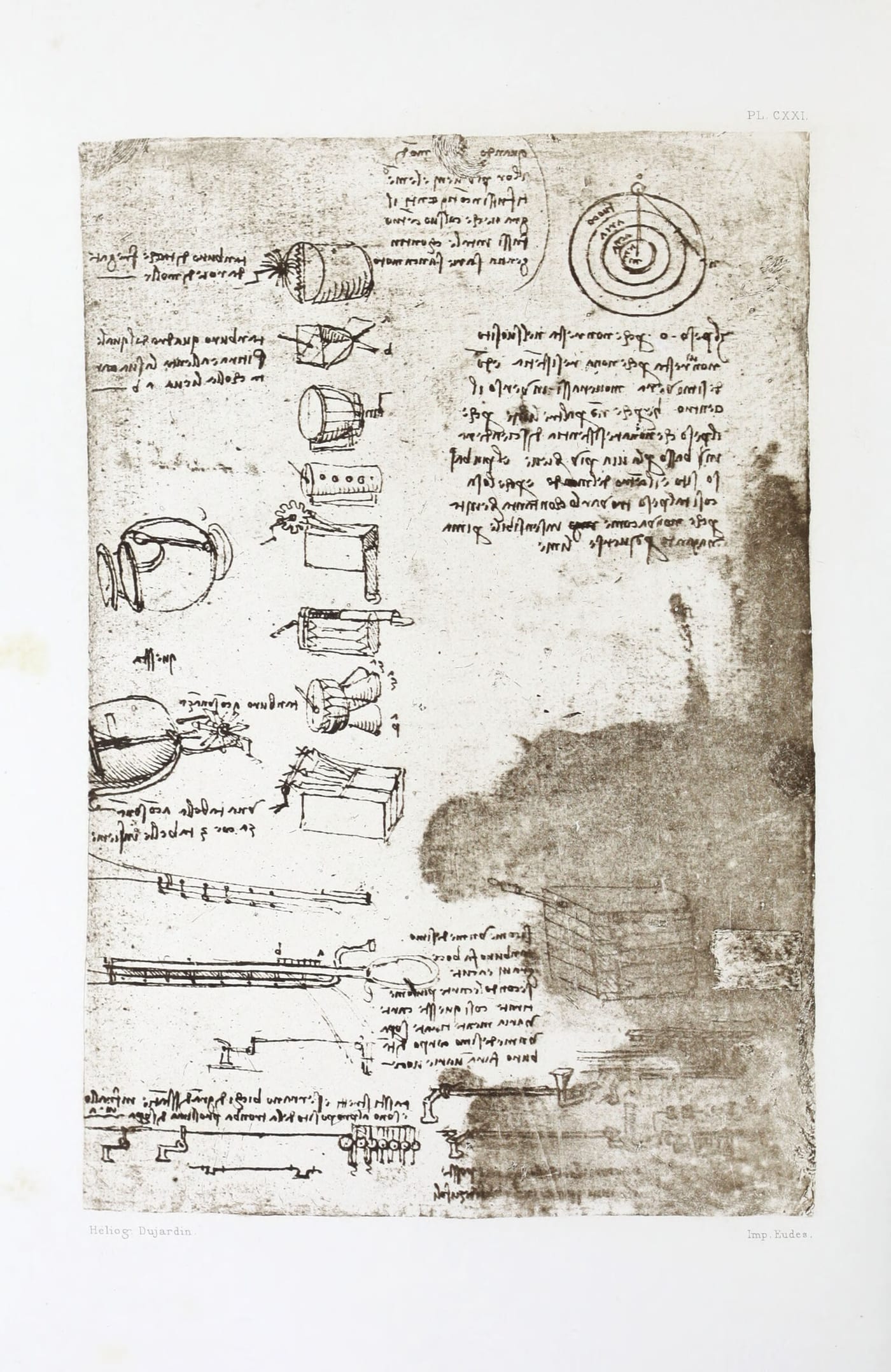
Br. M. 175a · Pl. CXXI
Let the earth turn on which side it may the surface of the waters will never move from its spherical form, but will always remain equidistant from the centre of the globe.
Granting that the earth might be removed from the centre of the globe, what would happen to the water?
It would remain in a sphere round that centre equally thick, but the sphere would have a smaller diameter than when it enclosed the earth.
F. 22b
Supposing the earth at our antipodes which supports the ocean were to rise and stand uncovered, far out of the sea, but remaining almost level, by what means afterwards, in the course of time, would mountains and vallies be formed?
And the rocks with their various strata?
F. 11b
Each man is always in the middle of the surface of the earth and under the zenith of his own hemisphere, and over the centre of the earth.
Tr. 28
Mem.: That I must first show the distance of the sun from the earth; and, by means of a ray passing through a small hole into a dark chamber, detect its real size; and besides this, by means of the aqueous sphere calculate the size of the globe ...
Here it will be shown, that when the sun is in the meridian of our hemisphere, the antipodes to the East and to the West, alike, and at the same time, see the sun mirrored in their waters; and the same is equally true of the arctic and antarctic poles, if indeed they are inhabited.
Leic. 1a
That the earth is a star.
C. A. 111b; 345b
In your discourse you must prove that the earth is a star much like the moon, and the glory of our universe; and then you must treat of the size of various stars, according to the authors.
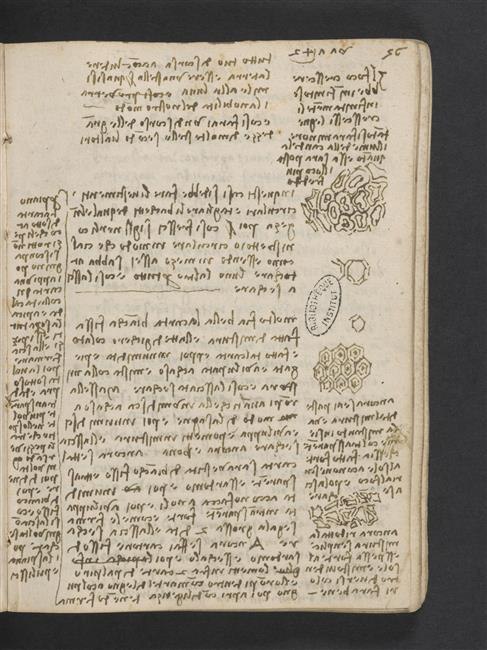
F. 56a
First describe the eye; then show how the twinkling of a star is really in the eye and why one star should twinkle more than another, and how the rays from the stars originate in the eye; and add, that if the twinkling of the stars were really in the stars —as it seems to be—that this twinkling appears to be an extension as great as the diameter of the body of the star; therefore, the star being larger than the earth, this motion effected in an instant would be a rapid doubling of the size of the star. Then prove that the surface of the air where it lies contiguous to fire, and the surface of the fire where it ends are those into which the solar rays penetrate, and transmit the images of the heavenly bodies, large when they rise, and small, when they are on the meridian. Let a be the earth and n d m the surface of the air in contact with the sphere of fire; h f g is the orbit of the moon or, if you please, of the sun; then I say that when the sun appears on the horizon g, its rays are seen passing through the surface of the air at a slanting angle, that is o m; this is not the case at d k. And so it passes through a greater mass of air; all of e m is a denser atmosphere.
F. 25b
Beyond the sun and us there is darkness and so the air appears blue.
W. XXVI
It is possible to find means by which the eye shall not see remote objects as much diminished as in natural perspective, which diminishes them by reason of the convexity of the eye which necessarily intersects, at its surface, the pyramid of every image conveyed to the eye at a right angle on its spherical surface. But by the method I here teach in the margin these pyramids are intersected at right angles close to the surface of the pupil. The convex pupil of the eye can take in the whole of our hemisphere, while this will show only a single star; but where many small stars transmit their images to the surface of the pupil those stars are extremely small; here only one star is seen but it will be large. And so the moon will be seen larger and its spots of a more defined form. You must place close to the eye a glass filled with the water of which mention is made in number 4 of Book 113 "On natural substances"; for this water makes objects which are enclosed in balls of crystalline glass appear free from the glass.
OF THE EYE.
Among the smaller objects presented to the pupil of the eye, that which is closest to it, will be least appreciable to the eye. And at the same time, the experiments here made with the power of sight, show that it is not reduced to speck if the &c..
Read in the margin.
Those objects are seen largest which come to the eye at the largest angles.
But the images of the objects conveyed to the pupil of the eye are distributed to the pupil exactly as they are distributed in the air: and the proof of this is in what follows; that when we look at the starry sky, without gazing more fixedly at one star than another, the sky appears all strewn with stars; and their proportions to the eye are the same as in the sky and likewise the spaces between them .
E. 15b
Among objects moved from the eye at equal distance, that undergoes least diminution which at first was most remote.
When various objects are removed at equal distances farther from their original position, that which was at first the farthest from the eye will diminish least. And the proportion of the diminution will be in proportion to the relative distance of the objects from the eye before they were removed.
That is to say in the object t and the object e the proportion of their distances from the eye a is quintuple. I remove each from its place and set it farther from the eye by one of the 5 parts into which the proposition is divided. Hence it happens that the nearest to the eye has doubled the distance and according to the last proposition but one of this, is diminished by the half of its whole size; and the body e, by the same motion, is diminished 1/5 of its whole size. Therefore, by that same last proposition but one, that which is said in this last proposition is true; and this I say of the motions of the celestial bodies which are more distant by 3500 miles when setting than when overhead, and yet do not increase or diminish in any sensible degree.
F. 60b
a b is the aperture through which the sun passes, and if you could measure the size of the solar rays at n m, you could accurately trace the real lines of the convergence of the solar rays, the mirror being at a b, and then show the reflected rays at equal angles to n m; but, as you want to have them at n m, take them at the. inner side of the aperture at cd, where they maybe measured at the spot where the solar rays fall. Then place your mirror at the distance a b, making the rays d b, c a fall and then be reflected at equal angles towards c d; and this is the best method, but you must use this mirror always in the same month, and the same day, and hour and instant, and this will be better than at no fixed time because when the sun is at a certain distance it produces a certain pyramid of rays.
Br. M. 174b
a, the side of the body in light and shade b, faces the whole portion of the hemisphere bed e f, and does not face any part of the darkness of the earth. And the same occurs at the point o; therefore the space a o is throughout of one and the same brightness, and s faces only four degrees of the hemisphere d e f g h, and also the whole of the earth s h, which will render it darker; and how much must be demonstrated by calculation.
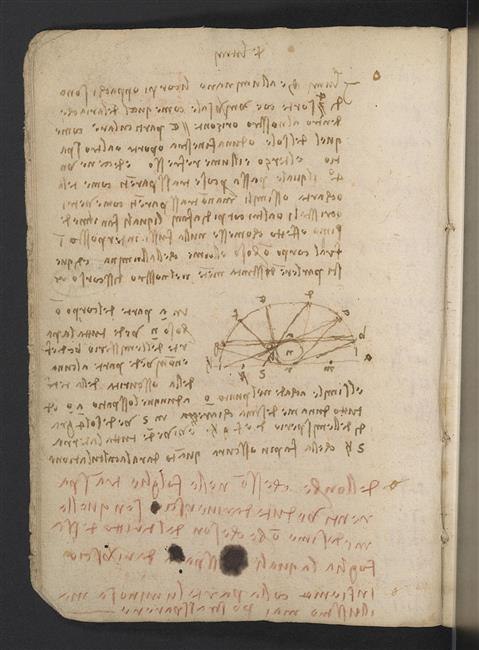
G. 3b
Some mathematicians explain that the sun looks larger as it sets, because the eye always sees it through a denser atmosphere, alleging that objects seen through mist or through water appear larger. To these I reply: No; because objects seen through a mist are similar in colour to those at a distance; but not being similarly diminished they appear larger. Again, nothing increases in size in smooth water; and the proof of this may be seen by throwing a light on a board placed half under water. But the reason why the sun looks larger is that every luminous body appears larger in proportion as it is more remote.
A. 64b
In the Treatise on Painting: chapter 320
In my book I propose to show, how the ocean and the other seas must, by means of the sun, make our world shine with the appearance of a moon, and to the remoter worlds it looks like a star; and this I shall prove.
Show, first that every light at a distance from the eye throws out rays which appear to increase the size of the luminous body; and from this it follows that 2 ....
The moon is cold and moist. Water is cold and moist. Thus our seas must appear to the moon as the moon does to us.
F. 94b
The waves in water magnify the image of an object reflected in it.
Let a be the sun, and n m the ruffled water, b the image of the sun when the water is smooth. Let f be the eye which sees the image in all the waves included within the base of the triangle c e f. Now the sun reflected in the unruffled surface occupied the space c d, while in the ruffled surface it covers all the watery space c e (as is proved in the 4th of my "Perspective") and it will cover more of the water in proportion as the reflected image is remote from the eye.
The image of the sun will be more brightly shown in small waves than in large ones—and this is because the reflections or images of the sun are more numerous in the small waves than in large ones, and the more numerous reflections of its radiance give a larger light than the fewer.
Waves which intersect like the scales of a fir cone reflect the image of the sun with the greatest splendour; and this is the case because the images are as many as the ridges of the waves on which the sun shines, and the shadows between these waves are small and not very dark; and the radiance of so many reflections together becomes united in the image which is transmitted to the eye, so that these shadows are imperceptible.
That reflection of the sun will cover most space on the surface of the water which is most remote from the eye which sees it.
Let a be the sun, p q the reflection of the sun; a b is the surface of the water, in which the sun is mirrored, and r the eye which sees this reflection on the surface of the water occupying the space o m. c is the eye at a greater distance from the surface of the water and also from the reflection; hence this reflection covers a larger space of water, by the distance between n and o.
Br. M. 25a
It is impossible that the side of a spherical mirror, illuminated by the sun, should reflect its radiance unless this mirror were undulating or filled with bubbles.
You see here the sun which lights up the moon, a spherical mirror, and all of its surface, which faces the sun is rendered radiant.
Whence it may be concluded that what shines in the moon is water like that of our seas, and in waves as that is; and that portion which does not shine consists of islands and terra firma.
This diagram, of several spherical bodies interposed between the eye and the sun, is given to show that, just as the reflection of the sun is seen in each of these bodies, in the same way that image may be seen in each curve of the waves of the sea; and as in these many spheres many reflections of the sun are seen, so in many waves there are many images, each of which at a great distance is much magnified to the eye. And, as this happens with each wave, the spaces interposed between the waves are concealed; and, for this reason, it looks as though the many suns mirrored in the many waves were but one continuous sun; and the shadows,, mixed up with the luminous images, render this radiance less brilliant than that of the sun mirrored in these waves.
Br. M. 28a
This will have before it the treatise on light and shade.
The edges in the moon will be most strongly lighted and reflect most light, because, there, nothing will be visible but the tops of the waves of the water.
F. 77b
The sun will appear larger in moving water or on waves than in still water; an example is the light reflected on the strings of a monochord.
W. X
If you look at the stars, cutting off the rays (as may be done by looking through a very small hole made with the extreme point of a very fine needle, placed so as almost to touch the eye), you will see those stars so minute that it would seem as though nothing could be smaller; it is in fact their great distance which is the reason of their diminution, for many of them are very many times larger than the star which is the earth with water. Now reflect what this our star must look like at such a distance, and then consider how many stars might be added—both in longitude and latitude—between those stars which are scattered over the darkened sky. But I cannot forbear to condemn many of the ancients, who said that the sun was no larger than it appears; among these was Epicurus, and I believe that he founded his reason on the effects of a light placed in our atmosphere equidistant from the centre of the earth. Any one looking at it never sees it diminished in size at whatever distance; and the rea-
F. 5a
sons of its size and power I shall reserve for Book 4. But I wonder greatly that Socrates should have depreciated that solar body, saying that it was of the nature of incandescent stone, and the one who opposed him as to that error was not far wrong. But I only wish I had words to serve me to blame those who are fain to extol the worship of men more than that of the sun; for in the whole universe there is nowhere to be seen a body of greater magnitude and power than the sun. Its light gives light to all the celestial bodies which are distributed throughout the universe; and from it descends all vital force, for the heat that is in living beings comes from the soul [vital spark]; and there is no other centre of heat and light in the universe as will be shown in Book 4; and certainly those who have chosen to worship men as gods—as Jove, Saturn, Mars and the like—have fallen into the gravest error, seeing that even if a man were as large as our earth, he would look no bigger than a little star which appears but as a speck in the universe; and seeing again that these men are mortal, and putrid and corrupt in their sepulchres.
Marcellus and many others praise the sun.
F. 4b
Epicurus perhaps saw the shadows cast by columns on the walls in front of them equal in diameter to the columns from which the shadows were cast; and the breadth of the shadows being parallel from beginning to end, he thought he might infer that the sun also was directly opposite to this parallel and that consequently its breadth was not greater than that of the column; not perceiving that the diminution in the shadow was insensibly slight by reason of the remoteness of the sun. If the sun were smaller than the earth, the stars on a great portion of our hemisphere would have no light, which is evidence against Epicurus who says the sun is only as large as it appears.
F. 6a
Epicurus says the sun is the size it looks. Hence as it looks about a foot across we must consider that to be its size; it would follow that when the moon eclipses the sun, the sun ought not to appear the larger, as it does. Then, the moon being smaller than the sun, the moon must be less than a foot, and consequently when our world eclipses the moon, it must be less than a foot by a finger's breadth; inasmuch as if the sun is a foot across, and our earth casts a conical shadow on the moon, it is inevitable that the luminous cause of the cone of shadow must be larger than the opaque body which casts the cone of shadow.
F. 8b
To measure how many times the diameter of the sun will go into its course in 24 hours.
Make a circle and place it to face the south, after the manner of a sundial, and place a rod in the middle in such a way as that its length points to the centre of this circle, and mark the shadow cast in the sunshine by this rod on the circumference of the circle, and this shadow will be—let us say— as broad as from a to n. Now measure how many times this shadow will go into this circumference of a circle, and that will give you the number of times that the solar body will go into its orbit in 24 hours. Thus you may see whether Epicurus was [right in] saying that the sun was only as large as it looked; for, as the apparent diameter of the sun is about a foot, and as that sun would go a thousand times into the length of its course in 24 hours, it would have gone a thousand feet, that is 300 braccia, which is the sixth of a mile. Whence it would follow that the course of the sun during the day would be the sixth part of a mile and that this venerable snail, the sun will have travelled 25 braccia an hour.
F. 10a
Posidonius composed books on the size of the sun.
F. o"
Of the nature of Sunlight.
That the heat of the sun resides in its nature and not in its virtue [or mode of action] is abundantly proved by the radiance of the solar body on which the human eye cannot dwell and besides this no less manifestly by the rays reflected from a concave mirror, which—when they strike the eye with such splendour that the eye cannot bear them—have a brilliancy equal to the sun in its own place. And that this is true I prove by the fact that if the mirror has its concavity formed exactly as is requisite for the collecting and reflecting of these rays, no created being could endure the heat that strikes from the reflected rays of such a mirror. And if you argue that the mirror itself is cold and yet send forth hot rays, I should reply that those rays come really from the sun and that it is the ray of the concave mirror after having passed through the window.
G. 34a
The sun does not move.
W. L. 132a
If it is from the centre that the sun employs its radiance to intensify the power of its whole mass, it is evident that the farther its rays extend, the more widely they will be divided; and this being so, you, whose eye is near the water that mirrors the sun, see but a small portion of the rays of the sun strike the surface of the water, and reflecting the form of the sun. But if you were near to the sun—as would be the case when the sun is on the meridian and the sea to the westward—you would see the sun, mirrored in the sea, of a very great size; because, as you are nearer to the sun, your eye taking in the rays nearer to the point of radiation takes more of them in, and a great splendour is the result. And in this way it can be proved that the moon must have seas which reflect the sun, and that the parts which do not shine are land.
Ash. I. 19a
Take the measure of the sun at the solstice in mid-June.
Br. M. 78b
Every object seen through a curved medium seems to be of larger size than it is.
A. 64a
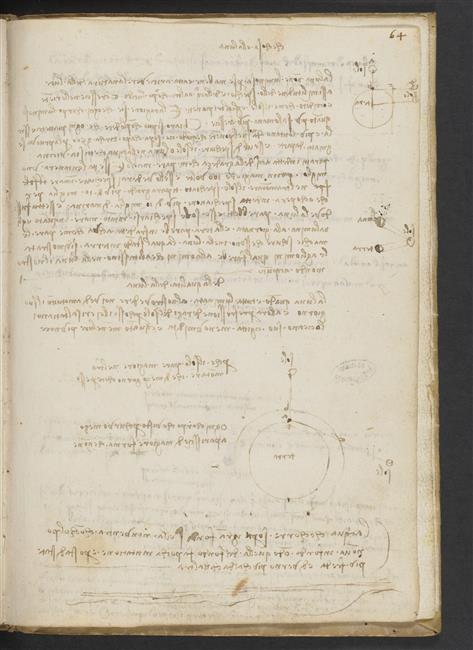
Because the eye is small it can only see the image of the sun as of a small size. If the eye were as large as the sun it would see the image of the sun in water of the same size as the real body of the sun, so long as the water is smooth.
C. A. 234a; 704a
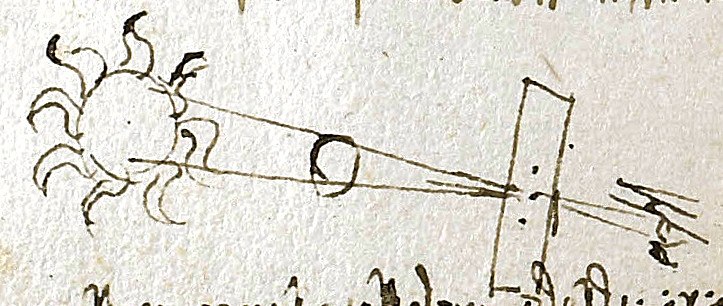
Take a piece of paper and pierce holes in it with a needle, and look at the sun through these holes.
T. 12
As I propose to treat of the nature of the moon, it is necessary that first I should describe the perspective of mirrors, whether plane, concave or convex; and first what is meant by a luminous ray, and how it is refracted by various kinds of media; then, when a reflected ray is most powerful, whether when the angle of incidence is acute, right, or obtuse, or from a convex, a plane, or a concave surface; or from an opaque or a transparent body. Besides this, how it is that the solar rays which fall on the waves of the sea, are seen by the eye of the same width at the angle nearest to the eye, as at the highest line of the waves on the horizon; but notwithstanding this the solar rays reflected from the waves of the sea assume the pyramidal form and consequently, at each degree of distance increase proportionally in size, although to our sight, they appear as parallel.
1st. Nothing that has very little weight is opaque.
2dly. Nothing that is excessively weighty can remain beneath that which is heavier.
3dly. As to whether the moon is situated in the centre of its elements or not.
And, if it has no proper place of its own, like the earth, in the midst of its elements, why does it not fall to the centre of our elements?
And, if the moon is not in the centre of its own elements and yet does not fall, it must then be lighter than any other element.
And, if the moon is lighter than the other elements why is it opaque and not transparent?
When objects of various sizes, being placed at various distances, look of equal size, there must be the same relative proportion in the distances as in the magnitudes of the objects.
Br. M. 94a
The image of the sun in the moon is powerfully luminous, and is only on a small portion of its surface. And the proof may be seen by taking a ball of burnished gold and placing it in the dark with a light at some distance from it; and then, although it will illuminate about half of the ball, the eye will perceive its reflection only in a small part of its surface, and all the rest of the surface reflects the darkness which surrounds it; so that it is only in that spot that the image of the light is seen, and all the rest remains invisible, the eye being at a distance from the ball. The same thing would happen on the surface of the moon if it were polished, lustrous and opaque, like all bodies with a reflecting surface.
Show how, if you were standing on the moon or on a star, our earth would seem to reflect the sun as the moon does.
And show that the image of the sun in the sea cannot appear one and undivided, as it appears in a perfectly plane mirror.
F. 93a
How shadows are lost at great distances, as is shown by the shadow side of the moon which is never seen.
Ash. I. 19a
Either the moon has intrinsic luminosity or not. If it has, why does it not shine without the aid of the sun? But if it has not any light in itself it must of necessity be a spherical mirror; and if it is a mirror, is it not proved in Perspective that the image of a luminous object will never be equal to the extent of surface of the reflecting body that it illuminates? And if it be thus, as is here shown at r s in the figure, whence comes so great an extent of radiance as that of the full moon as we see it, at the fifteenth day of the moon?
Br. M. 28a
The moon has no light in itself; but so much of it as faces the sun is illuminated, and of that illumined portion we see so much as faces the earth. And the moon's night receives just as much light as is lent it by our waters as they reflect the image of the sun, which is mirrored in all those waters which are on the side towards the sun. The outside or surface of the waters forming the seas of the moon and of the seas of our globe is always ruffled little or much, or more or less—and this roughness causes an extension of the numberless images of the sun which are repeated in the ridges and hollows, the sides and fronts of the innumerable waves; that is to say in as many different spots on each wave as our eyes find different positions to view them from. This could not happen, if the aqueous sphere which covers a great part of the moon were uniformly spherical, for then the images of the sun would be one to each spectator, and its reflections would be separate and independent and its radiance would always appear circular; as is plainly to be seen in the gilt balls placed on the tops of high buildings. But if those gilt balls were rugged or composed of several little balls, like mulberries, which are a black fruit composed of minute round globules, then each portion of these little balls, when seen in the sun, would display to the eye the lustre resulting from the reflection of the sun, and thus, in one and the same body many tiny suns would be seen; and these often combine at a long distance and appear as one. The lustre of the new moon is brighter and stronger, than when the moon is full; and the reason of this is that the angle of incidence is more obtuse in the new than in the full moon, in which the angles [of incidence and reflection] are highly acute. The waves of the moon therefore mirror the sun in the hollows of the waves as well as on the ridges, and the sides remain in shadow. But at the sides of the moon the hollows of the waves do not catch the sunlight, but only their crests; and thus the images are fewer and more mixed up with the shadows in the hollows; and this intermingling of the shaded and illuminated spots comes to the eye with a mitigated splendour, so that the edges will be darker, because the curves of the sides of the waves are insufficient to reflect to the eye the rays that fall upon them. Now the new moon naturally reflects the solar rays more directly towards the eye from the crests of the waves than from any other part, as is shown by the form of the moon, whose rays a strike the waves b and are reflected in the line b d, the eye being situated at d. This cannot happen at the full moon, when the solar rays, being in the west, fall on the extreme waters of the moon to the East from n to m, and are not reflected to the eye in the West, but are thrown back eastwards, with but slight deflection from the straight course of the solar ray; and thus the angle of incidence is very wide indeed.
The moon is an opaque and solid body and if, on the contrary, it were transparent, it would not receive the light of the sun.
The yellow or yolk of an egg remains in the middle of the albumen, without moving on either side; now it is either lighter or heavier than this albumen, or equal to it; if it is lighter, it ought to rise above all the albumen and stop in contact with the shell of the egg; and if it is heavier, it ought to sink, and if it is equal, it might just as well be at one of the ends, as in the middle or below .
The innumerable images of the solar rays reflected from the innumerable waves of the sea, as they fall upon those waves, are what cause us to see the very broad and continuous radiance on the surface of the sea.
Br. M. 94b
That the sun could not be mirrored in the body of the moon, which is a convex mirror, in such a way as that so much of its surface as is illuminated by the sun, should reflect the sun unless the moon had a surface adapted to reflect it—in waves and ridges, like the surface of the sea when its surface is moved by the wind.
The waves in water multiply the image of the object reflected in it.
These waves reflect light, each by its own line, as the surface of the fir cone does
These are 2 figures one different from the other; one with undulating water and the other with smooth water.
It is impossible that at any distance the image of the sun cast on the surface of a spherical body should occupy the half of the sphere.
Here you must prove that the earth produces all the same effects with regard to the moon, as the moon with regard to the earth.
The moon, with its reflected light, does not shine like the sun, because the light of the moon is not a continuous reflection of that of the sun on its whole surface, but only on the crests and hollows of the waves of its waters; and thus the sun being confusedly reflected, from the admixture of the shadows that lie between the lustrous waves, its light is not pure and clear as the sun is.
. The earth between the moon on the fifteenth day and the sun. Here the sun is in the East and the moon on the fifteenth day in the West. The moon on the fifteenth [day] between the earth and the sun. Here it is the moon which has the sun to the West and the earth to the East.
Br. M. 103a (his margin: Br. M. 104a)
The moon is not of itself luminous, but is highly fitted to assimilate the character of light after the manner of a mirror, or of water, or of any other reflecting body; and it grows larger in the East and in the West, like the sun and the other planets. And the reason is that every luminous body looks larger in proportion as it is remote. It is easy to understand that every planet and star is farther from us when in the West than when it is overhead, by about 3500 miles, as is proved on the margin, and if you see the sun or moon mirrored in the water near to you, it looks to you of the same size in the water as in the sky. But if you recede to the distance of a mile, it will look 100 times larger; and if you see the sun reflected in the sea at sunset, its image would look to you more than 10 miles long; because that reflected image extends over more than 10 miles of sea. And if you could stand where the moon is, the sun would look to you, as if it were reflected from all the sea that it illuminates by day; and the land amid the water would appear just like the dark spots that are on the moon, which, when looked at from our earth, appears to men the same as our earth would appear to any men who might dwell in the moon.
OF THE NATURE OF THE MOON.
When the moon is entirely lighted up to our sight, we see its full daylight; and at that time, owing to the reflection of the solar rays which fall on it and are thrown off towards us, its ocean casts off less moisture towards us; and the less light it gives the more injurious it is.
A. 64a
I say that as the moon has no light in itself and yet is luminous, it is inevitable but that its light is caused by some other body.
Leic. 30a
All my opponent's arguments to say that there is no water in the moon.
Leic. 36b
Answer to Maestro Andrea da Imola, who said that the solar rays reflected from a convex mirror are mingled and lost at a short distance; whereby it is altogether denied that the luminous side of the moon is of the nature of a mirror, and that consequently the light is not produced by the innumerable multitude of the waves of that sea, which I declared to be the portion of the moon which is illuminated by the solar rays.
Let o p be the body of the sun, c n s the moon, and b the eye which, above the base c n of the cathetus c n m, sees the body of the sun reflected at equal angles c n; and the same again on moving the eye from b to a.
Leic. 1b
No solid body is less heavy than the atmosphere.
Having proved that the part of the moon that shines consists of water, which mirrors the body of the sun and reflects the radiance it receives from it; and that, if these waters were devoid of waves, it would appear small, but of a radiance almost like the sun; —It must now be shown whether the moon is a heavy or a light body: for, if it were a heavy body—admitting that at every grade of distance from the earth greater levity must prevail, so that water is lighter than the earth, and air than water, and fire than air and so on successively—it would seem that if the moon had density as it really has, it would have weight, and having weight, that it could not be sustained in the space where it is, and consequently that it would fall towards the centre of the universe and become united to the earth; or if not the moon itself, at least its waters would fall away and be lost from it, and descend towards the centre, leaving the moon without any and so devoid of lustre. But as this does not happen, as might in reason be expected, it is a manifest sign that the moon is surrounded by its own elements: that is to say water, air and fire; and thus is, of itself and by itself, suspended in that part of space, as our earth with its element is in this part of space; and that heavy bodies act in the midst of its elements just as other heavy bodies do in ours
When the eye is in the East and sees the moon in the West near to the setting sun, it sees it with its shaded portion surrounded by luminous portions; and the lateral and upper portion of this light is derived from the sun, and the lower portion from the ocean in the West, which receives the solar rays and reflects them on the lower waters of the moon, and indeed affords the part of the moon that is in shadow as much radiance as the moon gives the earth at midnight. Therefore it is not totally dark, and hence some have believed that the moon must in parts have a light of its own besides that which is given it by the sun; and this light is due, as has been said, to the above-mentioned cause,—that our seas are illuminated by the sun.
Again, it might be said that the circle of radiance shown by the moon when it and the sun are both in the West is wholly borrowed from the sun, when it, and the sun, and the eye are situated as is shown above.
Some might say that the air surrounding the moon as an element, catches the light of the sun as our atmosphere does, and that it is this which completes the luminous circle on the body of the moon.
Some have thought that the moon has a light of its own, but this opinion is false, because they have founded it on that dim light seen between the hornes of the new moon, which looks dark where it is close to the bright part, while against the darkness of the background it looks so light that many have taken it to be a ring of new radiance completing the circle where the tips of the horns illuminated by the sun cease to shine. And this difference of background arises from the fact that the portion of that background which is conterminous with the bright part of the moon, by comparison with that brightness looks darker than it is; while at the upper part, where a portion of the luminous circle is to be seen of uniform width, the result is that the moon, being brighter there than the medium or background on which it is seen by comparison with that darkness it looks more luminous at that edge than it is. And that brightness at such a time itself is derived from our ocean and other inland-seas. These are, at that time, illuminated by the sun which is already setting in such a way as that the sea then fulfils the same function to the dark side of the moon as the moon at its fifteenth day does to us when the sun is set. And the small amount of light which the dark side of the moon receives bears the same proportion to the light of that side which is illuminated, as that....
If you want to see how much brighter the shaded portion of the moon is than the background on which it is seen, conceal the luminous portion of the moon with your hand or with some other more distant object.
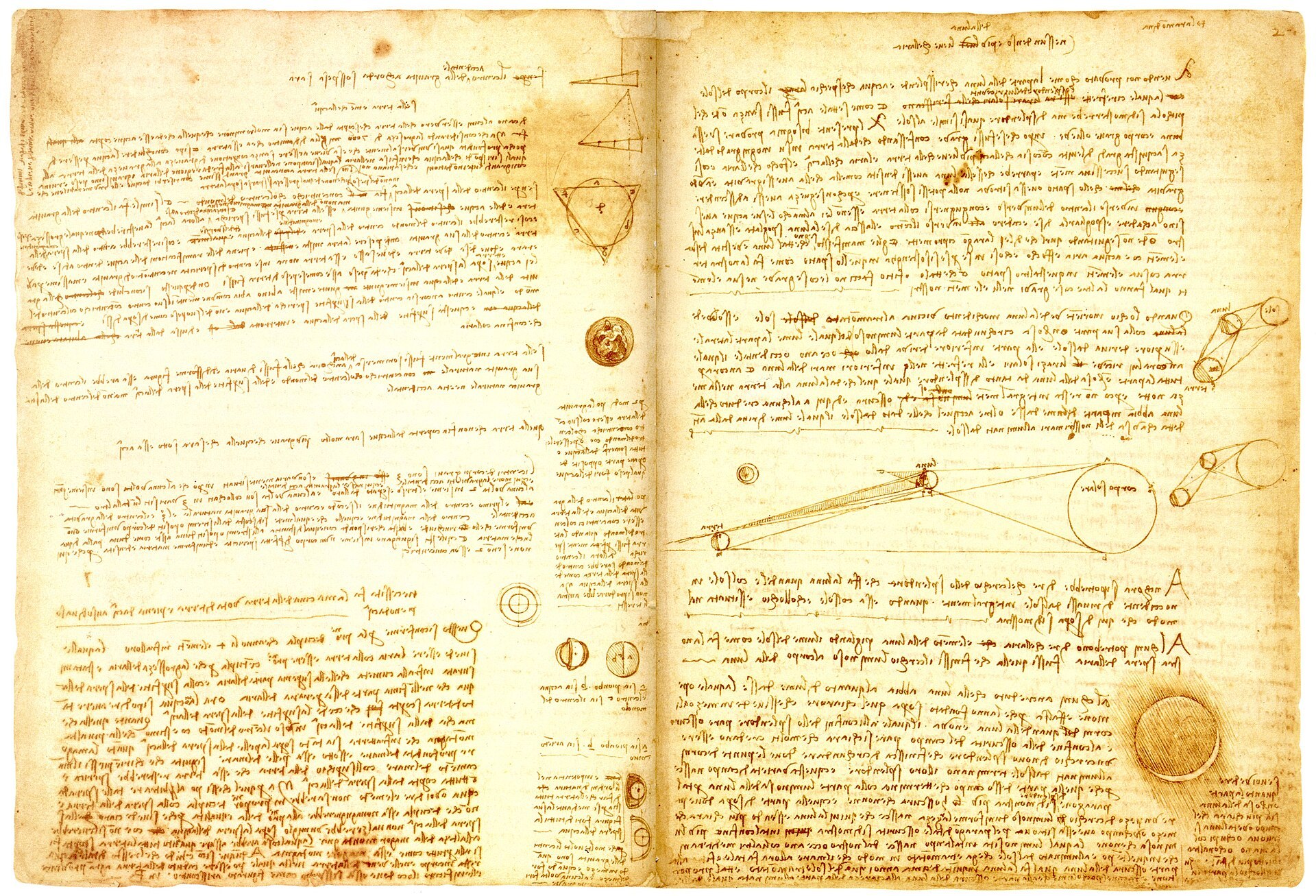
Leic. 2a · MS. C. A. 239b; 718b · Pl. CVIII, No. 5
See Plate CVIII, shown with § 809
Some have said that vapours rise from the moon, after the manner of clouds and are interposed between the moon and our eyes. But, if this were the case, these spots would never be permanent, either as to position or form; and, seeing the moon from various aspects, even if these spots did not move they would change in form, as objects do which are seen from different sides.
F. 84a
Others say that the moon is composed of more or less transparent parts; as though one part were something like alabaster and others like crystal or glass. It would follow from this that the sun casting its rays on the less transparent portions, the light would remain on the surface, and so the denser part would be illuminated, and the transparent portions would display the shadow of their darker depths; and this is their account of the structure and nature of the moon. And this opinion has found favour with many philosophers, and particularly with Aristotle, and yet it is a false view—for, in the various phases and frequent changes of the moon and sun to our eyes, we should see these spots vary, at one time looking dark and at another light: they would be dark when the sun is in the West and the moon in the middle of the sky; for then the transparent hollows would be in shadow as far as the tops of the edges of those transparent hollows, because the sun could not then fling his rays into the mouth of the hollows, which however, at full moon, would be seen in bright light, at which time the moon is in the East and faces the sun in the West; then the sun would illuminate even the lowest depths of these transparent places and thus, as there would be no shadows cast, the moon at these times would not show us the spots in question; and so it would be, now more and now less, according to the changes in the position of the sun to the moon, and of the moon to our eyes, as I have said above.
F. 84b
It has been asserted, that the spots on the moon result from the moon being of varying thinness or density; but if this were so, when there is an eclipse of the moon the solar rays would pierce through the portions which were thin as is alleged. But as we do not see this effect the opinion must be false.
Others say that the surface of the moon is smooth and polished and that, like a mirror, it reflects in itself the image of our earth. This view is also false, inasmuch as the land, where it is not covered with water, presents various aspects and forms. Hence when the moon is in the East it would reflect different spots from those it would show when it is above us or in the West; now the spots on the moon, as they are seen at full moon, never vary in the course of its motion over our hemisphere. A second reason is that an object reflected in a convex body takes up but a small portion of that body, as is proved in perspective. The third reason is that when the moon is full, it only faces half the hemisphere of the illuminated earth, on which only the ocean and other waters reflect bright light, while the land makes spots on that brightness; thus half of our earth would be seen girt round with the brightness of the sea lighted up by the sun, and in the moon this reflection would be the smallest part of that moon. Fourthly, a radiant body cannot be reflected from another equally radiant; therefore the sea, since it borrows its brightness from the sun,—as the moon does—, could not cause the earth to be reflected in it, nor indeed could the body of the sun be seen reflected in it, nor indeed any star opposite to it.
F. 85a
If you keep the details of the spots of the moon under observation you will often find great variation in them, and this I myself have proved by drawing them. And this is caused by the clouds that rise from the waters in the moon, which come between the sun and those waters, and by their shadow deprive these waters of the sun's rays. Thus those waters remain dark, not being able to reflect the solar body.
Br. M. 19a
How the spots on the moon must have varied from what they formerly were, by reason of the course of its waters.
Leic. 5a
I have found, that the circles which at night seem to surround the moon, of various sizes, and degrees of density are caused by various gradations in the densities of the vapours which exist at different altitudes between the moon and our eyes. And of these halos the largest and least red is caused by the lowest of these vapours; the second, smaller one, is higher up, and looks redder because it is seen through two vapours. And so on, as they are higher they will appear smaller and redder, because, between the eye and them, there is thicker vapour. Whence it is proved that where they are seen to be reddest, the vapours are most dense.
C. A. 341b; 1055a
If you want to prove why the moon appears larger than it is, when it reaches the horizon; take a lens which is highly convex on one surface and concave on the opposite, and place the concave side next the eye, and look at the object beyond the convex surface; by this means you will have produced an exact imitation of the atmosphere included beneath the sphere of fire and outside that of water; for this atmosphere is concave on the side next the earth, and convex towards the fire.
W. XXVII
Construct glasses to see the moon magnified.
C. A. 187a; 561a
The stars are visible by night and not by day, because we are beneath the dense atmosphere, which is full of innumerable particles of moisture, each of which independently, when the rays of the sun fall upon it, reflects a radiance, and so these numberless bright particles conceal the stars; and if it were not for this atmosphere the sky would always display the stars against its darkness.
F. 5b
Some say that they shine of themselves, alledging that if Venus and Mercury had not a light of their own, when they come between our eye and the sun they would darken so much of the sun as they could cover from our eye. But this is false, for it is proved that a dark object against a luminous body is enveloped and entirely concealed by the lateral rays of the rest of that luminous body and so remains invisible. As may be seen when the sun is seen through the boughs of trees bare of their leaves, at some distance the branches do not conceal any portion of the sun from our eye. The same thing happens with the above mentioned planets which, though they have no light of their own, do not—as has been said—conceal any part of the sun from our eye .
SECOND ARGUMENT.
Some say that the stars appear most brilliant at night in proportion as they are higher up; and that if they had no light of their own, the shadow of the earth which comes between them and the sun, would darken them, since they would not face nor be faced by the solar body. But those persons have not considered that the conical shadow of the earth cannot reach many of the stars; and even as to those it does reach, the cone is so much diminished that it covers very little of the star's mass, and all the rest is illuminated by the sun.
F. 57a
Why the planets appear larger in the East than they do overhead, whereas the contrary should be the case, as they are 3500 miles nearer to us when in mid sky than when on the horizon.
All the degrees of the elements, through which the images of the celestial bodies pass to reach the eye, are equal curves and the angles by which the central line of those images passes through them, are unequal angles; and the distance is greater, as is shown by the excess of a b beyond a d; and the enlargement of these celestial bodies on the horizon is shown by the 9th of the 7th.
F. 60a
To see the real nature of the planets open the covering and note at the base one single planet, and the reflected movement of this base will show the nature of the said planet; but arrange that the base may face only one at the time.
Br. M. 279b
Cicero says in [his book] De Divinatione that Astrology has been practised five hundred seventy thousand years before the Trojan war.
57000.
E. o'
Although time is included in the class of Continuous Quantities, being indivisible and immaterial, it does not come entirely under the head of Geometry, which represents its divisions by means of figures and bodies of infinite variety, such as are seen to be continuous in their visible and material properties. But only with its first principles does it agree, that is with the Point and the Line; the point may be compared to an instant of time, and the line may be likened to the length of a certain quantity of time, and just as a line begins and terminates in a point, so such a space of time. begins and terminates in an instant. And whereas a line is infinitely divisible, the divisibility of a space of time is of the same nature; and as the divisions of the line may bear a certain proportion to each other, so may the divisions of time.
Br. M. 173b and 190b
Describe the nature of Time as distinguished from the Geometrical definitions.
Br. M. 176a
Divide an hour into 3000 parts, and this you can do with a clock by making the pendulum lighter or heavier.
Br. M. 191a


