The Notebooks of Leonardo da Vinci · translated by Jean Paul Richter · § 222 to 262 · public domain · plain text
Nothing in this part mentions that.
Richter’s introduction to this part
The theory of the "Prospettiva de' perdimenti" would, in many important details, be quite unintelligible if it had not been led up by the principles of light and shade on which it is based. The word "Prospettiva" in the language of the time included the principles of optics; what Leonardo understood by "Perdimenti" will be clearly seen in the early chapters, Nos. 222–224. It is in the very nature of the case that the farther explanations given in the subsequent chapters must be limited to general rules. The sections given as 227–231 "On indistinctness at short distances" have, it is true, only an indirect bearing on the subject; but on the other hand, the following chapters, 232–234, "On indistinctness at great distances," go fully into the matter, and in chapters 235–239, which treat "Of the importance of light and shade in the Perspective of Disappearance", the practical issues are distinctly insisted on in their relation to the theory. This is naturally followed by the statements as to "the effect of light or dark backgrounds on the apparent size of bodies" (Nos. 240–250). At the end I have placed, in the order of the original, those sections from the MS. C which treat of the "Perspective of Disappearance" and serve to some extent to complete the treatment of the subject (251–262).
Of the Diminished Distinctness of the Outlines of Opaque Bodies
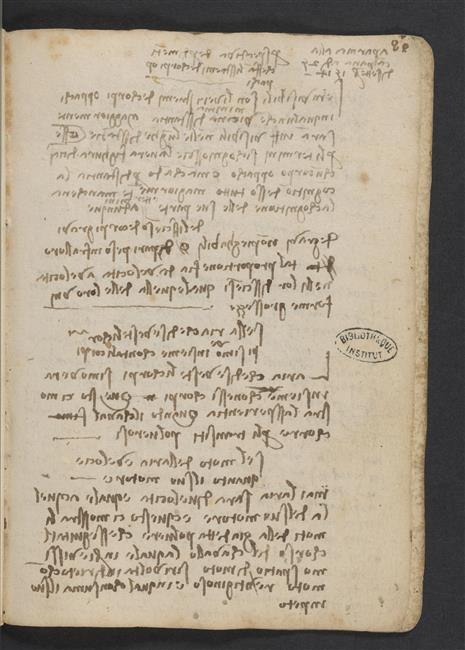
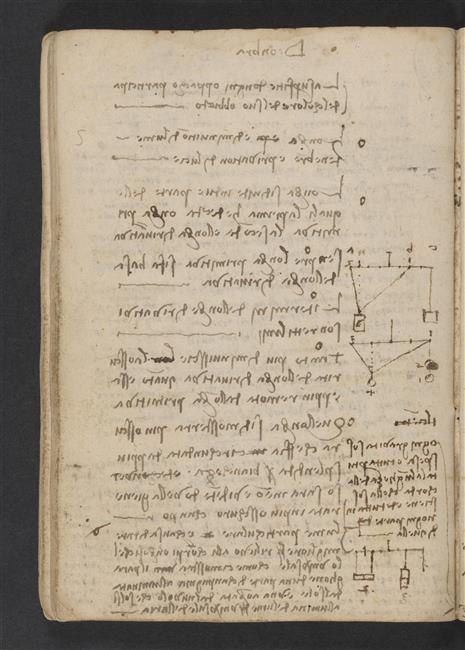
If the real outlines of opaque bodies are indistinguishable at even a very short distance, they will be more so at long distances; and, since it is by its outlines that we are able to know the real form of any opaque body, when by its remoteness we fail to discern it as a whole, much more must we fail to discern its parts and outlines.
Manuscript page cited by Richter for this passage: Leonardo, Paris Manuscript E, f. 80r, Bibliothèque de l'Institut de France Source
Of the Diminution in Perspective of Opaque Objects
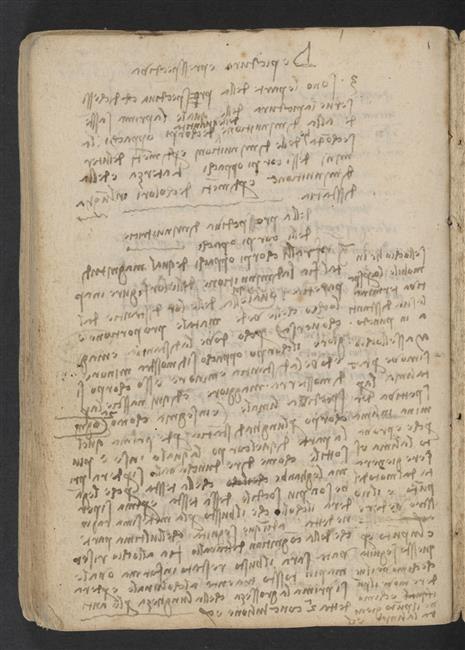
Among opaque objects of equal size the apparent diminution of size will be in proportion to their distance from the eye of the spectator; but it is an inverse proportion, since, where the distance is greater, the opaque body will appear smaller, and the less the distance the larger will the object appear. And this is the fundamental principle of linear perspective and it follows:—every object as it becomes more remote loses first those parts which are smallest. Thus of a horse, we should lose the legs before the head, because the legs are thinner than the head; and the neck before the body for the same reason. Hence it follows that the last part of the horse which would be discernible by the eye would be the mass of the body in an oval form, or rather in a cylindrical form and this would lose its apparent thickness before its length—according to the 2nd rule given above, &c..
If the eye remains stationary the perspective terminates in the distance in a point. But if the eye moves in a straight [horizontal] line the perspective terminates in a line and the reason is that this line is generated by the motion of the point and our sight; therefore it follows that as we move our sight [eye], the point moves, and as we move the point, the line is generated, &c.
Manuscript page cited by Richter for this passage: Leonardo, Paris Manuscript E, f. 80v, Bibliothèque de l'Institut de France Source
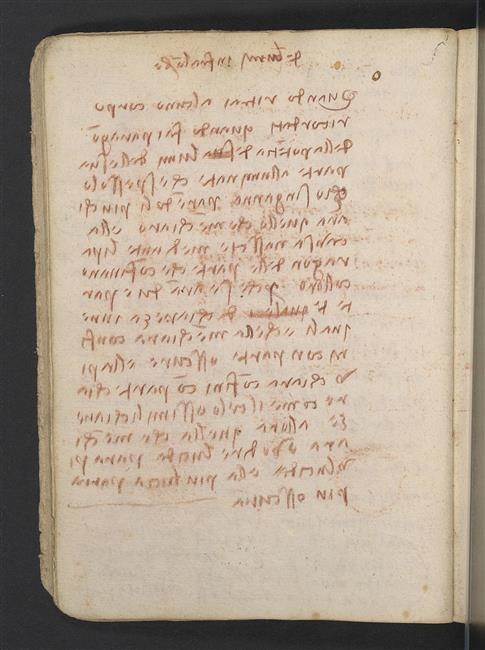
Every visible body, in so far as it affects the eye, includes three attributes; that is to say: mass, form and colour; and the mass is recognisable at a greater distance from the place of its actual existence than either colour or form. Again, colour is discernible at a greater distance than form, but this law does not apply to luminous bodies.
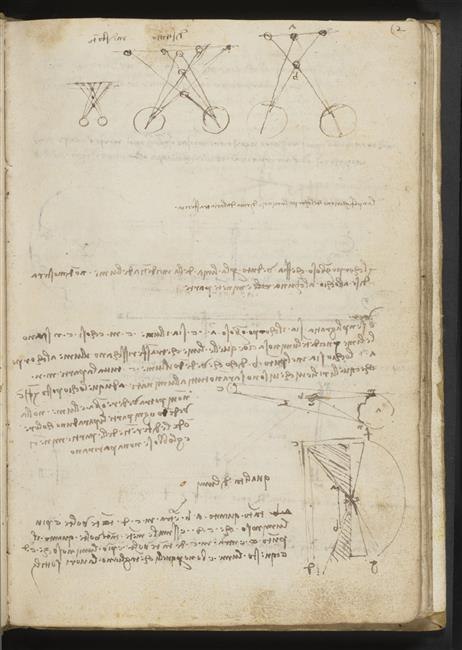
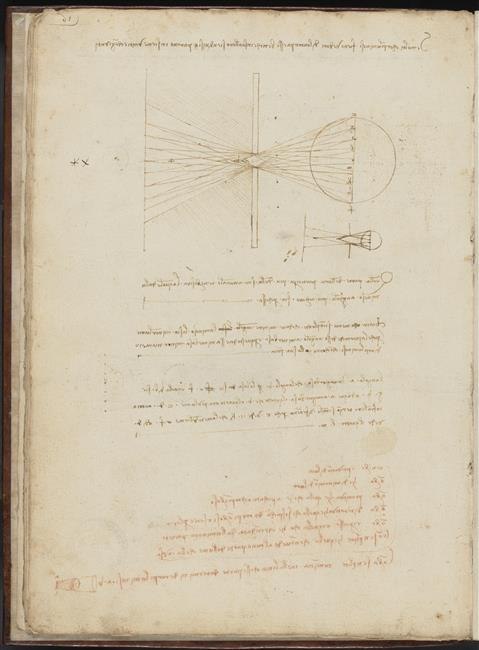
The above proposition is plainly shown and proved by experiment; because: if you see a man close to you, you discern the exact appearance of the mass and of the form and also of the colouring; if he goes to some distance you will not recognise who he is, because the character of the details will disappear, if he goes still farther you will not be able to distinguish his colouring, but he will appear as a dark object, and still farther he will appear as a very small dark rounded object. It appears rounded because distance so greatly diminishes the various details that nothing remains visible but the larger mass. And the reason is this: We know very well that all the images of objects reach the senses by a small aperture in the eye; hence, if the whole horizon a d is admitted through such an aperture, the object b c being but a very small fraction of this horizon what space can it fill in that minute image of so vast a hemisphere? And because luminous bodies have more power in darkness than any others, it is evident that, as the chamber of the eye is very dark, as is the nature of all colored cavities, the images of distant objects are confused and lost in the great light of the sky; and if they are visible at all, appear dark and black, as every small body must when seen in the diffused light of the atmosphere.
Of the Atmosphere That Interposes Between the Eye and Visible Objects
An object will appear more or less distinct at the same distance, in proportion as the atmosphere existing between the eye and that object is more or less clear. Hence, as I know that the greater or less quantity of the air that lies between the eye and the object makes the outlines of that object more or less indistinct, you must diminish the definiteness of outline of those objects in proportion to their increasing distance from the eye of the spectator.
When I was once in a place on the sea, at an equal distance from the shore and the mountains, the distance from the shore looked much greater than that from the mountains.
If you place an opaque object in front of your eye at a distance of four fingers' breadth, if it is smaller than the space between the two eyes it will not interfere with your seeing any thing that may be beyond it. No object situated beyond another object seen by the eye can be concealed by this [nearer] object if it is smaller than the space from eye to eye.
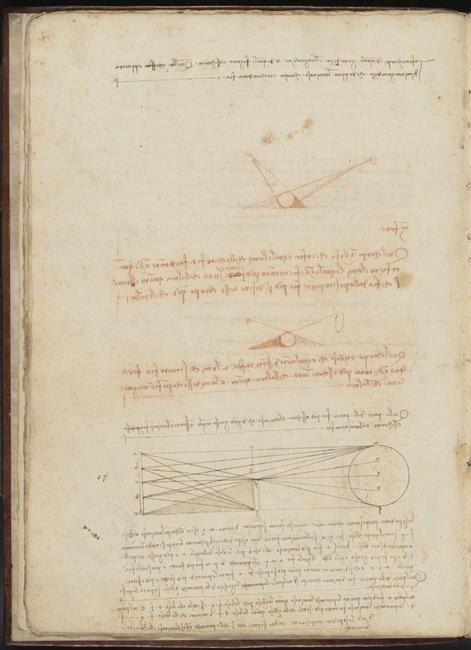
That part of a surface will be better lighted on which the light falls at the greater angle. And that part, on which the shadow falls at the greatest angle, will receive from those rays least of the benefit of the light.
Manuscript page cited by Richter for this passage: Leonardo, Paris Manuscript C, f. 12r, Bibliothèque de l'Institut de France Source
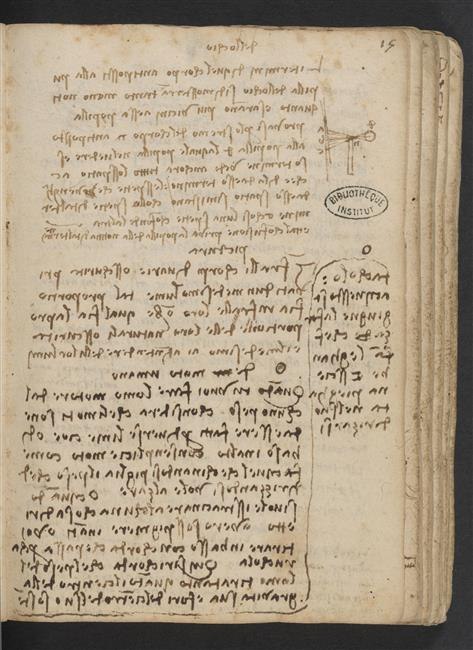
The edges of an object placed in front of the pupil of the eye will be less distinct in proportion as they are closer to the eye. This is shown by the edge of the object n placed in front of the pupil d; in looking at this edge the pupil also sees all the space a c which is beyond the edge; and the images the eye receives from that space are mingled with the images of the edge, so that one image confuses the other, and this confusion hinders the pupil from distinguishing the edge.
Manuscript page cited by Richter for this passage: Leonardo, Paris Manuscript E, f. 15r, Bibliothèque de l'Institut de France Source
The outlines of objects will be least clear when they are nearest to the eye, and therefore remoter outlines will be clearer. Among objects which are smaller than the pupil of the eye those will be less distinct which are nearer to the eye.
Why objects seen at a distance appear large to the eye and in the image on the vertical plane they appear small.
PERSPECTIVE.
I ask how far away the eye can discern a non-luminous body, as, for instance, a mountain. It will be very plainly visible if the sun is behind it; and could be seen at a greater or less distance according to the sun's place in the sky.
Manuscript page cited by Richter for this passage: Leonardo, Paris Manuscript A, f. 8v, Bibliothèque de l'Institut de France Source
A. 8b
The importance of light and shade in the perspective of disappearance (235-239)
An opaque body seen in a line in which the light falls will reveal no prominences to the eye. For instance, let a be the solid body and c the light; c m and c n will be the lines of incidence of the light, that is to say the lines which transmit the light to the object a. The eye being at the point b, I say that since the light c falls on the whole part m n the portions in relief on that side will all be illuminated. Hence the eye placed at c cannot see any light and shade and, not seeing it, every portion will appear of the same tone, therefore the relief in the prominent or rounded parts will not be visible.
Manuscript page cited by Richter for this passage: Leonardo, Paris Manuscript A, f. 2r, Bibliothèque de l'Institut de France Source
When you represent in your work shadows which you can only discern with difficulty, and of which you cannot distinguish the edges so that you apprehend them confusedly, you must not make them sharp or definite lest your work should have a wooden effect.
Ash. I. 21a
In the Treatise on Painting: chapter 189 (the same passage)
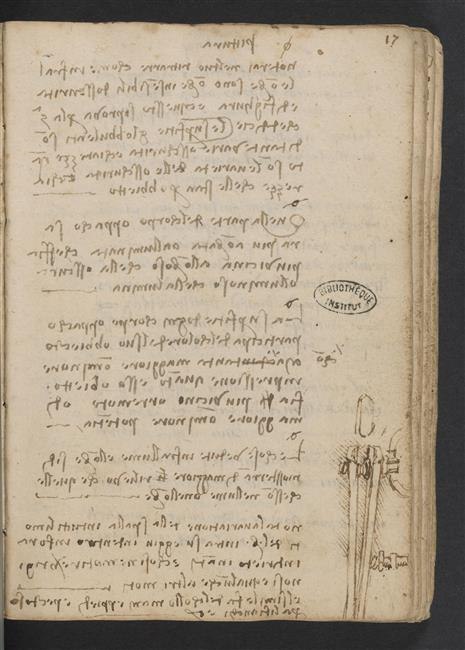
You will observe in drawing that among the shadows some are of undistinguishable gradation and form, as is shown in the 3rd [proposition] which says: Rounded surfaces display as many degrees of light and shade as there are varieties of brightness and darkness reflected from the surrounding objects.
Manuscript page cited by Richter for this passage: Leonardo, Paris Manuscript E, f. 17r, Bibliothèque de l'Institut de France Source
E. 17a
In the Treatise on Painting: chapter 188 (the same passage)
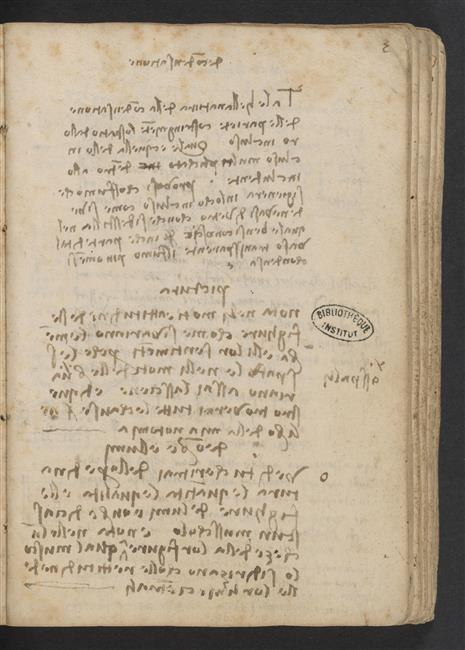
You who draw from nature, look (carefully) at the extent, the degree, and the form of the lights and shadows on each muscle; and in their position lengthwise observe towards which muscle the axis of the central line is directed.
Manuscript page cited by Richter for this passage: Leonardo, Paris Manuscript E, f. 3r, Bibliothèque de l'Institut de France Source
An object which is [so brilliantly illuminated as to be] almost as bright as light will be visible at a greater distance, and of larger apparent size than is natural to objects so remote.
Ash. I. 25b
The effect of light or dark backgrounds on the apparent size of objects (240-250)
A shadow will appear dark in proportion to the brilliancy of the light surrounding it and conversely it will be less conspicuous where it is seen against a darker background.
Manuscript page cited by Richter for this passage: Leonardo, Paris Manuscript E, f. 32v, Bibliothèque de l'Institut de France Source
An object of equal breadth and colour throughout, seen against a background of various colours will appear unequal in breadth.
And if an object of equal breadth throughout, but of various colours, is seen against a background of uniform colour, that object will appear of various breadth. And the more the colours of the background or of the object seen against the ground vary, the greater will the apparent variations in the breadth be though the objects seen against the ground be of equal breadth [throughout].
A luminous body when obscured by a dense atmosphere will appear smaller; as may be seen by the moon or sun veiled by mists.
OF LIGHT.
Of several luminous bodies of equal size and brilliancy and at an equal distance, that will look the largest which is surrounded by the darkest background.
OF LIGHT.
I find that any luminous body when seen through a dense and thick mist diminishes in proportion to its distance from the eye. Thus it is with the sun by day, as well as the moon and the other eternal lights by night. And when the air is clear, these luminaries appear larger in proportion as they are farther from the eye.
That portion of a body of uniform breadth which is against a lighter background will look narrower [than the rest].
e is a given object, itself dark and of uniform breadth; a b and c d are two backgrounds one darker than the other; b c is a bright background, as it might be a spot lighted by the sun through an aperture in a dark room. Then I say that the object e g will appear larger at e f than at g h; because e f has a darker background than g h; and again at f g it will look narrower from being seen by the eye o, on the light background b c. That part of a luminous body, of equal breadth and brilliancy throughout, will look largest which is seen against the darkest background; and the luminous body will seem on fire.
Why Bodies in Light and Shade Have Their Outlines Altered by the Colour and Brightness of the Objects Serving As a Background to Them
If you look at a body of which the illuminated portion lies and ends against a dark background, that part of the light which will look brightest will be that which lies against the dark [background] at d. But if this brighter part lies against a light background, the edge of the object, which is itself light, will be less distinct than before, and the highest light will appear to be between the limit of the background m f and the shadow. The same thing is seen with regard to the dark [side], inasmuch as that edge of the shaded portion of the object which lies against a light background, as at l, it looks much darker than the rest. But if this shadow lies against a dark background, the edge of the shaded part will appear lighter than before, and the deepest shade will appear between the edge and the light at the point o.
An opaque body will appear smaller when it is surrounded by a highly luminous background, and a light body will appear larger when it is seen against a darker background. This may be seen in the height of buildings at night, when lightning flashes behind them; it suddenly seems, when it lightens, as though the height of the building were diminished. For the same reason such buildings look larger in a mist, or by night than when the atmosphere is clear and light.
When you are drawing any object, remember, in comparing the grades of light in the illuminated portions, that the eye is often deceived by seeing things lighter than they are. And the reason lies in our comparing those parts with the contiguous parts. Since if two [separate] parts are in different grades of light and if the less bright is conterminous with a dark portion and the brighter is conterminous with a light background—as the sky or something equally bright—, then that which is less light, or I should say less radiant, will look the brighter and the brighter will seem the darker.
Manuscript page cited by Richter for this passage: Leonardo, Paris Manuscript G, f. 12v, Bibliothèque de l'Institut de France Source
To Prove How It Is That Luminous Bodies Appear Larger, at a Distance, Than They Are
If you place two lighted candles side by side half a braccio apart, and go from them to a distance 200 braccia you will see that by the increased size of each they will appear as a single luminous body with the light of the two flames, one braccio wide.
TO PROVE HOW YOU MAY SEE THE REAL SIZE OF LUMINOUS BODIES.
If you wish to see the real size of these luminous bodies, take a very thin board and make in it a hole no bigger than the tag of a lace and place it as close to your eye as possible, so that when you look through this hole, at the said light, you can see a large space of air round it. Then by rapidly moving this board backwards and forwards before your eye you will see the light increase [and diminish].
Manuscript page cited by Richter for this passage: Leonardo, Paris Manuscript A, f. 64v, Bibliothèque de l'Institut de France Source
A. 64b
Propositions on perspective of disappearance from MS. C. (250-262)
Of several bodies of equal size and equally distant from the eye, those will look the smallest which are against the lightest background.
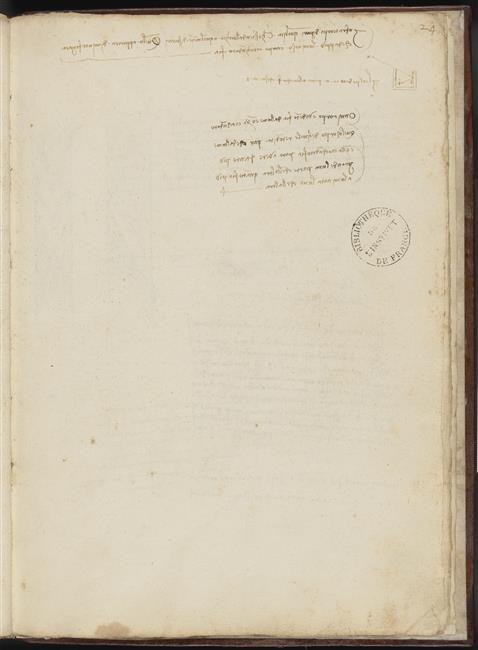
Every visible object must be surrounded by light and shade. A perfectly spherical body surrounded by light and shade will appear to have one side larger than the other in proportion as one is more highly lighted than the other.
Manuscript page cited by Richter for this passage: Leonardo, Paris Manuscript C, f. 24r, Bibliothèque de l'Institut de France Source
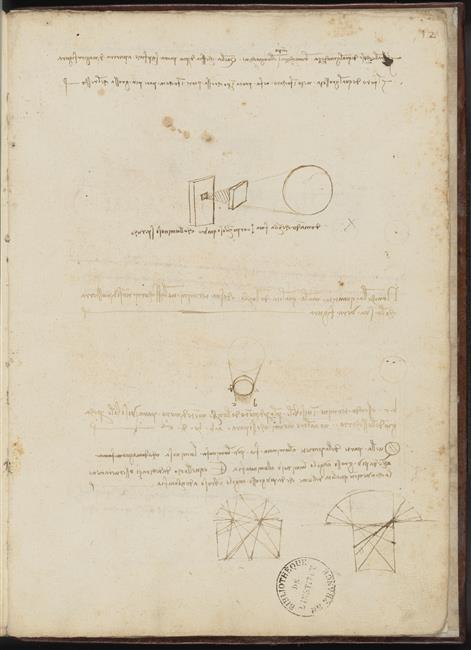
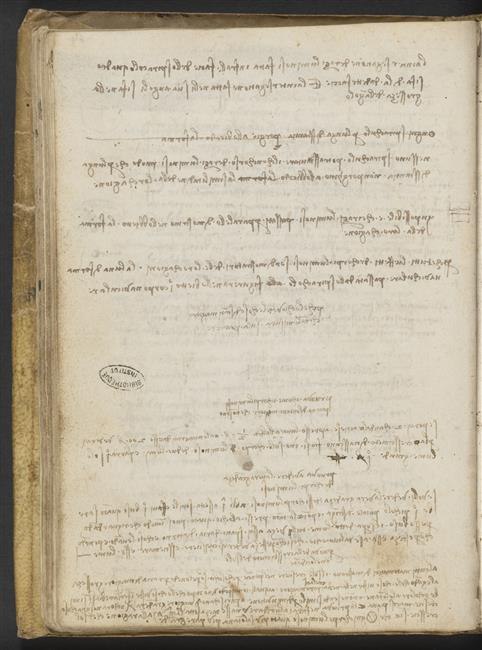
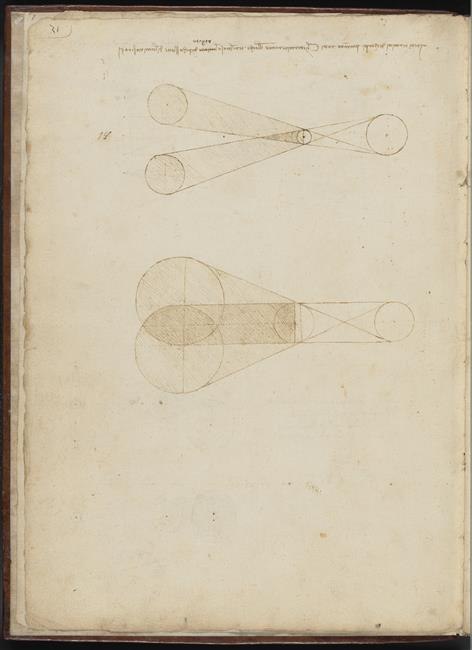
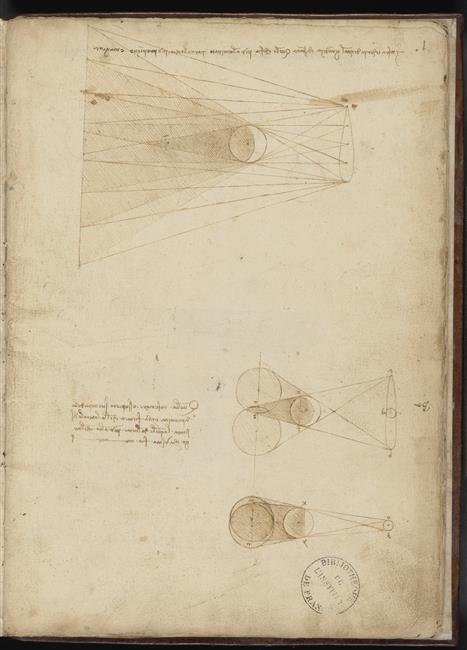
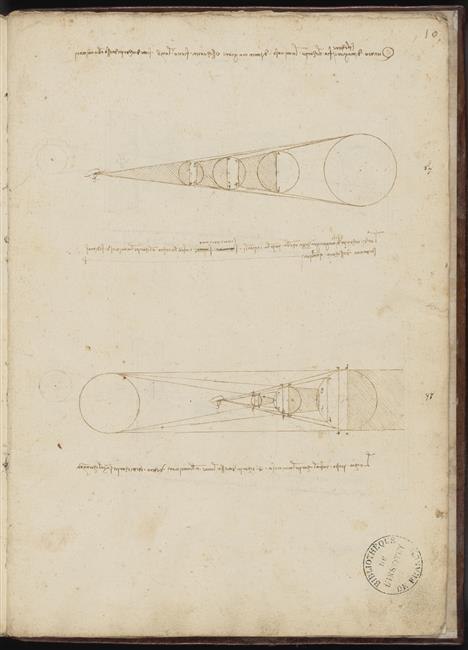
No visible object can be well understood and comprehended by the human eye excepting from the difference of the background against which the edges of the object terminate and by which they are bounded, and no object will appear [to stand out] separate from that background so far as the outlines of its borders are concerned. The moon, though it is at a great distance from the sun, when, in an eclipse, it comes between our eyes and the sun, appears to the eyes of men to be close to the sun and affixed to it, because the sun is then the background to the moon.
Manuscript page cited by Richter for this passage: Leonardo, Paris Manuscript C, f. 23r, Bibliothèque de l'Institut de France Source
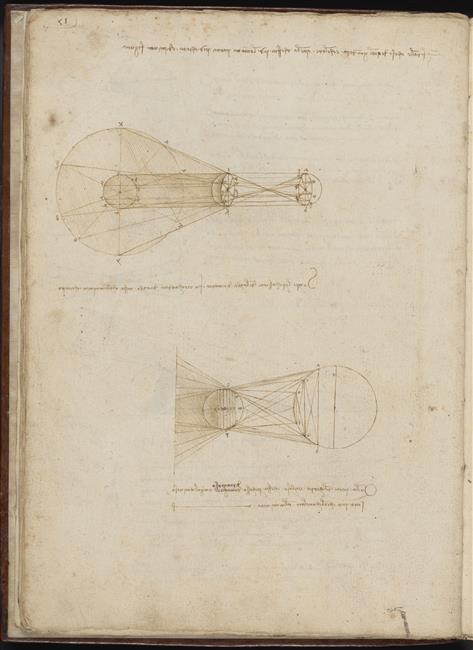
Of several objects equal in size, brightness of background and length that which has the flattest surface will look the largest. A bar of iron equally thick throughout and of which half is red hot, affords an example, for the red hot part looks thicker than the rest.
Manuscript page cited by Richter for this passage: Leonardo, Paris Manuscript C, f. 12r, Bibliothèque de l'Institut de France Source
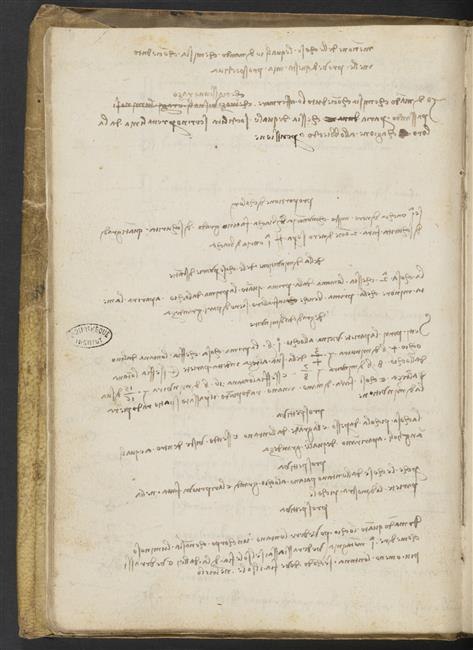
Of several bodies of equal size and length, and alike in form and in depth of shade, that will appear smallest which is surrounded by the most luminous background.
Manuscript page cited by Richter for this passage: Leonardo, Paris Manuscript C, f. 8v, Bibliothèque de l'Institut de France Source
Different Portions of a Wall Surface Will Be Darker or Brighter in Proportion As the Light or Shadow Falls on Them at a Larger Angle
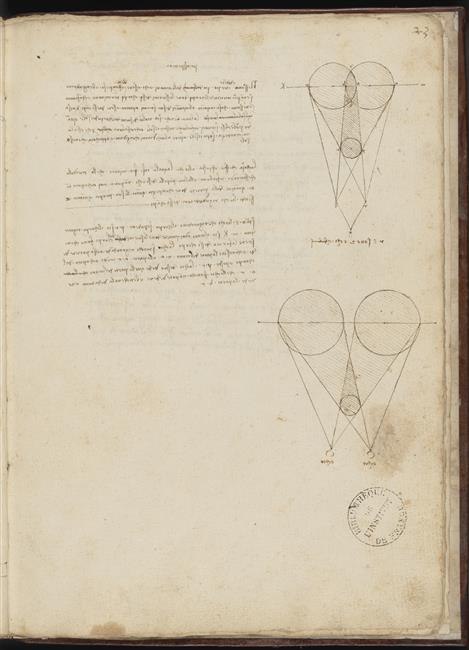
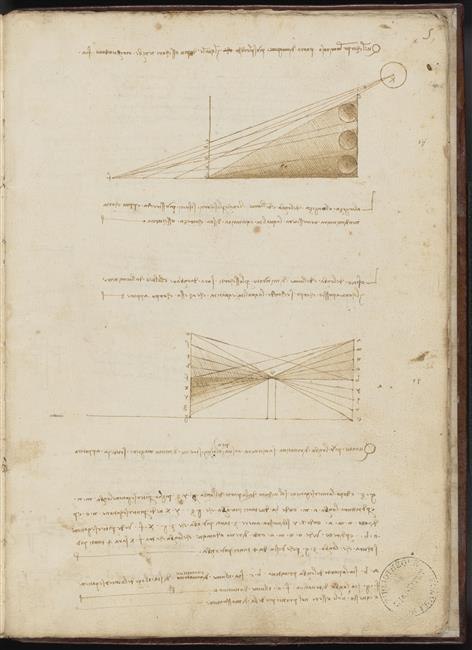
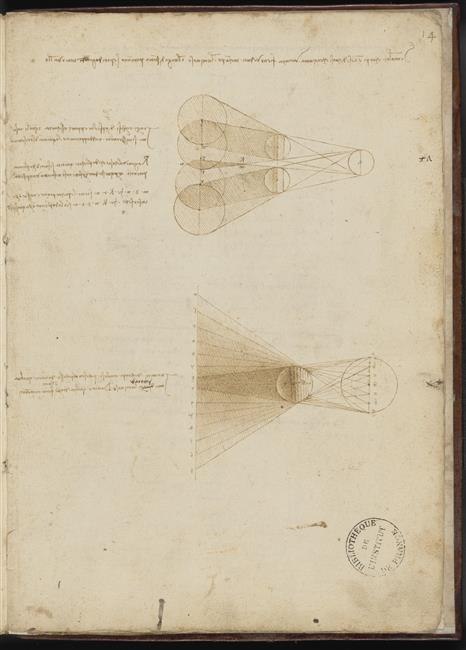
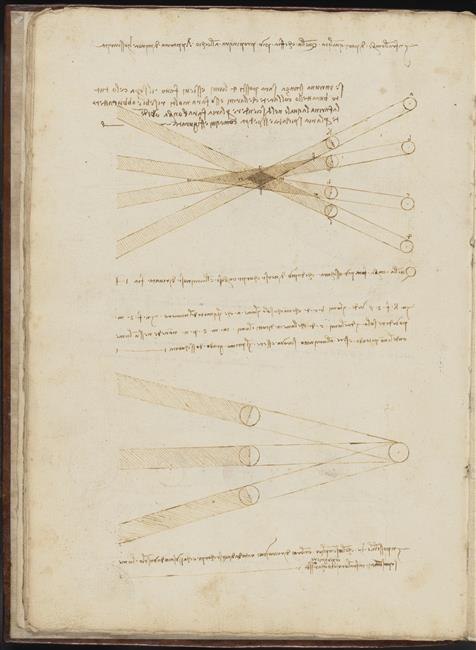
The foregoing proposition can be clearly proved in this way. Let us say that m q is the luminous body, then f g will be the opaque body; and let a e be the above-mentioned plane on which the said angles fall, showing [plainly] the nature and character of their bases. Then: a will be more luminous than b; the base of the angle a is larger than that of b and it therefore makes a greater angle which will be a m q; and the pyramid b p m will be narrower and m o c will be still finer, and so on by degrees, in proportion as they are nearer to e, the pyramids will become narrower and darker. That portion of the wall will be the darkest where the breadth of the pyramid of shadow is greater than the breadth of the pyramid of light.
At the point a the pyramid of light is equal in strength to the pyramid of shadow, because the base f g is equal to the base r f. At the point d the pyramid of light is narrower than the pyramid of shadow by so much as the base s f is less than the base f g.
Divide the foregoing proposition into two diagrams, one with the pyramids of light and shadow, the other with the pyramids of light [only].
Manuscript page cited by Richter for this passage: Leonardo, Paris Manuscript C, f. 8v, Bibliothèque de l'Institut de France Source