[In the autumn of] 1478 I began the two Madonna [pictures].
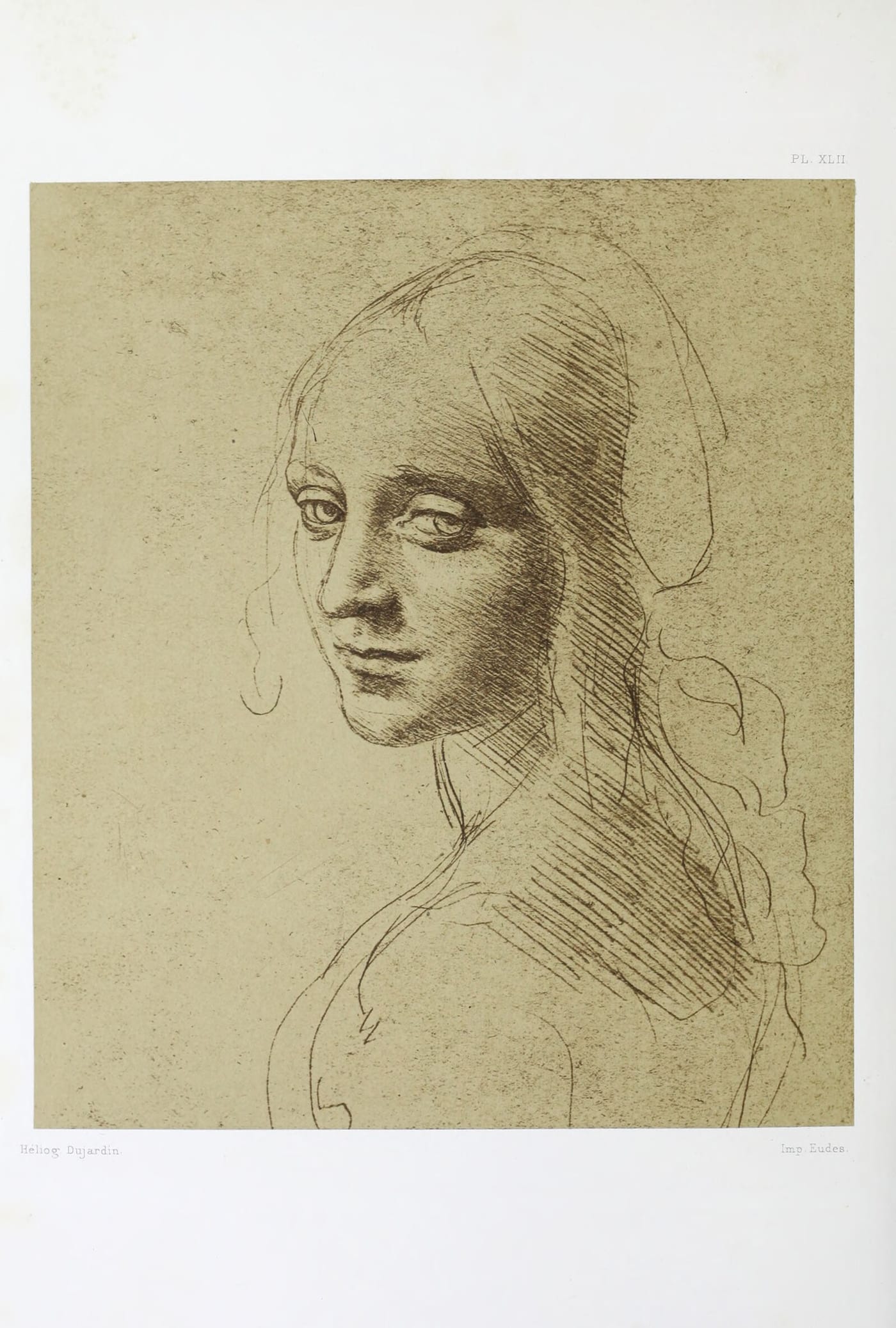
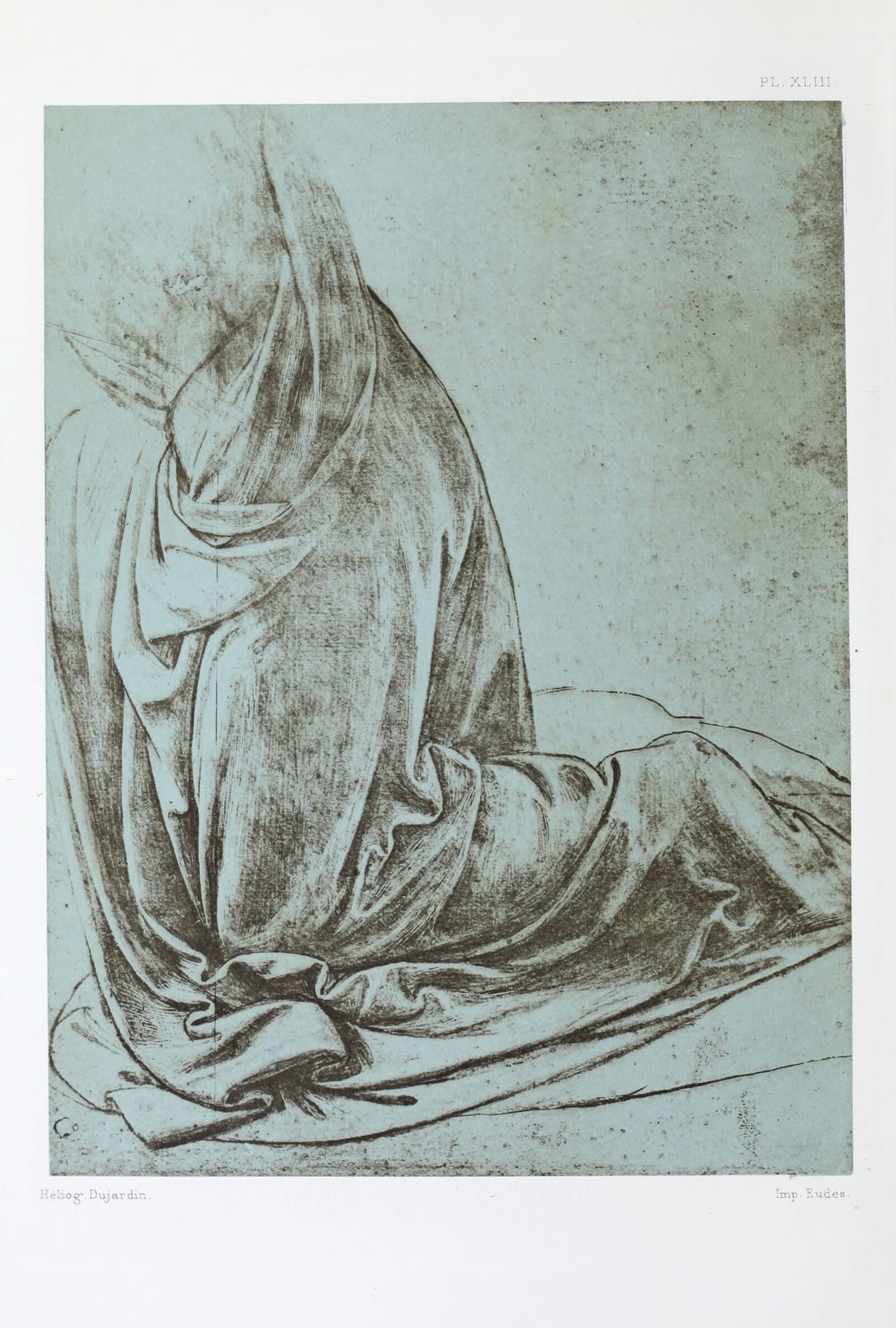
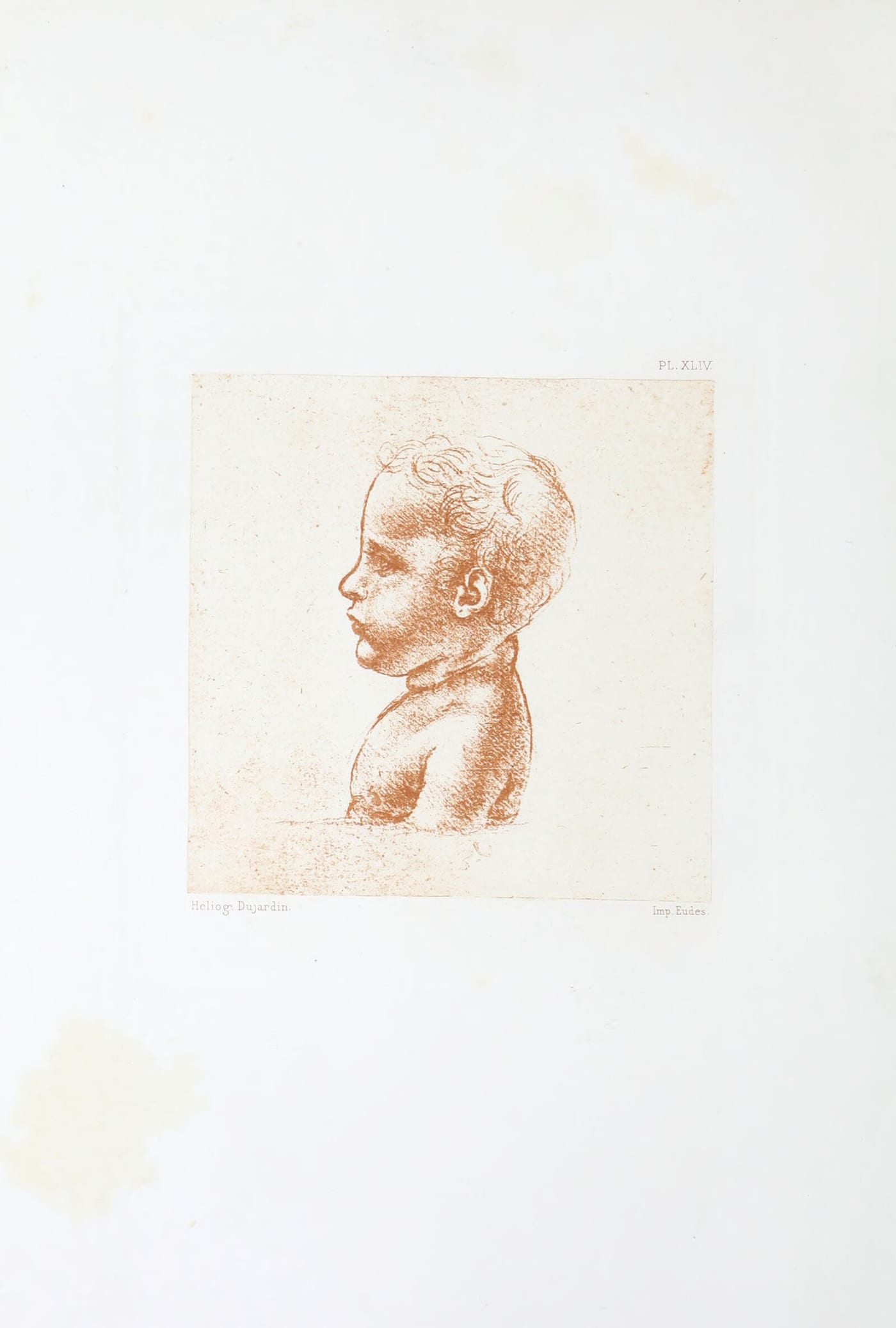
F. U. 115, 446 · Pl. XL, No. 3 · Pl. XLII · Pl. XLIII · Pl. XLIV
See Plate XL, shown with § 473
Mixwell Library › Leonardo da Vinci › The Notebooks › Part X
The Notebooks of Leonardo da Vinci · translated by Jean Paul Richter · § 663 to 705 · 15 plates · public domain · plain text
Nothing in this part mentions that.
An artist's manuscript notes can hardly be expected to contain any thing more than incidental references to those masterpieces of his work of which the fame, sounded in the writings of his contemporaries, has left a glorious echo to posterity. We need not therefore be surprised to find that the texts here reproduced do not afford us such comprehensive information as we could wish. On the other hand, the sketches and studies prepared by Leonardo for the two grandest compositions he ever executed: The Fresco of the Last Supper in the Refectory of Santa Maria delle Grazie at Milan, and the Cartoon of the Battle of Anghiari, for the Palazzo della Signoria at Florence—have been preserved; and, though far from complete, are so much more numerous than the manuscript notes, that we are justified in asserting that in value and interest they amply compensate for the meagerness of the written suggestions.
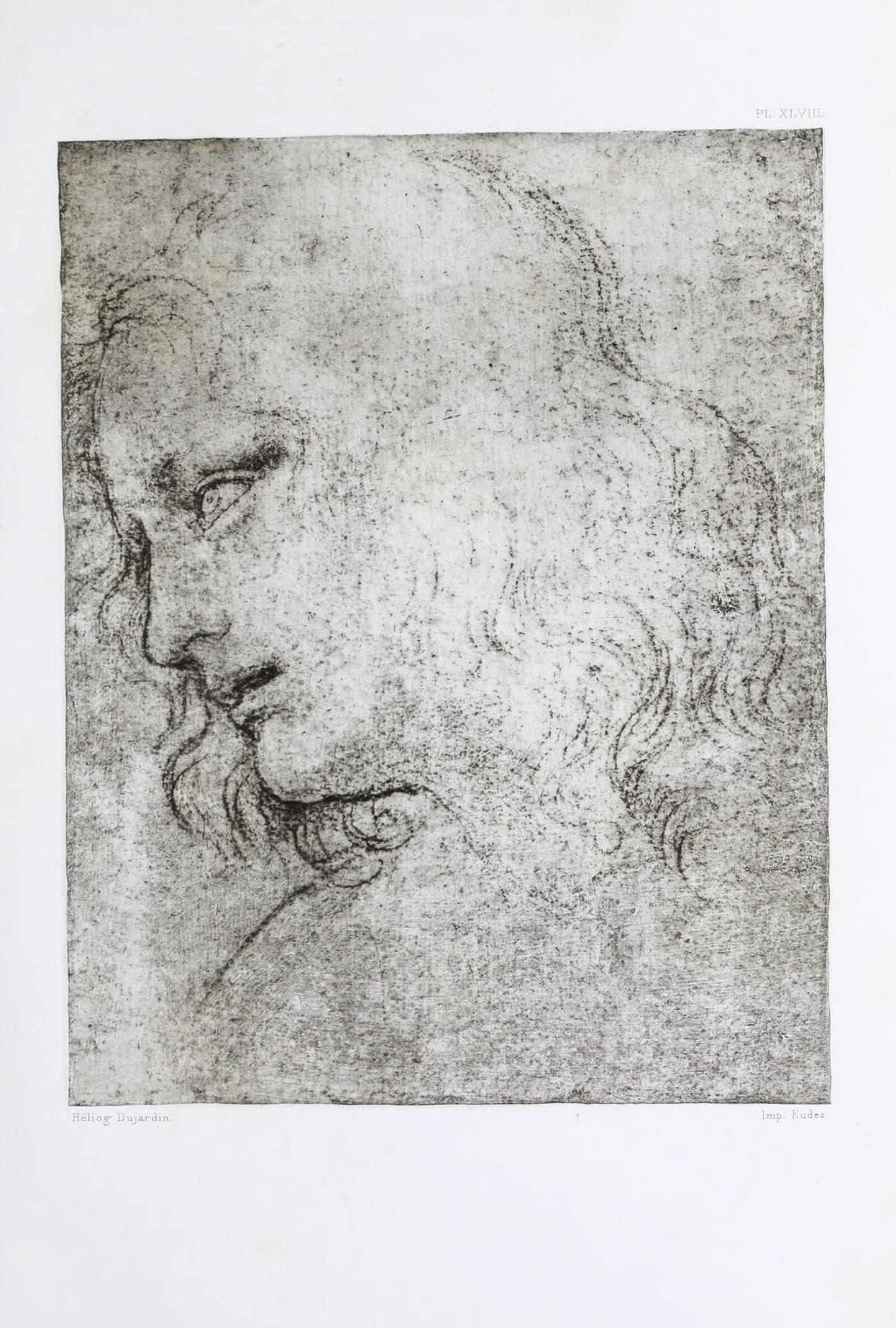
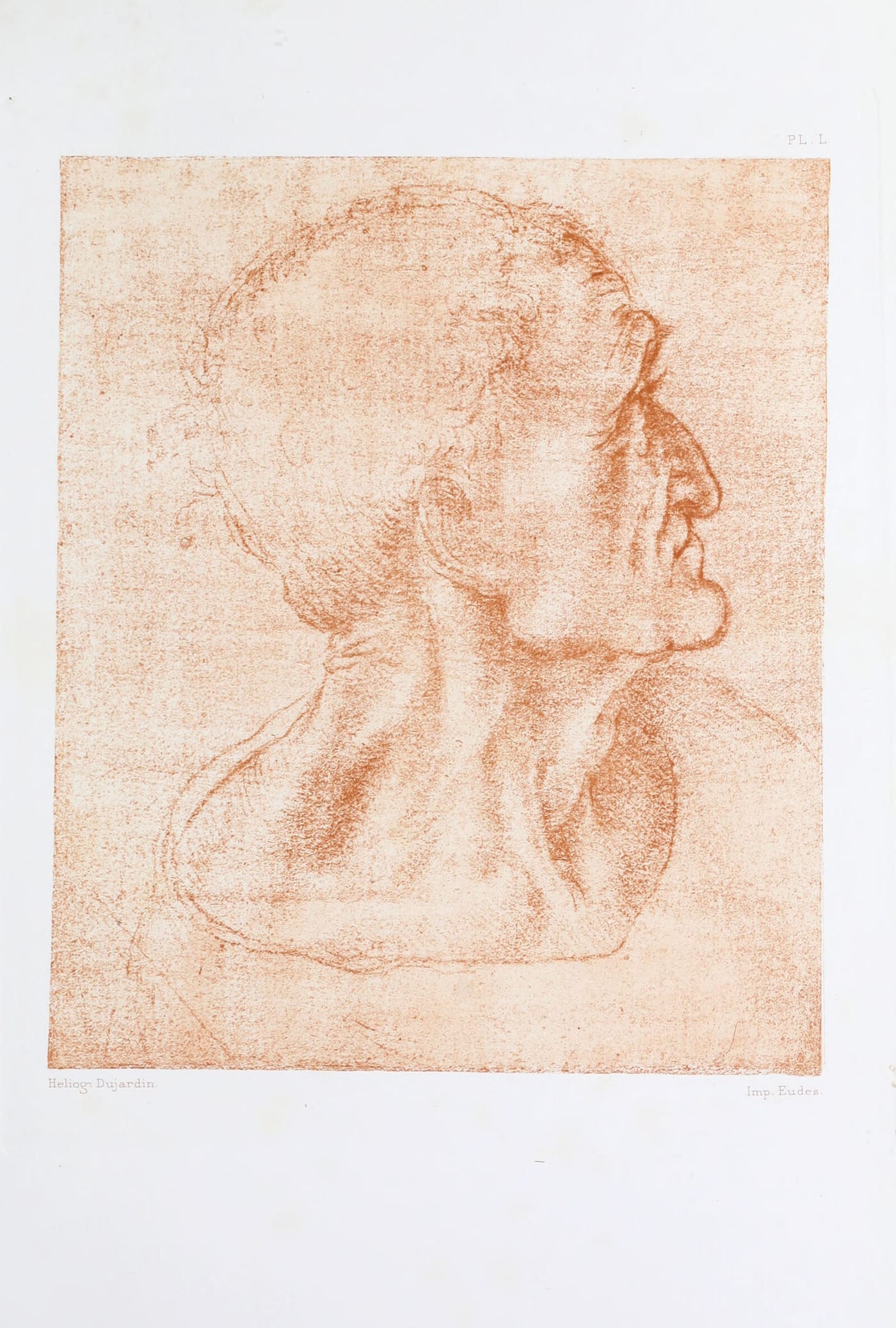
The notes for the composition of the Last Supper, which are given under nos. 665 and 666 occur in a MS. at South Kensington, II2, written in the years 1494-1495. This MS. sketch was noted down not more than three or four years before the painting was executed, which justifies the inference that at the time when it was written the painter had not made up his mind definitely even as to the general scheme of the work; and from this we may also conclude that the drawings of apostles' heads at Windsor, in red chalk, must be ascribed to a later date. They are studies for the head of St. Matthew, the fourth figure on Christ's left hand—see Pl. XL VII, the sketch (in black chalk) for the head of St. Philip, the third figure on the left hand—see Pl. XL VIII, for St. Peter's right arm—see Pl. XLIX, and for the expressive head of Judas which has unfortunately somewhat suffered by subsequent restoration of outlines,—see Pl. L. According to a tradition, as unfounded as it is improbable, Leonardo made use of the head of Padre Bandelli, the prior of the convent, as the prototype of his Judas; this however has already been contradicted by Amoretti "Memorie storiche" cap. XIV. The study of the head of a criminal on Pl. LI has, it seems to me, a better claim to be regarded as one of the preparatory sketches for the head of Judas. The Windsor collection contains two old copies of the head of St. Simon, the figure to the extreme left of Christ, both of about equal merit (they are marked as Nos. 21 and 36)—the second was reproduced on Pl. VIII of the Grosvenor Gallery Publication in 1878. There is also at Windsor a drawing in black chalk of folded hands (marked with the old No. 212; No. LXI of the Grosvenor Gallery Publication) which I believe to be a copy of the hands of St. John, by some unknown pupil. A reproduction of the excellent drawings of heads of Apostles in the possession of H. R. H. the Grand Duchess of Weimar would have been out of my province in this work, and, with regard to them, I must confine myself to pointing out that the difference in style does not allow of our placing the Weimar drawings in the same category as those here reproduced. The mode of grouping in the Weimar drawings is of itself sufficient to indicate that they were not executed before the picture was painted, but, on the contrary, afterwards, and it is, on the face of it, incredible that so great a master should thus have copied from his own work.
The drawing of Christ's head, in the Brera palace at Milan was perhaps originally the work of Leonardo's hand; it has unfortunately been entirely retouched and re-drawn, so that no decisive opinion can be formed as to its genuineness.
The red chalk drawing reproduced on Pl. XLVI is in the Accademia at Venice; it was probably made before the text, Nos. 664 and 665, was written.
The two pen and ink sketches on Pl. XLV seem to belong to an even earlier date; the more finished drawing of the two, on the right hand, represents Christ with only St. John and Judas and a third disciple whose action is precisely that described in No. 666, Pl. 4. It is hardly necessary to observe that the other sketches on this page and the lines of text below the circle (containing the solution of a geometrical problem) have no reference to the picture of the Last Supper. With this figure of Christ may be compared a similar pen and ink drawing reproduced on page 297 below on the left hand; the original is in the Louvre. On this page again the rest of the sketches have no direct bearing on the composition of the Last Supper, not even, as it seems to me, the group of four men at the bottom to the right hand—who are listening to a fifth, in their midst addressing them. Moreover the writing on this page (an explanation of a disk shaped instrument) is certainly not in the same style as we find constantly used by Leonardo after the year 1489.
It may be incidentally remarked that no sketches are known for the portrait of "Mona Lisa", nor do the MS. notes ever allude to it, though according to Vasari the master had it in hand for fully four years.
Leonardo's cartoon for the picture of the battle of Anghiari has shared the fate of the rival work, Michaelangelo's "Bathers summoned to Battle". Both have been lost in some wholly inexplicable manner. I cannot here enter into the remarkable history of this work; I can only give an account of what has been preserved to us of Leonardo's scheme and preparations for executing it. The extent of the material in studies and drawings was till now quite unknown. Their publication here may give some adequate idea of the grandeur of this famous work. The text given as No. 669 contains a description of the particulars of the battle, but for the reasons given in the note to this text, I must abandon the idea of taking this passage as the basis of my attempt to reconstruct the picture as the artist conceived and executed it.
I may here remind the reader that Leonardo prepared the cartoon in the Sala del Papa of Santa Maria Novella at Florence and worked there from the end of October 1503 till February 1504, and then was busied with the painting in the Sala del Consiglio in the Palazzo della Signoria, till the work was interrupted at the end of May 1506. (See Milanesi's note to Vasari pp. 43–45 Vol. IV ed. 1880.) Vasari, as is well known, describes only one scene or episode of the cartoon—the Battle for the Standard in the foreground of the composition, as it would seem; and this only was ever finished as a mural decoration in the Sala del Consiglio. This portion of the composition is familiar to all from the disfigured copy engraved by Edelinck. Mariette had already very acutely observed that Edelinck must surely have worked from a Flemish copy of the picture. There is in the Louvre a drawing by Rubens (No. 565) which also represents four horsemen fighting round a standard and which agrees with Edelinck's engraving, but the engraving reverses the drawing. An earlier Flemish drawing, such as may have served as the model for both Rubens and Edelinck, is in the Uffizi collection (see Philpots's Photograph, No. 732). It seems to be a work of the second half of the XVIth century, a time when both the picture and the cartoon had already been destroyed. It is apparently the production of a not very skilled hand. Raphael Trichet du Fresne, 1651, mentions that a small picture by Leonardo himself of the Battle of the Standard was then extant in the Tuileries; by this he probably means the painting on panel which is now in the possession of Madame Timbal in Paris, and which has lately been engraved by Haussoullier as a work by Leonardo. The picture, which is very carefully painted, seems to me however to be the work of some unknown Florentine painter, and probably executed within the first ten years of the XVIth century. At the same time, it would seem to be a copy not from Leonardo's cartoon, but from his picture in the Palazzo della Signoria; at any rate this little picture, and the small Flemish drawing in Florence are the oldest finished copies of this episode in the great composition of the Battle of Anghiari.
In his Life of Raphael, Vasari tells us that Raphael copied certain works of Leonardo's during his stay in Florence. Raphael's first visit to Florence lasted from the middle of October 1504 till July 1505, and he revisited it in the summer of 1506. The hasty sketch, now in the possession of the University of Oxford and reproduced on page 337 also represents the Battle of the Standard and seems to have been made during his first stay, and therefore not from the fresco but from the cartoon; for, on the same sheet we also find, besides an old man's head drawn in Leonardo's style, some studies for the figure of St. John the Martyr which Raphael used in 1505 in his great fresco in the Church of San Severo at Perugia.
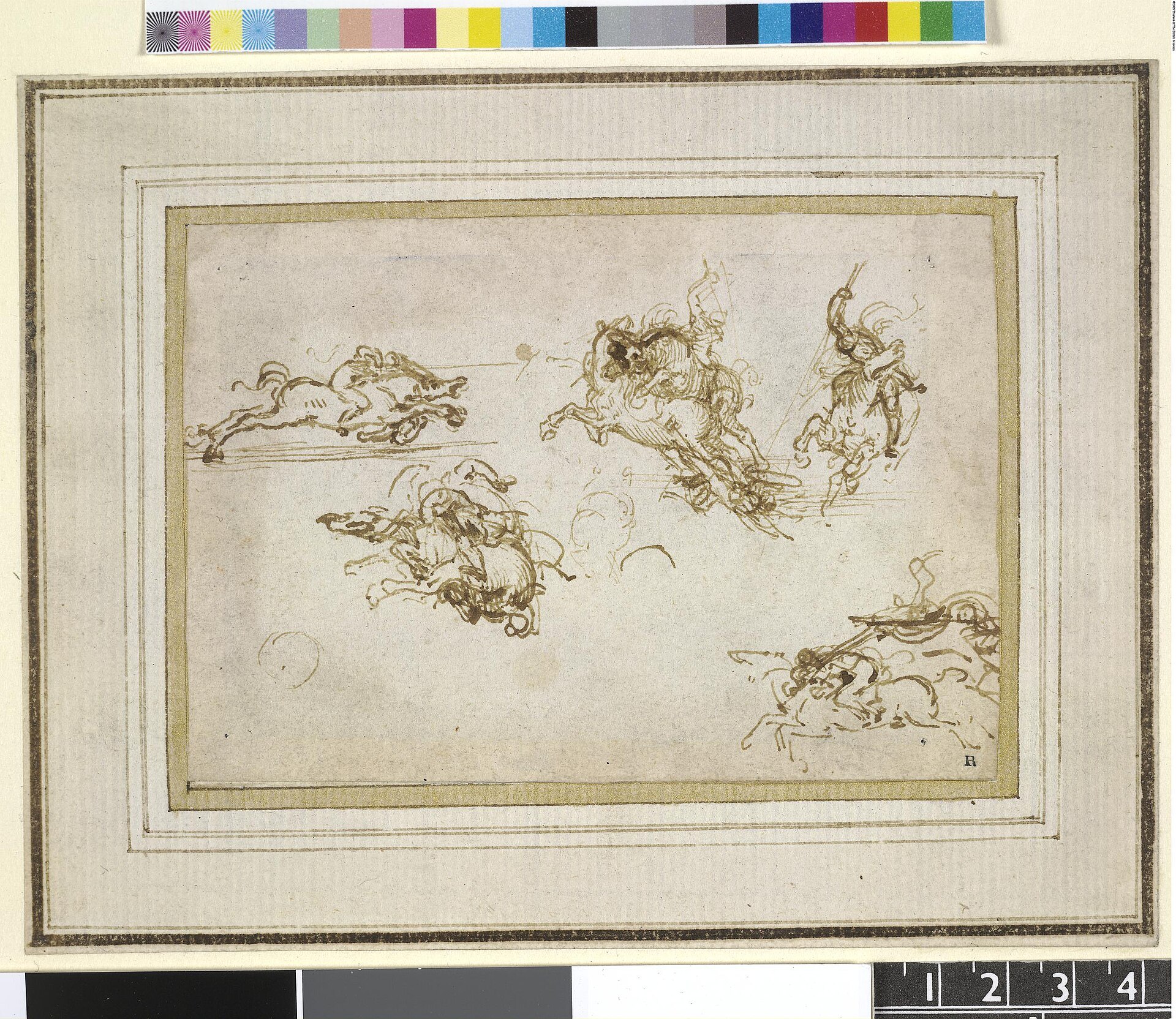
Of Leonardo's studies for the Battle of Anghiari I must in the first place point to five, on three of which—Pl. LII 2, Pl. LIII, Pl. LVI—we find studies for the episode of the Standard. The standard bearer, who, in the above named copies is seen stooping, holding on to the staff across his shoulder, is immediately recognisable as the left-hand figure in Raphael's sketch, and we find it in a similar attitude in Leonardo's pen and ink drawing in the British Museum—Pl. LII, 2—the lower figure to the right. It is not difficult to identify the same figure in two more complicated groups in the pen and ink drawings, now in the Accademia at Venice—Pl. LIII, and Pl. LIV—where we also find some studies of foot soldiers fighting. On the sheet in the British Museum—Pl. LII, 2—we find, among others, one group of three horses galloping forwards: one horseman is thrown and protects himself with his buckler against the lance thrusts of two others on horseback, who try to pierce him as they ride past. The same action is repeated, with some variation, in two sketches in pen and ink on a third sheet, in the Accademia at Venice, Pl. LV; a coincidence which suggests the probability of such an incident having actually been represented on the cartoon. We are not, it is true, in a position to declare with any certainty which of these three dissimilar sketches may have been the nearest to the group finally adopted in executing the cartoon.
With regard, however, to one of the groups of horsemen it is possible to determine with perfect certainty not only which arrangement was preferred, but the position it occupied in the composition. The group of horsemen on Pl. LVII is a drawing in black chalk at Windsor, which is there attributed to Leonardo, but which appears to me to be the work of Cesare da Sesto, and the Commendatore Giov. Morelli supports me in this view. It can hardly be doubted that da Sesto, as a pupil of Leonardo's, made this drawing from his master's cartoon, if we compare it with the copy made by Raphael—here reproduced, for just above the fighting horseman in Raphael's copy it is possible to detect a horse which is seen from behind, going at a slower pace, with his tail flying out to the right and the same horse may be seen in the very same attitude carrying a dimly sketched rider, in the foreground of Cesare da Sesto's drawing.
If a very much rubbed drawing in black chalk at Windsor—Pl. LVI—is, as it appears to be, the reversed impression of an original drawing, it is not difficult to supplement from it the portions drawn by Cesare da Sesto. Nay, it may prove possible to reconstruct the whole of the lost cartoon from the mass of materials we now have at hand which we may regard as the nucleus of the composition. A large pen and ink drawing by Raphael in the Dresden collection, representing three horsemen fighting, and another, by Cesare da Sesto, in the Uffizi, of light horsemen fighting are a further contribution which will help us to reconstruct it.
The sketch reproduced on Pl. LV gives a suggestive example of the way in which foot-soldiers may have been introduced into the cartoon as fighting among the groups of horsemen; and I may here take the opportunity of mentioning that, for reasons which it would be out of place to enlarge upon here, I believe the two genuine drawings by Raphael's hand in his "Venetian sketch-book" as it is called—one of a standard bearer marching towards the left, and one of two foot-soldiers armed with spears and fighting with a horseman—to be undoubtedly copies from the cartoon of the Battle of Anghiari.
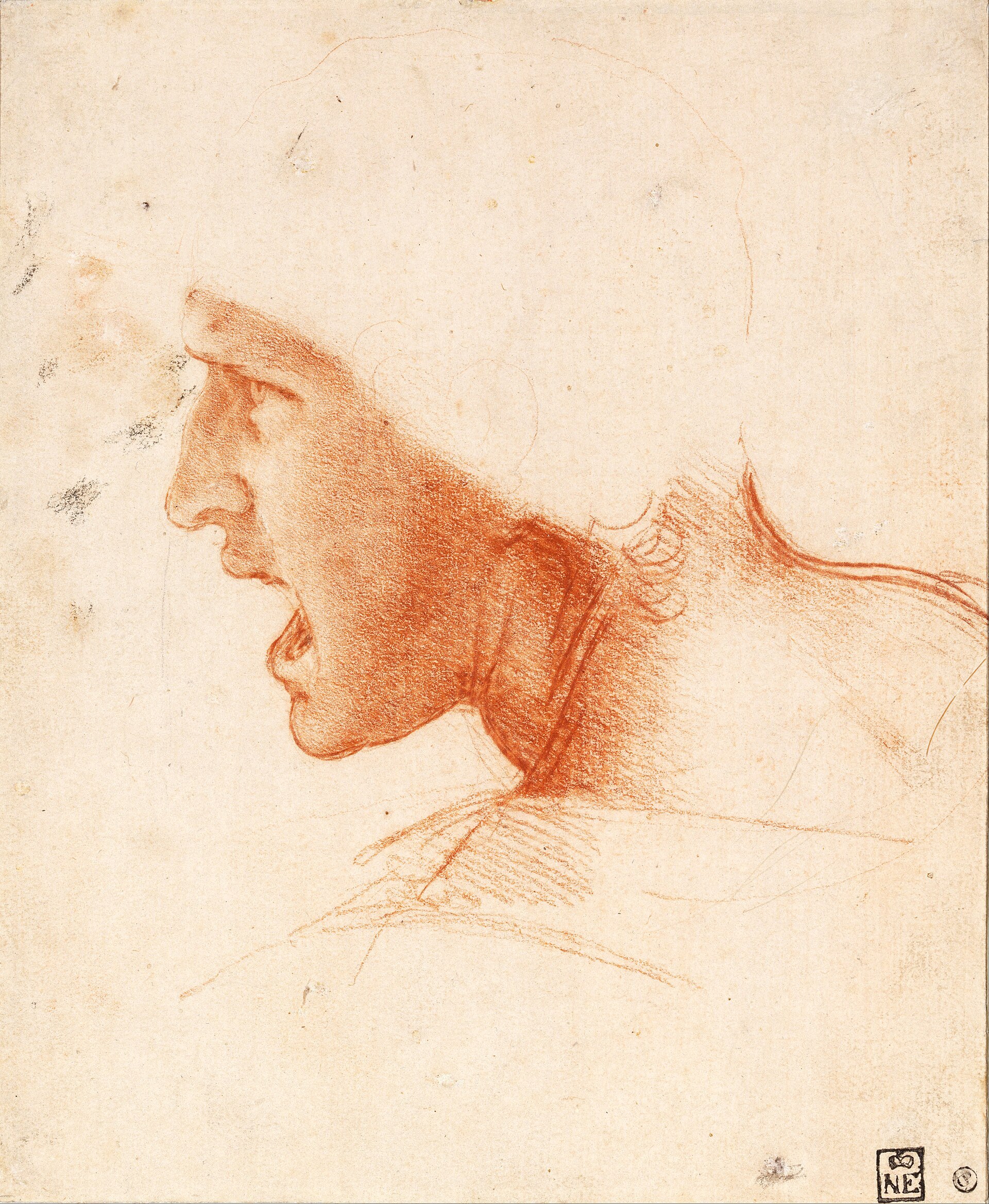
Leonardo's two drawings, preserved in the museum at Buda-Pesth and reproduced on pages 338 and 339 are preliminary studies for the heads of fighting warriors. The two heads drawn in black chalk (pg. 338) and the one seen in profile, turned to the left, drawn in red chalk (pg. 339), correspond exactly with those of two horsemen in the scene of the fight round the standard as we see them in Madame Timbal's picture and in the other finished copies. An old copy of the last named drawing by a pupil of Leonardo is in MS. C. A. 187b; 561b (See Saggio, Tav. XXII). Leonardo used to make such finished studies of heads as those, drawn on detached sheets, before beginning his pictures from his drawings—compare the preparatory studies for the fresco of the Last Supper, given on Pl. XLVII and Pl. L. Other drawings of heads, all characterised by the expression of vehement excitement that is appropriate to men fighting, are to be seen at Windsor (No. 44) and at the Accademia at Venice (IV, 13); at the back of one of the drawings at Buda-Pesth there is the bust of a warrior carrying a spear on his left shoulder, holding up the left arm (See Csatakepek a XVI—lk Szazadbol osszeallitotta Pvlszky Karoly). These drawings may have been made for other portions of the cartoon, of which no copies exist, and thus we are unable to identify these preparatory drawings. Finally I may add that a sketch of fighting horse and foot soldiers, formerly in the possession of M. Thiers and published by Charles Blanc in his "Vies des Peintres" can hardly be accepted as genuine. It is not to be found, as I am informed, among the late President's property, and no one appears to know where it now is.
An attempted reconstruction of the Cartoon, which is not only unsuccessful but perfectly unfounded, is to be seen in the lithograph by Bergeret, published in Charles Blanc's "Vies des peintres" and reprinted in "The great Artists. L. da Vinci", p. 80. This misleading pasticcio may now be rejected without hesitation.
There are yet a few original drawings by Leonardo which might be mentioned here as possibly belonging to the cartoon of the Battle; such as the pen and ink sketches on Pl. XXI and on Pl. XXXVIII, No. 3, but we should risk too wide a departure from the domain of ascertained fact.
With regard to the colours and other materials used by Leonardo the reader may be referred to the quotations from the accounts for the picture in question given by Milanesi in his edition of Vasari (Vol. IV, p. 44, note) where we find entries of a similar character to those in Leonardo's note books for the year 1505; S. K. M. 12 (see No. 636).
That Leonardo was employed in designing decorations and other preparations for high festivals, particularly for the court of Milan, we learn not only from the writings of his contemporaries but from his own incidental allusions; for instance in MS. C. l5b (1), l. 9. In the arrangement of the texts referring to this I have placed those first, in which historical personages are named—Nos. 670-674. Among the descriptions of Allegorical subjects two texts lately found at Oxford have been included, Nos. 676 and 677. They are particularly interesting because they are accompanied by large sketches which render the meaning of the texts perfectly clear. It is very intelligible that in other cases, where there are no illustrative sketches, the notes must necessarily remain obscure or admit of various interpretations. The literature of the time affords ample evidence of the use of such allegorical representations, particularly during the Carnival and in Leonardo's notes we find the Carnival expressly mentioned—Nos. 685 and 704. Vasari in his Life of Pontormo, particularly describes that artist's various undertakings for Carnival festivities. These very graphic descriptions appear to me to throw great light in more ways than one on the meaning of Leonardo's various notes as to allegorical representations and also on mottoes and emblems—Nos. 681-702. In passing judgment on the allegorical sketches and emblems it must not be overlooked that even as pictures they were always accompanied by explanations in words. Several finished drawings of allegorical compositions or figures have been preserved, but as they have no corresponding explanation in the MSS. they had no claim to be reproduced here. The female figure on Pl. XXVI may perhaps be regarded as a study for such an allegorical painting, of which the purport would have been explained by an inscription.
[In the autumn of] 1478 I began the two Madonna [pictures].
F. U. 115, 446 · Pl. XL, No. 3 · Pl. XLII · Pl. XLIII · Pl. XLIV
See Plate XL, shown with § 473
A tan-coloured small cap, A doublet of black serge, A black jerkin lined A blue coat lined, with fur of foxes' breasts, and the collar of the jerkin covered with black and white stippled velvet Bernardo di Bandino Baroncelli; black hose.
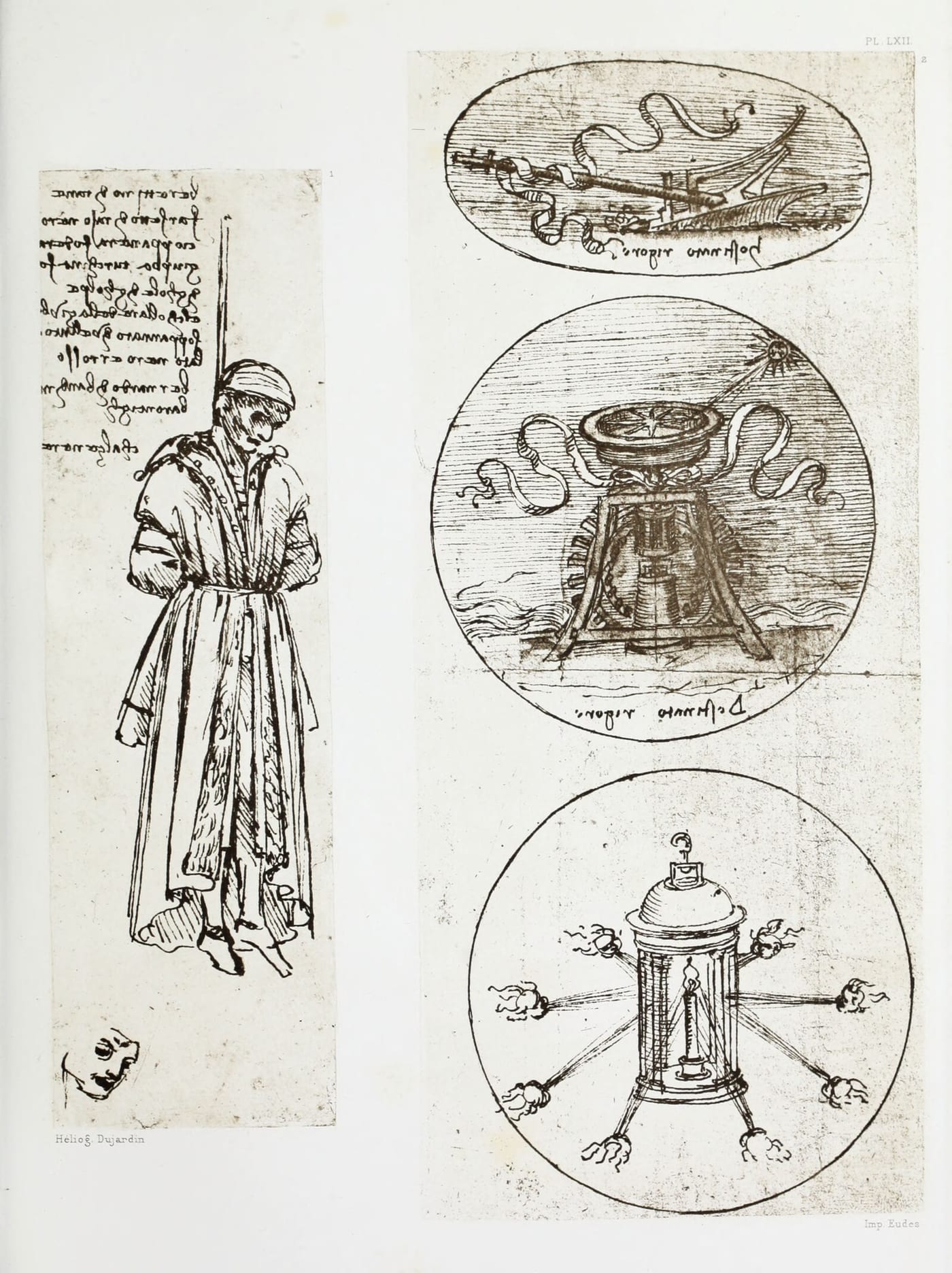
Th. · Pl. LXII, No. 1
One who was drinking and has left the glass in its position and turned his head towards the speaker.
Another, twisting the fingers of his hands together turns with stern brows to his companion. Another with his hands spread open shows the palms, and shrugs his shoulders up his ears making a mouth of astonishment.
Another speaks into his neighbour's ear and he, as he listens to him, turns towards him to lend an ear, while he holds a knife in one hand, and in the other the loaf half cut through by the knife. Another who has turned, holding a knife in his hand, upsets with his hand a glass on the table.
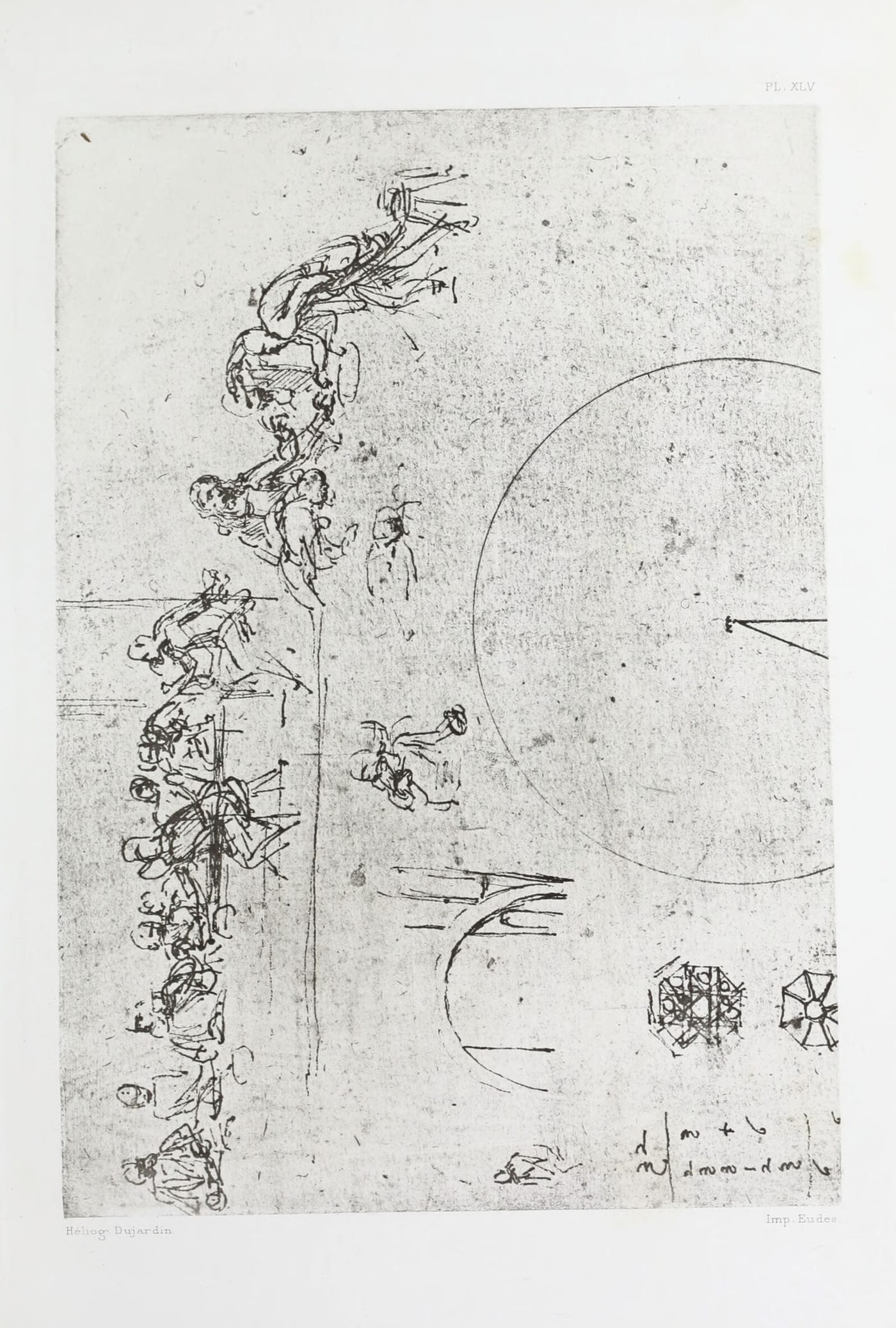
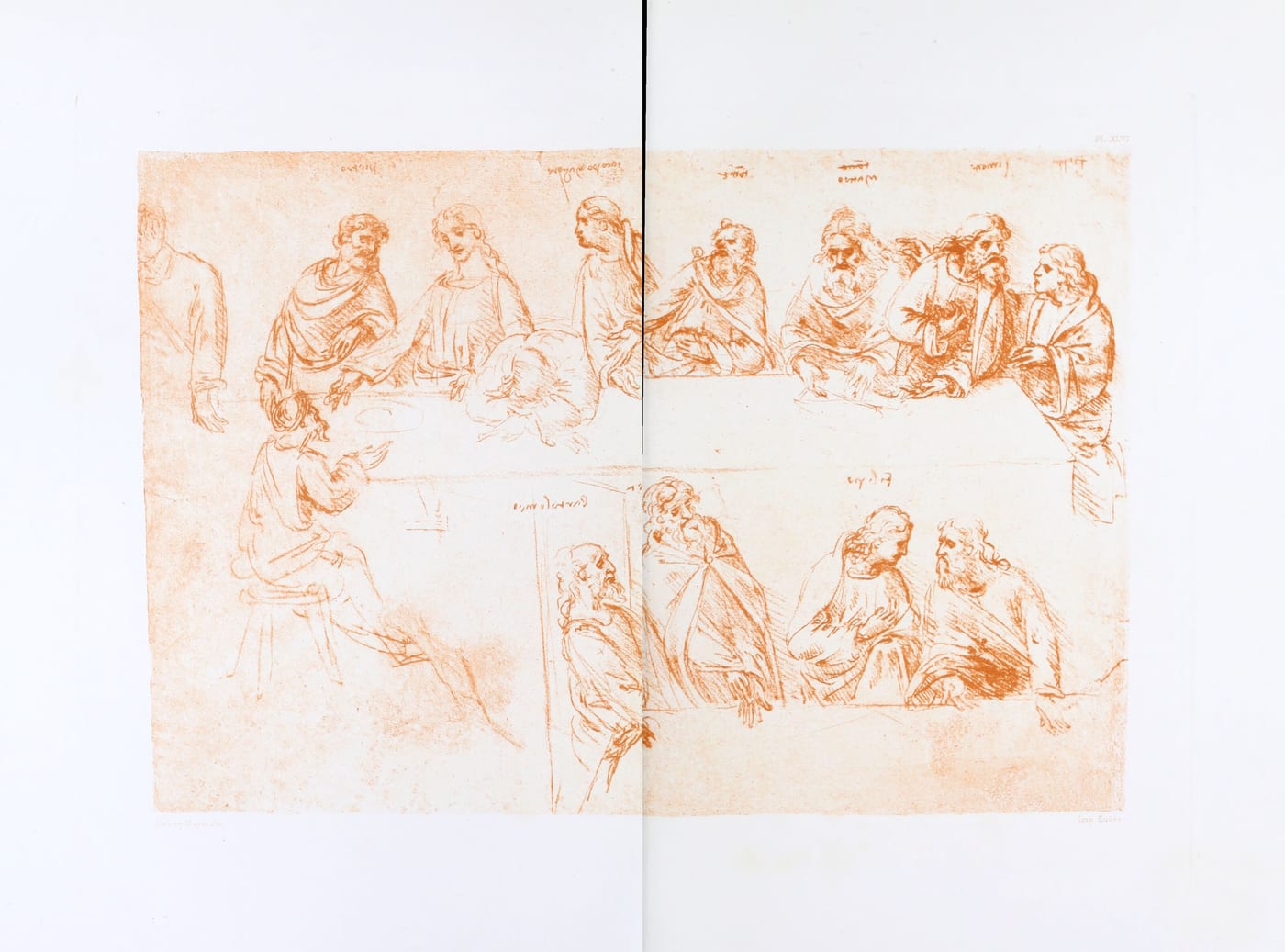
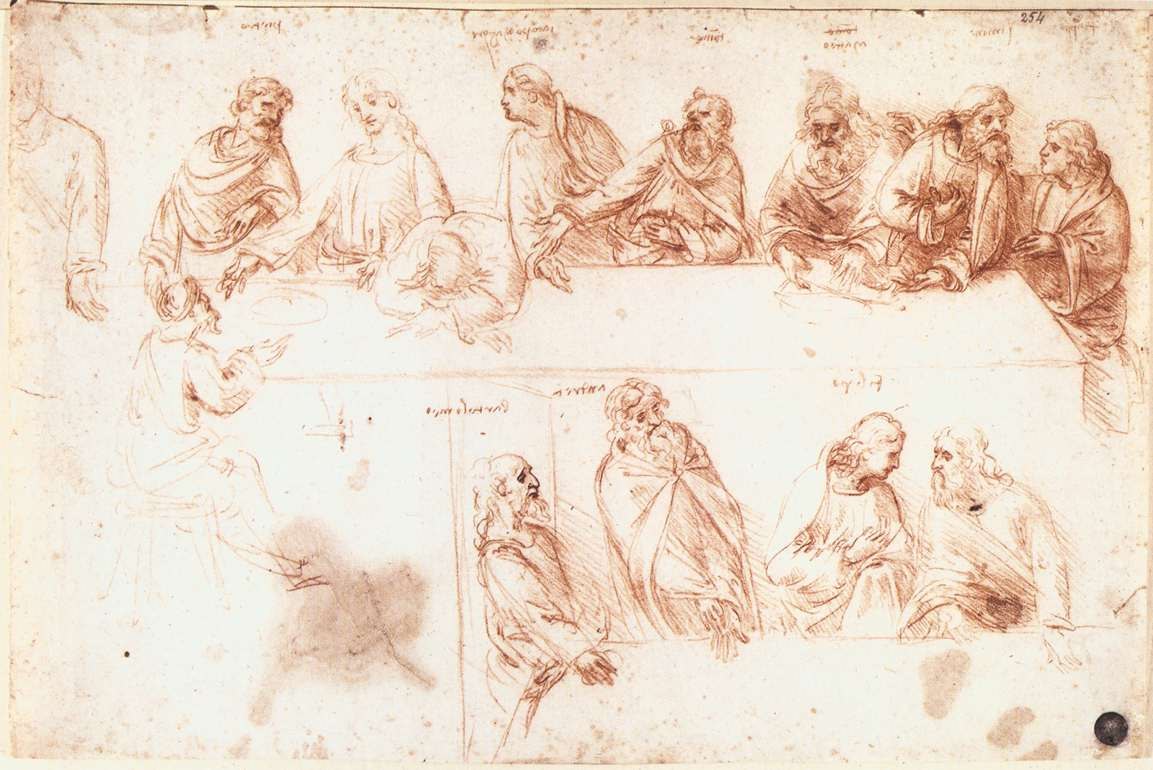
S. K. M. II.2 2a · Pl. XLV
See Plate LII, shown with § 594
Another lays his hand on the table and is looking. Another blows his mouthful. Another leans forward to see the speaker shading his eyes with his hand. Another draws back behind the one who leans forward, and sees the speaker between the wall and the man who is leaning.
S. K. M. II.2 1b
See Plate LII, shown with § 594
Count Giovanni, the one with the Cardinal of Mortaro.
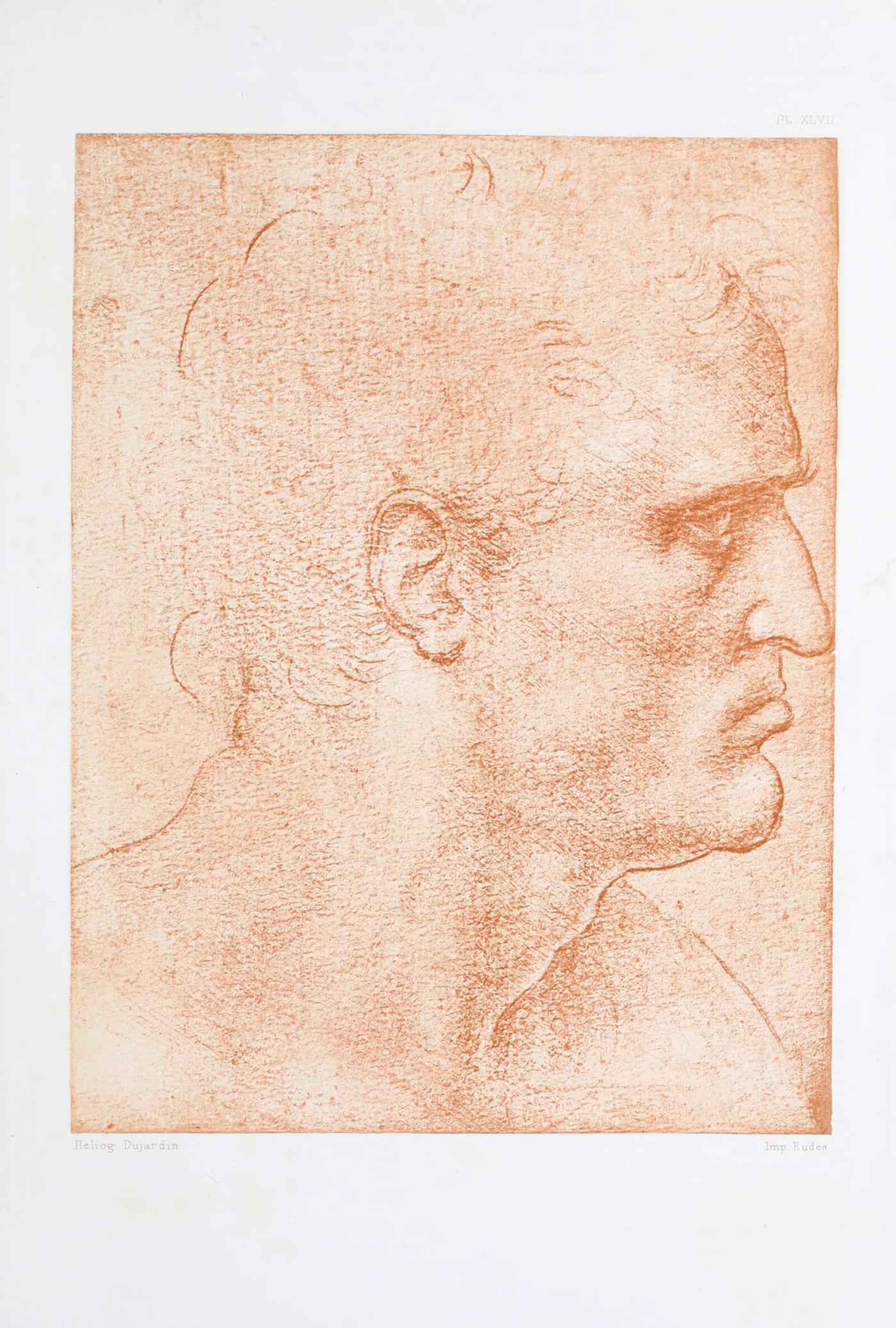
S. K. M. II.2 78b · Pl. XLVII
Philip, Simon, Matthew, Thomas, James the Greater, Peter, Philip, Andrew, Bartholomew.
V. A. X. 8 · Pl. XLVI
See Plate XLVI, shown with § 665
On the battle of Anghiari.
Florentine
Neri di Gino Capponi
Bernardetto de' Medici
Micheletto,
Niccolo da Pisa
Conte Francesco
Pietro Gian Paolo
Guelfo Orsino,
Messer Rinaldo degli
Albizzi
Begin with the address of Niccolo Piccinino to the soldiers and the banished Florentines among whom are Messer Rinaldo degli Albizzi and other Florentines. Then let it be shown how he first mounted on horseback in armour; and the whole army came after him—40 squadrons of cavalry, and 2000 foot soldiers went with him. Very early in the morning the Patriarch went up a hill to reconnoitre the country, that is the hills, fields and the valley watered by a river; and from thence he beheld Niccolo Picinino coming from Borgo San Sepolcro with his people, and with a great dust; and perceiving them he returned to the camp of his own people and addressed them. Having spoken he prayed to God with clasped hands, when there appeared a cloud in which Saint Peter appeared and spoke to the Patriarch.—500 cavalry were sent forward by the Patriarch to hinder or check the rush of the enemy. In the foremost troop Francesco the son of Niccolo Piccinino was the first to attack the bridge which was held by the Patriarch and the Florentines. Beyond the bridge to his left he sent forward some infantry to engage ours, who drove them back, among whom was their captain Micheletto whose lot it was to be that day at the head of the army. Here, at this bridge there is a severe struggle; our men conquer and the enemy is repulsed. Here Guido and Astorre, his brother, the Lord of Faenza with a great number of men, re-formed and renewed the fight, and rushed upon the Florentines with such force that they recovered the bridge and pushed forward as far as the tents. But Simonetto advanced with 600 horse, and fell upon the enemy and drove them back once more from the place, and recaptured the bridge; and behind him came more men with 2000 horse soldiers. And thus for a long time they fought with varying fortune. But then the Patriarch, in order to divert the enemy, sent forward Niccolo da Pisa and Napoleone Orsino, a beardless lad, followed by a great multitude of men, and then was done another great feat of arms. At the same time Niccolo Piccinino urged forward the remnant of his men, who once more made ours give way; and if it had not been that the Patriarch set himself at their head and, by his words and deeds controlled the captains, our soldiers would have taken to flight. The Patriarch had some artillery placed on the hill and with these he dispersed the enemy's infantry; and the disorder was so complete that Niccolo began to call back his son and all his men, and they took to flight towards Borgo. And then began a great slaughter of men; none escaped but the foremost of those who had fled or who hid themselves. The battle continued until sunset, when the Patriarch gave his mind to recalling his men and burying the dead, and afterwards a trophy was erected.
C. A. 75a; 214a
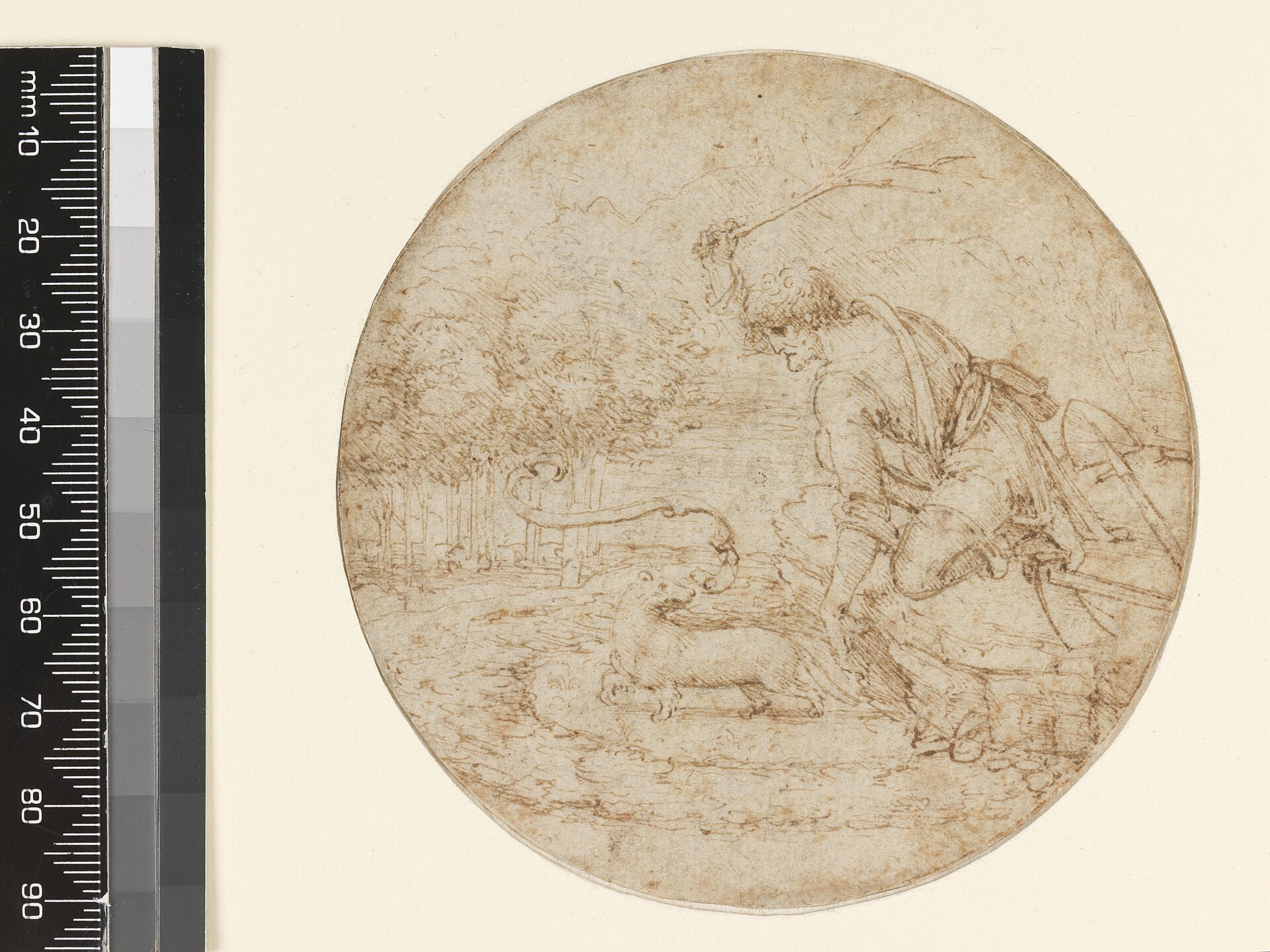
Ermine with blood Galeazzo, between calm weather and a representation of a tempest.
H.3 50a
Il Moro with spectacles, and Envy depicted with False Report and Justice black for il Moro.
Labour as having a branch of vine [or a screw] in her hand.
H.2 40b
Il Moro as representing Good Fortune, with hair, and robes, and his hands in front, and Messer Gualtieri taking him by the robes with a respectful air from below, having come in from the front.
Again, Poverty in a hideous form running behind a youth. Il Moro covers him with the skirt of his robe, and with his gilt sceptre he threatens the monster.
A plant with its roots in the air to represent one who is at his last;—a robe and Favour.
Of tricks [or of magpies] and of burlesque poems [or of starlings].
Those who trust themselves to live near him, and who will be a large crowd, these shall all die cruel deaths; and fathers and mothers together with their families will be devoured and killed by cruel creatures.
I.2 90b
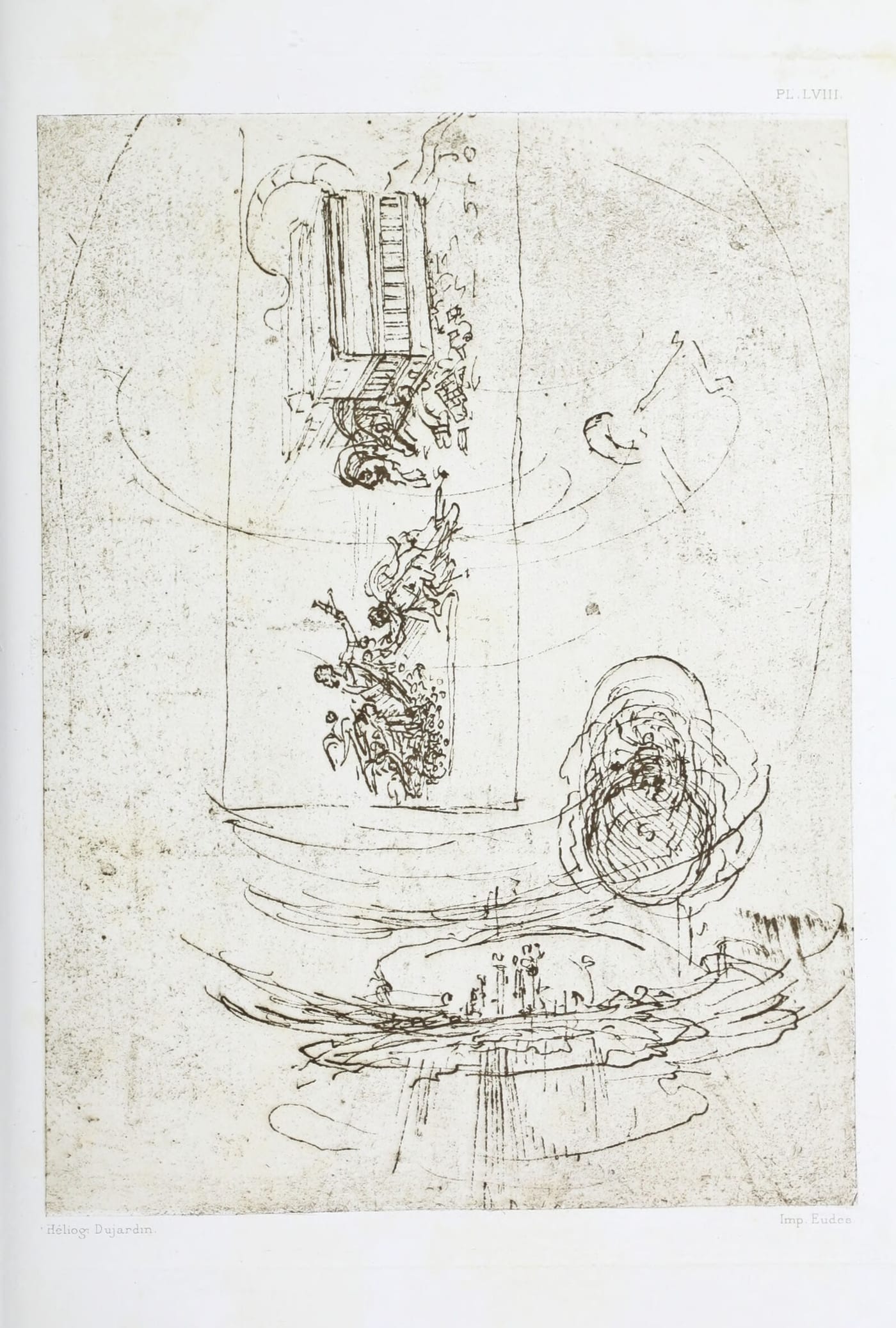
He was blacker than a hornet, his eyes were as red as a burning fire and he rode on a tall horse six spans across and more than 20 long with six giants tied up to his saddle-bow and one in his hand which he gnawed with his teeth. And behind him came boars with tusks sticking out of their mouths, perhaps ten spans.
I.2 91a
Above the helmet place a half globe, which is to signify our hemisphere, in the form of a world; on which let there be a peacock, richly decorated, and with his tail spread over the group; and every ornament belonging to the horse should be of peacock's feathers on a gold ground, to signify the beauty which comes of the grace bestowed on him who is a good servant.
On the shield a large mirror to signify that he who truly desires favour must be mirrored in his virtues.
On the opposite side will be represented Fortitude, in like manner in her place with her pillar in her hand, robed in white, to signify ... And all crowned; and Prudence with 3 eyes. The housing of the horse should be of plain cloth of gold closely sprinkled with peacock's eyes, and this holds good for all the housings of the horse, and the man's dress. And the man's crest and his neck-chain are of peacock's feathers on golden ground.
On the left side will be a wheel, the centre of which should be attached to the centre of the horse's hinder thigh piece, and in the centre Prudence is seen robed in red, Charity sitting in a fiery chariot and with a branch of laurel in her hand, to signify the hope which comes of good service.
Messer Antonio Grimani of Venice companion of Antonio Maria .
Br. M. 250a
Fame should be depicted as covered all over with tongues instead of feathers, and in the figure of a bird.
B. 3b
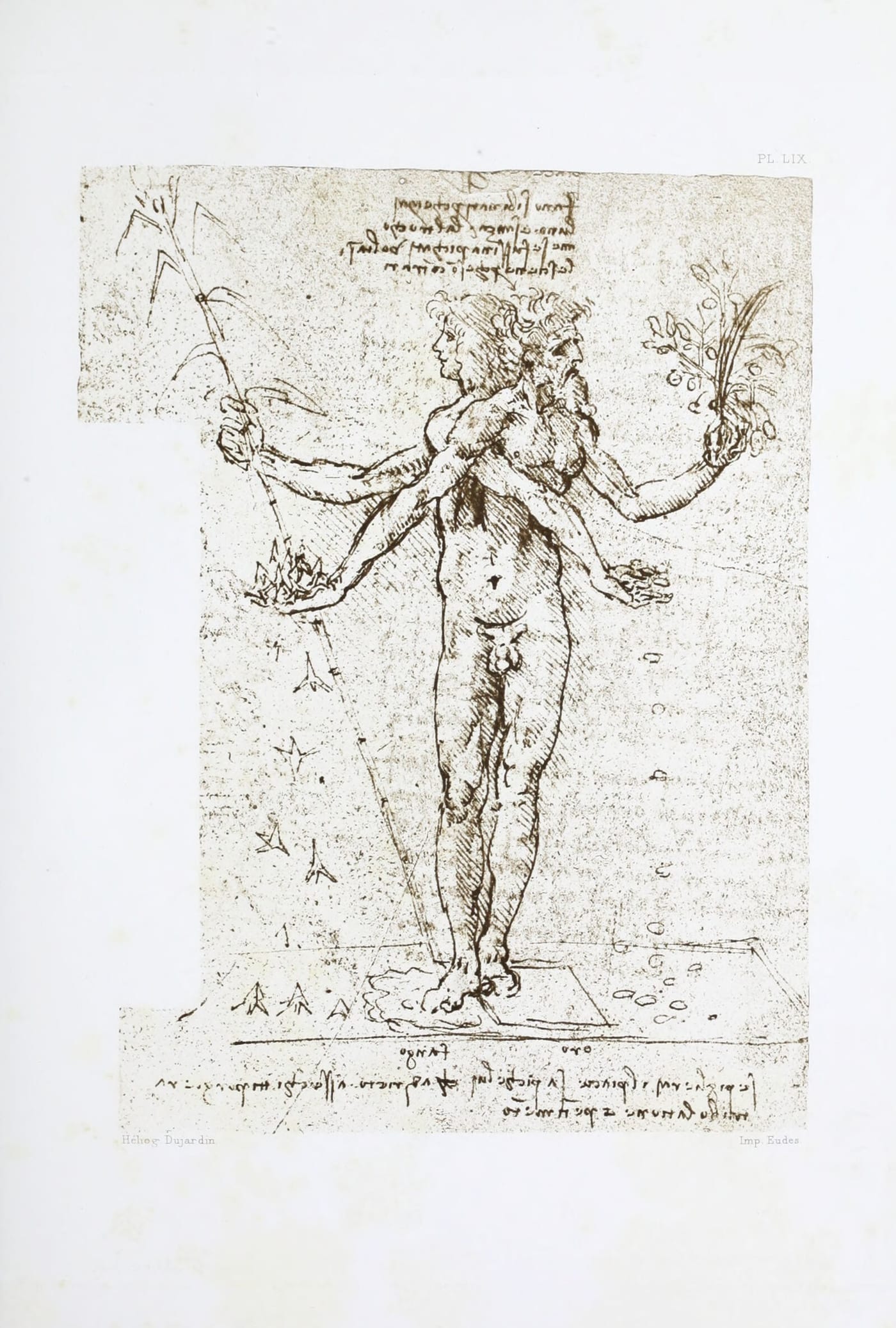
Pleasure and Pain represent as twins, since there never is one without the other; and as if they were united back to back, since they are contrary to each other.
Clay, gold.
If you take Pleasure know that he has behind him one who will deal you Tribulation and Repentance.
This represents Pleasure together with Pain, and show them as twins because one is never apart from the other. They are back to back because they are opposed to each other; and they exist as contraries in the same body, because they have the same basis, inasmuch as the origin of pleasure is labour and pain, and the various forms of evil pleasure are the origin of pain. Therefore it is here represented with a reed in his right hand which is useless and without strength, and the wounds it inflicts are poisoned. In Tuscany they are put to support beds, to signify that it is here that vain dreams come, and here a great part of life is consumed. It is here that much precious time is wasted, that is, in the morning, when the mind is composed and rested, and the body is made fit to begin new labours; there again many vain pleasures are enjoyed; both by the mind in imagining impossible things, and by the body in taking those pleasures that are often the cause of the failing of life. And for these reasons the reed is held as their support.
Evil-thinking is either Envy or Ingratitude.
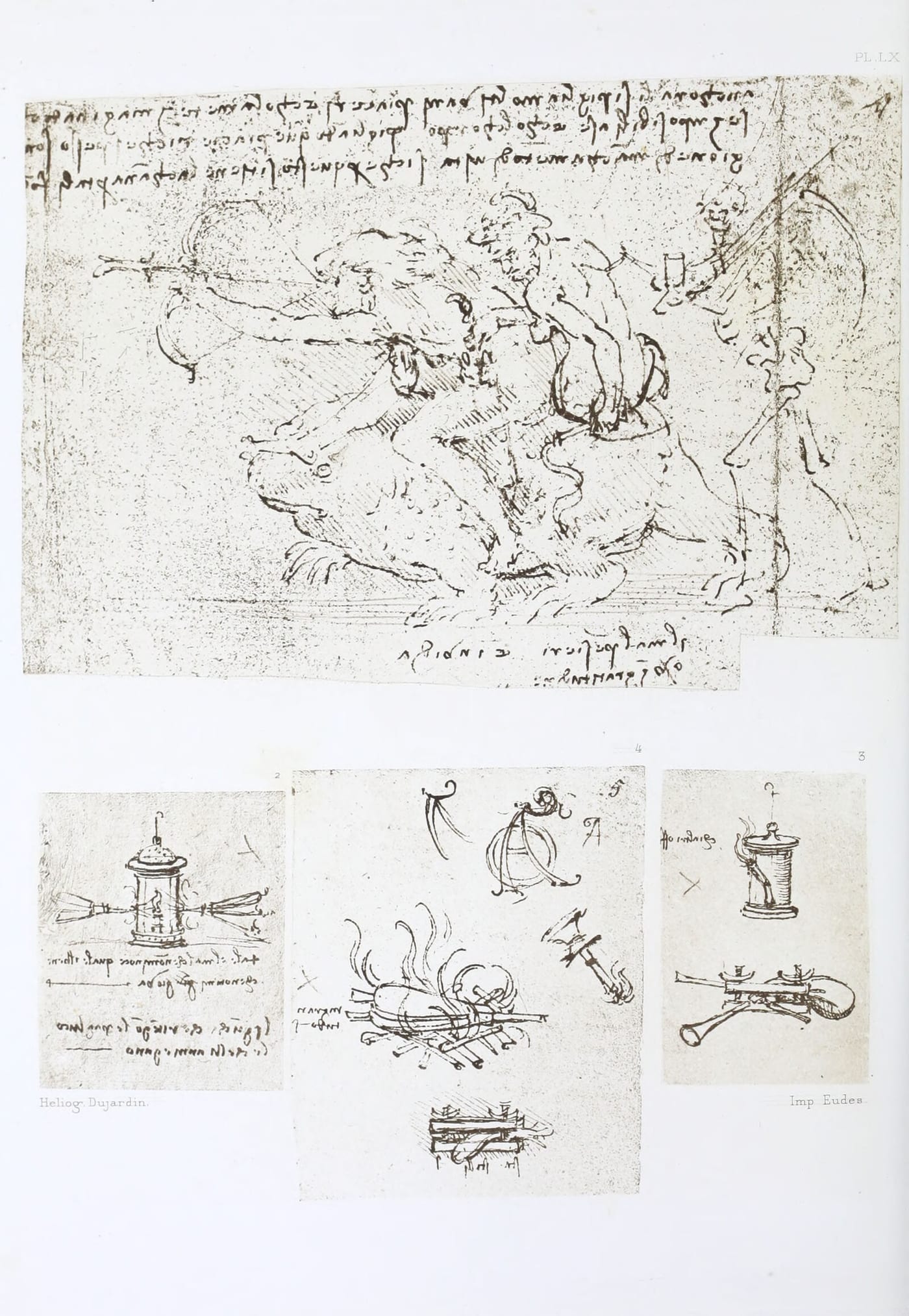
Envy must be represented with a contemptuous motion of the hand towards heaven, because if she could she would use her strength against God; make her with her face covered by a mask of fair seeming; show her as wounded in the eye by a palm branch and by an olive-branch, and wounded in the ear by laurel and myrtle, to signify that victory and truth are odious to her. Many thunderbolts should proceed from her to signify her evil speaking. Let her be lean and haggard because she is in perpetual torment. Make her heart gnawed by a swelling serpent, and make her with a quiver with tongues serving as arrows, because she often offends with it. Give her a leopard's skin, because this creature kills the lion out of envy and by deceit. Give her too a vase in her hand full of flowers and scorpions and toads and other venomous creatures; make her ride upon death, because Envy, never dying, never tires of ruling. Make her bridle, and load her with divers kinds of arms because all her weapons are deadly.
Toleration.
Intolerable.
No sooner is Virtue born than Envy comes into the world to attack it; and sooner will there be a body without a shadow than Virtue without Envy.
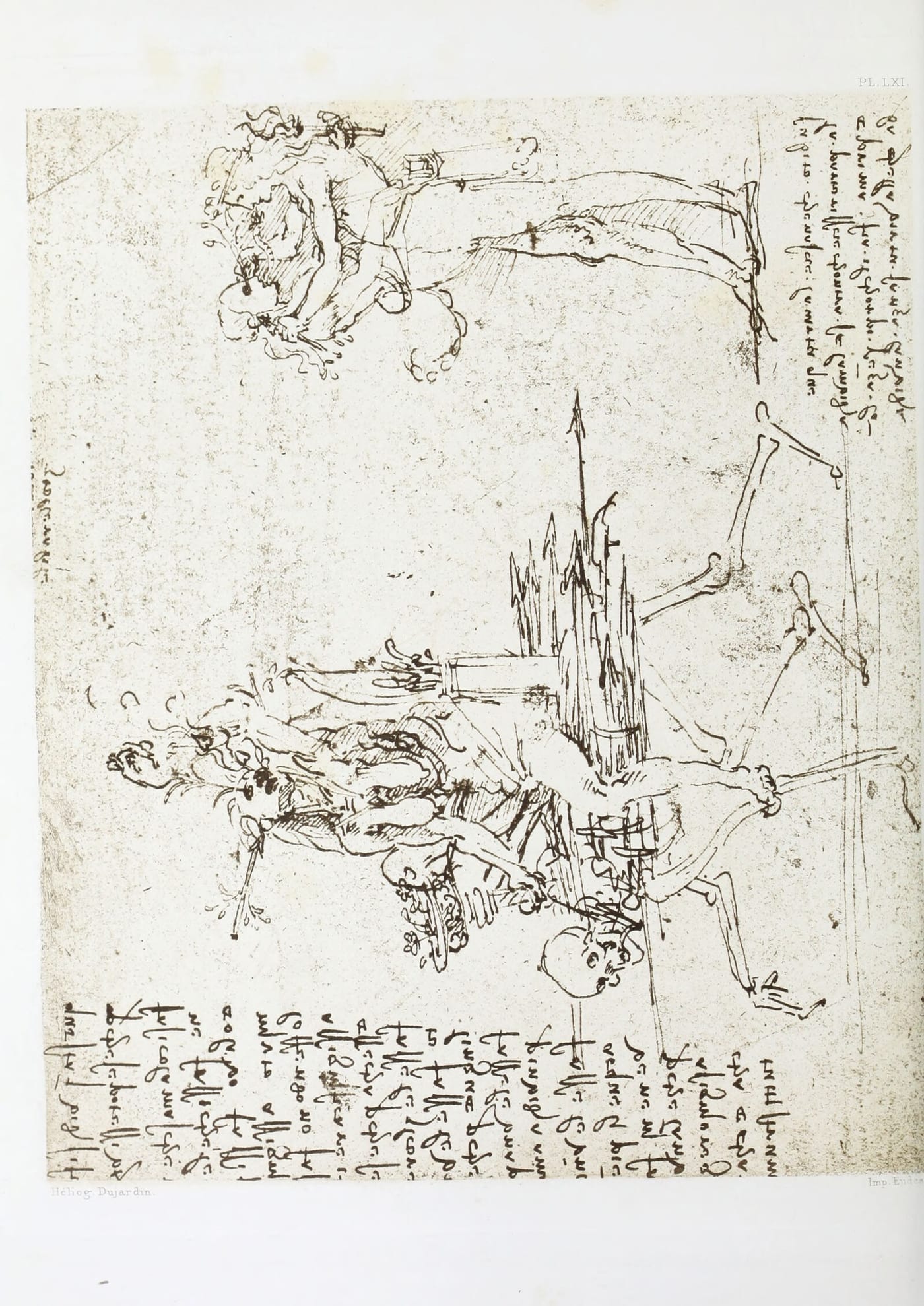
Ox. 2b · Pl. LXI
See Plate LXI, shown with § 676
When Pluto's Paradise is opened, then there may be devils placed in twelve pots like openings into hell. Here will be Death, the Furies, ashes, many naked children weeping; living fires made of various colours....
Br. M. 231b
John the Baptist
Saint Augustin
Saint Peter
Paul
Elisabeth
Saint Clara.
Bernardino
Our Lady Louis
Bonaventura
Anthony of Padua.
Saint Francis.
Francis,
Anthony, a lily and book;
Bernardino with the [monogram of] Jesus,
Louis with 3 fleur de lys on his breast and
the crown at his feet,
Bonaventura with Seraphim,
Saint Clara with the tabernacle,
Elisabeth with a Queen's crown.
I.2 59a
A head, full face, of a young man
with fine flowing hair,
Many flowers drawn from nature,
A head, full face, with curly hair,
Certain figures of Saint Jerome,
The measurements of a figure,
Drawings of furnaces.
A head of the Duke,
many designs for knots,
4 studies for the panel of Saint Angelo
A small composition of Girolamo da Fegline,
A head of Christ done with the pen,
8 Saint Sebastians,
Several compositions of Angels,
A chalcedony,
A head in profile with fine hair,
Some pitchers seen in(?) perspective,
Some machines for ships,
Some machines for waterworks,
A head, a portrait of Atalanta raising her
face;
The head of Geronimo da Fegline,
The head of Gian Francisco Borso,
Several throats of old women,
Several heads of old men,
Several nude figures, complete,
Several arms, eyes, feet, and positions,
A Madonna, finished,
Another, nearly in profile,
Head of Our Lady ascending into Heaven,
A head of an old man with long chin,
A head of a gypsy girl,
A head with a hat on,
A representation of the Passion, a cast,
A head of a girl with her hair gathered in a knot,
A head, with the brown hair dressed.
C. A. 317a; 959a
Stubborn rigour. Doomed rigour.
.
W. 243 · Pl. LXII, No. 2
See Plate LXII, shown with § 664
Obstacles cannot crush me Every obstacle yields to stern resolve He who is fixed to a star does not change his mind.
W. L. 198a
See Plate LXII, shown with § 664
Ivy is [a type] of longevity.
W. L. 198b
Truth the sun. falsehood a mask. innocence, malignity.
Fire destroys falsehood, that is sophistry, and restores truth, driving out darkness.
Fire may be represented as the destroy of all sophistry, and as the image and demonstration of truth; because it is light and drives out darkness which conceals all essences [or subtle things].
TRUTH.
Fire destroys all sophistry, that is deceit; and maintains truth alone, that is gold.
Truth at last cannot be hidden. Dissimulation is of no avail. Dissimulation is to no purpose before so great a judge. Falsehood puts on a mask. Nothing is hidden under the sun.
Fire is to represent truth because it destroys all sophistry and lies; and the mask is for lying and falsehood which conceal truth.
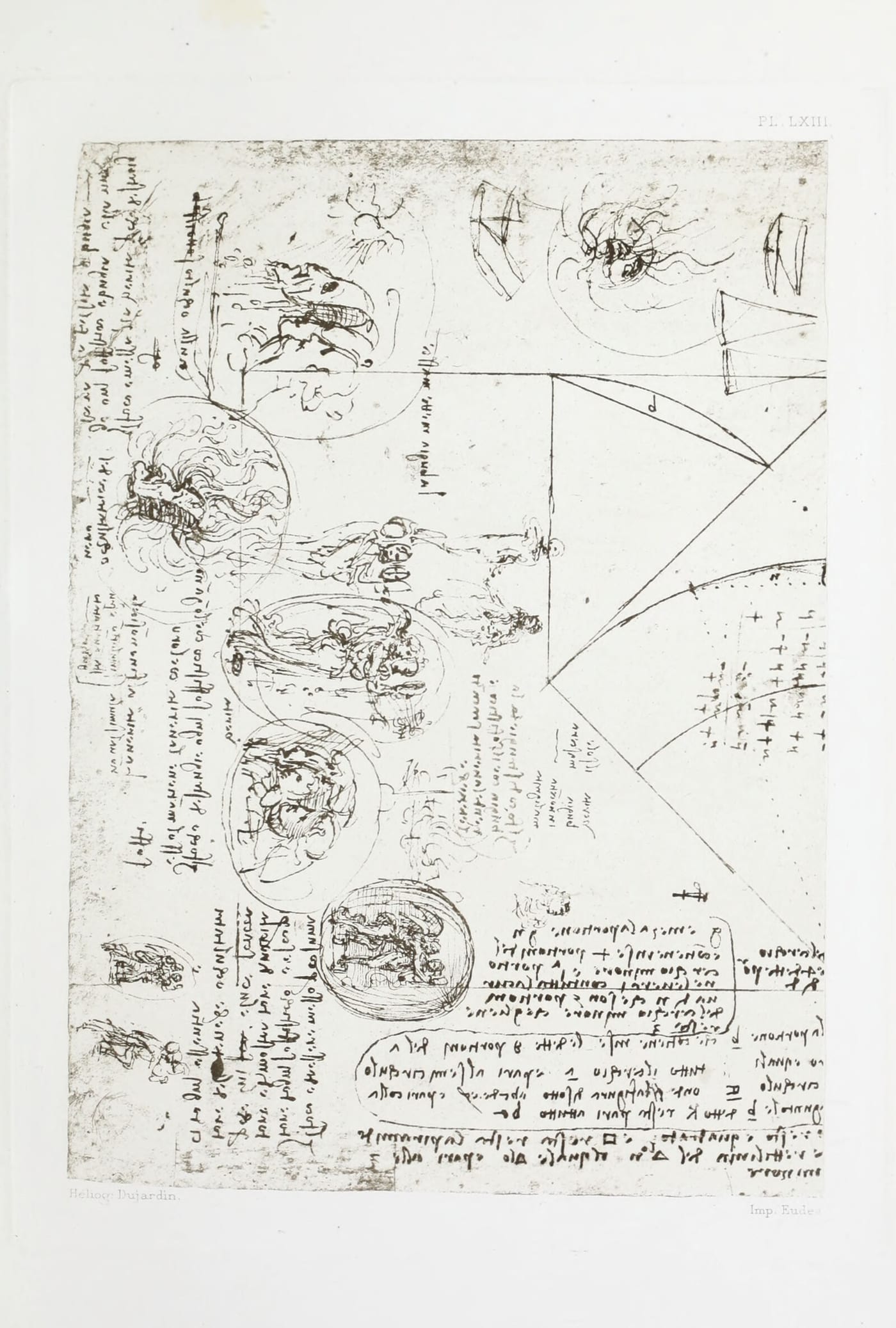
W. P. 11a · Pl. LXIII
Movement will cease before we are weary of being useful.
Movement will fail sooner than usefulness. Death sooner than I am never weary of weariness. being useful, In serving others I is a motto for carnval. cannot do enough. Without fatigue.
No labour is sufficient to tire me.
Hands into which ducats and precious stones fall like snow; they never become tired by serving, but this service is only for its utility and not for our I am never weary own benefit. of being useful.
Naturally nature has so disposed me.
W. P. 11b
This shall be placed in the hand of Ingratitude. Wood nourishes the fire that consumes it.
Ash. I. 1a
When the sun appears which dispels darkness in general, you put out the light which dispelled it for you in particular for your need and convenience.
Br. M. 173a
On this side Adam and Eve on the other; O misery of mankind, of how many things do you make yourself the slave for money!
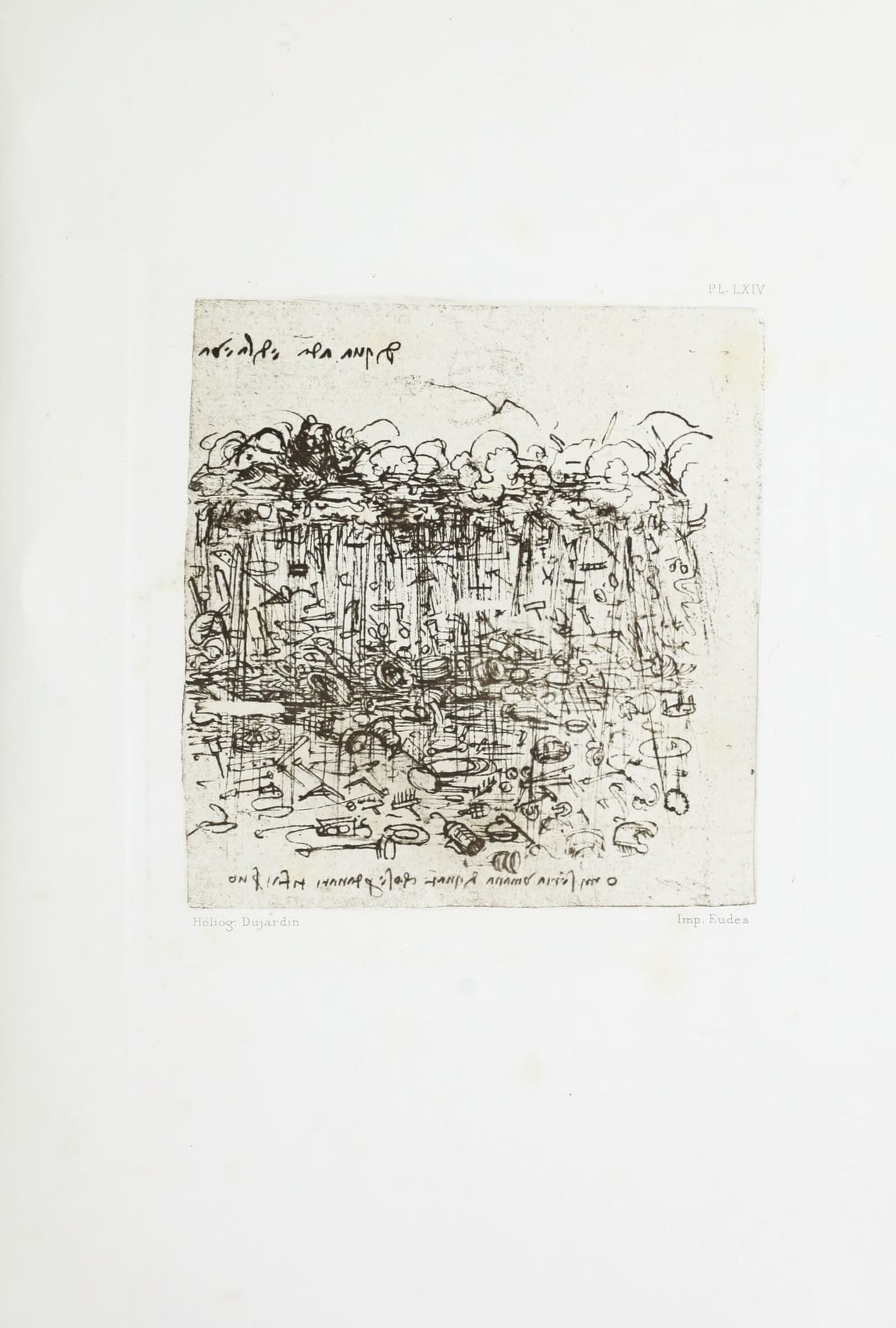
W. IX · Pl. LXIV
Thus are base unions sundered.
H.3 51b
Constancy does not begin, but is that which perseveres.
H.3 53a
Love, Fear, and Esteem,—Write these on three stones. Of servants.
H.3 70a
Prudence Strength.
H.2 1b
Fame alone raises herself to Heaven, because virtuous things are in favour with God.
Disgrace should be represented upside down, because all her deeds are contrary to God and tend to hell.
H.2 13a
Short liberty.
H.2 15b
Nothing is so much to be feared as Evil
Report.
This Evil Report is born of life.
H.1 40a
Not to disobey.
H.1 40b
A felled tree which is shooting again.
I am still hopeful.
A falcon,
Time.
S. K. M. II.2 1b
Truth here makes Falsehood torment lying tongues.
F. o"
Such as harm is when it hurts me not, is good which avails me not.
M. 4a · Pl. LX, No. 2 · Pl. LXII, No. 2
See Plate LX, shown with § 676
Compare Plate LXII, shown with § 664
He who offends others, does not secure himself.
M. 4b · Pl. LX, No. 3
See Plate LX, shown with § 676
Ingratitude.
M. 5a · Pl. LX, No. 4
See Plate LX, shown with § 676
One's thoughts turn towards Hope.
C. A. 67b; 203b
A bird, for a comedy.
C. A. 228b; 687b
To make a beautiful dress cut it in thin cloth and give it an odoriferous varnish, made of oil of turpentine and of varnish in grain, with a pierced stencil, which must be wetted, that it may not stick to the cloth; and this stencil may be made in a pattern of knots which afterwards may be filled up with black and the ground with white millet.
I.2 1b
Snow taken from the high peaks of mountains might be carried to hot places and let to fall at festivals in open places at summer time.
Mz. 10a


