Every man, at three years old is half the full height he will grow to at last.
H.1 31b
Mixwell Library › Leonardo da Vinci › The Notebooks › Part VII
The Notebooks of Leonardo da Vinci · translated by Jean Paul Richter · § 308 to 392 · 21 plates · public domain · plain text
Nothing in this part mentions that.
Richter’s introduction to this part
Leonardo's researches on the proportions and movements of the human figure must have been for the most part completed and written before the year 1498; for LUCA PACIOLO writes, in the dedication to Ludovico il Moro, of his book Divina Proportione, which was published in that year: "Leonardo da venci ... hauedo gia co tutta diligetia al degno libro de pictura e movimenti humani posto fine".
The selection of Leonardo's axioms contained in the Vatican copy attributes these words to the author: "e il resto si dira nella universale misura del huomo". (MANZI, p. 147; LUDWIG, No. 264). LOMAZZO, again, in his Idea del Tempio della Pittura Milano 1590, cap. IV, says: "Lionardo Vinci ... dimostro anco in figura tutte le proporzioni dei membri del corpo umano".
The Vatican copy includes but very few sections of the "Universale misura del huomo" and until now nothing has been made known of the original MSS. on the subject which have supplied the very extensive materials for this portion of the work. The collection at Windsor, belonging to her Majesty the Queen, includes by far the most important part of Leonardo's investigations on this subject, constituting about half of the whole of the materials here published; and the large number of original drawings adds greatly to the interest which the subject itself must command. Luca Paciolo would seem to have had these MSS. (which I have distinguished by the initials W. P.) in his mind when he wrote the passage quoted above. Still, certain notes of a later date—such as Nos. 360, 362 and 363, from MS. E, written in 1513–14, sufficiently prove that Leonardo did not consider his earlier studies on the Proportions and Movements of the Human Figure final and complete, as we might suppose from Luca Paciolo's statement. Or else he took the subject up again at a subsequent period, since his former researches had been carried on at Milan between 1490 and 1500. Indeed it is highly probable that the anatomical studies which he was pursuing zvith so much zeal between 1510–16 should have led him to reconsider the subject of Proportion.
Every man, at three years old is half the full height he will grow to at last.
H.1 31b
If a man 2 braccia high is too small, one of four is too tall, the medium being what is admirable. Between 2 and 4 comes 3; therefore take a man of 3 braccia in height and measure him by the rule I will give you. If you tell me that I may be mistaken, and judge a man to be well proportioned who does not conform to this division, I answer that you must look at many men of 3 braccia, and out of the larger number who are alike in their limbs choose one of those who are most graceful and take your measurements. The length of the hand is 1/3 of a braccio [8 inches] and this is found 9 times in man. And the face is the same, and from the pit of the throat to the shoulder, and from the shoulder to the nipple, and from one nipple to the other, and from each nipple to the pit of the throat.
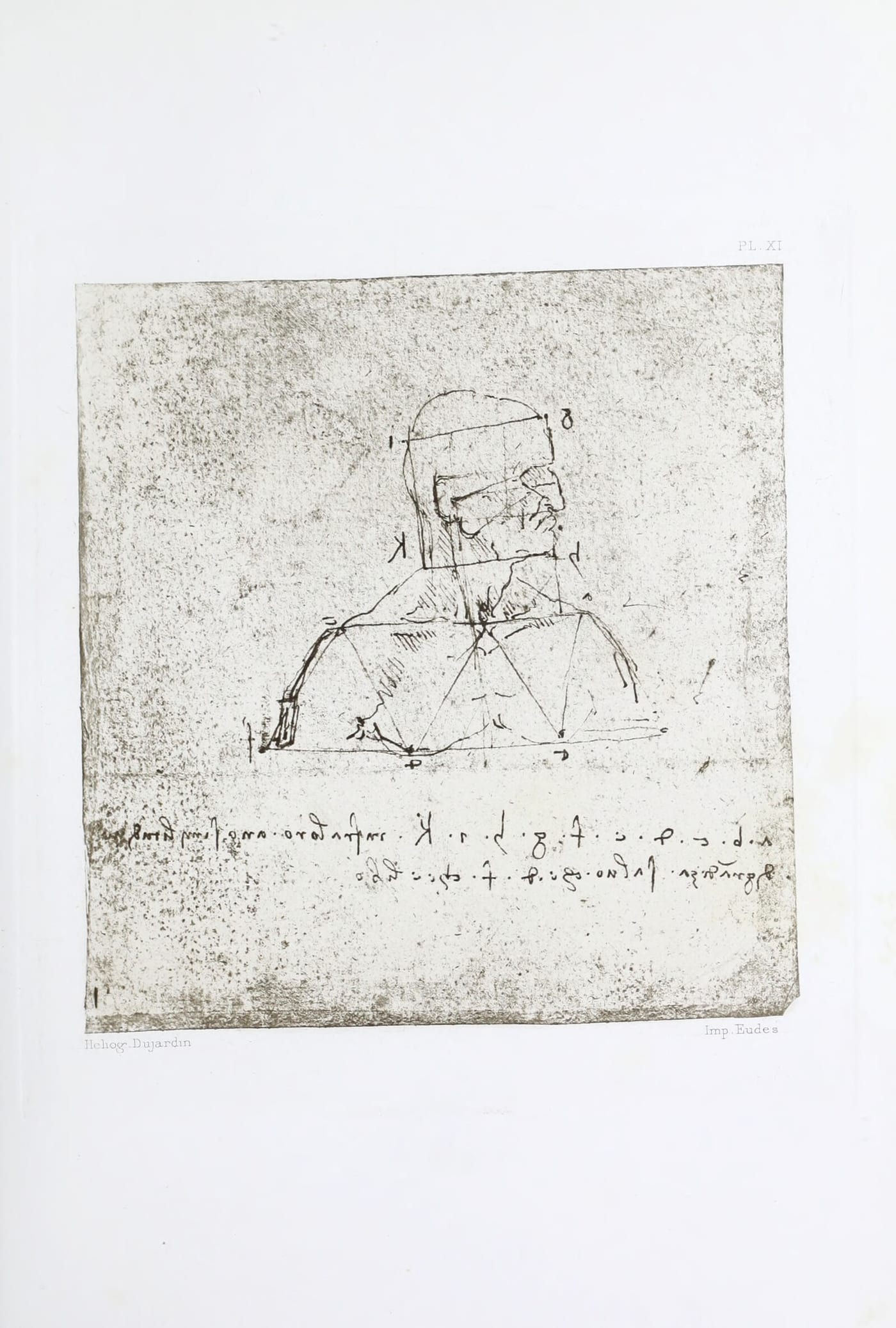
C. A. 157a; 463a · Pl. XI
The space between the parting of the lips [the mouth] and the base of the nose is one-seventh of the face.
The space from the mouth to the bottom of the chin c d is the fourth part of the face and equal to the width of the mouth.
The space from the chin to the base of the nose e f is the third part of the face and equal to the length of the nose and to the forehead.
The distance from the middle of the nose to the bottom of the chin g h, is half the length of the face.
The distance from the top of the nose, where the eyebrows begin, to the bottom of the chin, i k, is two thirds of the face.
The space from the parting of the lips to the top of the chin l m, that is where the chin ends and passes into the lower lip of the mouth, is the third of the distance from the parting of the lips to the bottom of the chin and is the twelfth part of the face. From the top to the bottom of the chin m n is the sixth part of the face and is the fifty fourth part of a man's height.
From the farthest projection of the chin to the throat o p is equal to the space between the mouth and the bottom of the chin, and a fourth of the face.
The distance from the top of the throat to the pit of the throat below q r is half the length of the face and the eighteenth part of a man's height.
From the chin to the back of the neck s t, is the same distance as between the mouth and the roots of the hair, that is three quarters of the head.
From the chin to the jaw bone v x is half the head and equal to the thickness of the neck in profile.
The thickness of the head from the brow to the nape is once and 3/4 that of the neck.
The distance from the attachment of one ear to the other is equal to that from the meeting of the eyebrows to the chin, and in a fine face the width of the mouth is equal to the length from the parting of the lips to the bottom of the chin.
A. 62b
The cut or depression below the lower lip of the mouth is half way between the bottom of the nose and the bottom of the chin.
The face forms a square in itself; that is its width is from the outer corner of one eye to the other, and its height is from the very top of the nose to the bottom of the lower lip of the mouth; then what remains above and below this square amounts to the height of such another square, a b is equal to the space between c d; d n in the same way to n c, and likewise s r, q p, h k are equal to each other.
It is as far between m and s as from the bottom of the nose to the chin. The ear is exactly as long as the nose. It is as far from x to j as from the nose to the chin. The parting of the mouth seen in profile slopes to the angle of the jaw. The ear should be as high as from the bottom of the nose to the top of the eye-lid. The space between the eyes is equal to the width of an eye. The ear is over the middle of the neck, when seen in profile. The distance from 4 to 5 is equal to that from s to r.
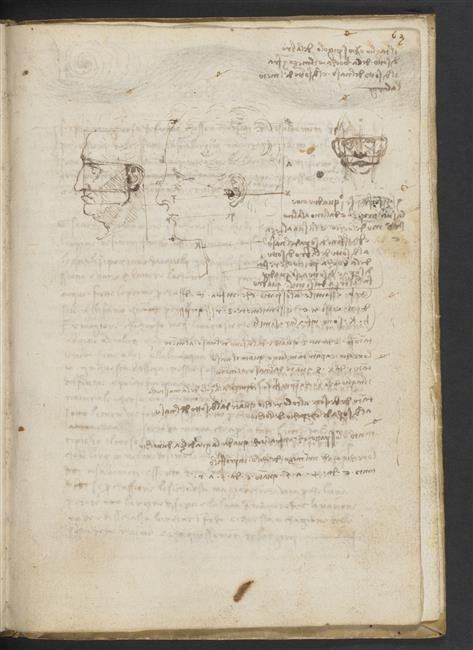
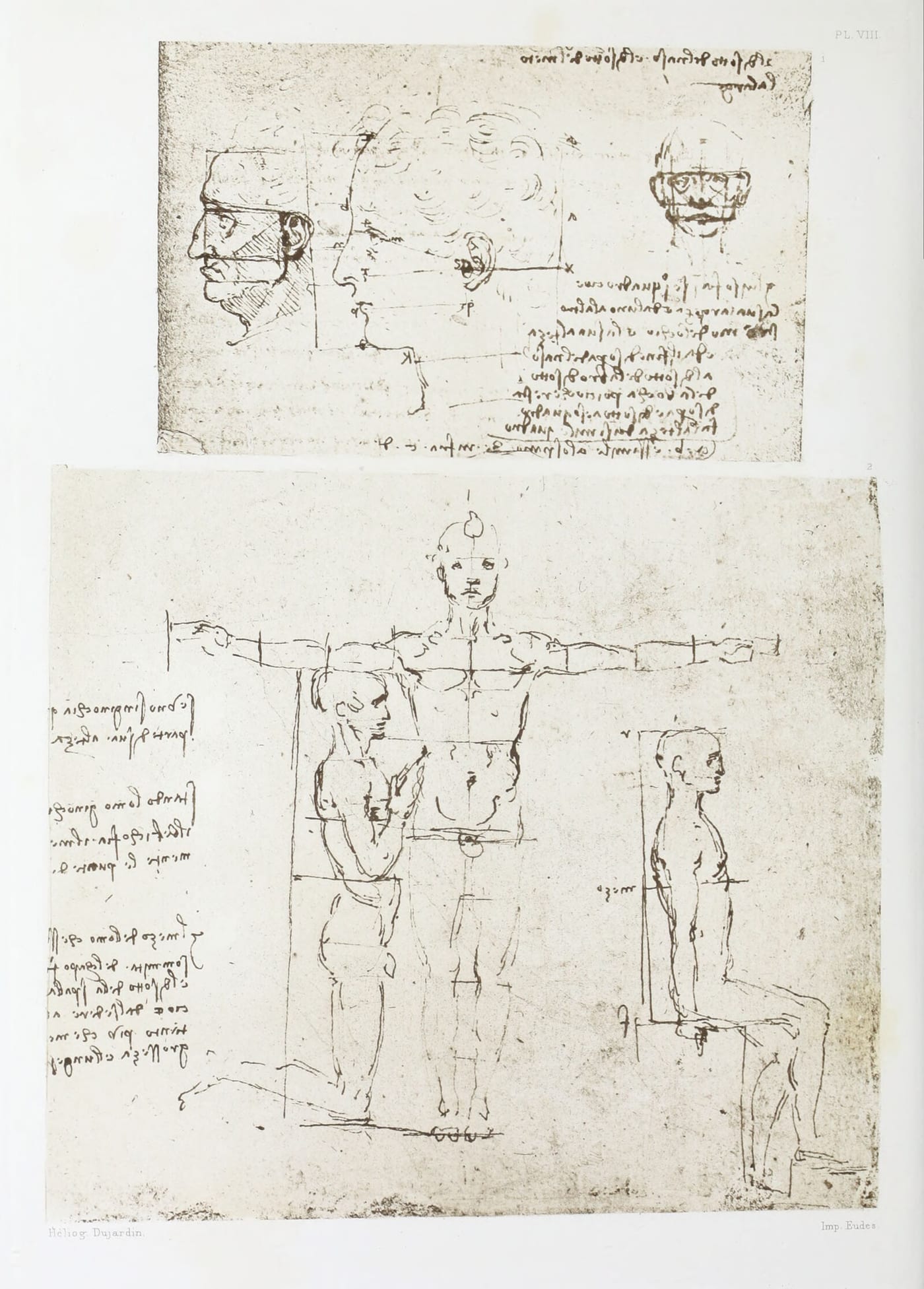
A. 63a · Pl. VIII, No. 1
(a b) is equal to (c d).
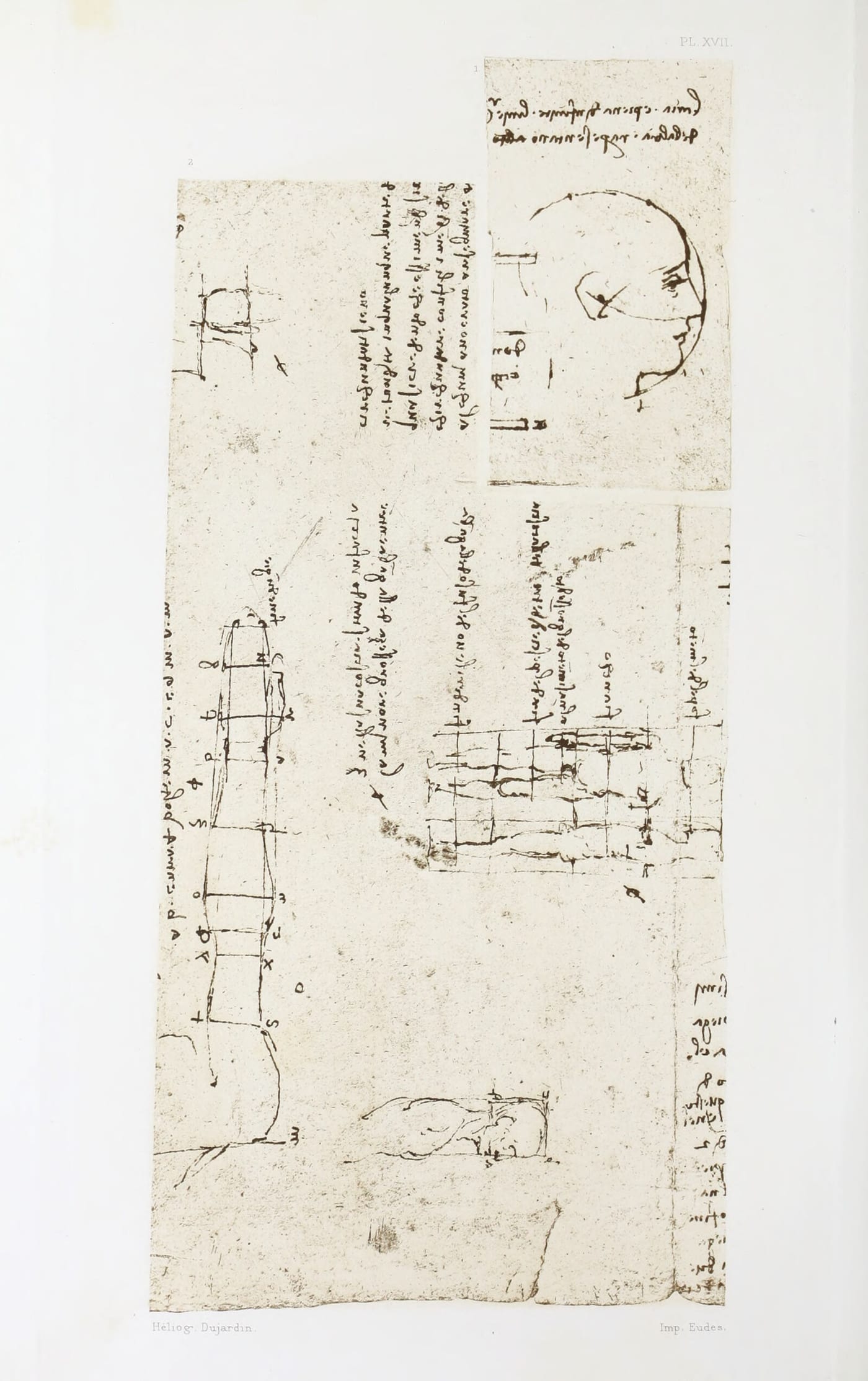
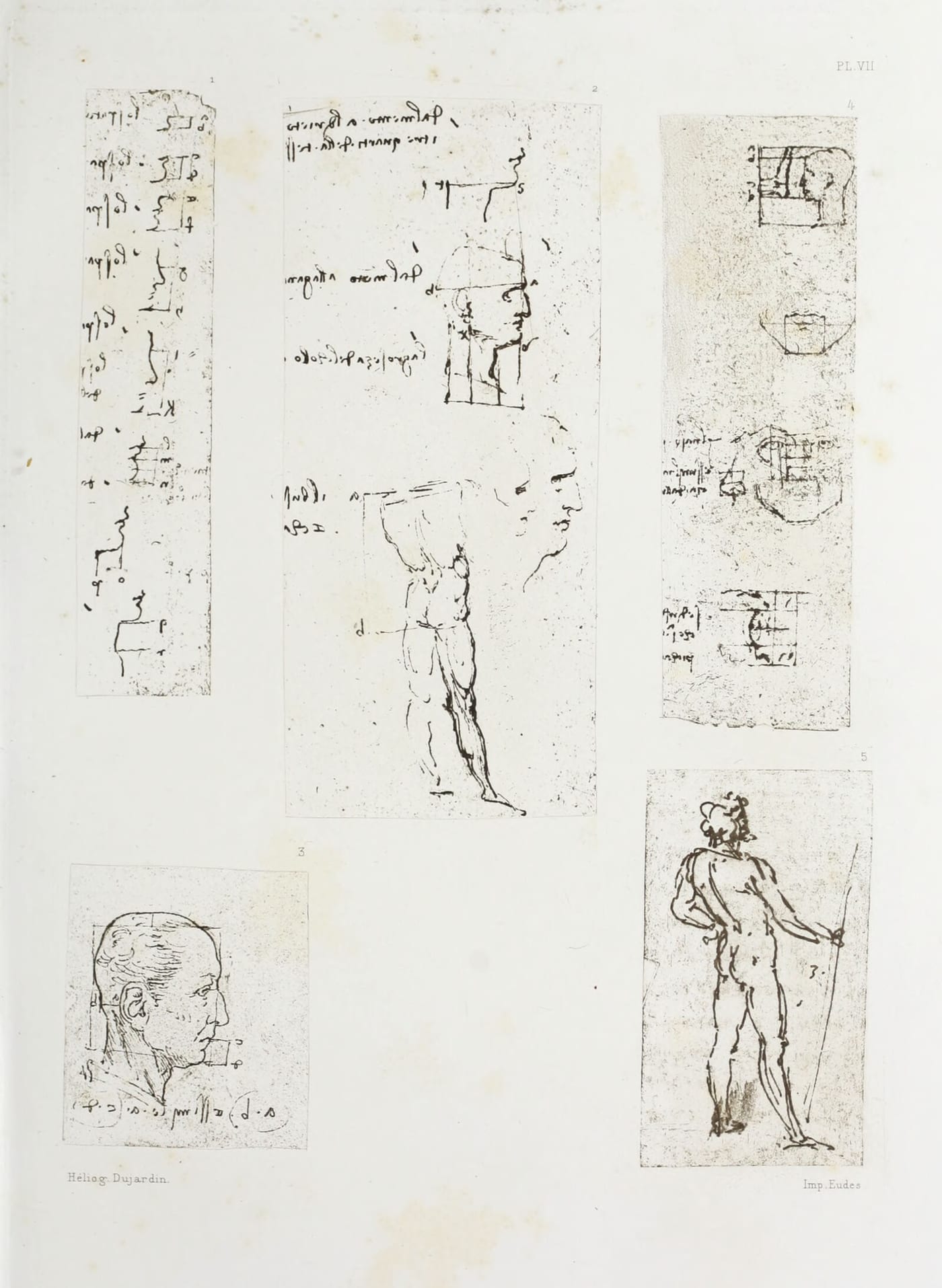
W. P. 119a · Pl. VII, No. 3 · Pl. XVII, No. 2 · W. P. 5a · MS. A 2b
See Plate VII, shown with § 310
The head a f 1/6 larger than n f.
W. P. 7a
From the eyebrow to the junction of the lip with the chin, and the angle of the jaw and the upper angle where the ear joins the temple will be a perfect square. And each side by itself is half the head.
The hollow of the cheek bone occurs half way between the tip of the nose and the top of the jaw bone, which is the lower angle of the setting on of the ear, in the frame here represented.
From the angle of the eye-socket to the ear is as far as the length of the ear, or the third of the face.
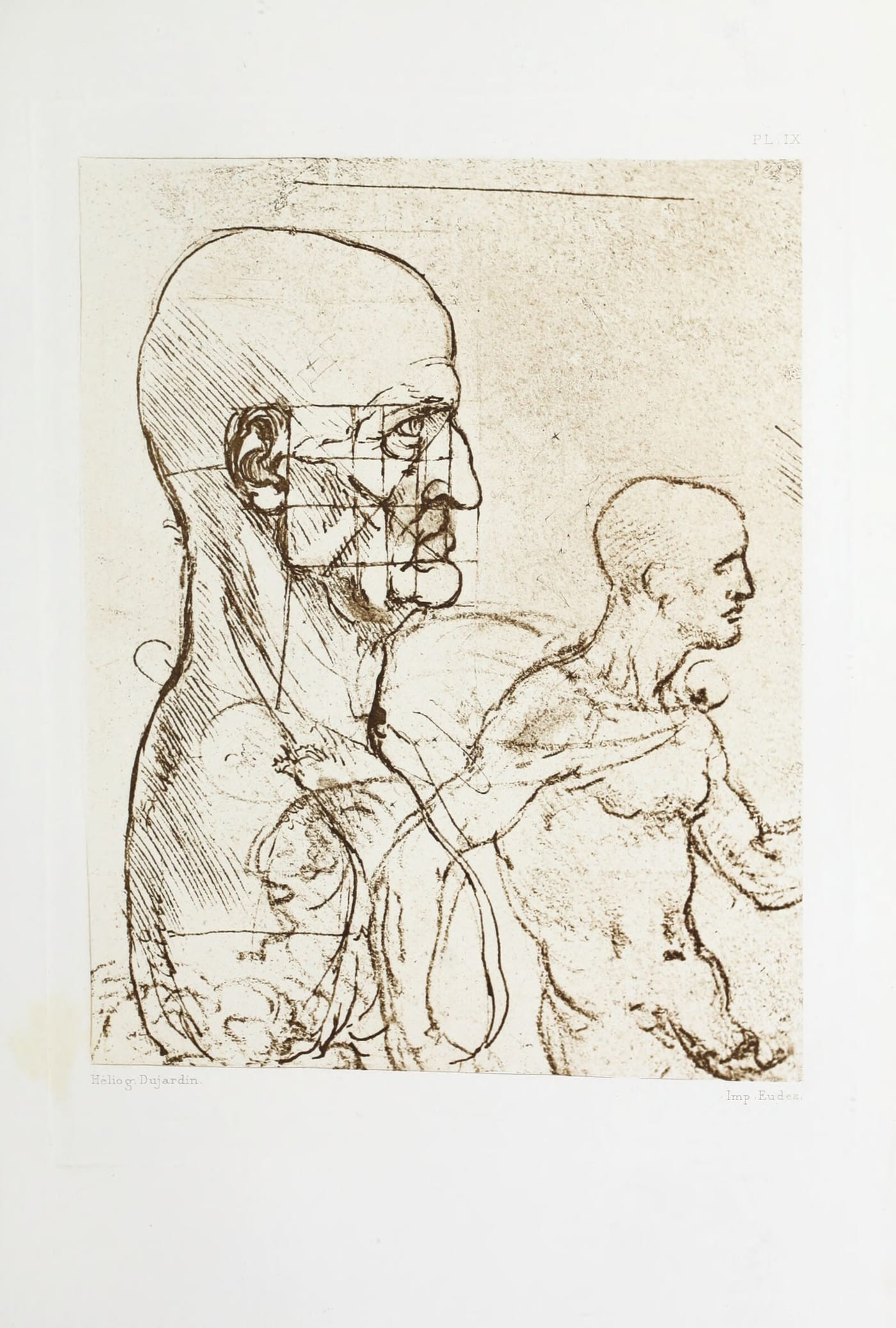
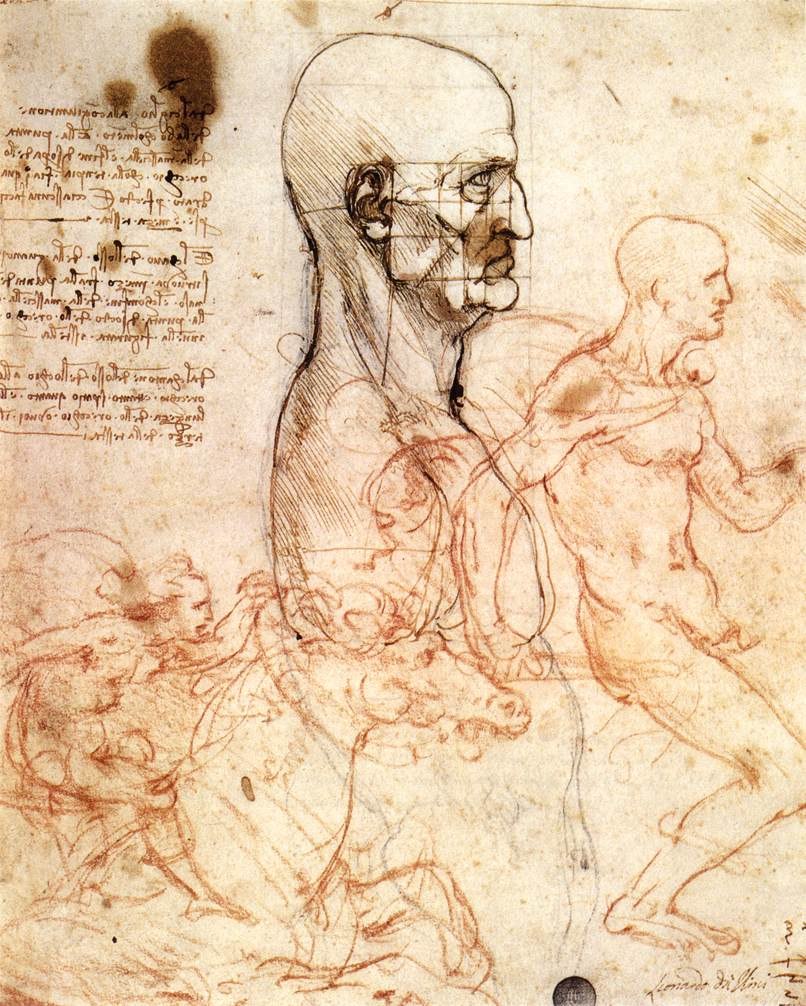
Ven. Ac. IV. 16 · Pl. IX
From a to b—that is to say from the roots of the hair in front to the top of the head—ought to be equal to c d;—that is from the bottom of the nose to the meeting of the lips in the middle of the mouth. From the inner corner of the eye m to the top of the head a is as far as from m down to the chin s. s c f b are all at equal distances from each other.
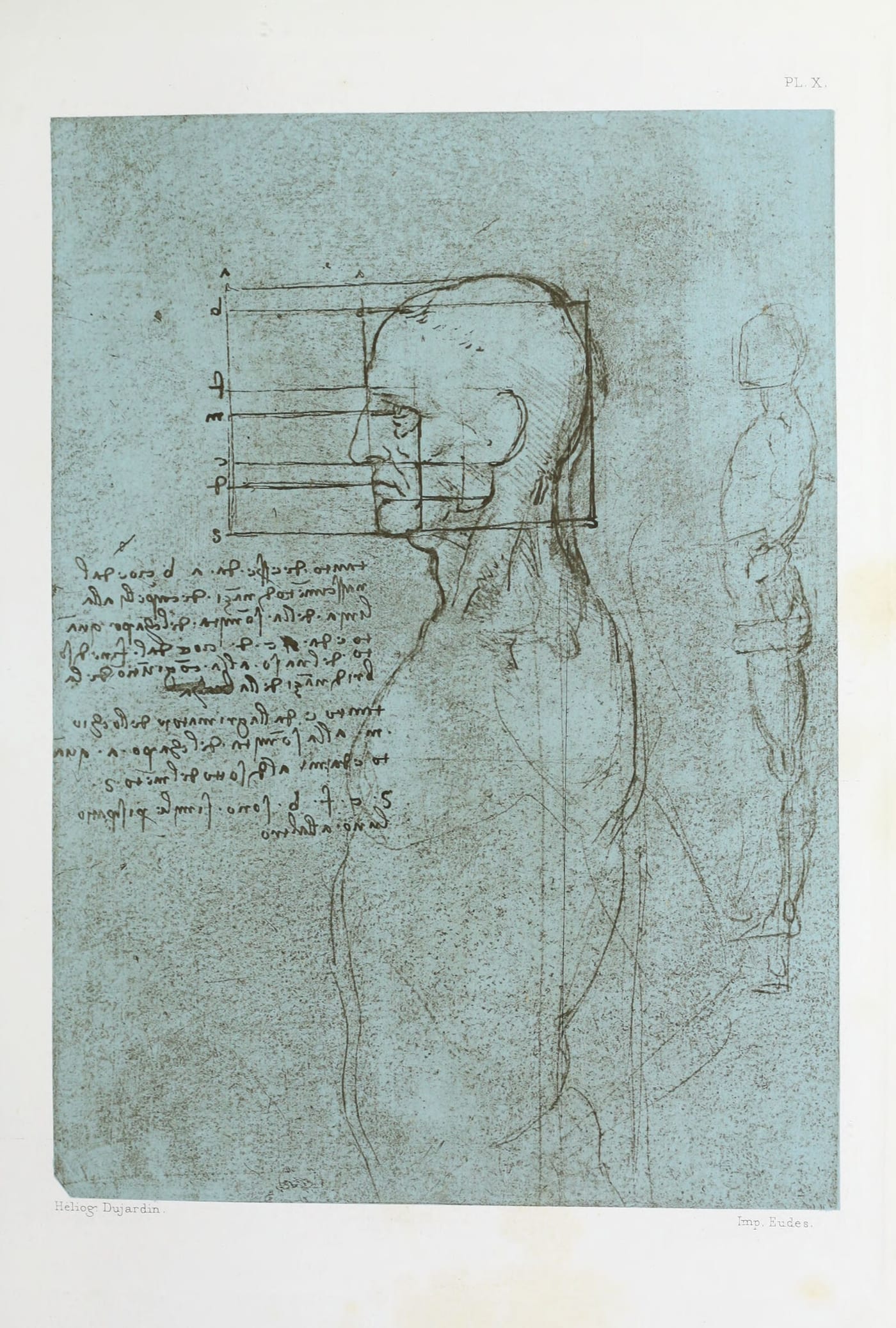
W. P. 12 · Pl. X
From the top of the head to the bottom of the chin is 1/9, and from the roots of the hair to the chin is 1/9 of the distance from the roots of the hair to the ground. The greatest width of the face is equal to the space between the mouth and the roots of the hair and is 1/12 of the whole height. From the top of the ear to the top of the head is equal to the distance from the bottom of the chin to the lachrymatory duct of the eye; and also equal to the distance from the angle of the chin to that of the jaw; that is the 1/16 of the whole. The small cartilage which projects over the opening of the ear towards the nose is half-way between the nape and the eyebrow; the thickness of the neck in profile is equal to the space between the chin and the eyes, and to the space between the chin and the jaw, and it is 1/18 of the height of the man.
W. P. 5a
a b, c d, e f, g h, i k are equal to each other in size excepting that d f is accidental.
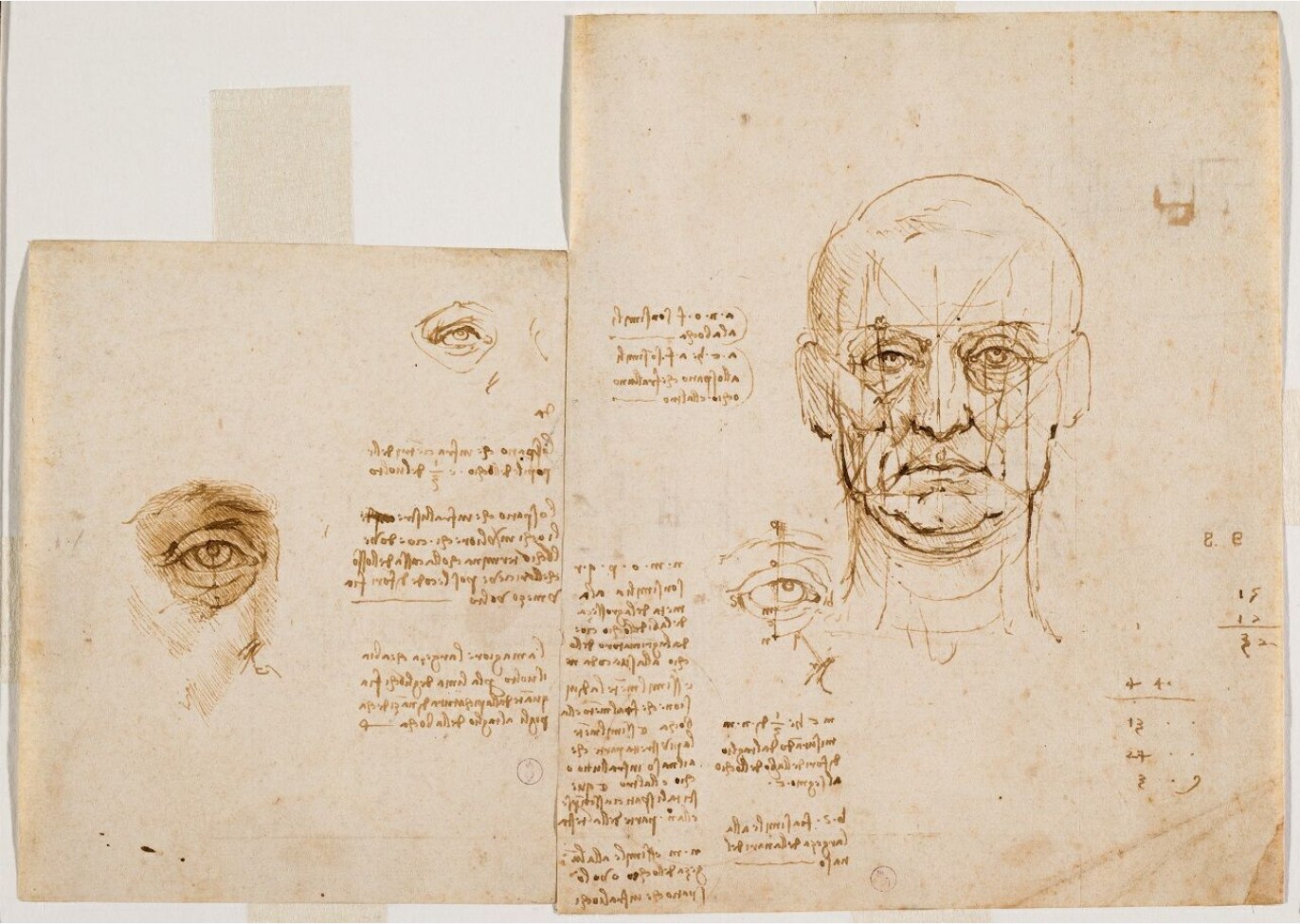
W. P. 3. Ia · Pl. XI
See Plate XI, shown with § 309
a n o f are equal to the mouth.
a c and a f are equal to the space between one eye and the other.
n m o f q r are equal to half the width of the eye lids, that is from the inner [lachrymatory] corner of the eye to its outer corner; and in like manner the division between the chin and the mouth; and in the same way the narrowest part of the nose between the eyes. And these spaces, each in itself, is the 19th part of the head, n o is equal to the length of the eye or of the space between the eyes.
m c is 1/3 of n m measuring from the outer corner of the eyelids to the letter c. b s will be equal to the width of the nostril.
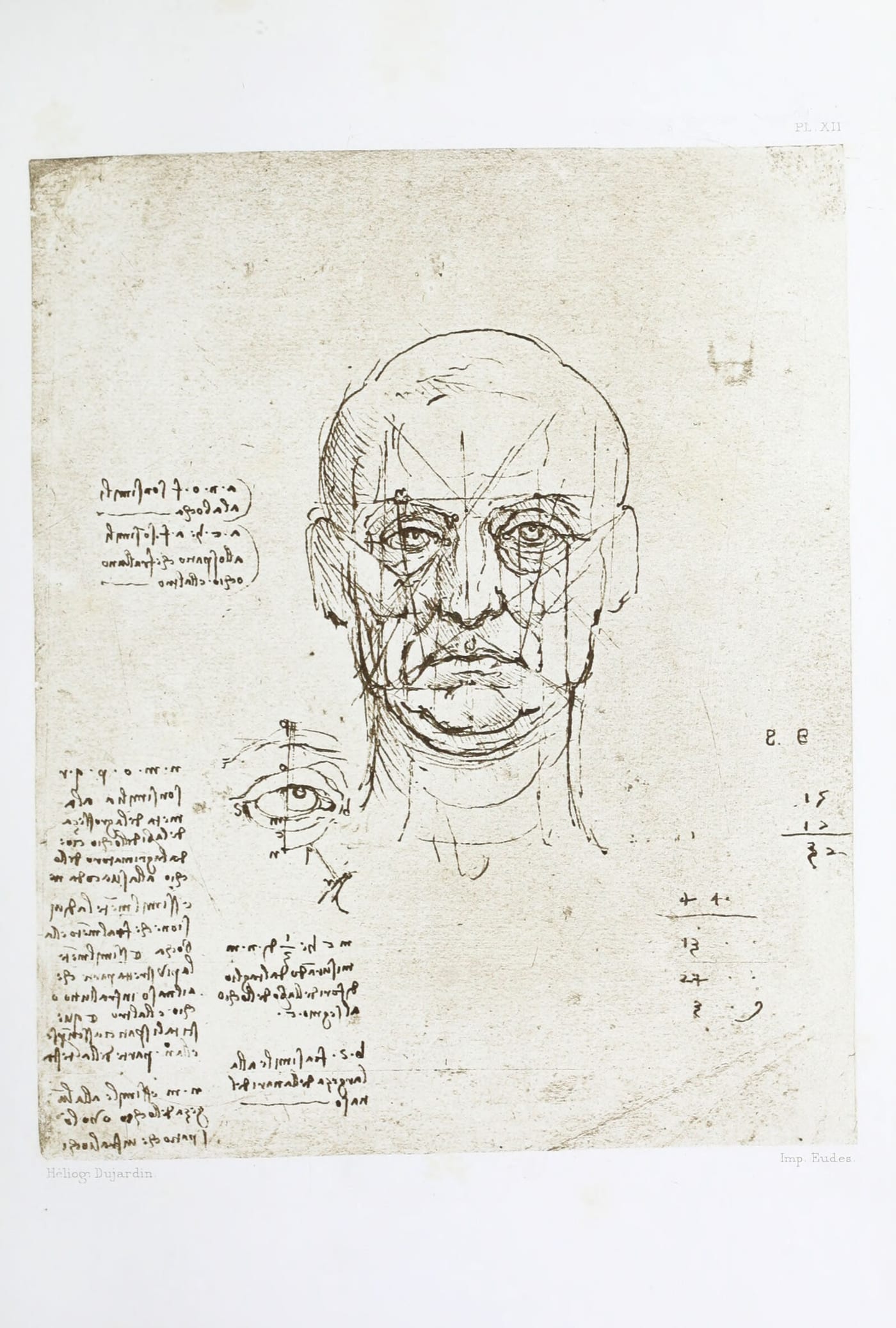
Tur. 7 · Pl. XII
The distance between the centres of the pupils of the eyes is 1/3 of the face. The space between the outer corners of the eyes, that is where the eye ends in the eye socket which contains it, thus the outer corners, is half the face.
The greatest width of the face at the line of the eyes is equal to the distance from the roots of the hair in front to the parting of the lips.
Tur. 11
The nose will make a double square; that is the width of the nose at the nostrils goes twice into the length from the tip of the nose to the eyebrows. And, in the same way, in profile the distance from the extreme side of the nostril where it joins the cheek to the tip of the nose is equal to the width of the nose in front from one nostril to the other. If you divide the whole length of the nose—that is from the tip to the insertion of the eyebrows, into 4 equal parts, you will find that one of these parts extends from the tip of the nostrils to the base of the nose, and the upper division lies between the inner corner of the eye and the insertion of the eyebrows; and the two middle parts [together] are equal to the length of the eye from the inner to the outer corner.
W. P. 3. II · Pl. VII, No. 4
See Plate VII, shown with § 310
The great toe is the sixth part of the foot, taking the measure in profile, on the inside of the foot, from where this toe springs from the ball of the sole of the foot to its tip a b; and it is equal to the distance from the mouth to the bottom of the chin. If you draw the foot in profile from the outside, make the little toe begin at three quarters of the length of the foot, and you will find the same distance from the insertion of this toe as to the farthest prominence of the great toe.
W. P. 1b
For each man respectively the distance between a b is equal to c d.
W. P. 8a
The foot is as much longer than the hand as the thickness of the arm at the wrist where it is thinnest seen facing.
Again, you will find that the foot is as much longer than the hand as the space between the inner angle of the little toe to the last projection of the big toe, if you measure along the length of the foot.
The palm of the hand without the fingers goes twice into the length of the foot without the toes.
If you hold your hand with the fingers straight out and close together you will find it to be of the same width as the widest part of the foot, that is where it is joined onto the toes.
And if you measure from the prominence of the inner ancle to the end of the great toe you will find this measure to be as long as the whole hand.
From the top angle of the foot to the insertion of the toes is equal to the hand from wrist joint to the tip of the thumb.
The smallest width of the hand is equal to the smallest width of the foot between its joint into the leg and the insertion of the toes.
The width of the heel at the lower part is equal to that of the arm where it joins the hand; and also to the leg where it is thinnest when viewed in front.
The length of the longest toe, from its first division from the great toe to its tip is the fourth of the foot from the centre of the ancle bone to the tip, and it is equal to the width of the mouth. The distance between the mouth and the chin is equal to that of the knuckles and of the three middle fingers and to the length of their first joints if the hand is spread, and equal to the distance from the joint of the thumb to the outset of the nails, that is the fourth part of the hand and of the face.
The space between the extreme poles inside and outside the foot called the ancle or ancle bone a b is equal to the space between the mouth and the inner corner of the eye.
W. P. 1a
The foot, from where it is attached to the leg, to the tip of the great toe is as long as the space between the upper part of the chin and the roots of the hair a b; and equal to five sixths of the face.
W. P. 4b
a d is a head's length, c b is a head's length. The four smaller toes are all equally thick from the nail at the top to the bottom, and are 1/13 of the foot.
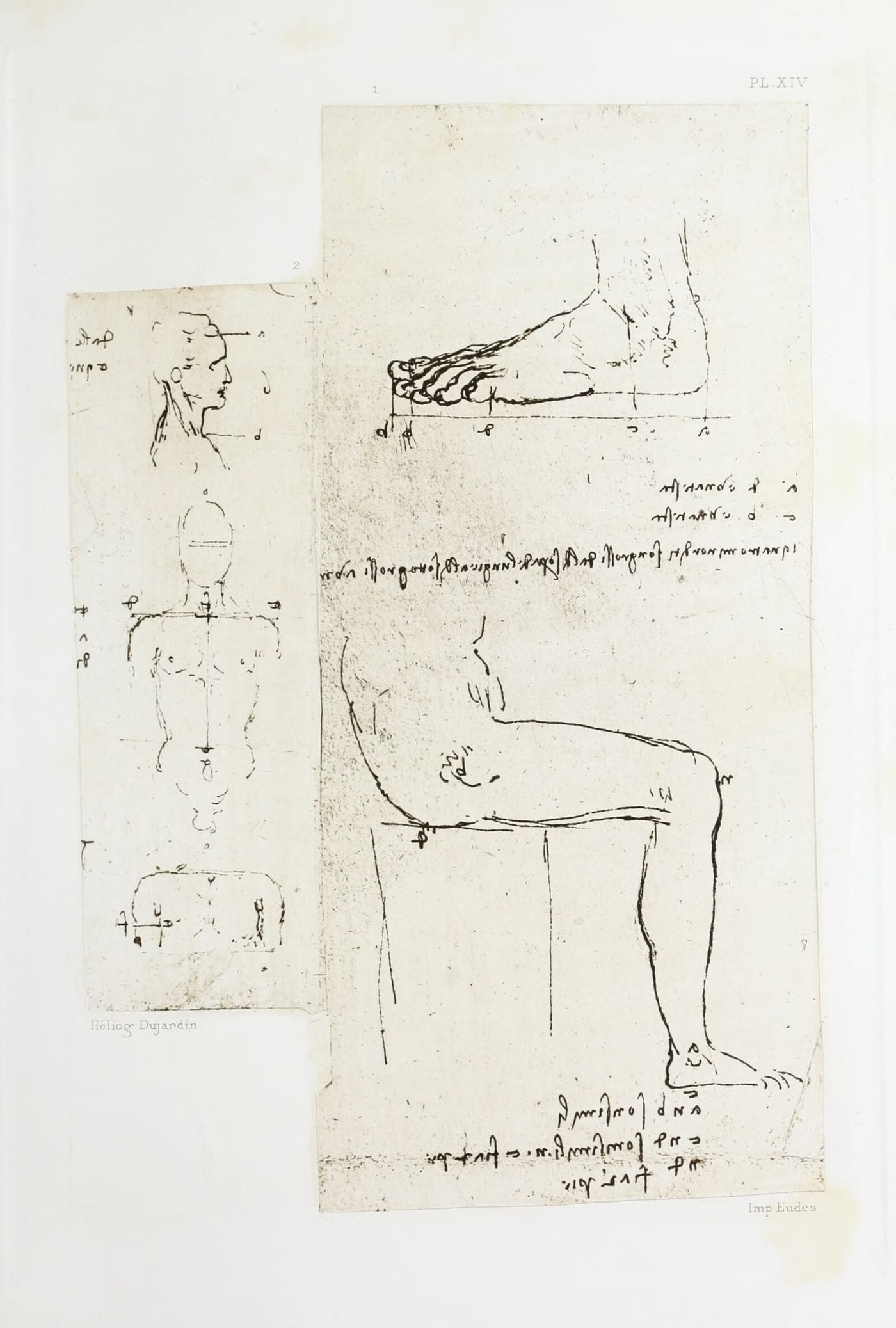
W. P. 7a · Pl. XIV, No. 1
The whole length of the foot will lie between the elbow and the wrist and between the elbow and the inner angle of the arm towards the breast when the arm is folded. The foot is as long as the whole head of a man, that is from under the chin to the topmost part of the head in the way here figured.
W. P. 3. IIa · Pl. VII, No. 4
See Plate VII, shown with § 310
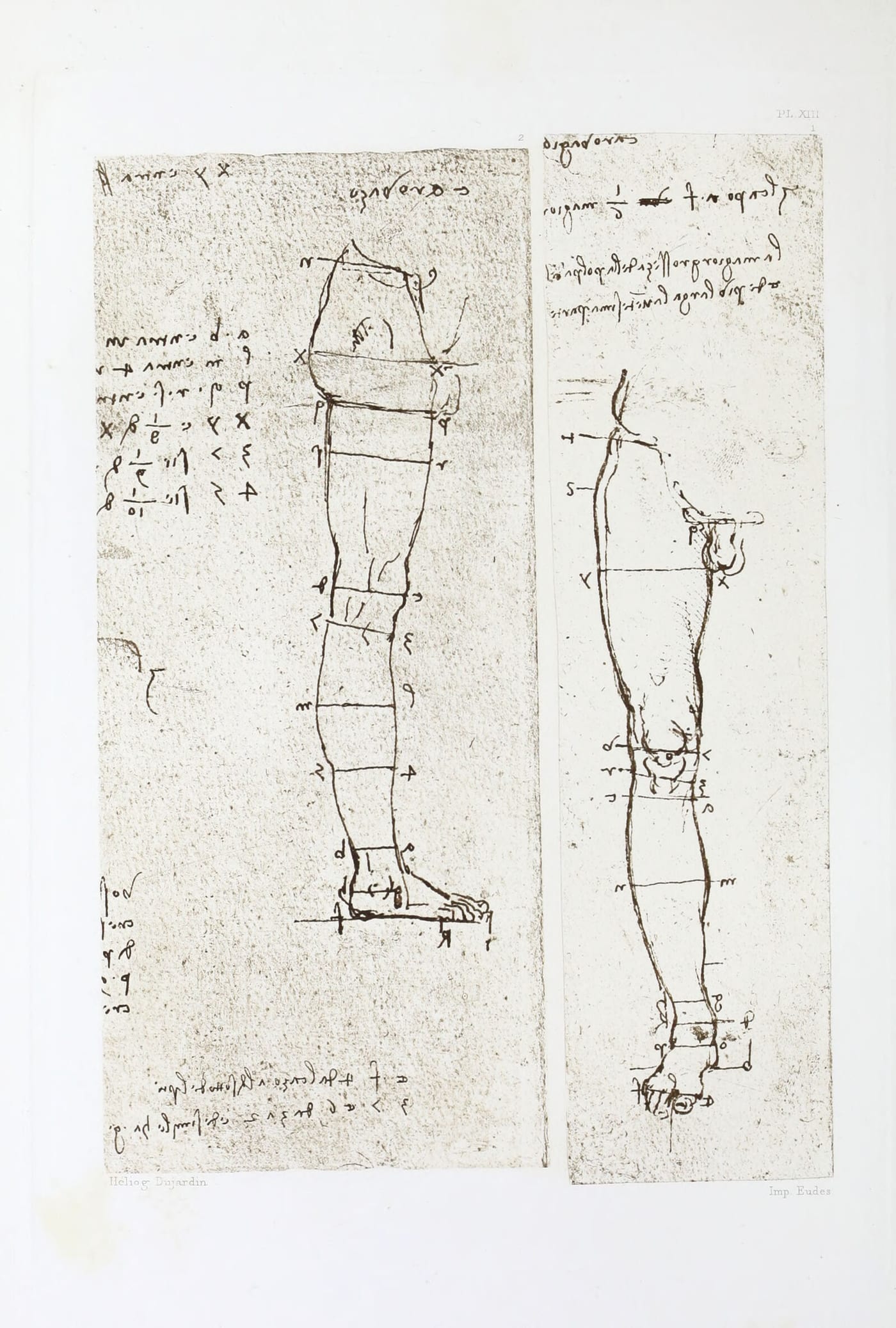
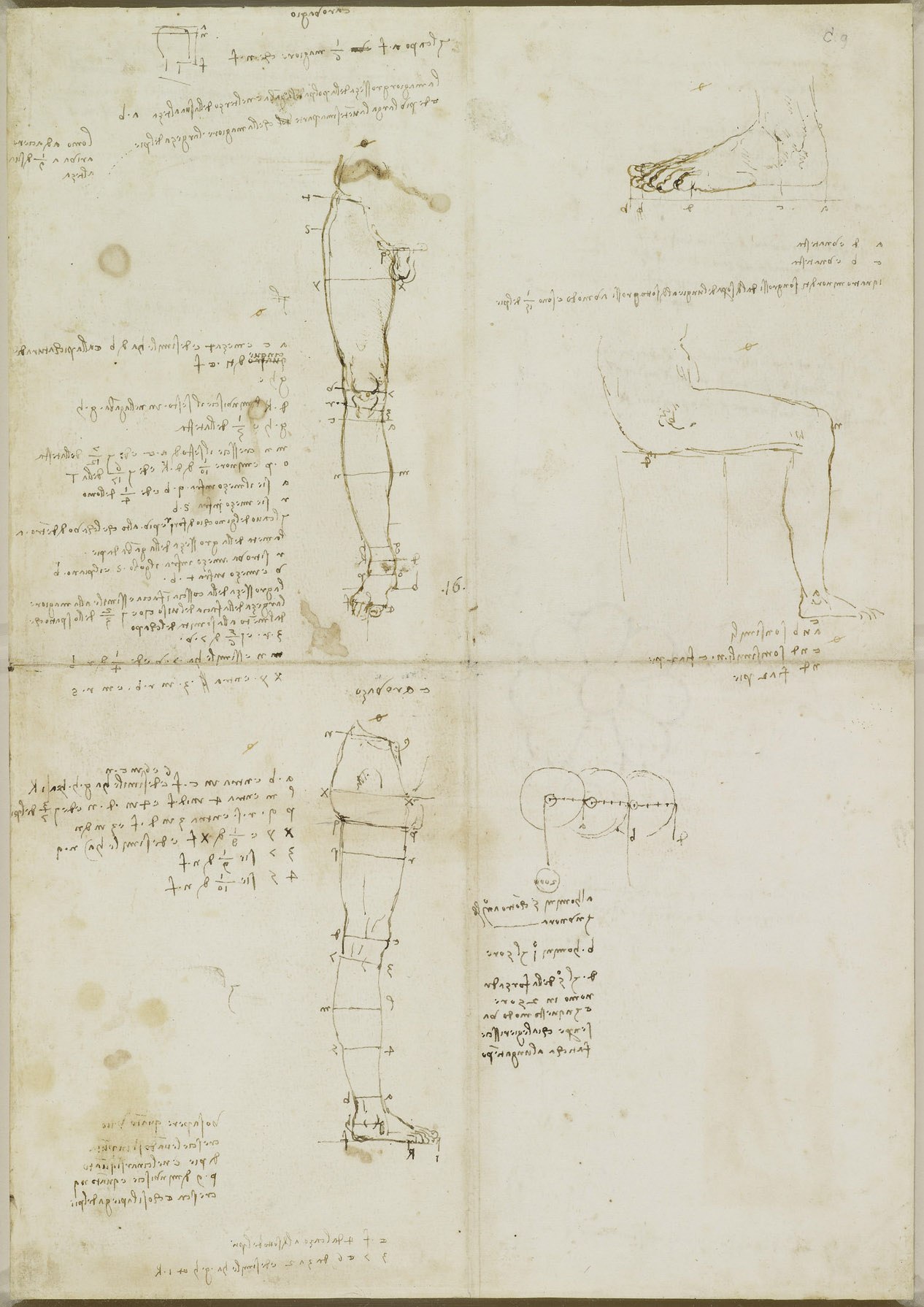
The greatest thickness of the calf of the leg is at a third of its height a b, and is a twentieth part thicker than the greatest thickness of the foot.
a c is half of the head, and equal to d b and to the insertion of the five toes e f. d k diminishes one sixth in the leg g h. g h is 1/3 of the head; m n increases one sixth from a e and is 7/12 of the head, o p is 1/10 less than d k and is 6/17 of the head. a is at half the distance between b q, and is 1/4 of the man. r is half way between s and b. The concavity of the knee outside r is higher than that inside a. The half of the whole height of the leg from the foot r, is half way between the prominence s and the ground b. v is half way between t and b. The thickness of the thigh seen in front is equal to the greatest width of the face, that is 2/3 of the length from the chin to the top of the head; z r is 5/6 of 7 to v; m n is equal to 7 v and is 1/4 of r b, x y goes 3 times into r b, and into r s.
a b goes six times into c f and six times into c n and is equal to g h; i k l m goes 4 times into d f, and 4 times into d n and is 3/7 of the foot; p q r s goes 3 times into d f, and 3 times into b n; x y is 1/8 of x f and is equal to n q. 3 7 is 1/9 of n f; 4 5 is 1/10 of n f .
I want to know how much a man increases in height by standing on tip-toe and how much p g diminishes by stooping; and how much it increases at n q likewise in bending the foot.
e f is four times in the distance between the genitals and the sole of the foot; 3 7 is six times from 3 to 2 and is equal to g h and i k.
The length of the foot from the end of the toes to the heel goes twice into that from the heel to the knee, that is where the leg bone [fibula] joins the thigh bone [femur].
B. 3b
a n b are equal; c n d are equal; n c makes two feet; n d makes 2 feet.
W. P. 7a · Pl. XIV, No. 1
See Plate XIV, shown with § 326
m n o are equal. The narrowest width of the leg seen in front goes 8 times from the sole of the foot to the joint of the knee, and is the same width as the arm, seen in front at the wrist, and as the longest measure of the ear, and as the three chief divisions into which we divide the face; and this measurement goes 4 times from the wrist joint of the hand to the point of the elbow. The foot is as long as the space from the knee between a and b; and the patella of the knee is as long as the leg between r and s.
The least thickness of the leg in profile goes 6 times from the sole of the foot to the knee joint and is the same width as the space between the outer corner of the eye and the opening of the ear, and as the thickest part of the arm seen in profile and between the inner corner of the eye and the insertion of the hair.
a b c [d] are all relatively of equal length, c d goes twice from the sole of the foot to the centre of the knee and the same from the knee to the hip.
a b c are equal; a to b is 2 feet—that is to say measuring from the heel to the tip of the great toe.
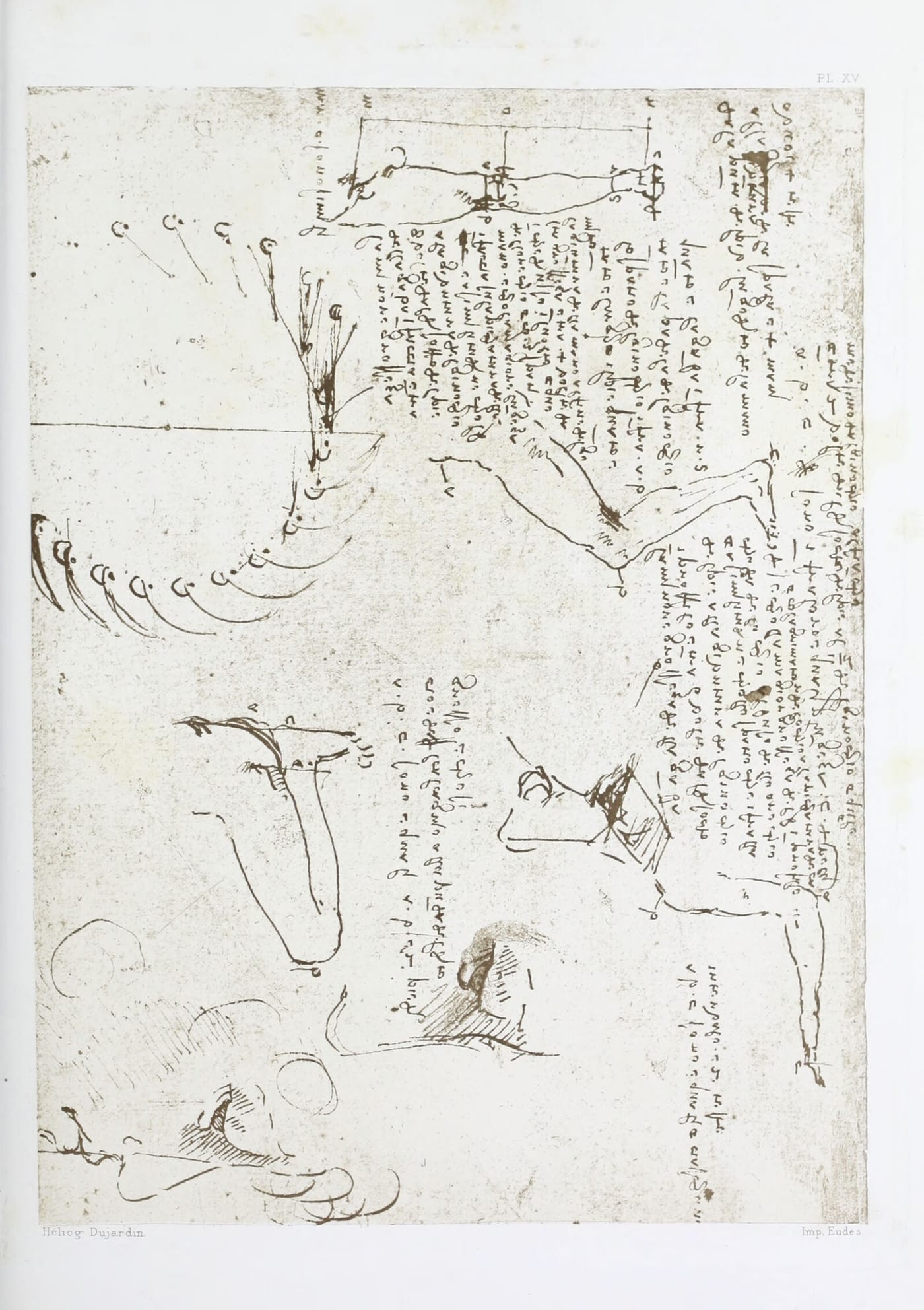
W. P. 8a · Pl. XV
See Plate XV, shown with § 328
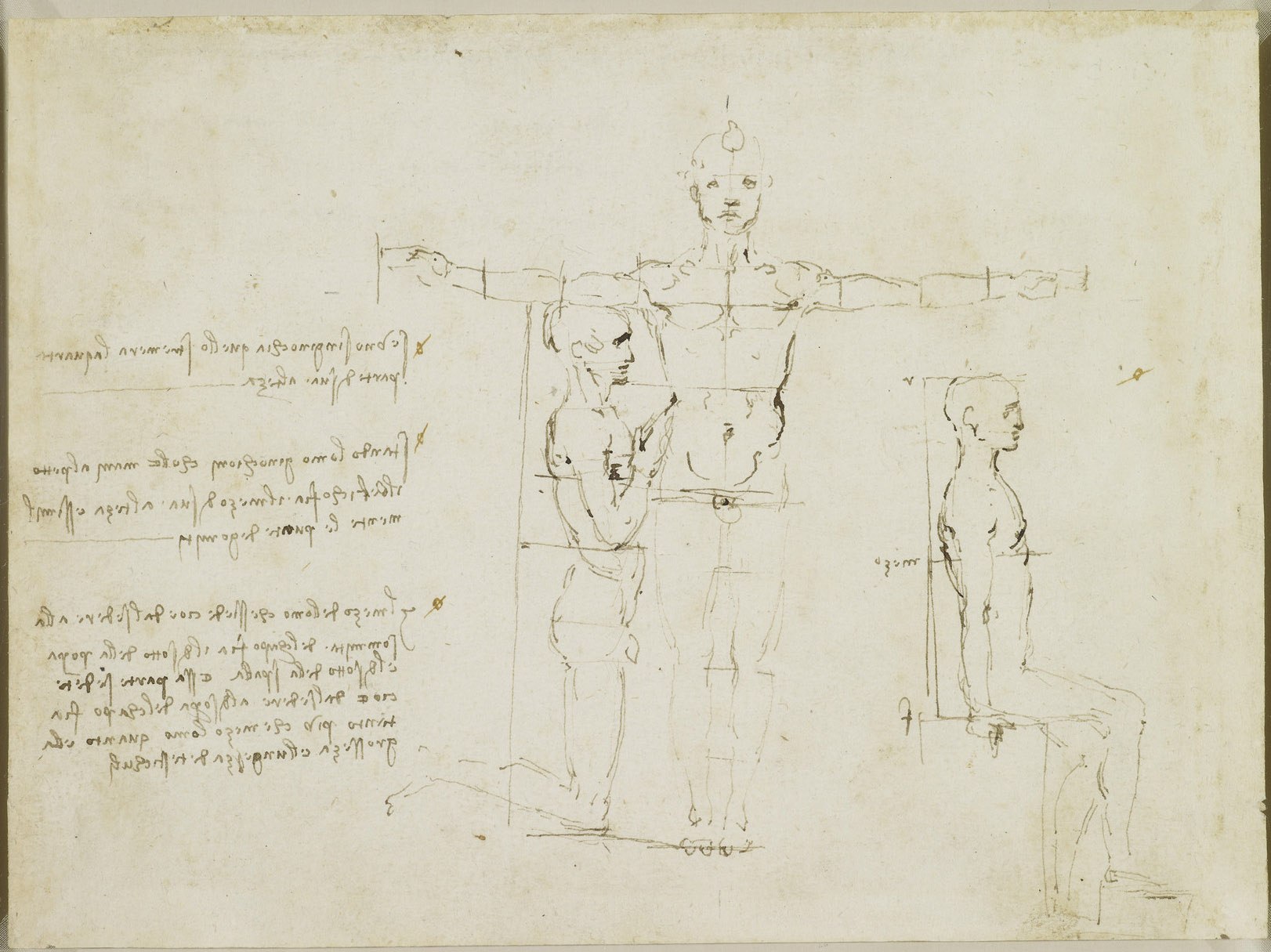
In kneeling down a man will lose the fourth part of his height.
When a man kneels down with his hands folded on his breast the navel will mark half his height and likewise the points of the elbows.
Half the height of a man who sits—that is from the seat to the top of the head—will be where the arms fold below the breast, and below the shoulders. The seated portion—that is from the seat to the top of the head—will be more than half the man's [whole height] by the length of the scrotum.
W. P. 6. Ib · Pl. VIII, No. 2
See Plate VIII, shown with § 312
The cubit is one fourth of the height of a man and is equal to the greatest width of the shoulders. From the joint of one shoulder to the other is two faces and is equal to the distance from the top of the breast to the navel. From this point to the genitals is a face's length.
W. P. 6. Ib · Pl. VIII, No. 2
See Plate VIII, shown with § 312
From the roots of the hair to the top of the breast a b is the sixth part of the height of a man and this measure is equal.
From the outside part of one shoulder to the other is the same distance as from the top of the breast to the navel and this measure goes four times from the sole of the foot to the lower end of the nose.
The [thickness of] the arm where it springs from the shoulder in front goes 6 times into the space between the two outside edges of the shoulders and 3 times into the face, and four times into the length of the foot and three into the hand, inside or outside.
W. P. 6. IIa · Pl. XIV, No. 2
See Plate XIV, shown with § 326
a b c are equal to each other and to the space from the armpit of the shoulder to the genitals and to the distance from the tip of the fingers of the hand to the joint of the arm, and to the half of the breast; and you must know that c b is the third part of the height of a man from the shoulders to the ground; d e f are equal to each other and equal to the greatest width of the shoulders.
W. P. 6. IIb · Pl. XVI, No. 1
—Top of the chin—hip—the insertion of the middle finger. The end of the calf of the leg on the inside of the thigh.—The end of the swelling of the shin bone of the leg. The smallest thickness of the leg goes 3 times into the thigh seen in front.
W. P. 5a · Pl. XVII, No. 2
See Plate XVII, shown with § 313
The torso a b in its thinnest part measures a foot; and from a to b is 2 feet, which makes two squares to the seat—its thinnest part goes 3 times into the length, thus making 3 squares.
W. P. 2a · Pl. VII, No. 2
See Plate VII, shown with § 310
A man when he lies down is reduced to 1/9 of his height.
W. P. 7a
The opening of the ear, the joint of the shoulder, that of the hip and the ancle are in perpendicular lines; a n is equal to m o.
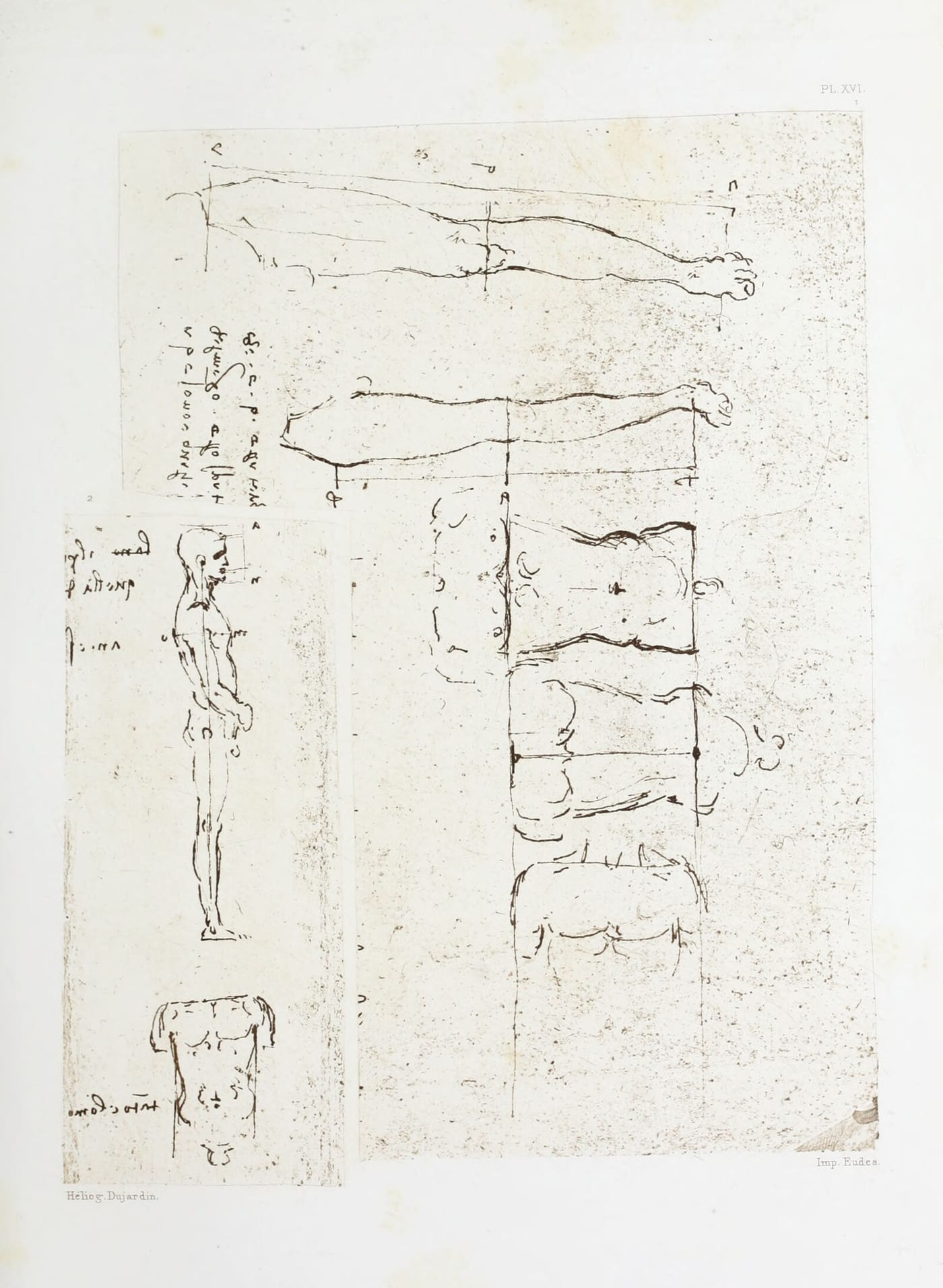
W. P. 7b · Pl. XVI, No. 2
See Plate XVI, shown with § 335
From the chin to the roots of the hair is 1/10 of the whole figure. From the joint of the palm of the hand to the tip of the longest finger is 1/10. From the chin to the top of the head 1/8; and from the pit of the stomach to the top of the breast is 1/6, and from the pit below the breast bone to the top of the head 1/4. From the chin to the nostrils 1/3 Part of the face, the same from the nostrils to the brow and from the brow to the roots of the hair, and the foot is 1/6, the elbow 1/4, the width of the shoulders 1/4.
C. A. 350a; 1089a
The width of the shoulders is 1/4 of the whole. From the joint of the shoulder to the hand is 1/3, from the parting of the lips to below the shoulder-blade is one foot.
The greatest thickness of a man from the breast to the spine is one 8th of his height and is equal to the space between the bottom of the chin and the top of the head.
The greatest width is at the shoulders and goes 4.
W. P. 5a
The width of a man under the arms is the same as at the hips.
A man's width across the hips is equal to the distance from the top of the hip to the bottom of the buttock, when a man stands equally balanced on both feet; and there is the same distance from the top of the hip to the armpit. The waist, or narrower part above the hips will be half way between the arm pits and the bottom of the buttock.
W. P. 7b · Pl. XVI, No. 2, 1
See Plate XVI, shown with § 335
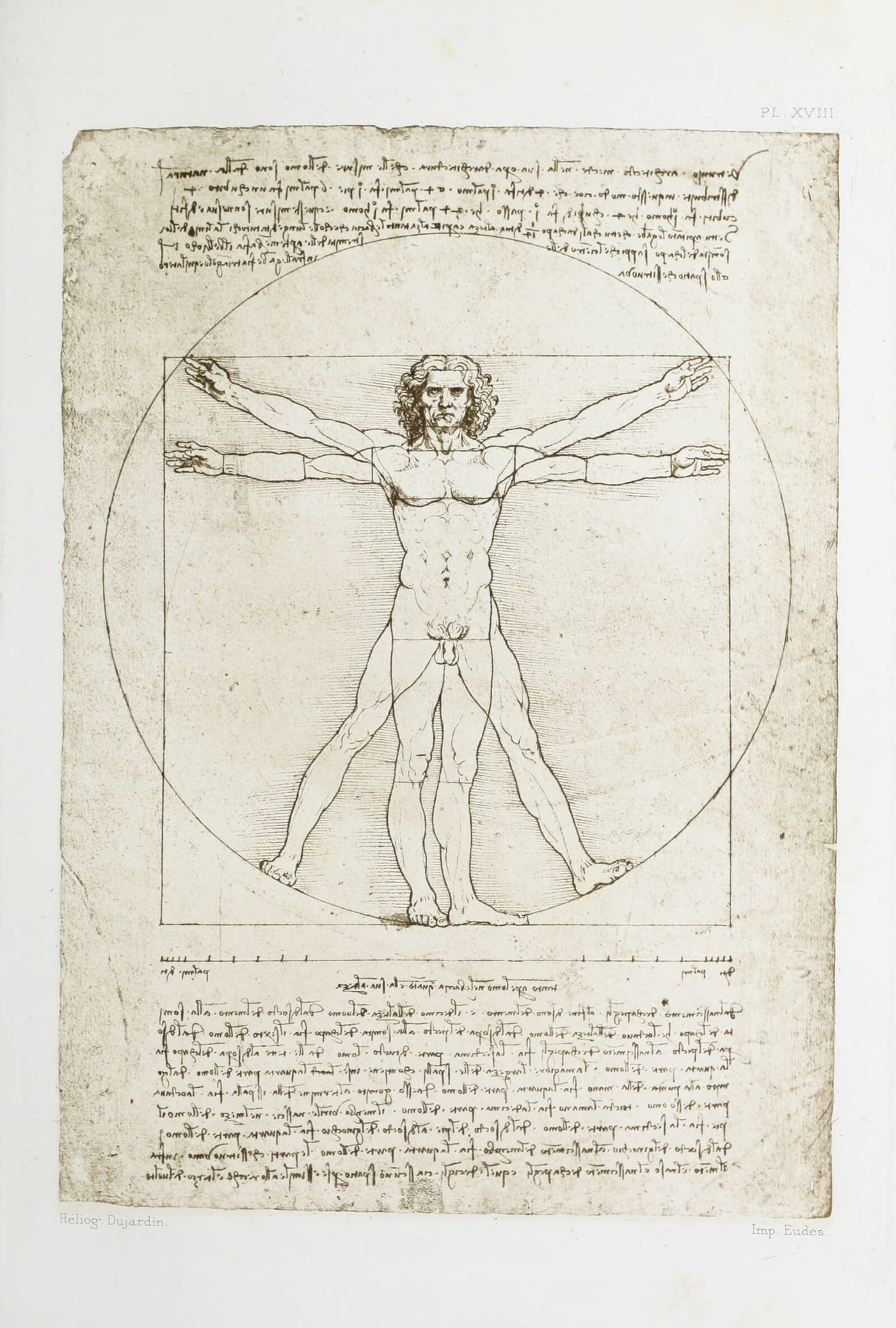
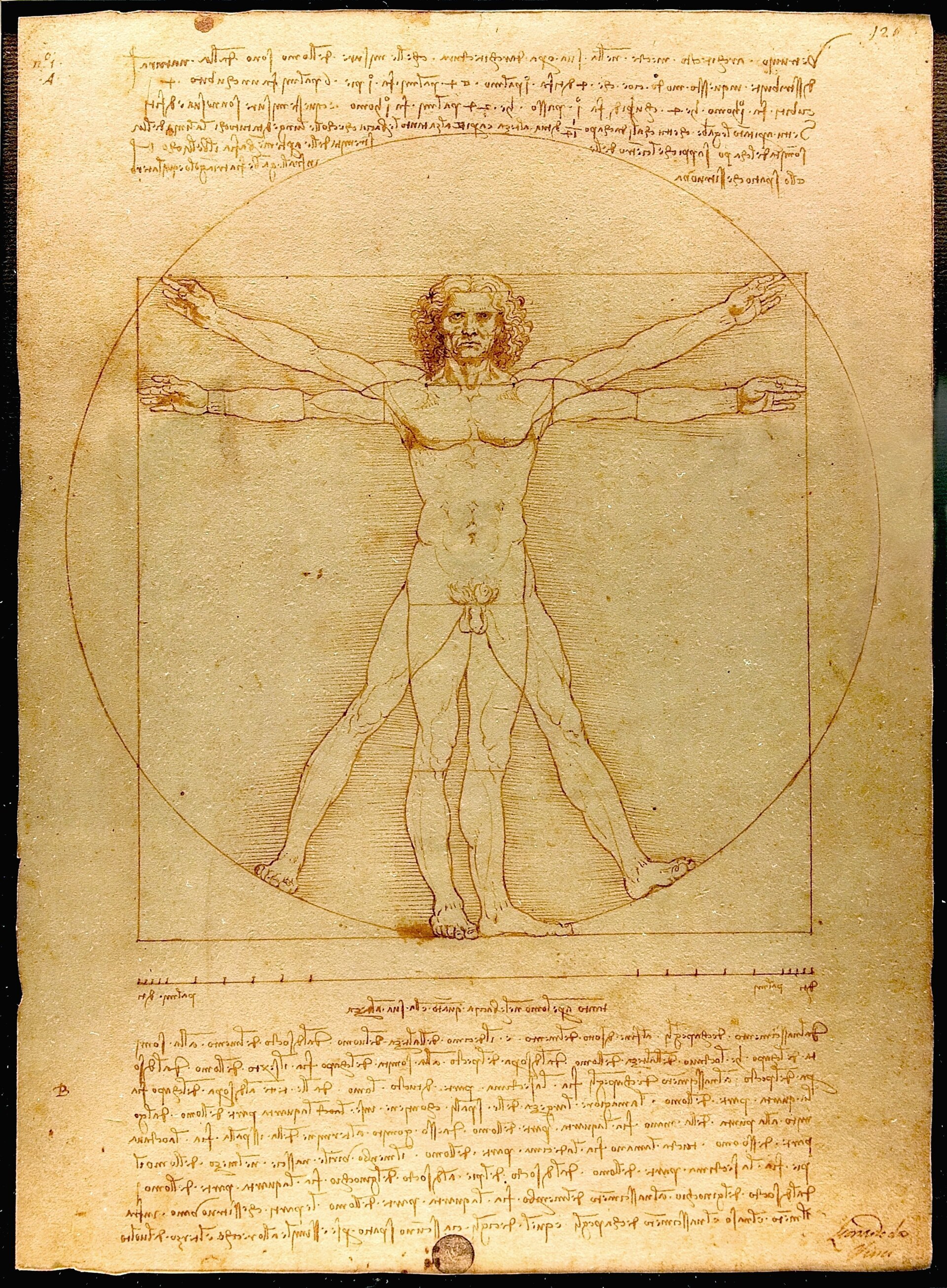
Vitruvius, the architect, says in his work on architecture that the measurements of the human body are distributed by Nature as follows: that is that 4 fingers make 1 palm, and 4 palms make 1 foot, 6 palms make 1 cubit; 4 cubits make a man's height. And 4 cubits make one pace and 24 palms make a man; and these measures he used in his buildings. If you open your legs so much as to decrease your height 1/14 and spread and raise your arms till your middle fingers touch the level of the top of your head you must know that the centre of the outspread limbs will be in the navel and the space between the legs will be an equilateral triangle.
The length of a man's outspread arms is equal to his height.
From the roots of the hair to the bottom of the chin is the tenth of a man's height; from the bottom of the chin to the top of his head is one eighth of his height; from the top of the breast to the top of his head will be one sixth of a man. From the top of the breast to the roots of the hair will be the seventh part of the whole man. From the nipples to the top of the head will be the fourth part of a man. The greatest width of the shoulders contains in itself the fourth part of the man. From the elbow to the tip of the hand will be the fifth part of a man; and from the elbow to the angle of the armpit will be the eighth part of the man. The whole hand will be the tenth part of the man; the beginning of the genitals marks the middle of the man. The foot is the seventh part of the man. From the sole of the foot to below the knee will be the fourth part of the man. From below the knee to the beginning of the genitals will be the fourth part of the man. The distance from the bottom of the chin to the nose and from the roots of the hair to the eyebrows is, in each case the same, and like the ear, a third of the face.
Ven. (121) no I. A · Pl. XVIII
From b to a is one head, as well as from c to a and this happens when the elbow forms a right angle.
Ash. I. 12a · Pl. XLI, No. 1
See Plate XLI, shown with § 142
From the tip of the longest finger of the hand to the shoulder joint is four hands or, if you will, four faces.
a b c are equal and each interval is 2 heads.
W. P. 8a · Pl. XV
See Plate XV, shown with § 328
The hand from the longest finger to the wrist joint goes 4 times from the tip of the longest finger to the shoulder joint.
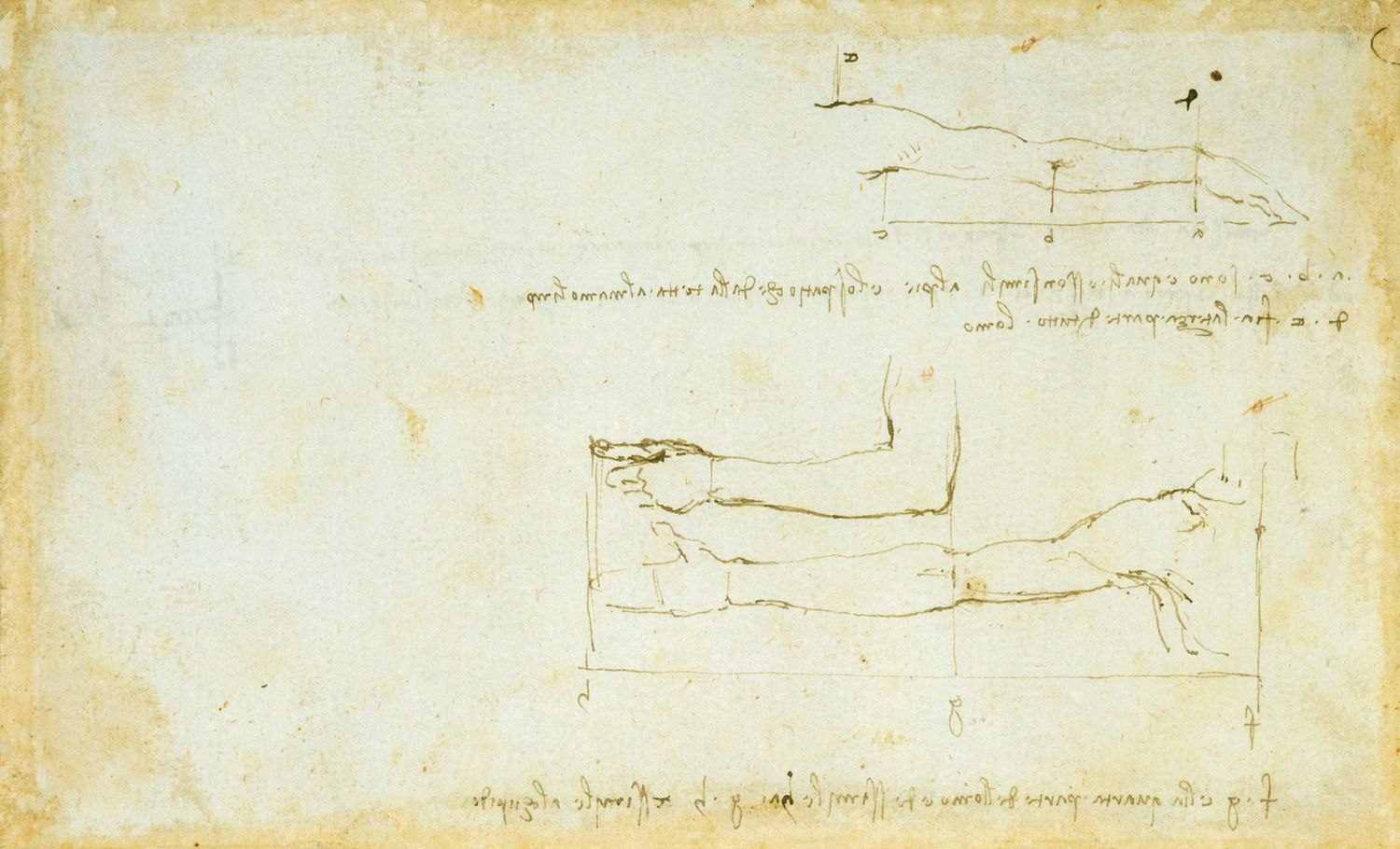
B. 3b
a b c are equal to each other and to the foot and to the space between the nipple and the navel d e will be the third part of the whole man.
f g is the fourth part of a man and is equal to g h and measures a cubit.
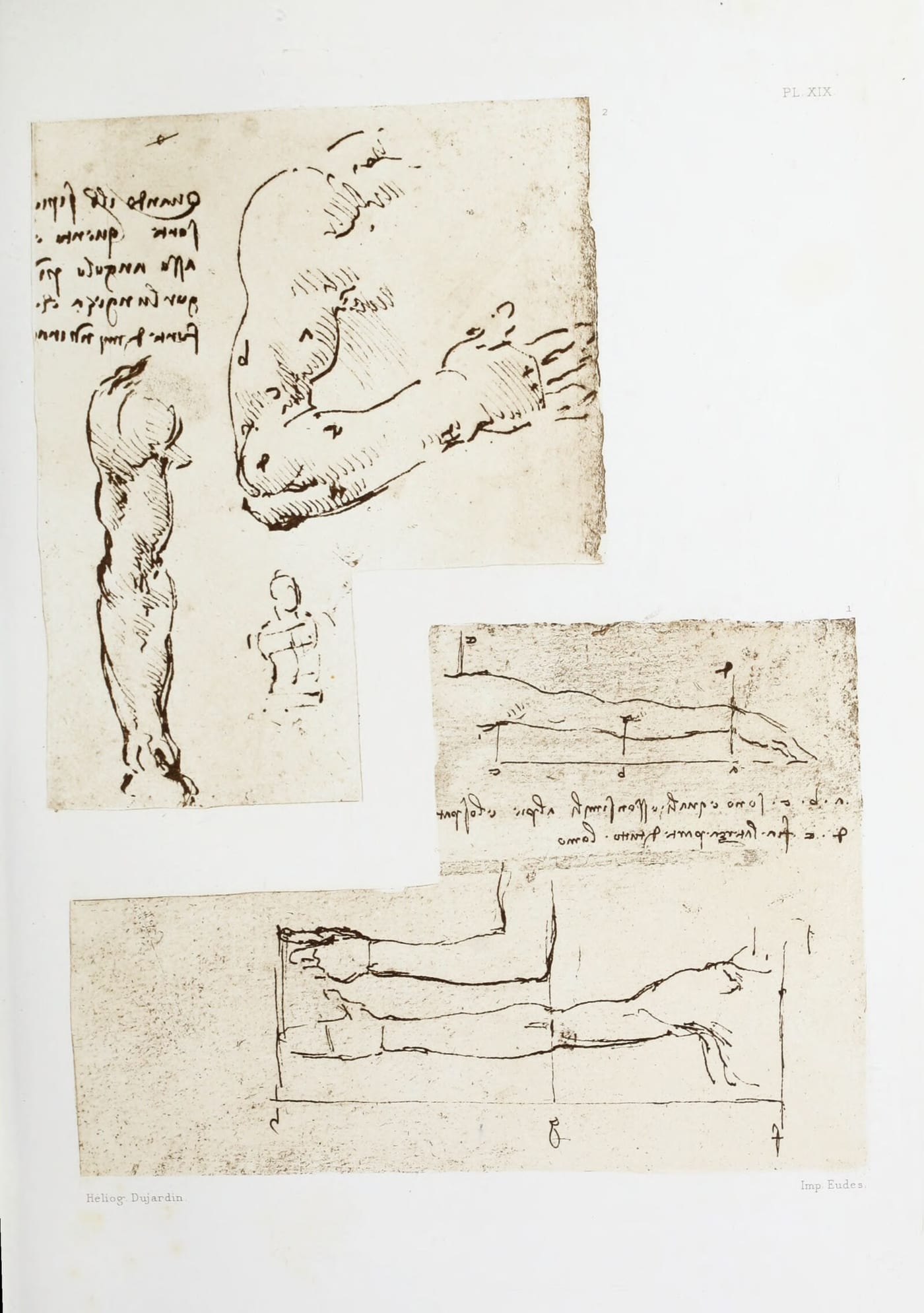
W. P. 4a · Pl. XIX, No. 1
a b goes 4 times into a c and 9 into a m. The greatest thickness of the arm between the elbow and the hand goes 6 times into a m and is equal to r f. The greatest thickness of the arm between the shoulder and the elbow goes 4 times into c m, and is equal to h n g. The smallest thickness of the arm above the elbow x y is not the base of a square, but is equal to half the space h 3 which is found between the inner joint of the arm and the wrist joint.
The width of the wrist goes 12 times into the whole arm; that is from the tip of the fingers to the shoulder joint; that is 3 times into the hand and 9 into the arm.
The arm when bent is 4 heads.
The arm from the shoulder to the elbow in bending increases in length, that is in the length from the shoulder to the elbow, and this increase is equal to the thickness of the arm at the wrist when seen in profile. And the space between the bottom of the chin and the parting of the lips, is equal to the thickness of the 2 middle fingers, and to the width of the mouth and to the space between the roots of the hair on the forehead and the top of the head. All these distances are equal to each other, but they are not equal to the above-mentioned increase in the arm.
The arm between the elbow and wrist never increases by being bent or extended.
The arm, from the shoulder to the inner joint when extended.
When the arm is extended, p n is equal to n a. And when it is bent n a diminishes 1/6 of its length and p n does the same. The outer elbow joint increases 1/7 when bent; and thus by being bent it increases to the length of 2 heads. And on the inner side, by bending, it is found that whereas the arm from where it joins the side to the wrist, was 2 heads and a half, in bending it loses the half head and measures only two: one from the [shoulder] joint to the end [by the elbow], and the other to the hand.
The arm when folded will measure 2 faces up to the shoulder from the elbow and 2 from the elbow to the insertion of the four fingers on the palm of the hand. The length from the base of the fingers to the elbow never alters in any position of the arm.
If the arm is extended it decreases by 1/3 of the length between b and h; and if—being extended—it is bent, it will increase the half of o e. The length from the shoulder to the elbow is the same as from the base of the thumb, inside, to the elbow a b c.
The smallest thickness of the arm in profile z c goes 6 times between the knuckles of the hand and the dimple of the elbow when extended and 14 times in the whole arm and 42 in the whole man. The greatest thickness of the arm in profile is equal to the greatest thickness of the arm in front; but the first is placed at a third of the arm from the shoulder joint to the elbow and the other at a third from the elbow towards the hand.
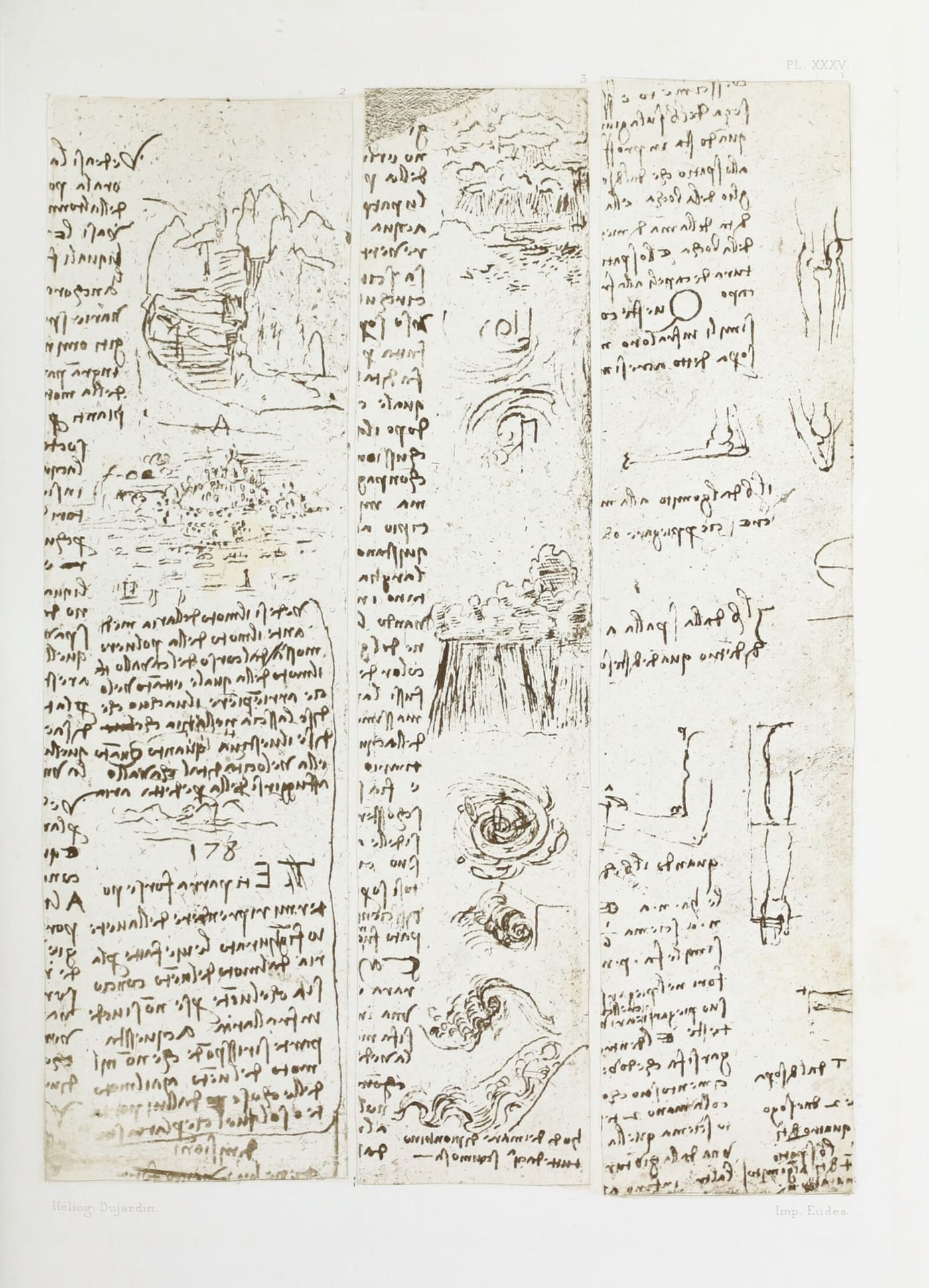
W. P. 5a · Pl. XX · Pl. XXXV, No. 1
See Plate XVII, shown with § 313
In the Treatise on Painting: chapter 30
From the top of the shoulder to the point of the elbow is as far as from that point to the joints of the four fingers with the palm of the hand, and each is 2 faces.
a e is equal to the palm of the hand, r f and o g are equal to half a head and each goes 4 times into a b and b c. From c to m is 1/2 a head; m n is 1/3 of a head and goes 6 times into c b and into b a; a b loses 1/7 of its length when the arm is extended; c b never alters; o will always be the middle point between a and s.
y l is the fleshy part of the arm and measures one head; and when the arm is bent this shrinks 2/5 of its length; o a in bending loses 1/6 and so does o r.
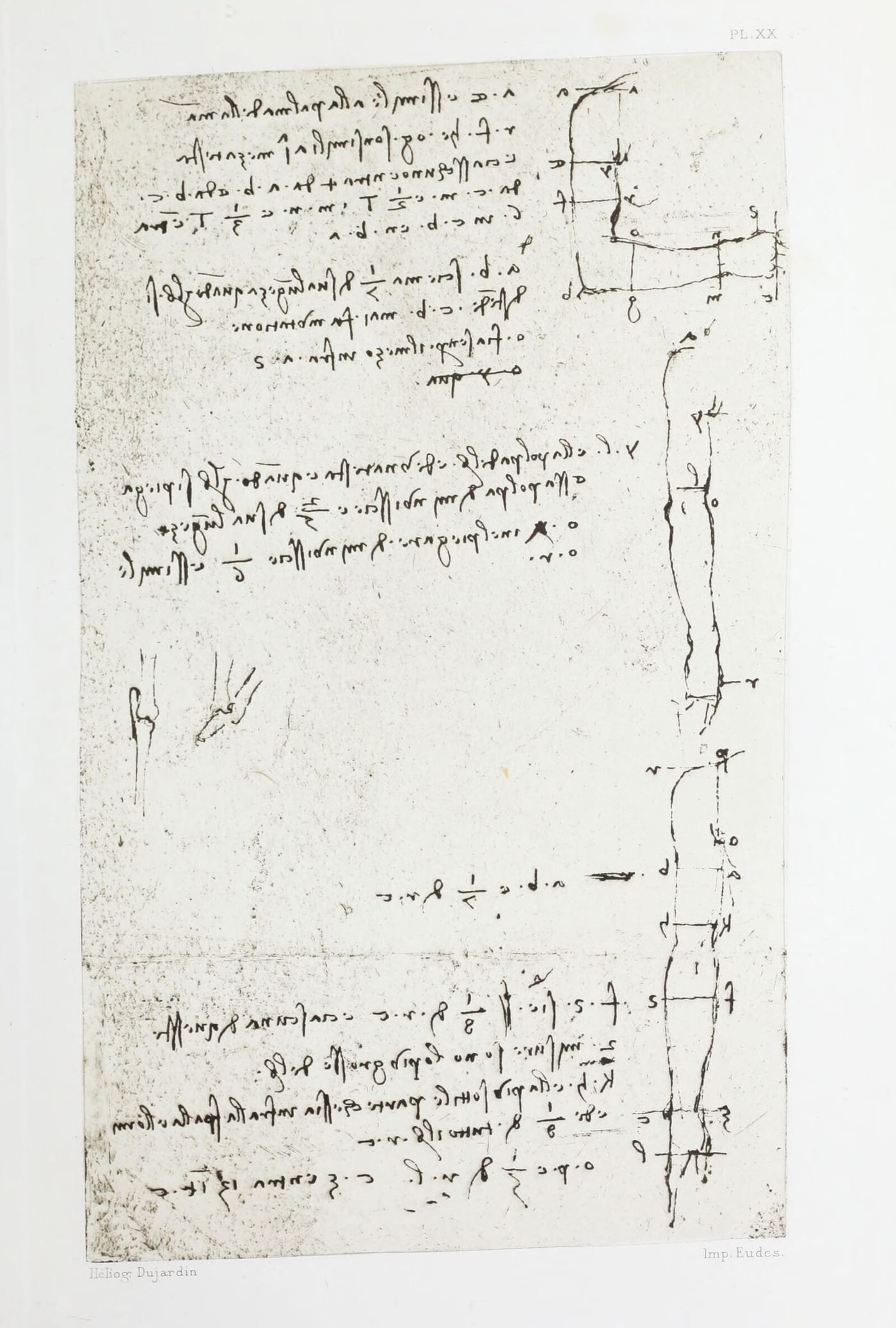
a b is 1/7 of r c. f s will be 1/8 of r c, and each of those 2 measurements is the largest of the arm; k h is the thinnest part between the shoulder and the elbow and it is 1/8 of the whole arm r c; o p is 1/5 of r l; c z goes 13 times into r c.
W. P. 7b · Pl. XX
See Plate XX, shown with § 348
In the innermost bend of the joints of every limb the reliefs are converted into a hollow, and likewise every hollow of the innermost bends becomes a convexity when the limb is straightened to the utmost. And in this very great mistakes are often made by those who have insufficient knowledge and trust to their own invention and do not have recourse to the imitation of nature; and these variations occur more in the middle of the sides than in front, and more at the back than at the sides.
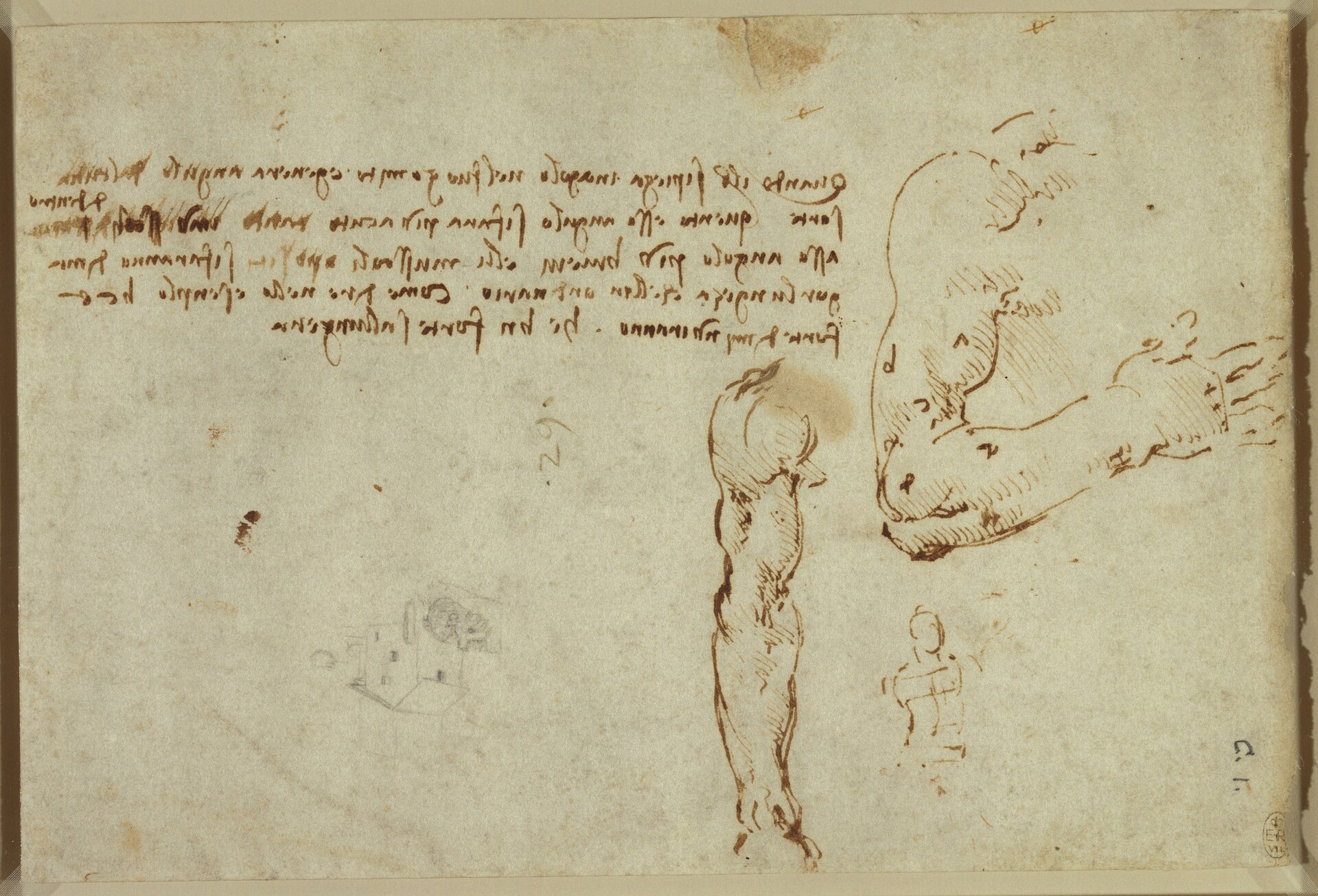
Br. M. 44a
When the arm is bent at an angle at the elbow, it will produce some angle; the more acute the angle is, the more will the muscles within the bend be shortened; while the muscles outside will become of greater length than before. As is shown in the example; d c e will shrink considerably; and b n will be much extended.
W. 197 · Pl. XIX, No. 2
See Plate XIX, shown with § 347
In the Treatise on Painting: chapter 8, chapter 50
The arm, as it turns, thrusts back its shoulder towards the middle of the back.
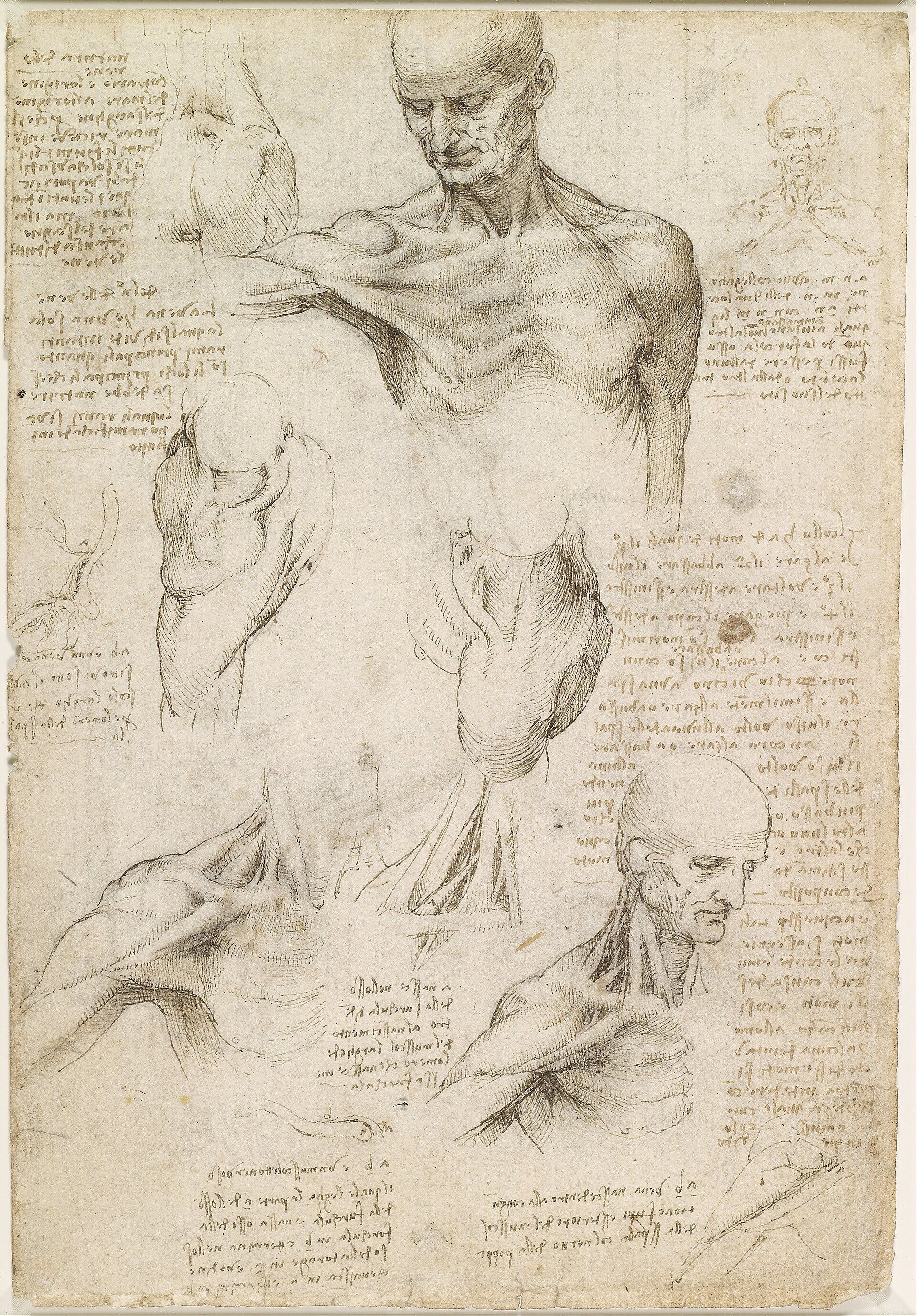
Ash. I. 25. IIa
The principal movements of the hand are 10; that is forwards, backwards, to right and to left, in a circular motion, up or down, to close and to open, and to spread the fingers or to press them together.
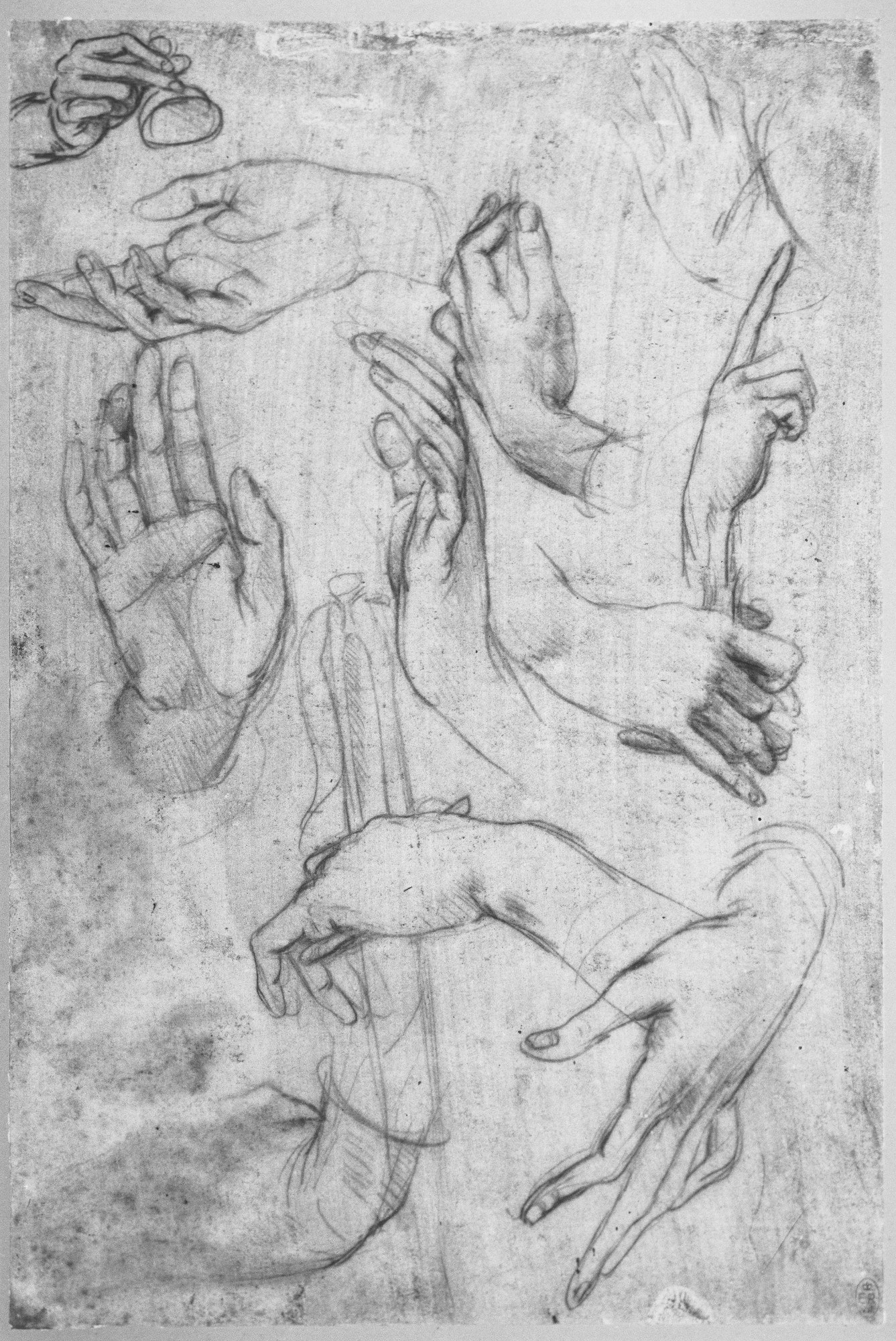
C. A. 44b; 137b
The movements of the fingers principally consist in extending and bending them. This extension and bending vary in manner; that is, sometimes they bend altogether at the first joint; sometimes they bend, or extend, half way, at the 2nd joint; and sometimes they bend in their whole length and in all the three joints at once. If the 2 first joints are hindered from bending, then the 3rd joint can be bent with greater ease than before; it can never bend of itself, if the other joints are free, unless all three joints are bent. Besides all these movements there are 4 other principal motions of which 2 are up and down, the two others from side to side; and each of these is effected by a single tendon. From these there follow an infinite number of other movements always effected by two tendons; one tendon ceasing to act, the other takes up the movement. The tendons are made thick inside the fingers and thin outside; and the tendons inside are attached to every joint but outside they are not.
Of the strength [and effect] of the 3 tendons inside the fingers at the 3 joints.
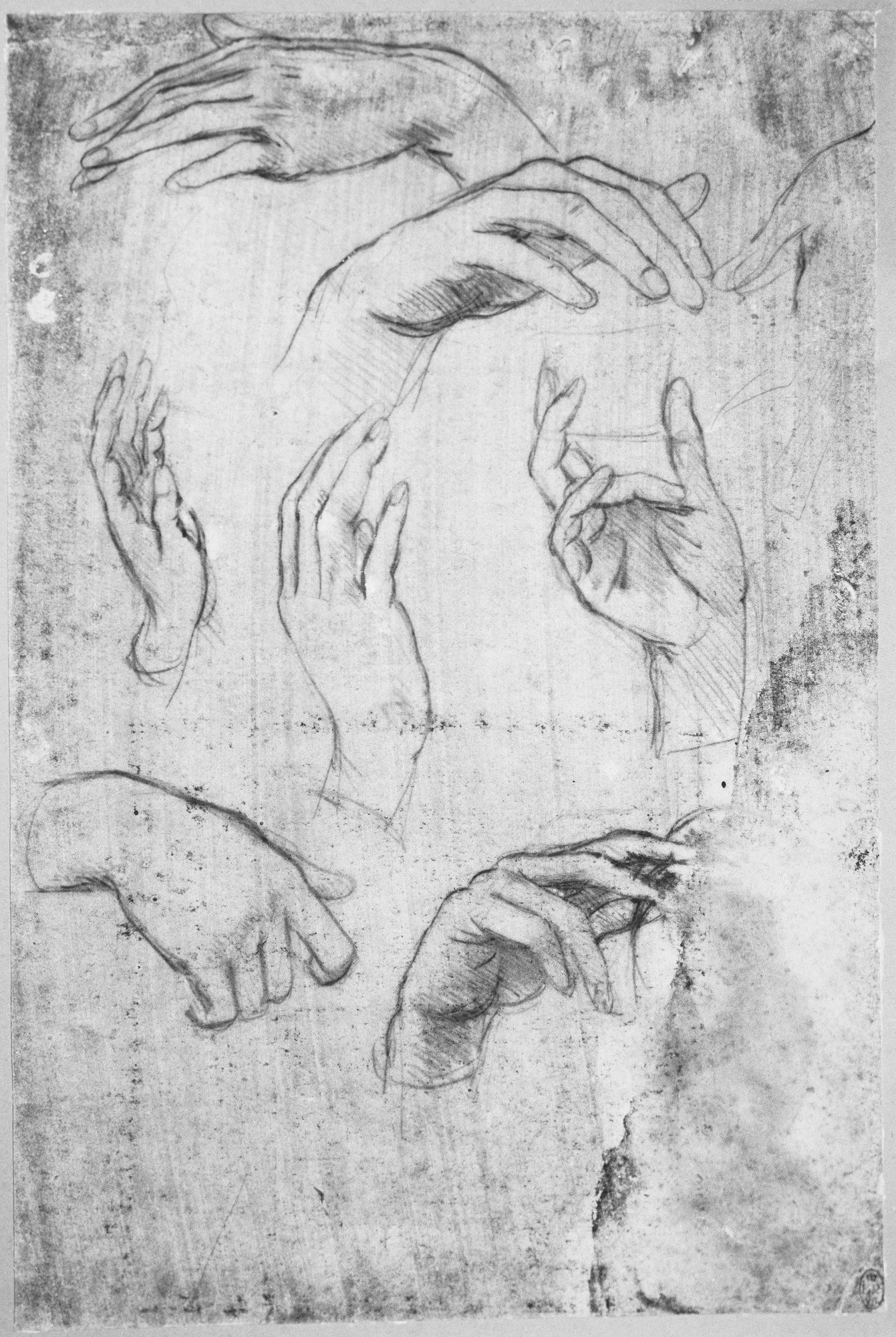
C. A. 98b; 308a
Observe the altered position of the shoulder in all the movements of the arm, going up and down, inwards and outwards, to the back and to the front, and also in circular movements and any others.
And do the same with reference to the neck, hands and feet and the breast above the lips &c.
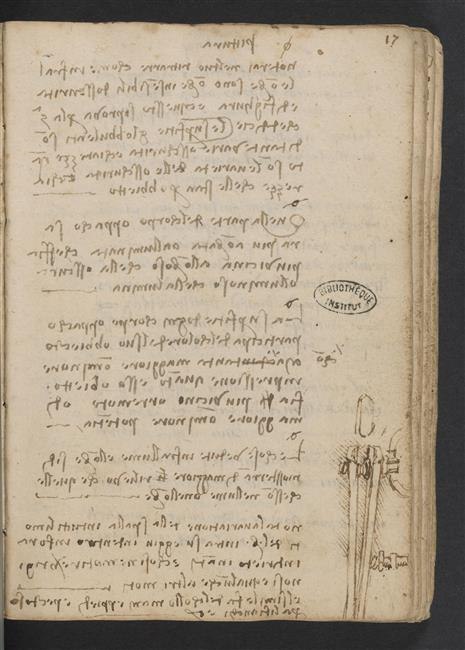
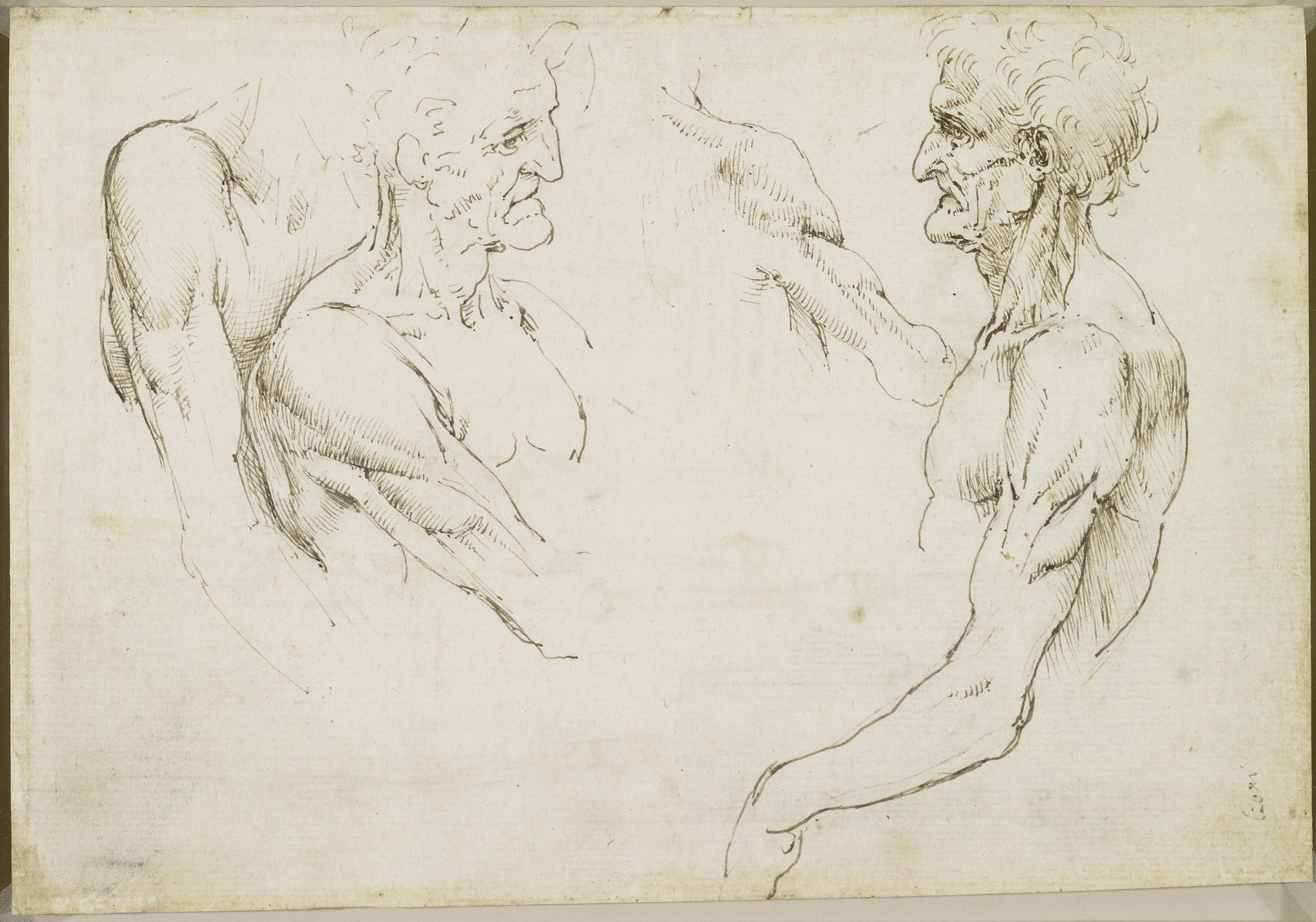
E. 17a
In the Treatise on Painting: chapter 33, chapter 87
Three are the principal muscles of the shoulder, that is b c d, and two are the lateral muscles which move it forward and backward, that is a o; a moves it forward, and o pulls it back; and bed raises it; a b c moves it upwards and forwards, and c d o upwards and backwards. Its own weight almost suffices to move it downwards.
The muscle d acts with the muscle c when the arm moves forward; and in moving backward the muscle b acts with the muscle c.
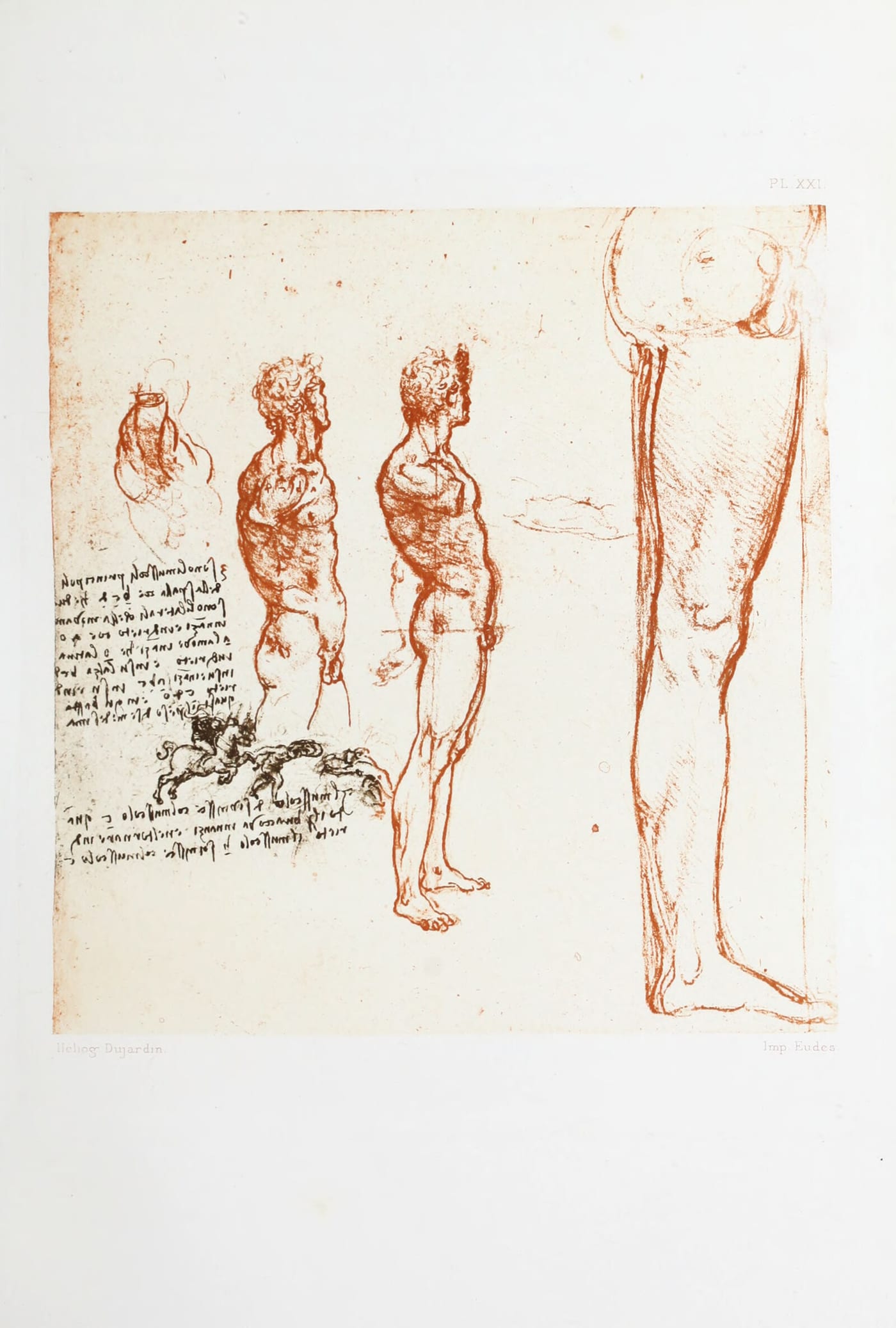
W. III · Pl. XXI
The loins or backbone being bent. The breasts are are always lower than the shoulderblades of the back.
If the breast bone is arched the breasts are higher than the shoulderblades.
If the loins are upright the breast will always be found at the same level as the shoulderblades.
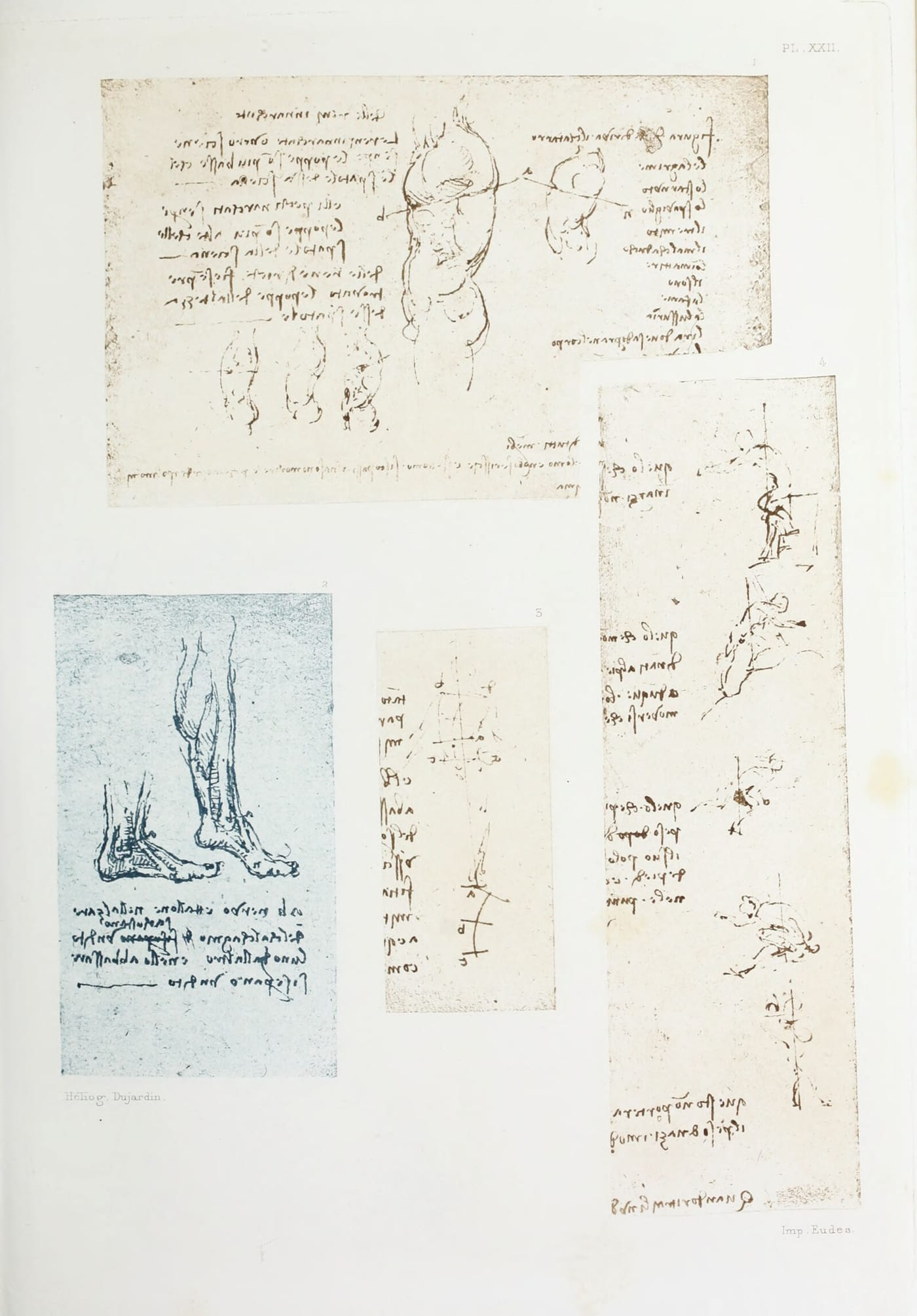
W. An. II. 203b (24) · Pl. XXII, No. 1
a b the tendon and ankle in raising the heel approach each other by a finger's breadth; in lowering it they separate by a finger's breadth.
W. 215 · Pl. XXII, No. 2 · Pl. III, No. 2
Compare Plate III, shown with § 148
See Plate XXII, shown with § 357
Just so much as the part d a of the nude figure decreases in this position so much does the opposite part increase; that is: in proportion as the length of the part d a diminishes the normal size so does the opposite upper part increase beyond its [normal] size. The navel does not change its position to the male organ; and this shrinking arises because when a figure stands on one foot, that foot becomes the centre [of gravity] of the superimposed weight. This being so, the middle between the shoulders is thrust above it out of it perpendicular line, and this line, which forms the central line of the external parts of the body, becomes bent at its upper extremity [so as to be] above the foot which supports the body; and the transverse lines are forced into such angles that their ends are lower on the side which is supported. As is shown at a b c.
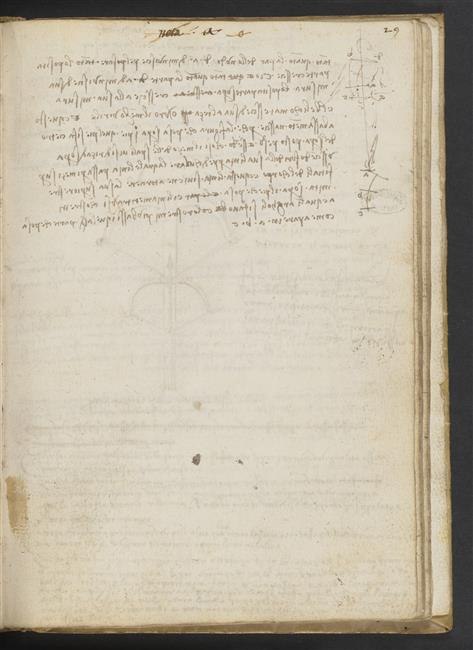
A. 29a · Pl. XXII, No. 3
See Plate XXII, shown with § 357
In the Treatise on Painting: chapter 57, chapter 58, chapter 78, chapter 85 (the same passage)
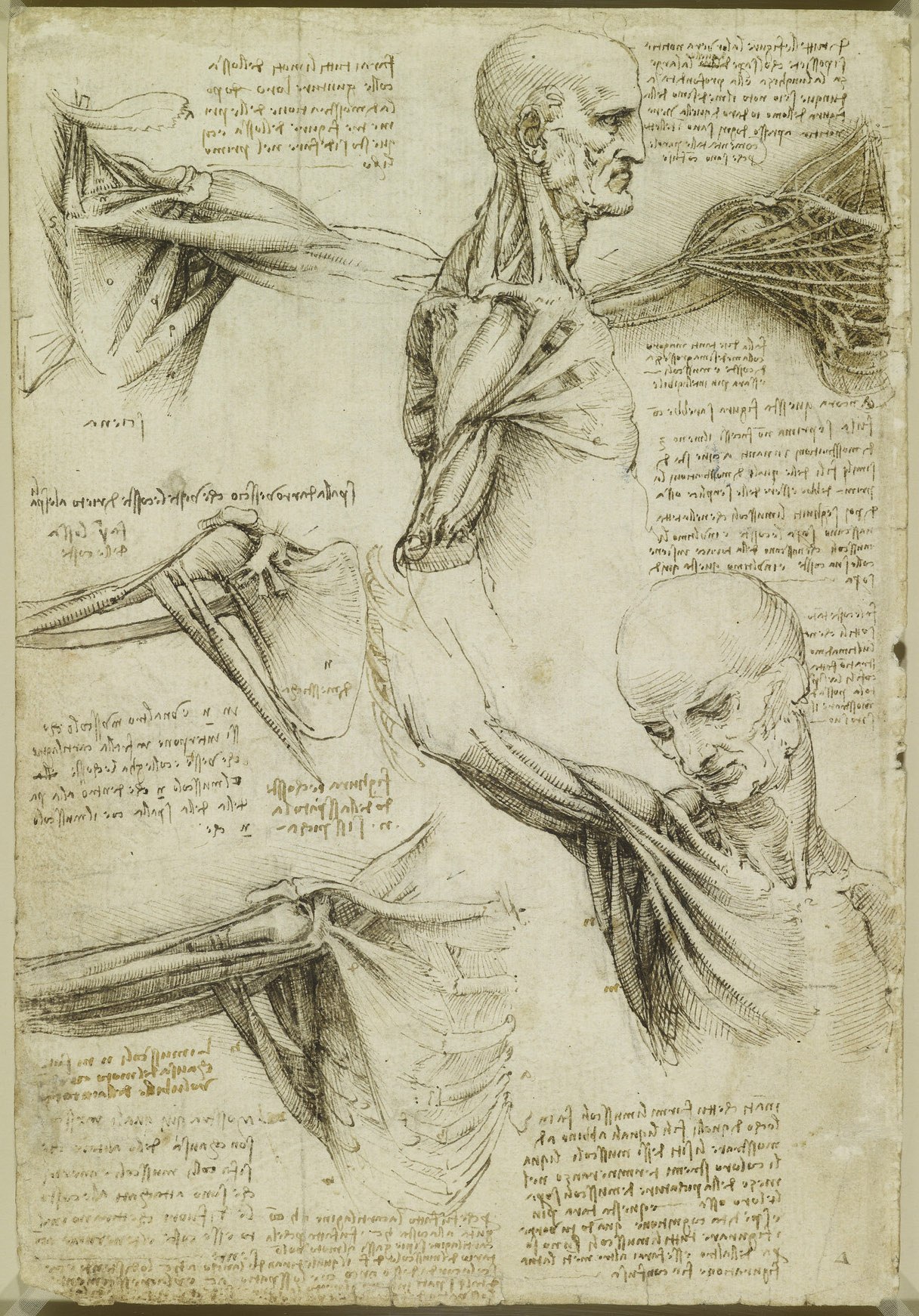
Note in the motions and attitudes of figures how the limbs vary, and their feeling, for the shoulderblades in the motions of the arms and shoulders vary the [line of the] back bone very much. And you will find all the causes of this in my book of Anatomy.
E. 3a
In the Treatise on Painting: chapter 33
The pit of the throat is over the feet, and by throwing one arm forward the pit of the throat is thrown off that foot. And if the leg is thrown forward the pit of the throat is thrown forward; and. so it varies in every attitude.
Ash. I. 15a
In the Treatise on Painting: chapter 63 (the same passage)
Indicate which are the muscles, and which the tendons, which become prominent or retreat in the different movements of each limb; or which do neither [but are passive]. And remember that these indications of action are of the first importance and necessity in any painter or sculptor who professes to be a master &c.
And indicate the same in a child, and from birth to decrepitude at every stage of its life; as infancy, childhood, boyhood, youth &c.
And in each express the alterations in the limbs and joints, which swell and which grow thinner.
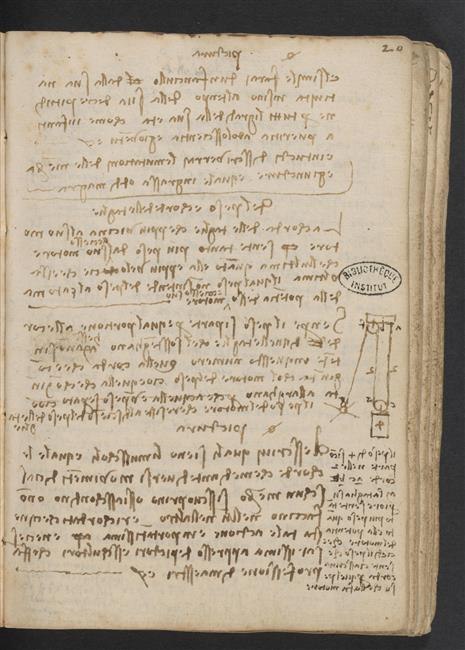
E. 20a
In the Treatise on Painting: chapter 32 (the same passage)
O Anatomical Painter! beware lest the too strong indication of the bones, sinews and muscles, be the cause of your becoming wooden in your painting by your wish to make your nude figures display all their feeling. Therefore, in endeavouring to remedy this, look in what manner the muscles clothe or cover their bones in old or lean persons; and besides this, observe the rule as to how these same muscles fill up the spaces of the surface that extend between them, which are the muscles which never lose their prominence in any amount of fatness; and which too are the muscles of which the attachments are lost to sight in the very least plumpness. And in many cases several muscles look like one single muscle in the increase of fat; and in many cases, in growing lean or old, one single muscle divides into several muscles. And in this treatise, each in its place, all their peculiarities will be explained—and particularly as to the spaces between the joints of each limb &c. Again, do not fail [to observe] the variations in the forms of the above mentioned muscles, round and about the joints of the limbs of any animal, as caused by the diversity of the motions of each limb; for on some side of those joints the prominence of these muscles is wholly lost in the increase or diminution of the flesh of which these muscles are composed, &c.
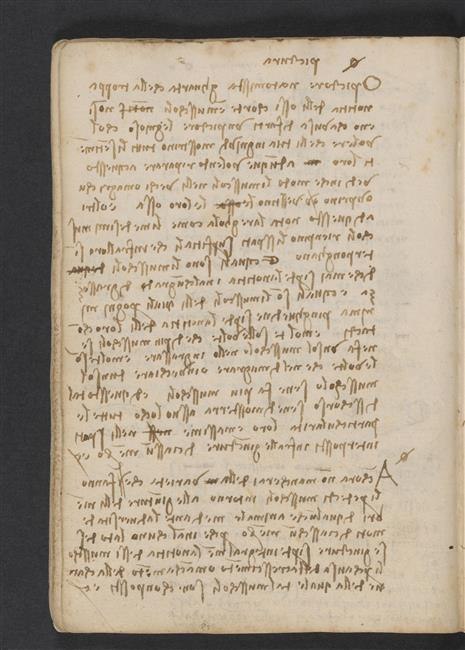
E. 19b
In the Treatise on Painting: chapter 43, chapter 44, chapter 55
There is a great difference in the length between the joints in men and boys for, in man, from the top of the shoulder [by the neck] to the elbow, and from the elbow to the tip of the thumb and from one shoulder to the other, is in each instance two heads, while in a boy it is but one because Nature constructs in us the mass which is the home of the intellect, before forming that which contains the vital elements.
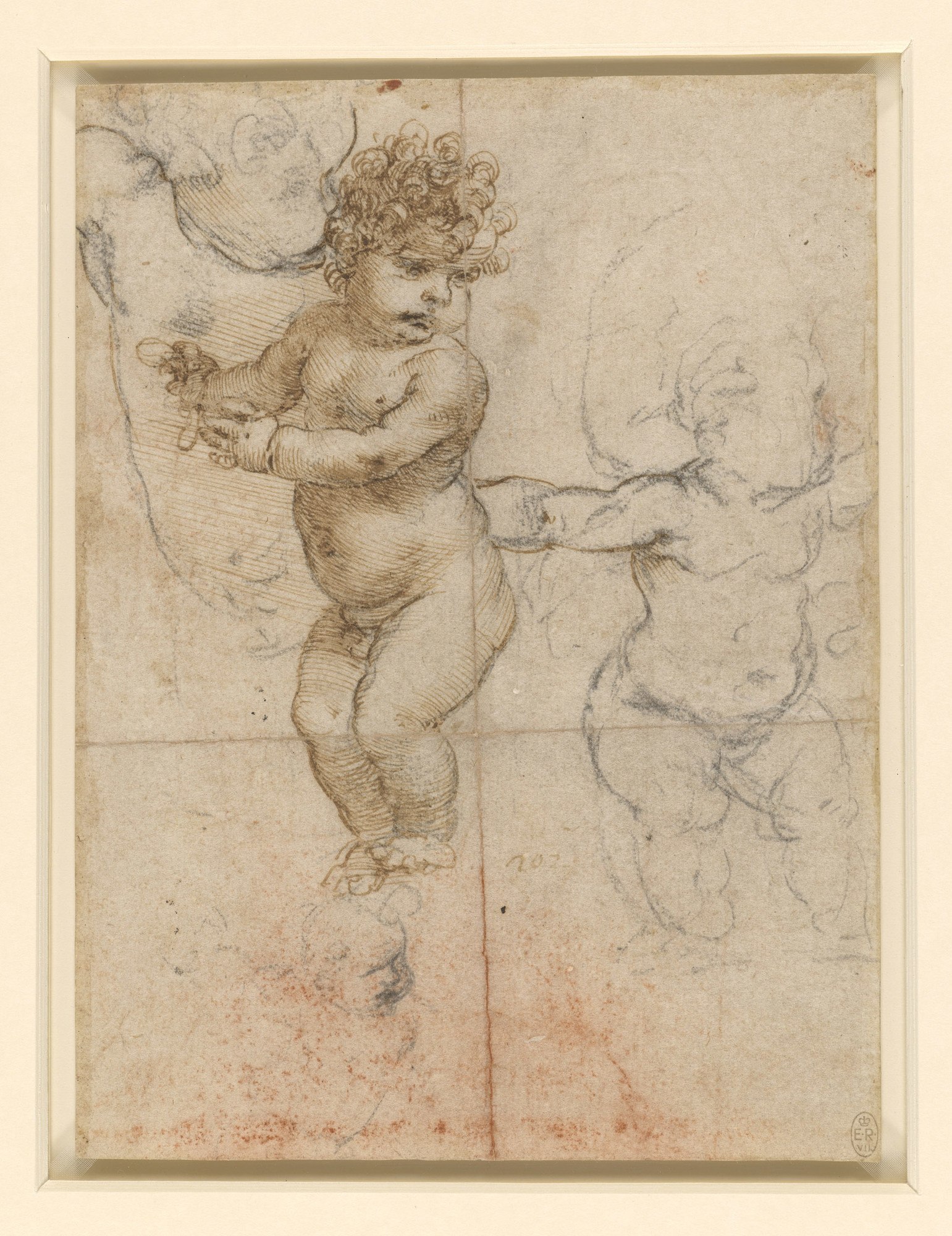
Ash. I. 7a
In the Treatise on Painting: chapter 9 (the same passage), chapter 10, chapter 351
Which are the muscles which subdivide in old age or in youth, when becoming lean? Which are the parts of the limbs of the human frame where no amount of fat makes the flesh thicker, nor any degree of leanness ever diminishes it?
The thing sought for in this question will be found in all the external joints of the bones, as the shoulder, elbow, wrists, finger-joints, hips, knees, ankle-bone and toes and the like; all of which shall be told in its place. The greatest thickness acquired by any limb is at the part of the muscles which is farthest from its attachments.
Flesh never increases on those portions of the limb where the bones are near to the surface.
At b r d a c e f the increase or diminution of the flesh never makes any considerable difference. Nature has placed in front of man all those parts which feel most pain under a blow; and these are the shin of the leg, the forehead, and the nose. And this was done for the preservation of man, since, if such pain were not felt in these parts, the number of blows to which they would be exposed must be the cause of their destruction.
Describe why the bones of the arm and leg are double near the hand and foot [respectively].
And where the flesh is thicker or thinner in the bending of the limbs.
W. 240b
In the Treatise on Painting: chapter 41
Every part of the whole must be in proportion to the whole. Thus, if a man is of a stout short figure he will be the same in all his parts: that is with short and thick arms, wide thick hands, with short fingers with their joints of the same character, and so on with the rest. I would have the same thing understood as applying to all animals and plants; in diminishing, [the various parts] do so in due proportion to the size, as also in enlarging.
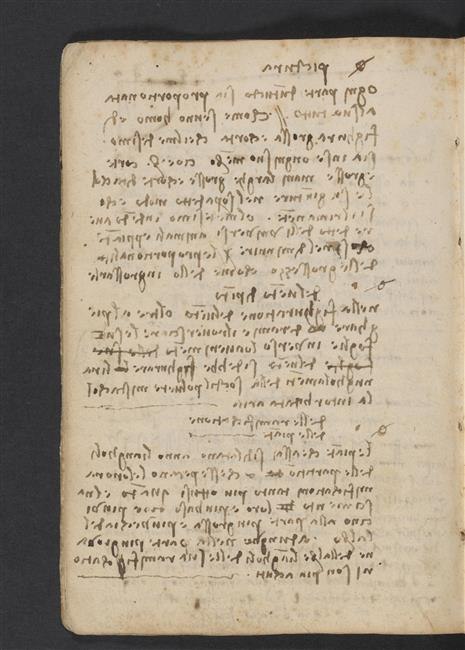
E. 6b
In the Treatise on Painting: chapter 11, chapter 12 (the same passage)
And again, remember to be very careful in giving your figures limbs, that they must appear to agree with the size of the body and likewise to the age. Thus a youth has limbs that are not very muscular not strongly veined, and the surface is delicate and round, and tender in colour. In man the limbs are sinewy and muscular, while in old men the surface is wrinkled, rugged and knotty, and the sinews very prominent.
HOW YOUNG BOYS HAVE THEIR JOINTS JUST THE REVERSE OF THOSE OF MEN, AS TO SIZE.
Little children have all the joints slender and the portions between them are thick; and this happens because nothing but the skin covers the joints without any other flesh and has the character of sinew, connecting the bones like a ligature. And the fat fleshiness is laid on between one joint and the next, and between the skin and the bones. But, since the bones are thicker at the joints than between them, as a mass grows up the flesh ceases to have that superfluity which it had, between the skin and the bones; whence the skin clings more closely to the bone and the limbs grow more slender. But since there is nothing over the joints but the cartilaginous and sinewy skin this cannot dry up, and, not drying up, cannot shrink. Thus, and for this reason, children are slender at the joints and fat between the joints; as may be seen in the joints of the fingers, arms, and shoulders, which are slender and dimpled, while in man on the contrary all the joints of the fingers, arms, and legs are thick; and wherever children have hollows men have prominences.
Ash. I. 7a
In the Treatise on Painting: chapter 6, chapter 34 (the same passage)
Of the manner of representing the 18 actions of man. Repose, movement, running, standing, supported, sitting, leaning, kneeling, lying down, suspended. Carrying or being carried, thrusting, pulling, striking, being struck, pressing down and lifting up.
[As to how a figure should stand with a weight in its hand Remember].
Ash. I. 6b
A sitting man cannot raise himself if that part of his body which is front of his axis [centre of gravity] does not weigh more than that which is behind that axis [or centre] without using his arms.
A man who is mounting any slope finds that he must involuntarily throw the most weight forward, on the higher foot, rather than behind—that is in front of the axis and not behind it. Hence a man will always, involuntarily, throw the greater weight towards the point whither he desires to move than in any other direction.
The faster a man runs, the more he leans forward towards the point he runs to and throws more weight in front of his axis than behind. A man who runs down hill throws the axis onto his heels, and one who runs up hill throws it into the points of his feet; and a man running on level ground throws it first on his heels and then on the points of his feet.
This man cannot carry his own weight unless, by drawing his body back he balances the weight in front, in such a way as that the foot on which he stands is the centre of gravity.
A. 28b · Pl. XXII, No. 4
See Plate XXII, shown with § 357
In the Treatise on Painting: chapter 72, chapter 73
How a man proceeds to raise himself to his feet, when he is sitting on level ground.
W. An. III. 167b
A man when walking has his head in advance of his feet.
A man when walking across a long level plain first leans [rather] backwards and then as much forwards.
F. 83a
A man when running throws less weight on his legs than when standing still. And in the same way a horse which is running feels less the weight of the man he carries. Hence many persons think it wonderful that, in running, the horse can rest on one single foot. From this it may be stated that when a weight is in progressive motion the more rapid it is the less is the perpendicular weight towards the centre.
S. K. M. II.2 14a
If a man, in taking a jump from firm ground, can leap 3 braccia, and when he was taking his leap it were to recede 1/3 of a braccio, that would be taken off his former leap; and so if it were thrust forward 1/3 of a braccio, by how much would his leap be increased?
M. 55a
When a man who is running wants to neutralise the impetus that carries him on he prepares a contrary impetus which is generated by his hanging backwards. This can be proved, since, if the impetus carries a moving body with a momentum equal to 4 and the moving body wants to turn and fall back with a momentum of 4, then one momentum neutralises the other contrary one, and the impetus is neutralised.
C. A. 178a; 536a
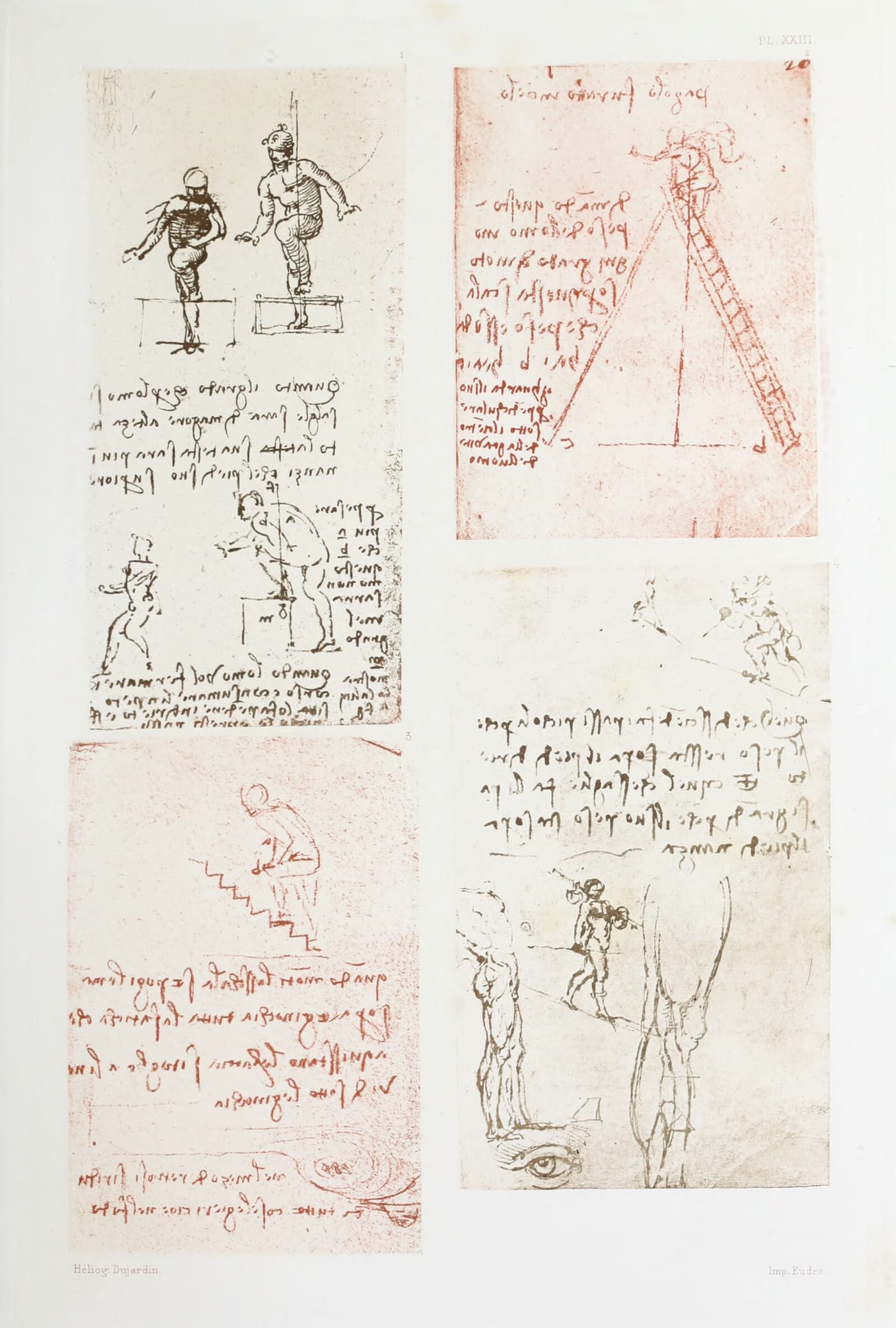
When a man wants to stop running and check the impetus he is forced to hang back and take short quick steps. The centre of gravity of a man who lifts one of his feet from the ground always rests on the centre of the sole of the foot [he stands on].
A man, in going up stairs involuntarily throws so much weight forward and on the side of the upper foot as to be a counterpoise to the lower leg, so that the labour of this lower leg is limited to moving itself.
The first thing a man does in mounting steps is to relieve the leg he is about to lift of the weight of the body which was resting on that leg; and besides this, he gives to the opposite leg all the rest of the bulk of the whole man, including [the weight of] the other leg; he then raises the other leg and sets the foot upon the step to which he wishes to raise himself. Having done this he restores to the upper foot all the weight of the body and of the leg itself, and places his hand on his thigh and throws his head forward and repeats the movement towards the point of the upper foot, quickly lifting the heel of the lower one; and with this impetus he lifts himself up and at the same time extends the arm which rested on his knee; and this extension of the arm carries up the body and the head, and so straightens the spine which was curved.
The higher the step is which a man has to mount, the farther forward will he place his head in advance of his upper foot, so as to weigh more on a than on b; this man will not be on the step m. As is shown by the line g f.
W. An. II. 203a · Pl. XXIII, No. 1
In the Treatise on Painting: chapter 62, chapter 66, chapter 67
I ask the weight [pressure] of this man at every degree of motion on these steps, what weight he gives to b and to c.
Observe the perpendicular line below the centre of gravity of the man.
S. K. M. II.2 20a · Pl. XXIII, No. 2
See Plate XXIII, shown with § 375
In going up stairs if you place your hands on your knees all the labour taken by the arms is removed from the sinews at the back of the knees.
H.2 27a · Pl. XXIII, No. 3
See Plate XXIII, shown with § 375
The sinew which guides the leg, and which is connected with the patella of the knee, feels it a greater labour to carry the man upwards, in proportion as the leg is more bent; and the muscle which acts upon the angle made by the thigh where it joins the body has less difficulty and has a less weight to lift, because it has not the [additional] weight of the thigh itself. And besides this it has stronger muscles, being those which form the buttock.
L. 27b
A man coming down hill takes little steps, because the weight rests upon the hinder foot, while a man mounting takes wide steps, because his weight rests on the foremost foot.
W. 3a · Pl. XXIII, No. 4
See Plate XXIII, shown with § 375
When you want to represent a man as moving some weight consider what the movements are that are to be represented by different lines; that is to say either from below upwards, with a simple movement, as a man does who stoops forward to take up a weight which he will lift as he straightens himself. Or as a man does who wants to squash something backwards, or to force it forwards or to pull it downwards with ropes passed through pullies. And here remember that the weight of a man pulls in proportion as his centre of gravity is distant from his fulcrum, and to this is added the force given by his legs and bent back as he raises himself.
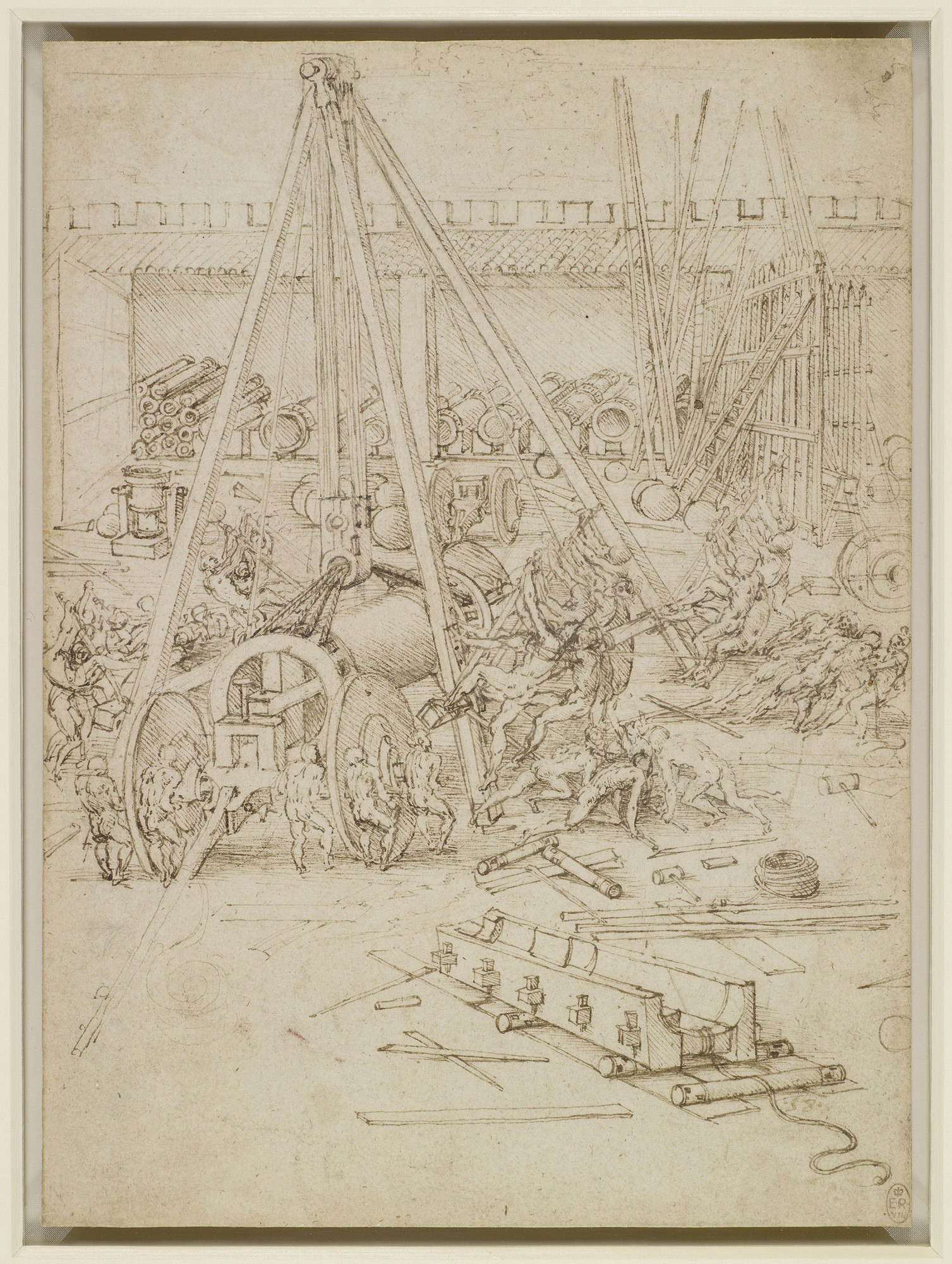
E. 15a · S. K. M. II.1 86b
In the Treatise on Painting: chapter 88 (the same passage)
Again, a man has even a greater store of strength in his legs than he needs for his own weight; and to see if this is true, make a man stand on the shore-sand and then put another man on his back, and you will see how much he will sink in. Then take the man from off his back and make him jump straight up as high as he can, and you will find that the print of his feet will be made deeper by the jump than from having the man on his back. Hence, here, by 2 methods it is proved that a man has double the strength he requires to support his own body.
Mz. 13a
If you have to draw a man who is in motion, or lifting or pulling, or carrying a weight equal to his own, in what way must you set on his legs below his body?
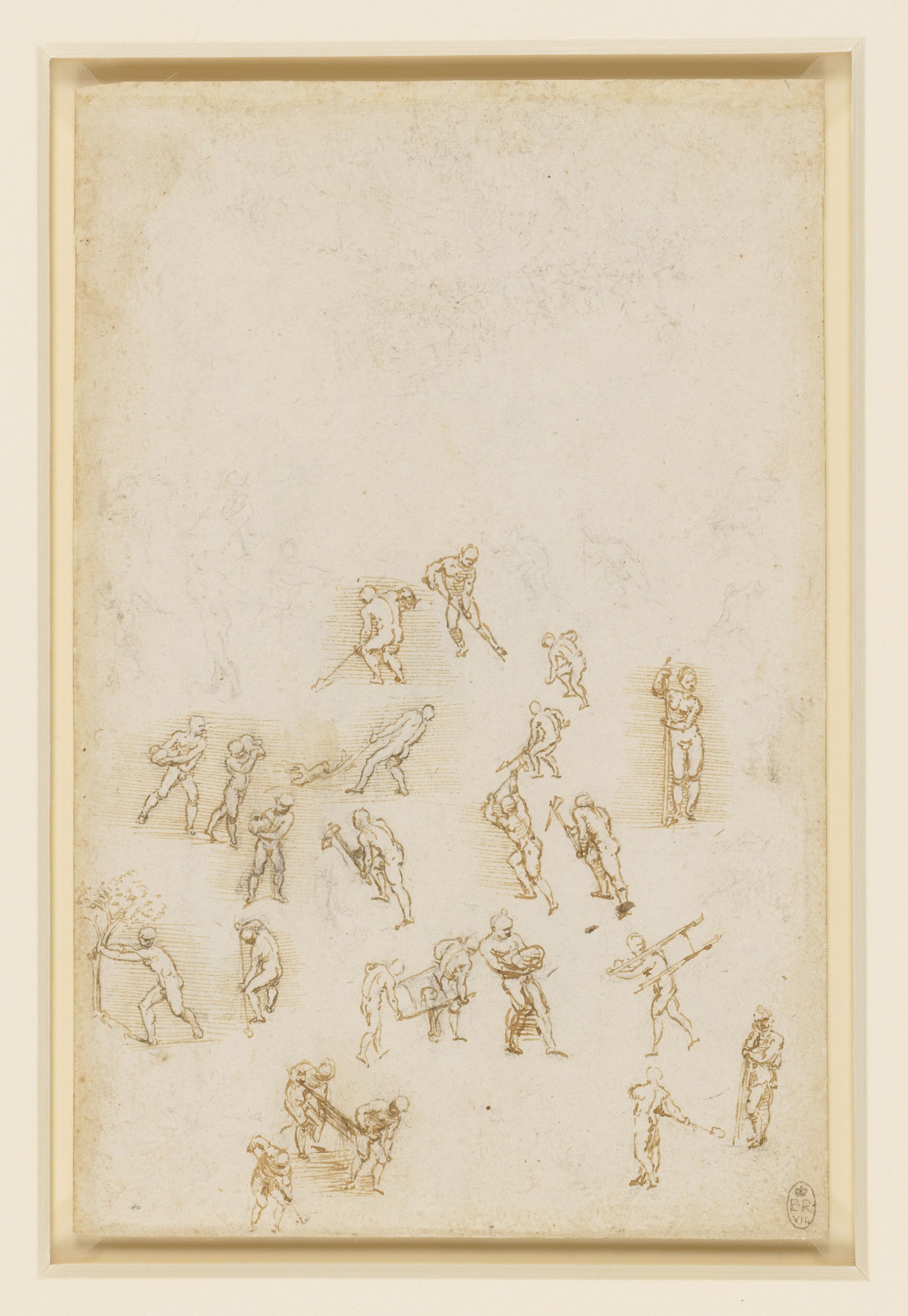
C. A. 341a; 1052a
In the Treatise on Painting: chapter 65
A man pulling a [dead] weight balanced against himself cannot pull more than his own weight. And if he has to raise it he will [be able to] raise as much more than his weight as his strength may be more than that of other men. The greatest force a man can apply, with equal velocity and impetus, will be when he sets his feet on one end of the balance [or lever] and then presses his shoulders against some stable body. This will raise a weight at the other end of the balance [lever], equal to his own weight and [added to that] as much weight as he can carry on his shoulders.
A. 30b
No animal can simply move [by its dead weight] a greater weight than the sum of its own weight outside the centre of his fulcrum.
S. K. M. III. 58b
A man who wants to send an arrow very far from the bow must be standing entirely on one foot and raising the other so far from the foot he stands on as to afford the requisite counterpoise to his body which is thrown on the front foot. And he must not hold his arm fully extended, and in order that he may be more able to bear the strain he must hold a piece of wood which there is in all crossbows, extending from the hand to the breast, and when he wishes to shoot he suddenly leaps forward at the same instant and extends his arm with the bow and releases the string. And if he dexterously does every thing at once it will go a very long way.
S. K. M. I.2 7
When two men are at the opposite ends of a plank that is balanced, and if they are of equal weight, and if one of them wants to make a leap into the air, then his leap will be made down from his end of the plank and the man will never go up again but must remain in his place till the man at the other end dashes up the board.
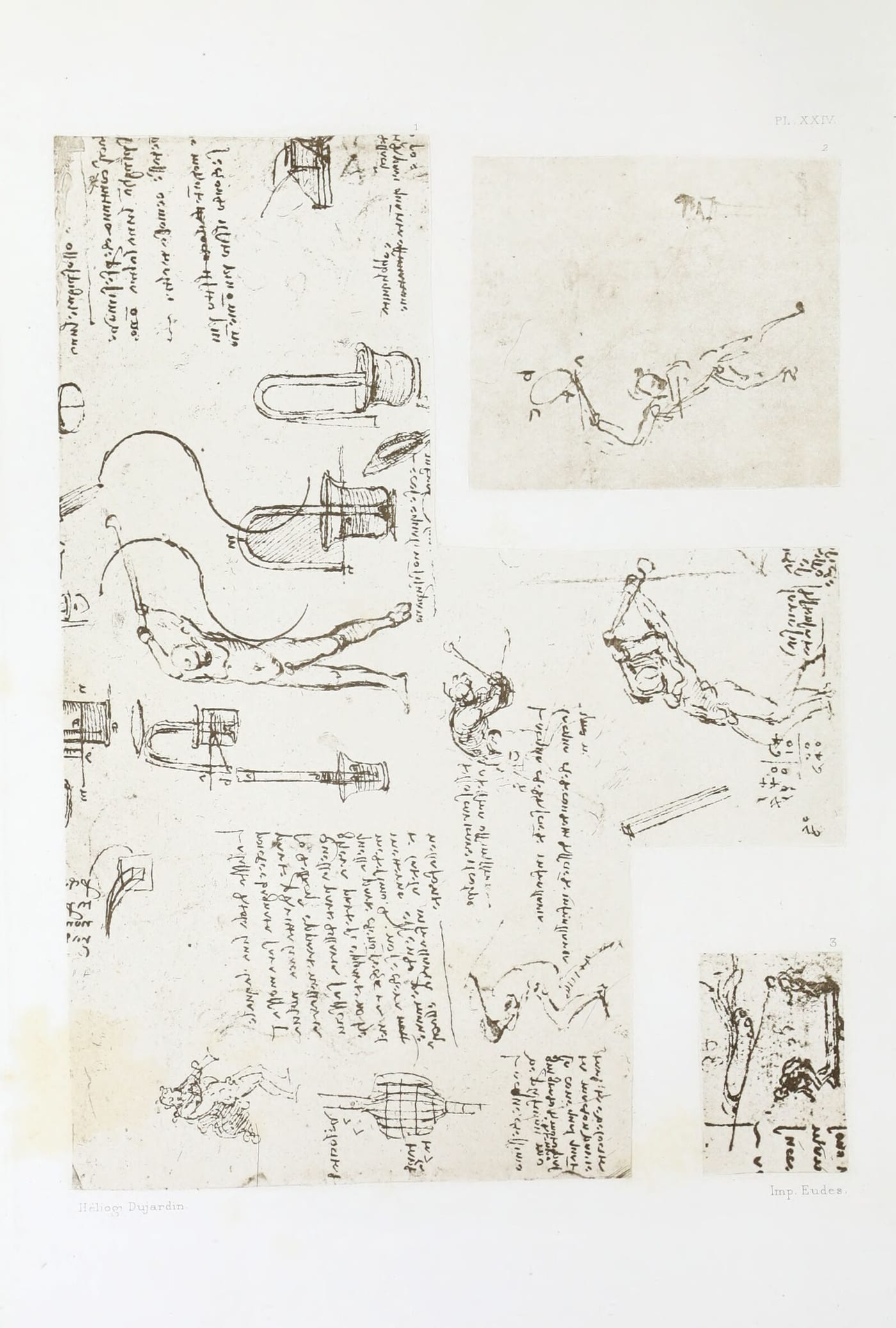
Leic. 8a · Pl. XXIV, No. 3
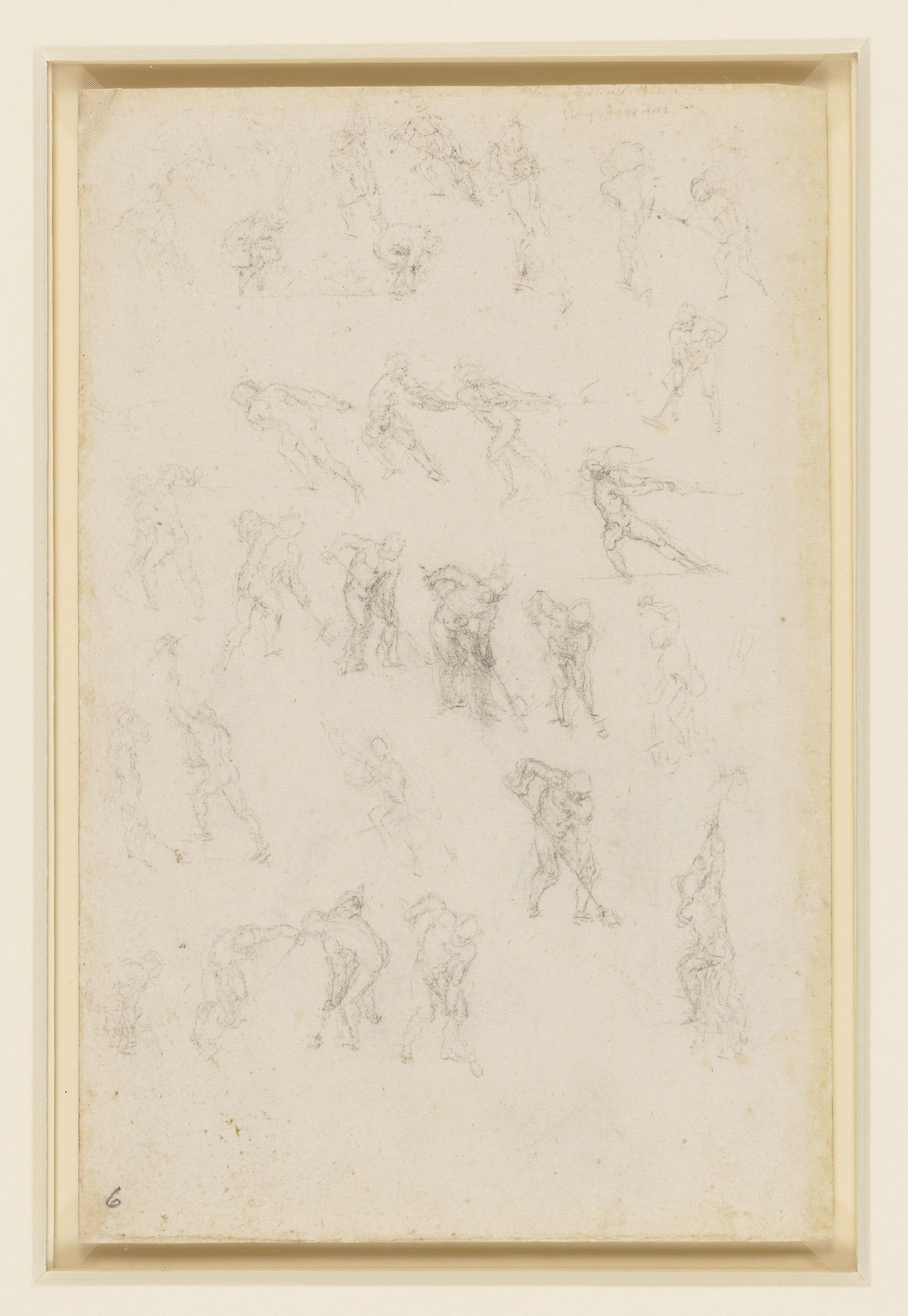
Of delivering a blow to the right or left.
W. 1a · Pl. XXIV, No. 1
See Plate XXIV, shown with § 386
In the Treatise on Painting: chapter 154
Why an impetus is not spent at once [but diminishes] gradually in some one direction? The impetus acquired in the line a b c d is spent in the line d e but not so completely but that some of its force remains in it and to this force is added the momentum in the line d e with the force of the motive power, and it must follow than the impetus multiplied by the blow is greater that the simple impetus produced by the momentum d e.
A man who has to deal a great blow with his weapon prepares himself with all his force on the opposite side to that where the spot is which he is to hit; and this is because a body as it gains in velocity gains in force against the object which impedes its motion.
C. A. 344b; 1066a · Pl. XXIV
See Plate XXIV, shown with § 386
Compare Plate LIV, under More plates
In the Treatise on Painting: chapter 89, chapter 92, chapter 153
Observe the motion of the surface of the water which resembles that of hair, and has two motions, of which one goes on with the flow of the surface, the other forms the lines of the eddies; thus the water forms eddying whirlpools one part of which are due to the impetus of the principal current and the other to the incidental motion and return flow.
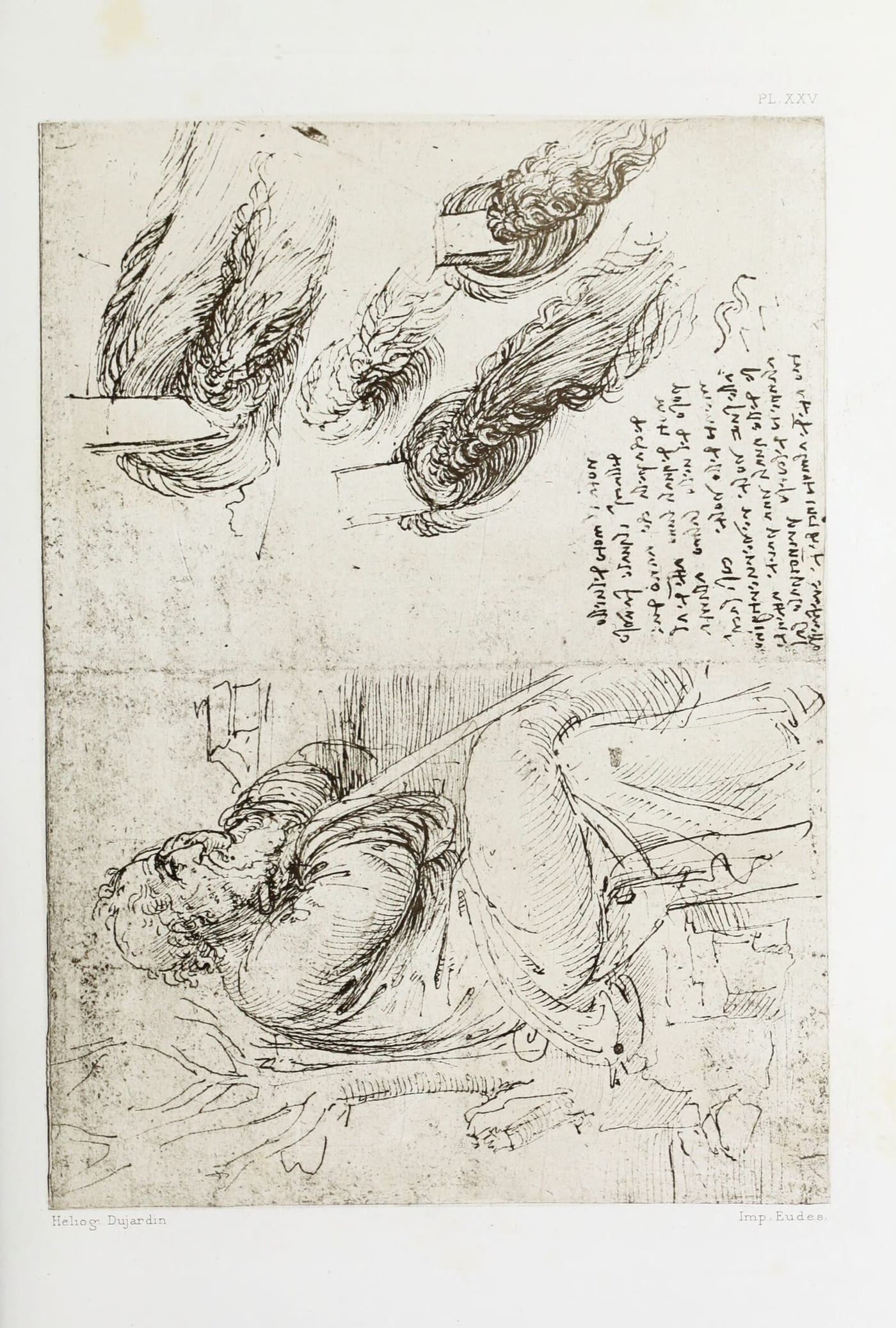
W. IV · Pl. XXV
That part of a fold which is farthest from the ends where it is confined will fall most nearly in its natural form.
Every thing by nature tends to remain at rest. Drapery, being of equal density and thickness on its wrong side and on its right, has a tendency to lie flat; therefore when you give it a fold or plait forcing it out of its flatness note well the result of the constraint in the part where it is most confined; and the part which is farthest from this constraint you will see relapses most into the natural state; that is to say lies free and flowing.
EXAMPLE.
Let a b c be the fold of the drapery spoken of above, a c will be the places where this folded drapery is held fast. I maintain that the part of the drapery which is farthest from the plaited ends will revert most to its natural form.
Therefore, b being farthest from a and c in the fold a b c it will be wider there than anywhere else.
Ash. I. 29b · Pl. XXVIII, No. 6 · Pl. XXX
See Plate XXVIII, shown with § 188
Compare Plate XXX, shown with § 486
In the Treatise on Painting: chapter 145 (the same passage)
How figures dressed in a cloak should not show the shape so much as that the cloak looks as if it were next the flesh; since you surely cannot wish the cloak to be next the flesh, for you must suppose that between the flesh and the cloak there are other garments which prevent the forms of the limbs appearing distinctly through the cloak. And those limbs which you allow to be seen you must make thicker so that the other garments may appear to be under the cloak. But only give something of the true thickness of the limbs to a nymph or an angel, which are represented in thin draperies, pressed and clinging to the limbs of the figures by the action of the wind.
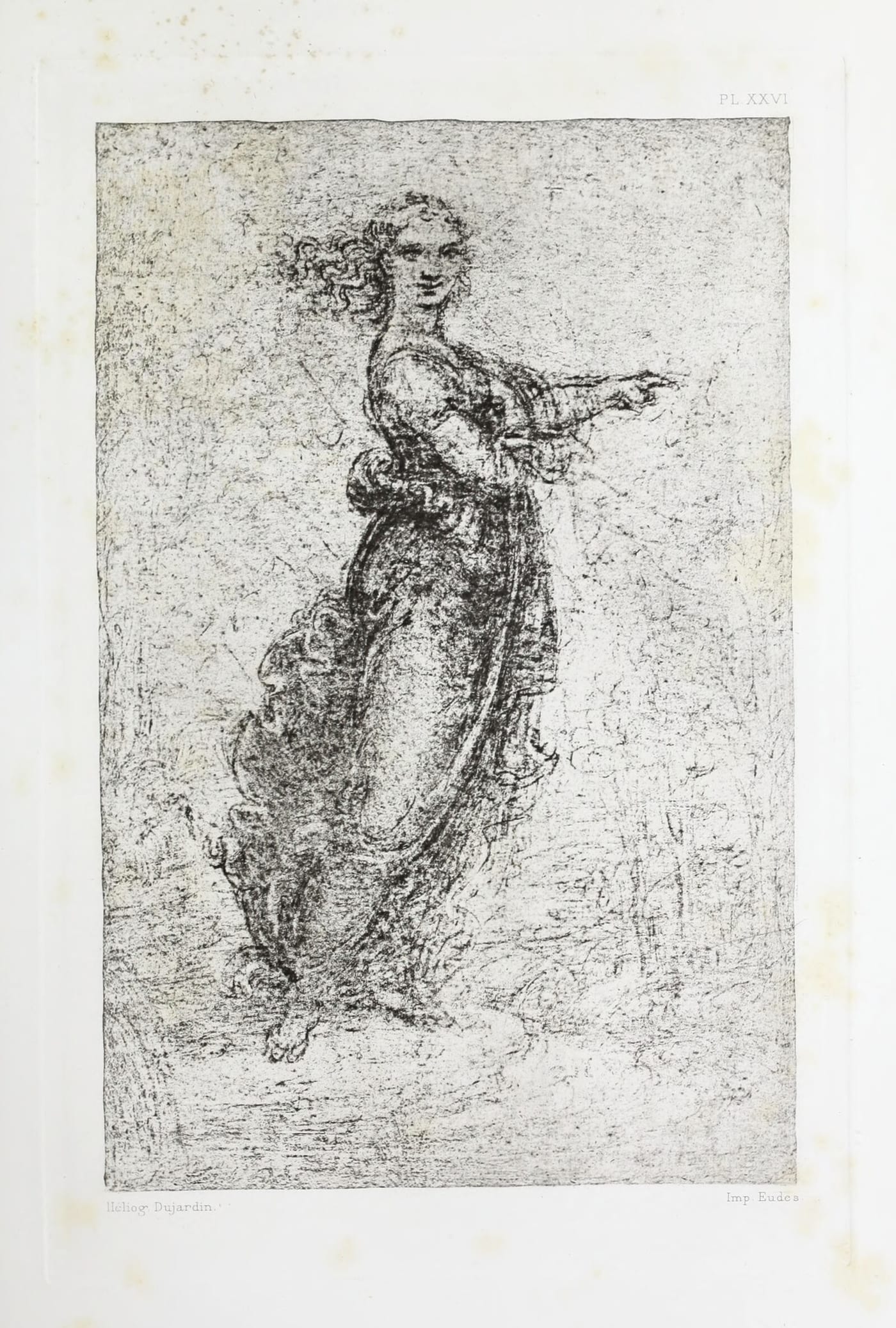
Ash. I. 17b · Pl. XXVI
See Plate XXVIII, shown with § 188
In the Treatise on Painting: chapter 148
You ought not to give to drapery a great confusion of many folds, but rather only introduce them where they are held by the hands or the arms; the rest you may let fall simply where it is its nature to flow; and do not let the nude forms be broken by too many details and interrupted folds. How draperies should be drawn from nature: that is to say if youwant to represent woollen cloth draw the folds from that; and if it is to be silk, or fine cloth or coarse, or of linen or of crape, vary the folds in each and do not represent dresses, as many do, from models covered with paper or thin leather which will deceive you greatly.
Ash. I. 1 8a · Pl. XXVIII, No. 7
See Plate XXVIII, shown with § 188
In the Treatise on Painting: chapter 143, chapter 146 (the same passage)


