The Notebooks of Leonardo da Vinci · translated by Jean Paul Richter · § 1379 to 1566 · public domain · plain text
Nothing in this part mentions that.
Richter’s introduction to this part
The incidental memoranda scattered here and there throughout the MSS. can have been for the most part intelligible to the writer only; in many cases their meaning and connection are all the more obscure because we are in ignorance about the persons with whom Leonardo used to converse nor can we say what part he may have played in the various events of his time. Vasari and other early biographers give us a very superficial and far from accurate picture of Leonardo's private life. Though his own memoranda, referring for the most part to incidents of no permanent interest, do not go far towards supplying this deficiency, they are nevertheless of some importance and interest as helping us to solve the numerous mysteries in which the history of Leonardo's long life remains involved. We may at any rate assume, from Leonardo's having committed to paper notes on more or less trivial matters on his pupils, on his house-keeping, on various known and unknown personages, and a hundred other trifies—that at the time they must have been in some way important to him.
I have endeavoured to make these 'Miscellaneous Notes' as complete as possible, for in many cases an incidental memorandum will help to explain the meaning of some other note of a similar kind. The first portion of these notes (Nos. l379—l457), as well as those referring to his pupils and to other artists and artificers who lived in his house (1458–1468,) are arranged in chronological order. A considerable proportion of these notes belong to the period between 1490 and 1500, when Leonardo was living at Milan under the patronage of Lodovico il Moro, a time concerning which we have otherwise only very scanty information. If Leonardo did really—as has always been supposed,—spend also the greater part of the preceding decade in Milan, it seems hardly likely that we should not find a single note indicative of the fact, or referring to any event of that period, on the numerous loose leaves in his writing that exist. Leonardo's life in Milan between 1489 and 1500 must have been comparatively uneventful. The MSS. and memoranda of those years seem to prove that it was a tranquil period of intellectual and artistic labour rather than of bustling court life. Whatever may have been the fate of the MSS. and note books of the foregoing years—whether they were destroyed by Leonardo himself or have been lost—it is certainly strange that nothing whatever exists to inform us as to his life and doings in Milan earlier than the consecutive series of manuscripts which begin in the year 1489.
There is nothing surprising in the fact that the notes regarding his pupils are few and meagre. Excepting for the record of money transactions only very exceptional circumstances would have prompted him to make any written observations on the persons with whom he was in daily intercourse, among whom, of course, were his pupils. Of them all none is so frequently mentioned as Salai, but the character of the notes does not—as it seems to me—justify us in supposing that he was any thing more than a sort of factotum of Leonardo's (see 1519, note).
Leonardo's quotations from books and his lists of titles supply nothing more than a hint as to his occasional literary studies or recreations. It was evidently no part of his ambition to be deeply read (see Nrs. 10, 11, 1159) and he more than once expressly states (in various passages which will be found in the foregoing sections) that he did not recognise the authority of the Ancients, on scientific questions, which in his day was held paramount. Archimedes is the sole exception, and Leonardo frankly owns his admiration for the illustrious Greek to whose genius his own was so much akin (see No. 1476). All his notes on various authors, excepting those which have already been inserted in the previous section, have been arranged alphabetically for the sake of convenience (1469–1508).
The passages next in order contain accounts and inventories principally of household property. The publication of these—often very trivial entries—is only justifiable as proving that the wealth, the splendid mode of life and lavish expenditure which have been attributed to Leonardo are altogether mythical; unless we put forward the very improbable hypothesis that these notes as to money in hand, outlay and receipts, refer throughout to an exceptional state of his affairs, viz. when he was short of money.
The memoranda collected at the end (No. 1505–1565) are, in the original, in the usual writing, from left to right. Besides, the style of the handwriting is at variance with what we should expect it to be, if really Leonardo himself had written these notes. Most of them are to be found in juxtaposition with undoubtedly authentic writing of his. But this may be easily explained, if we take into account the fact, that Leonardo frequently wrote on loose sheets. He may therefore have occasionally used paper on which others had made short memoranda, for the most part as it would seem, for his use. At the end of all I have given Leonardo's will from the copy of it preserved in the Melzi Library. It has already been printed by Amoretti and by Uzielli. It is not known what has become of the original document.
Find Longhi and tell him that you wait for him at Rome and will go with him to Naples; make you pay the donation and take the book by Vitolone, and the measurements of the public buildings. Have two covered boxes made to be carried on mules, but bed-covers will be best; this makes three, of which you will leave one at Vinci. Obtain the.............. from Giovanni Lombardo the linen draper of Verona. Buy handkerchiefs and towels,.... and shoes, 4 pairs of hose, a jerkin of... and skins, to make new ones; the lake of Alessandro.
Sell what you cannot take with you. Get from Jean de Paris the method of painting in tempera and the way of making white salt, and how to make tinted paper; sheets of paper folded up; and his box of colours; learn to work flesh colours in tempera, learn to dissolve gum lac, linseed ... white, of the garlic of Piacenza; take 'de Ponderibus'; take the works of Leonardo of Cremona. Remove the small furnace ... seed of lilies and of... Sell the boards of the support. Make him who stole it, give you the ... learn levelling and how much soil a man can dig out in a day.
Callias of Rhodes, Epimachus the Athenian, Diogenes, a philosopher, of Rhodes, Calcedonius of Thrace, Febar of Tyre, Callimachus the architect, a master of fires.
Any one who spends one ducat may take the instrument; and he will not pay more than half a ducat as a premium to the inventor of the instrument and one grosso to the workman every year. I do not want sub-officials.
Work of ... of the stable of Galeazzo; by the road of Brera; benefice of Stanghe; benefice of Porta Nuova; benefice of Monza; Indaco's mistake; give first the benefices; then the works; then ingratitude, indignity and lamentations.
Give your master the instance of a captain who does not himself win the victory, but the soldiers do by his counsels; and so he still deserves the reward.
Piece of tapestry,-pair of compasses,—Tommaso's book,—the book of Giovanni Benci,—the box in the custom-house,—to cut the cloth,—the sword-belt,—to sole the boots, —a light hat,—the cane from the ruined houses,—the debt for the table linen, —swimming-belt,—a book of white paper for drawing,—charcoal.—How much is a florin .... a leather bodice.
Where is Valentino?—boots,—boxes in the custom-house ...,— the monk at the Carmine,—squares,—Piero Martelli,—Salvi Borgherini,—send back the bags,—a support for the spectacles,—the nude study of San Gallo,—the cloak. Porphyry,—groups,—square,—Pandolfino.
Concave mirrors; philosophy of Aristotle; the books of Avicenna Italian and Latin vocabulary; Messer Ottaviano Palavicino or his Vitruvius. bohemian knives; Vitruvius; go every Saturday to the hot bath where you will see naked men;
Meteora',
Archimedes, on the centre of gravity; anatomy Alessandro Benedetto; The Dante of Niccolo della Croce; Inflate the lungs of a pig and observe whether they increase in width and in length, or in width diminishing in length.
Marliano, on Calculation, to Bertuccio. Albertus, on heaven and earth, [from the monk Bernardino]. Horace has written on the movements of the heavens.
The figures you will have to reserve for the last book on shadows that they may appear in the study of Gerardo the illuminator at San Marco at Florence.
[Go to see Melzo, and the Ambassador, and Maestro Bernardo].
The great bird will take its first flight;—on the back of his great swan,—filling the universe with wonders; filling all writings with his fame and bringing eternal glory to his birthplace.
Have Avicenna's work on useful inventions translated; spectacles with the case, steel and fork and...., charcoal, boards, and paper, and chalk and white, and wax;.... .... for glass, a saw for bones with fine teeth, a chisel, inkstand ........ three herbs, and Agnolo Benedetto. Get a skull, nut,—mustard.
Boots,—gloves, socks, combs, papers, towels, shirts,.... shoe-tapes,—..... shoes, penknife, pens. A skin for the chest.
To make some provisions for my garden, —Giordano, De Ponderibus,—the peacemaker, the flow and ebb of the sea,—have two baggage trunks made, look to Beltraffio's lathe and have taken the stone,—out leave the books belonging to Messer Andrea the German,—make scales of a long reed and weigh the substance when hot and again when cold. The mirror of Master Luigi; A b the flow and ebb of the water is shown at the mill of Vaprio,—a cap.
[Lactantius], [the book of Benozzo], groups, to bind the book,—a lantern,—Ser Pecantino,—Pandolfino.—[Rosso]—a square, —small knives,—carriages,—curry combs—cup.
Quadrant of Carlo Marmocchi,—Messer Francesco Araldo,—Ser Benedetto d'Accie perello,—Benedetto on arithmetic,—Maestro Paulo, physician,—Domenico di Michelino,—...... of the Alberti,—Messer Giovanni Argimboldi.
Pandolfino's book,—knives,—a pen for ruling,—to have the vest dyed,—The library at St.-Mark's,—The library at Santo Spirito,—Lactantius of the Daldi,—Antonio Covoni,—A book by Maestro Paolo Infermieri, —Boots, shoes and hose,—(Shell)lac, —An apprentice to do the models for me. Grammar, by Lorenzo de Medici,—Giovanni del Sodo,—Sansovino,—a ruler,—a very sharp knife,—Spectacles,—fractions...., —repair.........,—Tomaso's book,—Michelagnolo's little chain; Learn the multiplication of roots from Maestro Luca;—my map of the world which Giovanni Benci has;—Socks,—clothes from the customhouse —officier,—Red Cordova leather,—The map of the world, of Giovanni Benci,—a print, the districts about Milan—Market book.
An algebra, which the Marliani have, written by their father,—
On the bone, by the Marliani,—
On the bone which penetrates, Gian Giacomo of Bellinzona, to draw out the nail with facility,—
The measurement of Boccalino,—
The measurement of Milan and the suburbs, —
A book, treating of Milan and its churches which is to be had at the last stationer's on the way to Corduso,—
The measurement of the Corte Vecchia,—
The measurement of the Castle,—
Get the master of arithmetic to show you how to square a....,—
Get Messer Fazio to show you [the book] on proportion,—Get the Friar di Brera to show you [the book] 'de Ponderibus',—
Of the measurement of San Lorenzo,—
I lent certain groups to Fra Filippo de Brera,—
Memorandum: to ask Maestro Giovannino as to the mode in which the tower of Ferrara is walled without loopholes,—
Ask Maestro Antonio how mortars are placed on bastions by day or by night,—
Ask Benedetto Portinari how the people go on the ice in Flanders,—
On proportions by Alchino, with notes by Marliano, from Messer Fazio,—
The measurement of the sun, promised me by Maestro Giovanni, the Frenchman,—
The cross bow of Maestro Gianetto,—
The book by Giovanni Taverna that Messer Fazio,—
You will draw Milan,—
The measurement of the canal, locks and supports, and large boats; and the expense,—
Plan of Milan,—
Groups by Bramante,—
The book on celestial phenomena by Aristoteles, in Italian,—
Try to get Vitolone, which is in the library at Pavia and which treats of Mathematics,—He had a master [learned] in waterworks and get him to explain the repairs and the costs, and a lock and a canal and a mill in the Lombard fashion.
A grandson of Gian Angelo's, the painter has a book on water which was his fathers.
Paolino Scarpellino, called Assiolo has great knowledge of water works.
Giuliano Condi,—Tomaso Ridolf1,—Tomaso Paganelli,—Nicolo delNero,—Simone Zasti,—Nasi,—the heir of Lionardo Manelli, —Guglielmo di Ser Martino,—Bartolomeo del Tovaglia,—Andrea Arrigucci,—Nicolo Capponi,—Giovanni Portinari.
A box, a cage,— A square, to make the bird,— Pandolfino's book, mortar [?],— Small knives, Venieri for the Pen for ruling, stone,—star,—
To have the vest dyed, Alfieri's tazza,—
The Libraries, the book on celestial phenomena,—
Lactantius of the go to the house of Daldi,— the Pazzi,
Book from Maestro small box,—Paolo Infermieri,—
Boots, shoes and small gimlet,—hose,
Lac, .......,—
An apprentice for .....,—models,
Grammar of Lo-the amount of the renzo de' Medici,...
Giovanni del Sodo ..... for...,—the broken
Sansovino, the....
Piero di Cosino, the wings,—
Filippo and Lorenzo,—A ruler-,—Spectacles,—to do the..... again,—Tomaso's book,—Michelagnolo's chain,—The multiplication of roots,—Of the bow and strinch,—The map of the world from Benci,—Socks,—The clothes from the custom-house officier,—Cordova leather,—Market books,
—waters of Cronaca,—waters of Tanaglino...,
—the caps,—Rosso's mirror; to see him make it,—1/3 of which I have 5/6,—on the celestial phenomena, by Aristotle,—boxes of Lorenzo di Pier Francesco,—Maestro Piero of the Borgo,—To have my book bound,—Show the book to Serigatto,—and get the rule of the clock,—ring,—nutmeg,—gum,—the square,—Giovan' Batista at the piazza, de' Mozzi,—Giovanni Benci has my book and jaspers,—brass for the spectacles.
Giacomo came to live with me on St.-Mary Magdalen's day, 1490, aged 10 years. The second day I had two shirts cut out for him, a pair of hose, and a jerkin, and when I put aside some money to pay for these things he stole 4 lire the money out of the purse; and I could never make him confess, though I was quite certain of the fact.—Thief, liar, obstinate, glutton.
The day after, I went to sup with Giacomo Andrea, and the said Giacomo supped for two and did mischief for four; for he brake 3 cruets, spilled the wine, and after this came to sup where I....
Item: on the 7th day of September he stole a silver point of the value of 22 soldi from Marco who was living with me, 4 lire this being of silver; and he took it from his studio, and when the said Marco had searched for it a long while he found it hidden in the said Giacomo's box 4 lire.
Item: on the 26th January following, I, being in the house of Messer Galeazzo da San Severino, was arranging the festival for his jousting, and certain footmen having undressed to try on some costumes of wild men for the said festival, Giacomo went to the purse of one of them which lay on the bed with other clothes, 2 lire 4 S, and took out such money as was in it.
Item: when I was in the same house, Maestro Agostino da Pavia gave to me a Turkish hide to have 2 lire. a pair of short boots made of it; this Giacomo stole it of me within a month and sold it to a cobbler for 20 soldi, with which money, by his own confession, he bought anise comfits.
Item: again, on the 2nd April, Giovan Antonio having left a silver point on a drawing of his, Giacomo stole it, and this was of the value of 24 soldi 1 lira 4 S.
The first year-
A cloak, 2 lire, 6 shirts, 4 lire, 3 jerkins, 6 lire, 4 pairs of hose, 7 lire 8 soldi, 1 lined doublet, 5 lire, 24 pairs of shoes, 6 lire 5 soldi, A cap, l lira, laces, 1 lira.
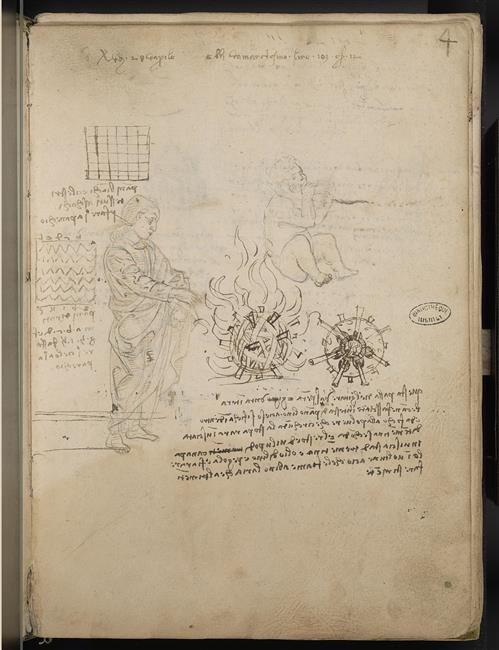
Manuscript page cited by Richter for this passage: Leonardo, Paris Manuscript C, f. 15v, Bibliothèque de l'Institut de France Source
Thursday the 27th day of September Maestro Tommaso came back and worked for himself until the last day but one of February. On the 18th day of March, 1493, Giulio, a German, came to live with me,—Lucia, Piero, Leonardo.
1493. On the 1st day of November we settled accounts. Giulio had to pay 4 months; and Maestro Tommaso 9 months; Maestro Tommaso afterwards made 6 candlesticks, 10 days' work; Giulio some fire-tongs 15 days work. Then he worked for himself till the 27th May, and worked for me at a lever till the 18th July; then for himself till the 7th of August, and for one day, on the fifteenth, for a lady. Then again for me at 2 locks until the 20th of August.
On the 23rd day of August, 12 lire from Pulisona. On the 14th of March 1494, Galeazzo came to live with me, agreeing to pay 5 lire a month for his cost paying on the l4th day of each month.
His father gave me 2 Rhenish florins.
On the l4th of July, I had from Galeazze 2 Rhenish florins.
Saturday morning the 3rd of August 1504 Jacopo the German came to live with me in the house, and agreed with me that I should charge him a carlino a day.
Benedetto carne on the 17th of October; he stayed with me two months and 13 days of last year, in which time he earned 38 lire, 18 soldi and 8 dinari; he had of this 26 lire and 8 soldi, and there remains to be paid for the past year 12 lire 10 soldi.
Giodatti (?) came on the 8th day of September, at 4 soldi a month, and stayed with me 3 months and 24 days, and earned 59 lire 14 soldi and 8 dinari; he has had 43 lire, 4 soldi, there remains to pay 16 lire, 10 soldi and 8 dinari.
The first decade, 'On the preservation of health', The third decade, Ciecho d'Ascoli, The fourth decade, Albertus Magnus, Guido, New treatise on rhetorics, Piero Crescentio, Cibaldone, 'Quadriregio', AEsop,
Map of Elephanta in India which Antonello Merciaio has from maestro Maffeo;—there for seven years the earth rises and for seven years it sinks;—Enquire at the stationers about Vitruvius.
Anaxagoras: Every thing proceeds from every thing, and every thing becomes every thing, and every thing can be turned into every thing else, because that which exists in the elements is composed of those elements.
Archimedes gave the quadrature of a polygonal figure, but not of the circle. Hence Archimedes never squared any figure with curved sides. He squared the circle minus the smallest portion that the intellect can conceive, that is the smallest point visible.
If any man could have discovered the utmost powers of the cannon, in all its various forms and have given such a secret to the Romans, with what rapidity would they have conquered every country and have vanquished every army, and what reward could have been great enough for such a service! Archimedes indeed, although he had greatly damaged the Romans in the siege of Syracuse, nevertheless did not fail of being offered great rewards from these very Romans; and when Syracuse was taken, diligent search was made for Archimedes; and he being found dead greater lamentation was made for him by the Senate and people of Rome than if they had lost all their army; and they did not fail to honour him with burial and with a statue. At their head was Marcus Marcellus. And after the second destruction of Syracuse, the sepulchre of Archimedes was found again by Cato, in the ruins of a temple. So Cato had the temple restored and the sepulchre he so highly honoured.... Whence it is written that Cato said that he was not so proud of any thing he had done as of having paid such honour to Archimedes.
Aristotle, Book 3 of the Physics, and Albertus Magnus, and Thomas Aquinas and the others on the rebound of bodies, in the 7th on Physics, on heaven and earth.
Aristotle says that if a force can move a body a given distance in a given time, the same force will move half the same body twice as far in the same time.
The highest good is wisdom, the chief evil is suffering in the body. Because, as we are composed of two things, that is soul and body, of which the first is the better, the body is the inferior; wisdom belongs to the better part, and the chief evil belongs to the worse part and is the worst of all. As the best thing of all in the soul is wisdom, so the worst in the body is suffering. Therefore just as bodily pain is the chief evil, wisdom is the chief good of the soul, that is with the wise man; and nothing else can be compared with it.
Demetrius was wont to say that there was no difference between the speech and words of the foolish and ignorant, and the noises and rumblings of the wind in an inflated stomach. Nor did he say so without reason, for he saw no difference between the parts whence the noise issued; whether their lower parts or their mouth, since one and the other were of equal use and importance.
5th Book of Euclid. First definition: a part is a quantity of less magnitude than the greater magnitude when the less is contained a certain number of times in the greater.
A part properly speaking is that which may be multiplied, that is when, being multiplied by a certain number, it forms exactly the whole. A common aggregate part ...
Second definition. A greater magnitude is said to be a multiple of a less, when the greater is measured by the less.
By the first we define the lesser [magnitude] and by the second the greater is defined. A part is spoken
Hippocrates says that the origin of men's sperm derives from the brain, and from the lungs and testicles of our parents, where the final decocture is made, and all the other limbs transmit their substance to this sperm by means of expiration, because there are no channels through which they might come to the sperm.
Mondino says that the muscles which raise the toes are in the outward side of the thigh, and he adds that there are no muscles in the back [upper side] of the feet, because nature desired to make them light, so as to move with ease; and if they had been fleshy they would be heavier; and here experience shows ...
I have found in a history of the Spaniards that in their wars with the English Archimedes of Syracuse who at that time was living at the court of Ecliderides, King of the Cirodastri. And in maritime warfare he ordered that the ships should have tall masts, and that on their tops there should be a spar fixed of 40 feet long and one third of a foot thick. At one end of this was a small grappling iron and at the other a counterpoise; and there was also attached 12 feet of chain; and, at the end of this chain, as much rope as would reach from the chain to the base of the top, where it was fixed with a small rope; from this base it ran down to the bottom of the mast where a very strong spar was attached and to this was fastened the end of the rope. But to go on to the use of his machine; I say that below this grappling iron was a fire which, with tremendous noise, threw down its rays and a shower of burning pitch; which, pouring down on the [enemy's] top, compelled the men who were in it to abandon the top to which the grappling-iron had clung. This was hooked on to the edges of the top and then suddenly the cord attached at the base of the top to support the cord which went from the grappling iron, was cut, giving way and drawing in the enemy's ship; and if the anchor—was cast ... Leic. 14b
Vitruvius says that small models are of no avail for ascertaining the effects of large ones; and I here propose to prove that this conclusion is a false one. And chiefly by bringing forward the very same argument which led him to this conclusion; that is, by an experiment with an auger. For he proves that if a man, by a certain exertion of strength, makes a hole of a given diameter, and afterwards another hole of double the diameter, this cannot be made with only double the exertion of the man's strength, but needs much more. To this it may very well be answered that an auger
of double the diameter cannot be moved by double the exertion, because the superficies of a body of the same form but twice as large has four times the extent of the superficies of the smaller, as is shown in the two figures a and n.
Of Squaring the Circle, and Who It Was That First Discovered It by Accident
Vitruvius, measuring miles by means of the repeated revolutions of the wheels which move vehicles, extended over many Stadia the lines of the circumferences of the circles of these wheels. He became aware of them by the animals that moved the vehicles. But he did not discern that this was a means of finding a square equal to a circle. This was first done by Archimedes of Syracuse, who by multiplying the second diameter of a circle by half its circumference produced a rectangular quadrilateral equal figure to the circle.
Manuscript page cited by Richter for this passage: Leonardo, Paris Manuscript G, f. 95r, Bibliothèque de l'Institut de France Source
On the ioth day of July 1492 in 135
Rhenish florins 1. 445
in dinari of 6 soldi 1. 112 S 16
in dinari of 5 1/2 soldi 1. 29 S 13
9 in gold and 3 scudi l. 53
1. 8II in all
How many braccia high is the level of the walls?—123 braccia
How large is the hall? How large is the garland? 30 ducats.
On the 29th day of January, 1494 cloth for hose lire 4 S 3 lining S 16 making S 8 to Salai S 3 a jasper ring S 13 a sparkling stone S 11 to Caterina S 10 to Caterina S 10
For the 3 Ibs of tapers 27 S
For the bier 8 S
A pall over the bier 12 S
For bearing and placing the cross 4 S
For bearing the body 8 S
For 4 priests and 4 clerks 20 S
Bell, book and sponge 2 S
For the gravediggers 16 S
To the senior 8 S
For a license from the authorities__ 1 S
106 S
The doctor 2 S
Sugar and candles __ 12 S
120 S
Salai's cloak, the 4th of April 1497. 4 braccia of silver cloth l. 15 S 4 green velvet to trim it l. 9 S — binding l.— S 9 loops l.— S 12 the making l. 1 S 5 binding for the front l.— S 5 stitching _________ here are 13 grossoni of his l. 26 S 5 Salai stole the soldi.
Memorandum. That on the 8th day of April 1503, I, Leonardo da Vinci, lent to Vante, miniature painter 4 gold ducats, in gold. Salai carried them to him and gave them into his own hand, and he said he would repay within the space of 40 days.
Memorandum. That on the same day I paid to Salai 3 gold ducats which he said he wanted for a pair of rose-coloured hose with their trimming; and there remain 9 ducats due to him-excepting that he owes me 20 ducats, that is 17 I lent him at Milan, and 3 at Venice.
Memorandum. That I gave Salai 21 braccia of cloth to make a shirt, at io soldi the braccio, which I gave him on the 20th day of April 1503.
On the morning of San Peter's day, June 29th, 1504, I took io ducats, of which I gave one to Tommaso my servant to spend. On Monday morning 1 florin to Salai to spend on the house.
On Thursday I took 1 florin for my own spending.
Wednesday evening 1 florin to Tommaso, before supper.
Saturday morning 1 florin to Tommaso.
Monday morning 1 florin less 10 soldi.
Thursday to Salai i florin less 10 soldi.
For a jerkin, 1 florin.
For a jerkin And a cap 2 florins.
To the hosier, 1 florin.
To Salai, 1 florin.
Friday morning, the 19th of July, 1 florin, less 6 soldi. I have 7 fl. left, and 22 in the box.
Tuesday, the 23th day of July, 1 florin to Tommaso.
Monday morning, to Tommaso 1 florin.
[Wednesday morning 1 fl. to Tommaso.]
Thursday morning the 1st day of August 1 fl. to Tommaso.
Sunday, the 4th of August, 1 florin.
Friday, the pth day of August 1504, I took 10 ducats out of the box.
1504. On the 9th day of August, 1504, I took 10 florins in gold.... on Friday the 9th day of August fifteen grossoni that is fl. 5 S 5 .... given to me 1 florin in gold on the l2th day of August ..... on the 14th of August, 32 grossoni to Tommaso. On the l8th of the same 5 grossoni to Salai. On the 8th of September 6 grossoni to the workman to spend; that is on the day of our Lady's birth. On the 16th day of September I gave 4 grossoni to Tommaso: on a Sunday.
Memorandum of the money I have had from the King as my salary from July 1508 till April next 1509. First 100 scudi, then 70, then 50, then 20 and then 200 florins at 48 soldi the florin.
Saturday the 2nd day of March I had from Santa Maria Novella 5 gold ducats, leaving 450. Of these I gave 2 the same day to Salai, who had lent them to me.
To Salai 4 grossoni, and for one braccio of velvet, 5 lire, and 1/2; viz. 10 soldi for loops of silver; Salai 14 soldi for binding, the making of the cloak 25 soldi.
Two large hatchets and one very small one, 8 brass spoons, 4 tablecloths, 2 towels, 15 small napkins, 2 coarse napkins, 2 coarse cloths, 2 wrappers, 3 pairs of sheets, 2 pairs new and 1 old.
New tin-ware 3 pairs of sheets
6 small bowls, each of 4 breadths,
6 bowls, 2 small sheets,
2 large dishes, 2 tablecloths and J/2,
2 dishes medium size, 16 coarse cloths,
2 small ones 8 shirts,
Old tin-ware 9 napkins,
3 small bowls, 2 hand-towels.
4 bowls,
3 square stones,
2 small bowls,
1 large bowl,
1 platter,
4 candlesticks,
1 small candlestick.
meat S 10 d
wine S 12 d
bran S 5 d 4
herbs S 10 d
buttermilk S 4 d 4
melon S 3 d
bread S 3 d 1
____________________
Monday S 9 8
____________________
..... S 6 d
wine S 12 d
bran S 9 d 4
buttermilk S 4 d 4
herbs S 8 d
____________________ Tuesday S d
meat S 0 d 8
wine S 12 d
bread S 3 d
meal S 5 d 4
herbs S 8 d
Wednesday __
wine S 5 d
melon S 2 d
meal S 5 d 4
vegetables S 8
C. A. 26a; 87a
Notes by unknown persons among the MSS. (1546–1565)
Miseracione divina sacro sancte Romane ecclesie tituli n cardinalis wulgariter nuncupatus venerabili religioso fratri Johanni Mair d'Nustorf ordinis praedicatorum provintie teutonie (?) conventus Wiennensis capellano nostro commensali salutem in dno sempiternam Religione zelus rite ac in [ferite?] honestas aliarumque laudabilium probitatis et virtutum merita quibus apud nos fide digno commendationis testimonio Magistri videlicet ordinis felicis recordacionis Leonardi de Mansuetis de Perusio sigillo suo ... us dans tibi ad ... opera virtutum comen(salem)? locum et tempus success(ores) cujus similiter officium ministratus qui praedecessoris sui donum (?) confirmavit et de novo dedit aliorumque plurima [laudatis] qui opera tua laudant nos inducunt ut tibi (?) reddamus ad gratiam liberalem hinc est quod nos cupientes.
Johannes Antonius di Johannes Ambrosius de Bolate. He who lets time pass and does not grow in virtue, the more I think of it the more I grieve. No man has it in him to be virtuous who will give up honour for gain. Good fortune is valueless to him who knows not toil. The man becomes happy who follows Christ. There is no perfect gift without great suffering. Our glories and our triumphs pass away. Foul lust, and dreams, and luxury, and sloth have banished every virtue from the world; so that our Nature, wandering and perplexed, has almost lost the old and better track. Henceforth it were well to rouse thyself from sleep. The master said that lying in down will not bring thee to Fame; nor staying beneath the quilts. He who, without Fame, burns his life to waste, leaves no more vestige of himself on earth than wind-blown smoke, or the foam upon the sea.
On the morning of Santo Zanobio the
29th of May 1504, I had from Lionardo Vinci
15 gold ducats and began to spend them.
to Mona Margarita S 62 d 4
to remake the ring S 19 d 8
clothes S 13
good beef S 4
eggs S 6
debt at the bank S 7
velvet S 12
wine S 6 d 4
meat S 4
mulberries S 2 d 4
mushrooms S 3 d 4
salad S 1
fruit S 1 d 4
candles S 3
.... S 1
flour S 2
_____________________________
Sunday 198 8
_____________________________
bread S 6
wine S 9 d 4
meat S 7
soup S 2
fruit S 3 d 4
candles S 3 d
____________________________
Monday 31
____________________________
bread S 6 d 4
meat S 10 d 8
wine S 9 d 4
fruit S 4
soup S 1 d 8
____________________________
32
To Monna Margarita S 5
to Tomaso S 14
to Monna Margarita d 5 S 2
on the day of San Zanobi
left..... after
payment d 13 S 2 d 4
of Monna Margarita
__________________
altogether d 14 S 5 d 4
Having become anxious.......... Bernardo di Simone, Silvestro di Stefano, Bernardo di Jacopo, Francesco di Matteo Bonciani, Antonio di Giovanni Ruberti, Antonio da Pistoia.... Antonio; He who has time and waits for time, will lose his friends and his money.
Reverend Maestro, Domino Giovanni, I spoke to Maestro Zacaria as a brother about this business, and I made him satisfied with the arrangement that I had wished; that is, as regards the commission that I had from the parties and I say that between us there is no need to pay money down, as regard the pictures of the ...
[The notes in Greek, Nos. 1557, 1558 and 1562 stand in close connection with each other, but the meaning of some words is very doubtful, and a translation is thus rendered impossible.]
Canonica of ... on the 5th of July 1507; my dearly beloved mother, sisters and cousin I herewith inform you that thanks to God I am ... about the sword which I ... bring it to Maso at the piazza ... and I will settle the business of Piero so that ...
Ut bene respondet Naturae ars docta! dedisset Vincius, ut tribuit cetera sic animam Noluit ut similis magis haec foret: altera sic est: Possidet illius Maurus amans animam.
Hujus quam cernis nomen Lucretia, Divi Omnia cui larga contribuere manu. Rara huic forma data est; pinxit Leonardos, amavit Maurus, pictorum primus hic, ille ducum.
Naturam, ac superas hac laesit imagine Divas Pictor: tantum hominis posse manum haec doluit, Illae longa dari tam magnae tempera formae, Quae spatio fuerat deperitura brevi.
[The notes in Greek, Nos. 1557, 1558 and 1562 stand in close connection with each other, but the meaning of some words is very doubtful, and a translation is thus rendered impossible.]
Be it known to all persons, present and to come that at the court of our Lord the King at Amboise before ourselves in person, Messer Leonardo da Vinci painter to the King, at present staying at the place known as Cloux near Amboise, duly considering the certainty of death and the uncertainty of its time, has acknowledged and declared in the said court and before us that he has made, according to the tenor of these presents, his testament and the declaration of his last will, as follows. And first he commends his soul to our Lord, Almighty God, and to the Glorious Virgin Mary, and to our lord Saint Michael, to all the blessed Angels and Saints male and female in Paradise.
Item. The said Testator desires to be buried within the church of Saint Florentin at Amboise, and that his body shall be borne thither by the chaplains of the church.
Item. That his body may be followed from the said place to the said church of Saint Florentin by the collegium of the said church, that is to say by the rector and the prior, or by their vicars and chaplains of the church of Saint Denis of Amboise, also the lesser friars of the place, and before his body shall be carried to the said church this Testator desires, that in the said church of Saint Florentin three grand masses shall be celebrated by the deacon and sub-deacon and that on the day when these three high masses are celebrated, thirty low masses shall also be performed at Saint Gregoire.
Item. That in the said church of Saint Denis similar services shall be performed, as above.
Item. That the same shall be done in the church of the said friars and lesser brethren.
Item. The aforesaid Testator gives and bequeaths to Messer Francesco da Melzo, nobleman, of Milan, in remuneration for services and favours done to him in the past, each and all of the books the Testator is at present possessed of, and the instruments and portraits appertaining to his art and calling as a painter.
Item. The same Testator gives and bequeaths henceforth for ever to Battista de Vilanis his servant one half, that is the moity, of his garden which is outside the walls of Milan, and the other half of the same garden to Salai his servant; in which garden aforesaid Salai has built and constructed a house which shall be and remain henceforth in all perpetuity the property of the said Salai, his heirs and successors; and this is in remuneration for the good and kind services which the said de Vilanis and Salai, his servants have done him in past times until now.
Item. The said Testator gives to Maturina his waiting woman a cloak of good black cloth lined with fur, a..... of cloth and two ducats paid once only; and this likewise is in remuneration for good service rendered to him in past times by the said Maturina.
Item. He desires that at his funeral sixty tapers shall be carried which shall be borne by sixty poor men, to whom shall be given money for carrying them; at the discretion of the said Melzo, and these tapers shall be distributed among the four above mentioned churches.
Item. The said Testator gives to each of the said churches ten lbs. of wax in thick tapers, which shall be placed in the said churches to be used on the day when those said services are celebrated.
Item. That alms shall be given to the poor of the Hotel-Dieu, to the poor of Saint Lazare d'Amboise and, to that end, there shall be given and paid to the treasurers of that same fraternity the sum and amount of seventy soldi of Tours.
Item. The said Testator gives and bequeaths to the said Messer Francesco Melzo, being present and agreeing, the remainder of his pension and the sums of money which are owing to him from the past time till the day of his death by the receiver or treasurer-general M. Johan Sapin, and each and every sum of money that he has already received from the aforesaid Sapin of his said pension, and in case he should die before the said Melzo and not otherwise; which moneys are at present in the possession of the said Testator in the said place called Cloux, as he says. And he likewise gives and bequeaths to the said Melzo all and each of his clothes which he at present possesses at the said place of Cloux, and all in remuneration for the good and kind services done by him in past times till now, as well as in payment for the trouble and annoyance he may incur with regard to the execution of this present testament, which however, shall all be at the expense of the said Testator.
And he orders and desires that the sum of four hundred scudi del Sole, which he has deposited in the hands of the treasurer of Santa Maria Nuova in the city of Florence, may be given to his brothers now living in Florence with all the interest and usufruct that may have accrued up to the present time, and be due from the aforesaid treasurer to the aforesaid Testator on account of the said four hundred crowns, since they were given and consigned by the Testator to the said treasurers.
Item. He desires and orders that the said Messer Francesco de Melzo shall be and remain the sole and only executor of the said will of the said Testator; and that the said testament shall be executed in its full and complete meaning and according to that which is here narrated and said, to have, hold, keep and observe, the said Messer Leonardo da Vinci, constituted Testator, has obliged and obliges by these presents the said his heirs and successors with all his goods moveable and immoveable present and to come, and has renounced and expressly renounces by these presents all and each of the things which to that are contrary. Given at the said place of Cloux in the presence of Magister Spirito Fieri vicar, of the church of Saint Denis at Amboise, of M. Guglielmo Croysant priest and chaplain, of Magister Cipriane Fulchin, Brother Francesco de Corion, and of Francesco da Milano, a brother of the Convent of the Minorites at Amboise, witnesses summoned and required to that end by the indictment of the said court in the presence of the aforesaid M. Francesco de Melze who accepting and agreeing to the same has promised by his faith and his oath which he has administered to us personally and has sworn to us never to do nor say nor act in any way to the contrary. And it is sealed by his request with the royal seal apposed to legal contracts at Amboise, and in token of good faith.
Given on the XXIIIrd day of April MDXVIII, before Easter.
And on the XXIIIrd day of this month of April MDXVIII, in the presence of M. Guglielmo Borian, Royal notary in the court of the bailiwick of Amboise, the aforesaid M. Leonardo de Vinci gave and bequeathed, by his last will and testament, as aforesaid, to the said M. Baptista de Vilanis, being present and agreeing, the right of water which the King Louis XII, of pious memory lately deceased gave to this same de Vinci, the stream of the canal of Santo Cristoforo in the duchy of Milan, to belong to the said Vilanis for ever in such wise and manner that the said gentleman made him this gift in the presence of M. Francesco da Melzo, gentleman, of Milan and in mine.
And on the aforesaid day in the said month of April in the said year MDXVIII the same M. Leonardo de Vinci by his last will and testament gave to the aforesaid M. Baptista de Vilanis, being present and agreeing, each and all of the articles of furniture and utensils of his house at present at the said place of Cloux, in the event of the said de Vilanis surviving the aforesaid M. Leonardo de Vinci, in the presence of the said M. Francesco Melzo and of me Notary &c. Borean.