Mixwell LibraryPlan an oil painting with Leonardo as your teacherTry Mixwell free

Mixwell Library › Leonardo da Vinci › The Notebooks › Part XXI

Part XXI. Letters. Personal Records. Dated Notes

The Notebooks of Leonardo da Vinci · translated by Jean Paul Richter · § 1336 to 1378 · 4 plates · public domain · plain text

Richter’s introduction to this part

When we consider how superficial and imperfect are the accounts of Leonardo's life written some time after his death by Vasari and others, any notes or letters which can throw more light on his personal circumstances cannot fail to be in the highest degree interesting. The texts here given as Nos. 1351–1353, set his residence in Rome in quite a new aspect; nay, the picture which irresistibly dwells in our minds after reading these details of his life in the Vatican, forms a striking contrast to the contemporary life of Raphael at Rome.

I have placed foremost of these documents the very remarkable letters to the Defterdar of Syria. In these Leonardo speaks of himself as having staid among the mountains of Armenia, and as the biographies of the master tell nothing of any such distant journeys, it would seem most obvious to treat this passage as fiction, and so spare ourselves the onus of proof and discussion. But on close examination no one can doubt that these documents, with the accompanying sketches, are the work of Leonardo's own hand. Not merely is the character of the handwriting his, but the spelling and the language are his also. In one respect only does the writing betray any marked deviation from the rest of the notes, especially those treating on scientific questions; namely, in these observations he seems to have taken particular pains to give the most distinct and best form of expression to all he had to say; we find erasures and emendations in almost every line. He proceeded, as we shall see, in the same way in the sketches for letters to Giuliano de' Medici, and what can be more natural, I may ask, than to find the draft of a letter thus altered and improved when it is to contain an account of a definite subject, and when personal interests are in the scale? The finished copies as sent off are not known to exist; if we had these instead of the rough drafts, we might unhesitatingly have declared that some unknown Italian engineer must have been, at that time, engaged in Armenia in the service of the Egyptian Sultan, and that Leonardo had copied his documents. Under this hypothesis however we should have to state that this unknown writer must have been so far one in mind with Leonardo as to use the same style of language and even the same lines of thought. This explanation might—as I say—have been possible, if only we had the finished letters. But why should these rough drafts of letters be regarded as anything else than what they actually and obviously are? If Leonardo had been a man of our own time, we might perhaps have attempted to account for the facts by saying that Leonardo, without having been in the East himself, might have undertaken to write a Romance of which the scene was laid in Armenia, and at the desire of his publisher had made sketches of landscape to illustrate the text.

I feel bound to mention this singular hypothesis as it has actually been put forward (see No. 1336 note 5); and it would certainly seem as though there were no other possible way of evading the conclusion to which these letters point, and their bearing on the life of the master,—absurd as the alternative is. But, if, on a question of such importance, we are justified in suggesting theories that have no foundation in probability, I could suggest another which, as compared with that of a Fiction by Leonardo, would be neither more nor less plausible; it is, moreover the only other hypothesis, perhaps, which can be devised to account for these passages, if it were possible to prove that the interpretation that the documents themselves suggest, must be rejected a priori; viz may not Leonardo have written them with the intention of mystifying those who, after his death, should try to decipher these manuscripts with a view to publishing them? But if, in fact, no objection that will stand the test of criticism can be brought against the simple and direct interpretation of the words as they stand, we are bound to regard Leonardo's travels in the East as an established fact. There is, I believe nothing in what we know of his biography to negative such a fact, especially as the details of his life for some few years are wholly unknown; nor need we be at a loss for evidence which may serve to explain—at any rate to some extent—the strangeness of his undertaking such a journey. We have no information as to Leonardo's history between 1482 and 1486; it cannot be proved that he was either in Milan or in Florence. On the other hand the tenor of this letter does not require us to assume a longer absence than a year or two. For, even if his appointment (offitio) as Engineer in Syria had been a permanent one, it might have become untenable—by the death perhaps of the Defterdar, his patron, or by his removal from office—, and Leonardo on his return home may have kept silence on the subject of an episode which probably had ended in failure and disappointment.

>From the text of No. 1379 we can hardly doubt that Leonardo intended to make an excursion secretly from Rome to Naples, although so far as has hitherto been known, his biographers never allude to it. In another place (No. 1077) he says that he had worked as an Engineer in Friuli. Are we to doubt this statement too, merely because no biographer has hitherto given us any information on the matter? In the geographical notes Leonardo frequently speaks of the East, and though such passages afford no direct proof of his having been there, they show beyond a doubt that, next to the Nile, the Euphrates, the Tigris and the Taurus mountains had a special interest in his eyes. As a still further proof of the futility of the argument that there is nothing in his drawings to show that he had travelled in the East, we find on Pl. CXX a study of oriental heads of Armenian type,—though of course this may have been made in Italy.

If the style of these letters were less sober, and the expressions less strictly to the point throughout, it miglit be possible to regard them as a romantic fiction instead of a narrative of fact. Nay, we have only to compare them with such obviously fanciful passages as No. 1354, Nos. 670-673, and the Fables and Prophecies. It is unnecessary to discuss the subject any further here; such explanations as the letter needs are given in the foot notes.

The drafts of letters to Lodovico il Moro are very remarkable. Leonardo and this prince were certainly far less closely connected, than has hitherto been supposed. It is impossible that Leonardo can have remained so long in the service of this prince, because the salary was good, as is commonly stated. On the contrary, it would seem, that what kept him there, in spite of his sore need of the money owed him by the prince, was the hope of some day being able to carry out the project of casting the 'gran cavallo'.

Drafts of Letters and Reports referring to Armenia (1336. 1337)

§ 1336

To the Devatdar of Syria, Lieutenant of the Sacred Sultan of Babylon
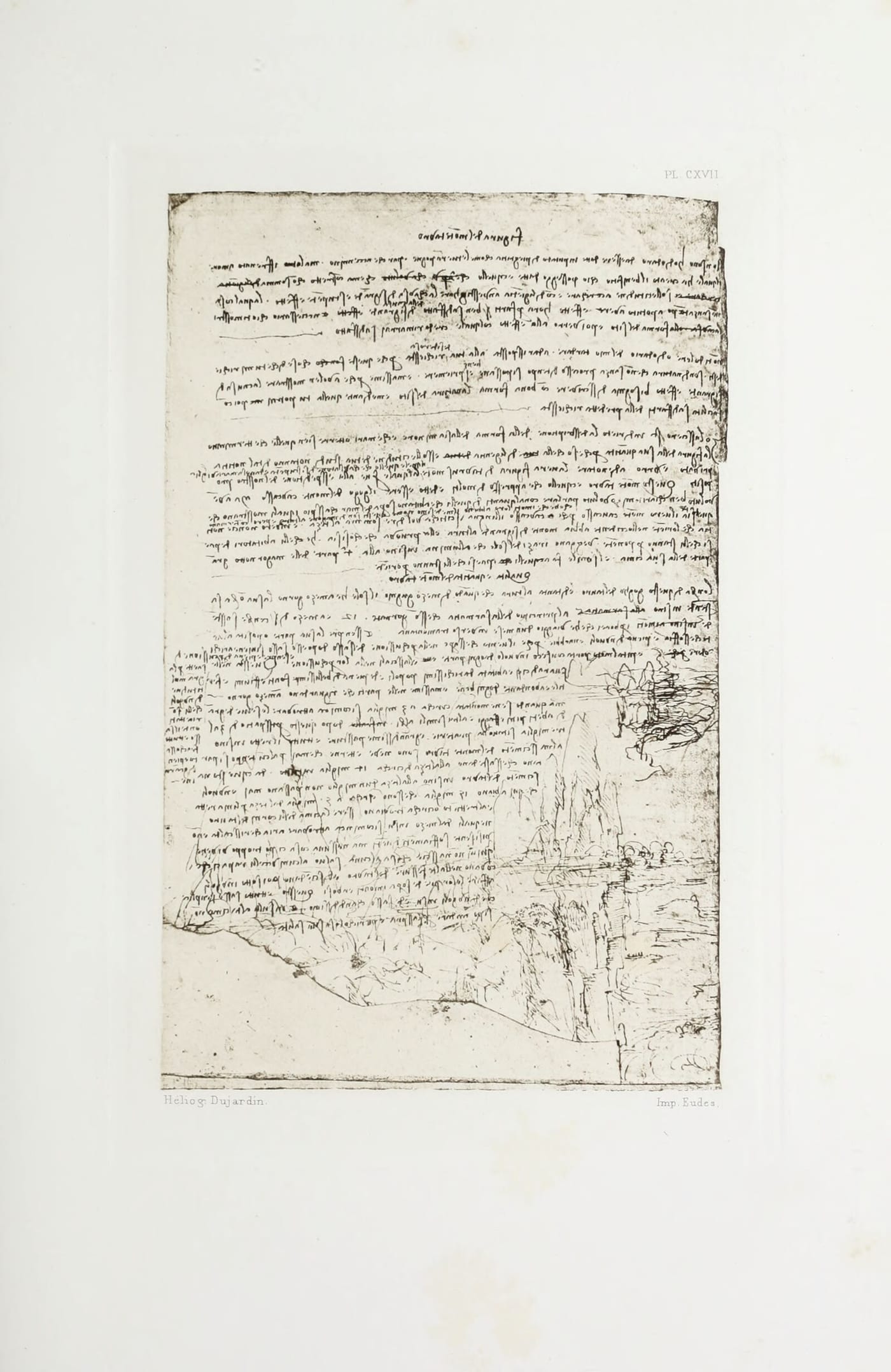
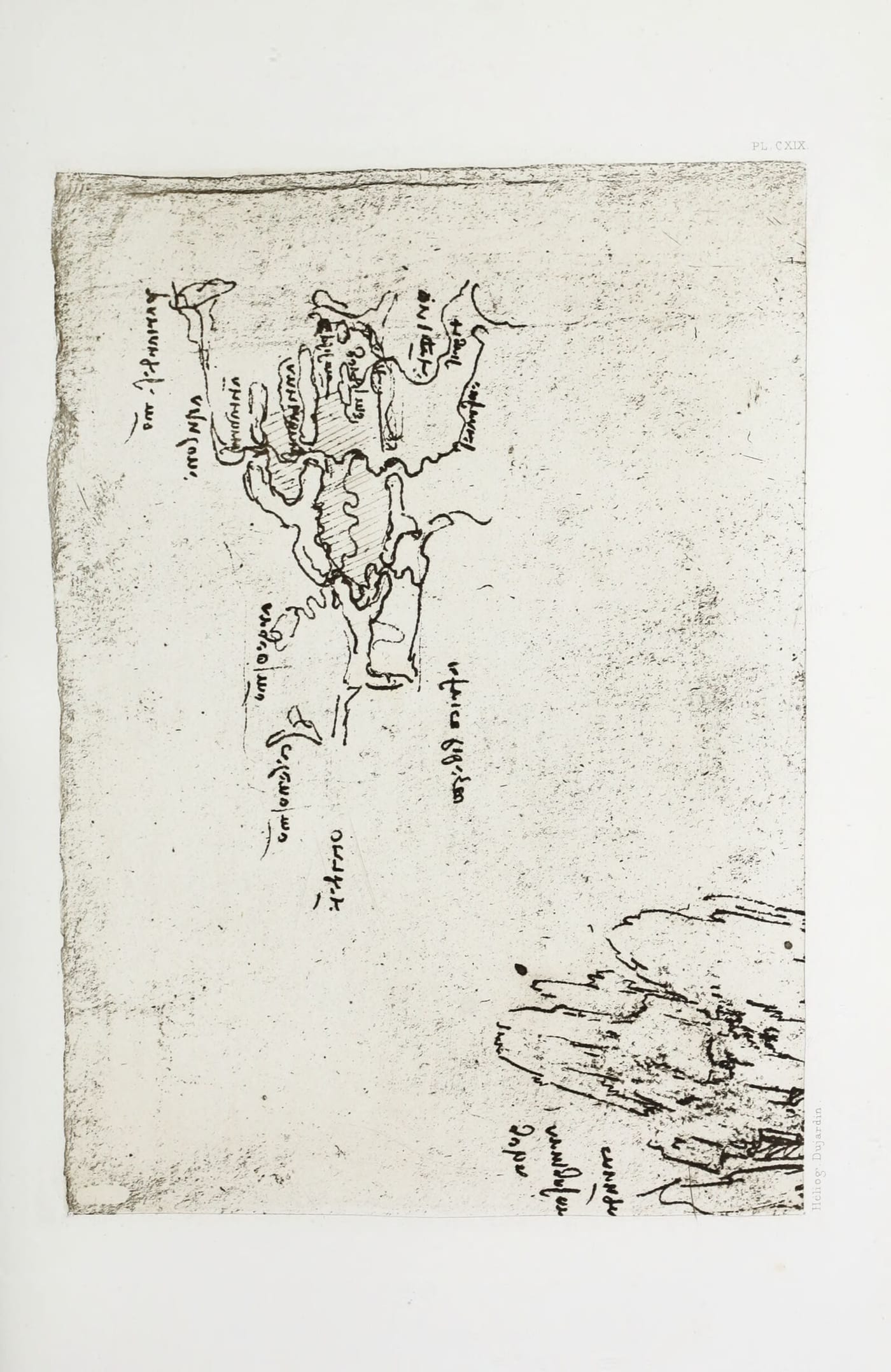
Plate CXVII: Sketch of Armenian Mountains; from the Codex Atlanticus, Milan,—see text No. 1336
Plate CXVII. Sketch of Armenian Mountains; from the Codex Atlanticus, Milan,—see text No. 1336
Plate CXIX: Sketch Map of Armenia; from the Codex Atlanticus, Milan—see text No. 1336
Plate CXIX. Sketch Map of Armenia; from the Codex Atlanticus, Milan—see text No. 1336

The recent disaster in our Northern parts which I am certain will terrify not you alone but the whole world, which shall be related to you in due order, showing first the effect and then the cause.

Finding myself in this part of Armenia to carry into effect with due love and care the task for which you sent me; and to make a beginning in a place which seemed to me to be most to our purpose, I entered into the city of Calindrafy, near to our frontiers. This city is situated at the base of that part of the Taurus mountains which is divided from the Euphrates and looks towards the peaks of the great Mount Taurus to the West. These peaks are of such a height that they seem to touch the sky, and in all the world there is no part of the earth, higher than its summit, and the rays of the sun always fall upon it on its East side, four hours before day-time, and being of the whitest stone it shines resplendently and fulfils the function to these Armenians which a bright moon-light would in the midst of the darkness; and by its great height it outreaches the utmost level of the clouds by a space of four miles in a straight line. This peak is seen in many places towards the West, illuminated by the sun after its setting the third part of the night. This it is, which with you we formerly in calm weather had supposed to be a comet, and appears to us in the darkness of night, to change its form, being sometimes divided in two or three parts, and sometimes long and sometimes short. And this is caused by the clouds on the horizon of the sky which interpose between part of this mountain and the sun, and by cutting off some of the solar rays the light on the mountain is intercepted by various intervals of clouds, and therefore varies in the form of its brightness.

THE DIVISIONS OF THE BOOK.

The praise and confession of the faith.

The sudden inundation, to its end.

The destruction of the city.

The death of the people and their despair.

The preacher's search, his release and benevolence

Description of the cause of this fall of the mountain.

The mischief it did.

Fall of snow.

The finding of the prophet.

His prophesy.

The inundation of the lower portion of Eastern Armenia, the draining of which was effected by the cutting through the Taurus Mountains.

How the new prophet showed that this destruction would happen as he had foretold.

Description of the Taurus Mountains and the river Euphrates.

Why the mountain shines at the top, from half to a third of the night, and looks like a comet to the inhabitants of the West after the sunset, and before day to those of the East.

Why this comet appears of variable forms, so that it is now round and now long, and now again divided into two or three parts, and now in one piece, and when it is to be seen again.

OF THE SHAPE OF THE TAURUS MOUNTAINS.

I am not to be accused, Oh Devatdar, of idleness, as your chidings seem to hint; but your excessive love for me, which gave rise to the benefits you have conferred on me is that which has also compelled me to the utmost painstaking in seeking out and diligently investigating the cause of so great and stupendous an effect. And this could not be done without time; now, in order to satisfy you fully as to the cause of so great an effect, it is requisite that I should explain to you the form of the place, and then I will proceed to the effect, by which I believe you will be amply satisfied.

Do not be aggrieved, O Devatdar, by my delay in responding to your pressing request, for those things which you require of me are of such a nature that they cannot be well expressed without some lapse of time; particularly because, in order to explain the cause of so great an effect, it is necessary to describe with accuracy the nature of the place; and by this means I can afterwards easily satisfy your above-mentioned request.

I will pass over any description of the form of Asia Minor, or as to what seas or lands form the limits of its outline and extent, because I know that by your own diligence and carefulness in your studies you have not remained in ignorance of these matters; and I will go on to describe the true form of the Taurus Mountain which is the cause of this stupendous and harmful marvel, and which will serve to advance us in our purpose. This Taurus is that mountain which, with many others is said to be the ridge of Mount Caucasus; but wishing to be very clear about it, I desired to speak to some of the inhabitants of the shores of the Caspian sea, who give evidence that this must be the true Caucasus, and that though their mountains bear the same name, yet these are higher; and to confirm this in the Scythian tongue Caucasus means a very high peak, and in fact we have no information of there being, in the East or in the West, any mountain so high. And the proof of this is that the inhabitants of the countries to the West see the rays of the sun illuminating a great part of its summit for as much as a quarter of the longest night. And in the same way, in those countries which lie to the East.

OF THE STRUCTURE AND SIZE OF MOUNT TAURUS.

The shadow of this ridge of the Taurus is of such a height that when, in the middle of June, the Sun is at its meridian, its shadow extends as far as the borders of Sarmatia, twelve days off; and in the middle of December it extends as far as the Hyperborean mountains, which are at a month's journey to the North. And the side which faces the wind is always free from clouds and mists, because the wind which is parted in beating on the rock, closes again on the further side of that rock, and in its motion carries with it the clouds from all quarters and leaves them where it strikes. And it is always full of thunderbolts from the great quantity of clouds which accumulate there, whence the rock is all riven and full of huge debris. This mountain, at its base, is inhabited by a very rich population and is full of most beautiful springs and rivers, and is fertile and abounding in all good produce, particularly in those parts which face to the South. But after mounting about three miles we begin to find forests of great fir trees, and beech and other similar trees; after this, for a space of three more miles, there are meadows and vast pastures; and all the rest, as far as the beginning of the Taurus, is eternal snows which never disappear at any time, and extend to a height of about fourteen miles in all. From this beginning of the Taurus up to the height of a mile the clouds never pass away; thus we have fifteen miles, that is, a height of about five miles in a straight line; and the summit of the peaks of the Taurus are as much, or about that. There, half way up, we begin to find a scorching air and never feel a breath of wind; but nothing can live long there; there nothing is brought forth save a few birds of prey which breed in the high fissures of Taurus and descend below the clouds to seek their prey. Above the wooded hills all is bare rock, that is, from the clouds upwards; and the rock is the purest white. And it is impossible to walk to the high summit on account of the rough and perilous ascent.

C. A. 143b; 426b · Pl. CXVI · Pl. CXVII · Pl. CXVI-CXVIII · Pl. CXVIII · Pl. CXVI and CXVII · Pl. CXIX

See Plate CXVI, shown with § 1294

See Plate CXVIII, shown with § 1293
§ 1337

Having often made you, by my letters, acquainted with the things which have happened, I think I ought not to be silent as to the events of the last few days, which—...

Having several times—

Having many times rejoiced with you by letters over your prosperous fortunes, I know now that, as a friend you will be sad with me over the miserable state in which I find myself; and this is, that during the last few days I have been in so much trouble, fear, peril and loss, besides the miseries of the people here, that we have been envious of the dead; and certainly I do not believe that since the elements by their separation reduced the vast chaos to order, they have ever combined their force and fury to do so much mischief to man. As far as regards us here, what we have seen and gone through is such that I could not imagine that things could ever rise to such an amount of mischief, as we experienced in the space of ten hours. In the first place we were assailed and attacked by the violence and fury of the winds; to this was added the falling of great mountains of snow which filled up all this valley, thus destroying a great part of our city. And not content with this the tempest sent a sudden flood of water to submerge all the low part of this city; added to which there came a sudden rain, or rather a ruinous torrent and flood of water, sand, mud, and stones, entangled with roots, and stems and fragments of various trees; and every kind of thing flying through the air fell upon us; finally a great fire broke out, not brought by the wind, but carried as it would seem, by ten thousand devils, which completely burnt up all this neighbourhood and it has not yet ceased. And those few who remain unhurt are in such dejection and such terror that they hardly have courage to speak to each other, as if they were stunned. Having abandoned all our business, we stay here together in the ruins of some churches, men and women mingled together, small and great, just like herds of goats. The neighbours out of pity succoured us with victuals, and they had previously been our enemies. And if it had not been for certain people who succoured us with victuals, all would have died of hunger. Now you see the state we are in. And all these evils are as nothing compared with those which are promised to us shortly.

I know that as a friend you will grieve for my misfortunes, as I, in former letters have shown my joy at your prosperity ...

C. A. 211b; 621a

Notes about events observed abroad (1338-1339)

§ 1338

Book 43. Of the Movement of Air Enclosed in Water

I have seen motions of the air so furious that they have carried, mixed up in their course, the largest trees of the forest and whole roofs of great palaces, and I have seen the same fury bore a hole with a whirling movement digging out a gravel pit, and carrying gravel, sand and water more than half a mile through the air.

F. 37b

Compare Plate XXXIV, shown with § 606

Compare Plate XXXV, shown with § 348

Compare Plate XXXVI, shown with § 477

Compare Plate XXXVII, shown with § 477

Compare Plate XXXVIII, shown with § 579

Compare Plate XXXIX, shown with § 608

Compare Plate XL, shown with § 473

§ 1339

Like a whirling wind which rushes down a sandy and hollow valley, and which, in its hasty course, drives to its centre every thing that opposes its furious course ...

No otherwise does the Northern blast whirl round in its tempestuous progress ...

Nor does the tempestuous sea bellow so loud, when the Northern blast dashes it, with its foaming waves between Scylla and Charybdis; nor Stromboli, nor Mount Etna, when their sulphurous flames, having been forcibly confined, rend, and burst open the mountain, fulminating stones and earth through the air together with the flames they vomit.

Nor when the inflamed caverns of Mount Etna, rejecting the ill-restained element vomit it forth, back to its own region, driving furiously before it every obstacle that comes in the way of its impetuous rage ...

Unable to resist my eager desire and wanting to see the great ... of the various and strange shapes made by formative nature, and having wandered some distance among gloomy rocks, I came to the entrance of a great cavern, in front of which I stood some time, astonished and unaware of such a thing. Bending my back into an arch I rested my left hand on my knee and held my right hand over my down-cast and contracted eye brows: often bending first one way and then the other, to see whether I could discover anything inside, and this being forbidden by the deep darkness within, and after having remained there some time, two contrary emotions arose in me, fear and desire—fear of the threatening dark cavern, desire to see whether there were any marvellous thing within it ...

Br. M. 155a

Drafts of Letters to Lodovico il Moro (1340-1345)

§ 1340

Most illustrious Lord, Having now sufficiently considered the specimens of all those who proclaim themselves skilled contrivers of instruments of war, and that the invention and operation of the said instruments are nothing different to those in common use: I shall endeavour, without prejudice to any one else, to explain myself to your Excellency showing your Lordship my secrets, and then offering them to your best pleasure and approbation to work with effect at opportune moments as well as all those things which, in part, shall be briefly noted below.

1) I have a sort of extremely light and strong bridges, adapted to be most easily carried, and with them you may pursue, and at any time flee from the enemy; and others, secure and indestructible by fire and battle, easy and convenient to lift and place. Also methods of burning and destroying those of the enemy.

2) I know how, when a place is besieged, to take the water out of the trenches, and make endless variety of bridges, and covered ways and ladders, and other machines pertaining to such expeditions.

3) Item. If, by reason of the height of the banks, or the strength of the place and its position, it is impossible, when besieging a place, to avail oneself of the plan of bombardment, I have methods for destroying every rock or other fortress, even if it were founded on a rock, &c.

4) Again I have kinds of mortars; most convenient and easy to carry; and with these can fling small stones almost resembling a storm; and with the smoke of these causing great terror to the enemy, to his great detriment and confusion.

9) And when the fight should be at sea I have kinds of many machines most efficient for offence and defence; and vessels which will resist the attack of the largest guns and powder and fumes.

5) Item. I have means by secret and tortuous mines and ways, made without noise to reach a designated [spot], even if it were needed to pass under a trench or a river.

6) Item. I will make covered chariots, safe and unattackable which, entering among the enemy with their artillery, there is no body of men so great but they would break them. And behind these, infantry could follow quite unhurt and without any hindrance.

7) Item. In case of need I will make big guns, mortars and light ordnance of fine and useful forms, out of the common type.

8) Where the operation of bombardment should fail, I would contrive catapults, mangonels, trabocchi and other machines of marvellous efficacy and not in common use. And in short, according to the variety of cases, I can contrive various and endless means of offence and defence.

10) In time of peace I believe I can give perfect satisfaction and to the equal of any other in architecture and the composition of buildings public and private; and in guiding water from one place to another.

Item: I can carry out sculpture in marble, bronze or clay, and also in painting whatever may be done, and as well as any other, be he whom he may.

Again, the bronze horse may be taken in hand, which is to be to the immortal glory and eternal honour of the prince your father of happy memory, and of the illustrious house of Sforza.

And if any one of the above-named things seem to any one to be impossible or not feasible, I am most ready to make the experiment in your park, or in whatever place may please your Excellency—to whom I commend myself with the utmost humility &c.

C. A. 388a; 1182b

Compare Plate XXXVIII, shown with § 579

§ 1341

To my illustrious Lord, Lodovico, Duke of Bari, Leonardo da Vinci of Florence— Leonardo.

S. K. M. III. 29a

§ 1342

You would like to see a model which will prove useful to you and to me, also it will be of use to those who will be the cause of our usefulness.

S. K. M. III. 23b

§ 1343

There are here, my Lord, many gentlemen who will undertake this expense among them, if they are allowed to enjoy the use of admission to the waters, the mills, and the passage of vessels and when it is sold to them the price will be repaid to them by the canal of Martesana.

S. K. M. III. 79b

§ 1344

I am greatly vexed to be in necessity, but I still more regret that this should be the cause of the hindrance of my wish which is always disposed to obey your Excellency.

Perhaps your Excellency did not give further orders to Messer Gualtieri, believing that I had money enough.

I am greatly annoyed that you should have found me in necessity, and that my having to earn my living should have hindered me ...

It vexes me greatly that having to earn my living has forced me to interrupt the work and to attend to small matters, instead of following up the work which your Lordship entrusted to me. But I hope in a short time to have earned so much that I may carry it out quietly to the satisfaction of your Excellency, to whom I commend myself; and if your Lordship thought that I had money, your Lordship was deceived. I had to feed 6 men for 56 months, and have had 50 ducats.

C. A. 308b; 339a

§ 1345

And if any other comission is given me by any ... of the reward of my service. Because I am not [able] to be ... things assigned because meanwhile they have ... to them ... ... which they well may settle rather than I ... not my art which I wish to change and ... given some clothing if I dare a sum ...

My Lord, I knowing your Excellency's mind to be occupied ... to remind your Lordship of my small matters and the arts put to silence that my silence might be the cause of making your Lordship scorn ... my life in your service. I hold myself ever in readiness to obey ...

Of the horse I will say nothing because I know the times [are bad] to your Lordship how I had still to receive two years' salary of the ... with the two skilled workmen who are constantly in my pay and at my cost that at last I found myself advanced the said sum about 15 lire ... works of fame by which I could show to those who shall see it that I have been everywhere, but I do not know where I could bestow my work [more] ...

I, having been working to gain my living ...

I not having been informed what it is, I find myself ...

remember the commission to paint the rooms ...

I conveyed to your Lordship only requesting you ...

C. A. 328b; 983b

Draft of letter to be sent to Piacenza (1346. 1347)

§ 1346

Magnificent Commissioners of Buildings I, understanding that your Magnificencies have made up your minds to make certain great works in bronze, will remind you of certain things: first that you should not be so hasty or so quick to give the commission, lest by this haste it should become impossible to select a good model and a good master; and some man of small merit may be chosen, who by his insufficiency may cause you to be abused by your descendants, judging that this age was but ill supplied with men of good counsel and with good masters; seeing that other cities, and chiefly the city of the Florentines, has been as it were in these very days, endowed with beautiful and grand works in bronze; among which are the doors of their Baptistery. And this town of Florence, like Piacenza, is a place of intercourse, through which many foreigners pass; who, seeing that the works are fine and of good quality, carry away a good impression, and will say that that city is well filled with worthy inhabitants, seeing the works which bear witness to their opinion; and on the other hand, I say seeing so much metal expended and so badly wrought, it were less shame to the city if the doors had been of plain wood; because, the material, costing so little, would not seem to merit any great outlay of skill...

Now the principal parts which are sought for in cities are their cathedrals, and of these the first things which strike the eye are the doors, by which one passes into these churches.

Beware, gentlemen of the Commission, lest too great speed in your determination, and so much haste to expedite the entrusting of so great a work as that which I hear you have ordered, be the cause that that which was intended for the honour of God and of men should be turned to great dishonour of your judgments, and of your city, which, being a place of mark, is the resort and gathering-place of innumerable foreigners. And this dishonour would result if by your lack of diligence you were to put your trust in some vaunter, who by his tricks or by favour shown to him here should obtain such work from you, by which lasting and very great shame would result to him and to you. Thus I cannot help being angry when I consider what men those are who have conferred with you as wishing to undertake this great work without thinking of their sufficiency for it, not to say more. This one is a potter, that one a maker of cuirasses, this one is a bell-founder, another a bell ringer, and one is even a bombardier; and among them one in his Lordship's service, who boasted that he was the gossip of Messer Ambrosio Ferrere, who has some power and who has made him some promises; and if this were not enough he would mount on horseback, and go to his Lord and obtain such letters that you could never refuse [to give] him the work. But consider where masters of real talent and fit for such work are brought when they have to compete with such men as these. Open your eyes and look carefully lest your money should be spent in buying your own disgrace. I can declare to you that from that place you will procure none but average works of inferior and coarse masters. There is no capable man,—and you may believe me,—except Leonardo the Florentine, who is making the equestrian statue in bronze of the Duke Francesco and who has no need to bring himself into notice, because he has work for all his life time; and I doubt, whether being so great a work, he will ever finish it.

The miserable painstakers ... with what hope may they expect a reward of their merit?

C. A. 316a; 958a

§ 1347

There is one whom his Lordship invited from Florence to do this work and who is a worthy master, but with so very much business he will never finish it; and you may imagine that a difference there is to be seen between a beautiful object and an ugly one. Quote Pliny.

C. A. 316b; 958b

Letter to the Cardinal Ippolito d' Este

§ 1348

Most Illustrious and most Reverend Lord. The Lord Ippolito, Cardinal of Este at Ferrare.

Most Illustrious and most Reverend Lord.

I arrived from Milan but a few days since and finding that my elder brother refuses to carry into effect a will, made three years ago when my father died—as also, and no less, because I would not fail in a matter I esteem most important—I cannot forbear to crave of your most Reverend Highness a letter of recommendation and favour to Ser Raphaello Hieronymo, at present one of the illustrious members of the Signoria before whom my cause is being argued; and more particularly it has been laid by his Excellency the Gonfaloniere into the hands of the said Ser Raphaello, that his Worship may have to decide and end it before the festival of All Saints. And therefore, my Lord, I entreat you, as urgently as I know how and am able, that your Highness will write a letter to the said Ser Raphaello in that admirable and pressing manner which your Highness can use, recommending to him Leonardo Vincio, your most humble servant as I am, and shall always be; requesting him and pressing him not only to do me justice but to do so with despatch; and I have not the least doubt, from many things that I hear, that Ser Raphaello, being most affectionately devoted to your Highness, the matter will issue ad votum. And this I shall attribute to your most Reverend Highness' letter, to whom I once more humbly commend myself. Et bene valeat.

Florence XVIIIa 7bris 1507. E. V. R. D.

your humble servant Leonardus Vincius, pictor.

M. D.

Draft of Letter to the Governor of Milan

§ 1349

I am afraid lest the small return I have made for the great benefits, I have received from your Excellency, have not made you somewhat angry with me, and that this is why to so many letters which I have written to your Lordship I have never had an answer. I now send Salai to explain to your Lordship that I am almost at an end of the litigation I had with my brother; that I hope to find myself with you this Easter, and to carry with me two pictures of two Madonnas of different sizes. These were done for our most Christian King, or for whomsoever your Lordship may please. I should be very glad to know on my return thence where I may have to reside, for I would not give any more trouble to your Lordship. Also, as I have worked for the most Christian King, whether my salary is to continue or not. I wrote to the President as to that water which the king granted me, and which I was not put in possession of because at that time there was a dearth in the canal by reason of the great droughts and because its outlets were not regulated; but he certainly promised me that when this was done I should be put in possession. Thus I pray your Lordship that you will take so much trouble, now that these outlets are regulated, as to remind the President of my matter; that is, to give me possession of this water, because on my return I hope to make there instruments and other things which will greatly please our most Christian King. Nothing else occurs to me. I am always yours to command.

C. A. 310a; 944a

Drafts of Letters to the Superintendent of Canals and to Fr. Melzi

§ 1350

Magnificent President, I am sending thither Salai, my pupil, who is the bearer of this, and from him you will hear by word of mouth the cause of my...

Magnificent President, I...

Magnificent President:—Having ofttimes remembered the proposals made many times to me by your Excellency, I take the liberty of writing to remind your Lordship of the promise made to me at my last departure, that is the possession of the twelve inches of water granted to me by the most Christian King. Your Lordship knows that I did not enter into possession, because at that time when it was given to me there was a dearth of water in the canal, as well by reason of the great drought as also because the outlets were not regulated; but your Excellency promised me that as soon as this was done, I should have my rights. Afterwards hearing that the canal was complete I wrote several times to your Lordship and to Messer Girolamo da Cusano, who has in his keeping the deed of this gift; and so also I wrote to Corigero and never had a reply. I now send thither Salai, my pupil, the bearer of this, to whom your Lordship may tell by word of mouth all that happened in the matter about which I petition your Excellency. I expect to go thither this Easter since I am nearly at the end of my lawsuit, and I will take with me two pictures of our Lady which I have begun, and at the present time have brought them on to a very good end; nothing else occurs to me.

My Lord the love which your Excellency has always shown me and the benefits that I have constantly received from you I have hitherto...

I am fearful lest the small return I have made for the great benefits I have received from your Excellency may not have made you somewhat annoyed with me. And this is why, to many letters which I have written to your Excellency I have never had an answer. I now send to you Salai to explain to your Excellency that I am almost at the end of my litigation with my brothers, and that I hope to be with you this Easter and carry with me two pictures on which are two Madonnas of different sizes which I began for the most Christian King, or for whomsoever you please. I should be very glad to know where, on my return from this place, I shall have to reside, because I do not wish to give more trouble to your Lordship; and then, having worked for the most Christian King, whether my salary is to be continued or not. I write to the President as to the water that the king granted me of which I had not been put in possession by reason of the dearth in the canal, caused by the great drought and because its outlets were not regulated; but he promised me certainly that as soon as the regulation was made, I should be put in possession of it; I therefore pray you that, if you should meet the said President, you would be good enough, now that the outlets are regulated, to remind the said President to cause me to be put in possession of that water, since I understand it is in great measure in his power. Nothing else occurs to me; always yours to command.

Good day to you Messer Francesco. Why, in God's name, of all the letters I have written to you, have you never answered one. Now wait till I come, by God, and I shall make you write so much that perhaps you will become sick of it.

Dear Messer Francesco. I am sending thither Salai to learn from His Magnificence the President to what end the regulation of the water has come since, at my departure this regulation of the outlets of the canal had been ordered, because His Magnificence the President promised me that as soon as this was done I should be satisfied. It is now some time since I heard that the canal was in order, as also its outlets, and I immediately wrote to the President and to you, and then I repeated it, and never had an answer. So you will have the goodness to answer me as to that which happened, and as I am not to hurry the matter, would you take the trouble, for the love of me, to urge the President a little, and also Messer Girolamo Cusano, to whom you will commend me and offer my duty to his Magnificence.

C. A. 364b; 1138b

Drafts of a letter to Giuliano de' Medici (1351-1352)

§ 1351

[Most illustrious Lord. I greatly rejoice most Illustrious Lord at your...]

I was so greatly rejoiced, most illustrious Lord, by the desired restoration of your health, that it almost had the effect that [my own health recovered]—[I have got through my illness]—my own illness left me— —of your Excellency's almost restored health. But I am extremely vexed that I have not been able completely to satisfy the wishes of your Excellency, by reason of the wickedness of that deceiver, for whom I left nothing undone which could be done for him by me and by which I might be of use to him; and in the first place his allowances were paid to him before the time, which I believe he would willingly deny, if I had not the writing signed by myself and the interpreter. And I, seeing that he did not work for me unless he had no work to do for others, which he was very careful in solliciting, invited him to dine with me, and to work afterwards near me, because, besides the saving of expense, he would acquire the Italian language. He always promised, but would never do so. And this I did also, because that Giovanni, the German who makes the mirrors, was there always in the workshop, and wanted to see and to know all that was being done there and made it known outside ... strongly criticising it; and because he dined with those of the Pope's guard, and then they went out with guns killing birds among the ruins; and this went on from after dinner till the evening; and when I sent Lorenzo to urge him to work he said that he would not have so many masters over him, and that his work was for your Excellency's Wardrobe; and thus two months passed and so it went on; and one day finding Gian Niccolo of the Wardrobe and asking whether the German had finished the work for your Magnificence, he told me this was not true, but only that he had given him two guns to clean. Afterwards, when I had urged him farther, be left the workshop and began to work in his room, and lost much time in making another pair of pincers and files and other tools with screws; and there he worked at mills for twisting silk which he hid when any one of my people went in, and with a thousand oaths and mutterings, so that none of them would go there any more.

I was so greatly rejoiced, most Illustrious Lord, by the desired restoration of your health, that my own illness almost left me. But I am greatly vexed at not having been able to completely satisfy your Excellency's wishes by reason of the wickedness of that German deceiver, for whom I left nothing undone by which I could have hope to please him; and secondly I invited him to lodge and board with me, by which means I should constantly see the work he was doing and with greater ease correct his errors while, besides this, he would learn the Italian tongue, by means of which be could with more ease talk without an interpreter; his moneys were always given him in advance of the time when due. Afterwards he wanted to have the models finished in wood, just as they were to be in iron, and wished to carry them away to his own country. But this I refused him, telling him that I would give him, in drawing, the breadth, length, height and form of what he had to do; and so we remained in ill-will.

The next thing was that he made himself another workshop and pincers and tools in his room where he slept, and there he worked for others; afterwards he went to dine with the Swiss of the guard, where there are idle fellows, in which he beat them all; and most times they went two or three together with guns, to shoot birds among the ruins, and this went on till evening.

At last I found how this master Giovanni the mirror-maker was he who had done it all, for two reasons; the first because he had said that my coming here had deprived him of the countenance and favour of your Lordship which always... The other is that he said that his iron-workers' rooms suited him for working at his mirrors, and of this he gave proof; for besides making him my enemy, he made him sell all he had and leave his workshop to him, where he works with a number of workmen making numerous mirrors to send to the fairs.

C. A. 243b; 729a

§ 1352

I was so greatly rejoiced, most Illustrious Lord, by the wished for recovery of your health, that my own ills have almost left me; and I say God be praised for it. But it vexes me greatly that I have not been able completely to satisfy your Excellency's wishes by reason of the wickedness of that German deceiver, for whom I left nothing undone by which I could hope to please him; and secondly I invited him to lodge and board with me, by which means I should see constantly the work he was doing, for which purpose I would have a table fixed at the foot of one of these windows, where he could work with the file and finish the things made below; and so I should constantly see the work he might do, and it could be corrected with greater ease.

C. A. 278a; 850a

Draft of letter written at Rome

§ 1353

This other hindered me in anatomy, blaming it before the Pope; and likewise at the hospital; and he has filled this whole Belvedere with workshops for mirrors; and he did the same thing in Maestro Giorgio's room. He said that he had been promised eight ducats every month, beginning with the first day, when he set out, or at latest when he spoke with you; and that you agreed.

Seeing that he seldom stayed in the workshop, and that he ate a great deal, I sent him word that, if he liked I could deal with him separately for each thing that he might make, and would give him what we might agree to be a fair valuation. He took counsel with his neighbour and gave up his room, selling every thing, and went to find...

C. A. 179b; 541a

Miscellaneous Records (1354. 1355)

§ 1354

Dear Benedetto de' Pertarti. When the proud giant fell because of the bloody and miry state of the ground it was as though a mountain had fallen so that the country shook as with an earthquake, and terror fell on Pluto in hell. From the violence of the shock he lay as stunned on the level ground. Suddenly the people, seeing him as one killed by a thunderbolt, turned back; like ants running wildly over the body of the fallen oak, so these rushing over his ample limbs.......... them with frequent wounds; by which, the giant being roused and feeling himself almost covered by the multitude, he suddenly perceives the smarting of the stabs, and sent forth a roar which sounded like a terrific clap of thunder; and placing his hands on the ground he raised his terrible face: and having lifted one hand to his head he found it full of men and rabble sticking to it like the minute creatures which not unfrequently are found there; wherefore with a shake of his head he sends the men flying through the air just as hail does when driven by the fury of the winds. Many of these men were found to be dead; stamping with his feet.

And clinging to his hair, and striving to hide in it, they behaved like sailors in a storm, who run up the ropes to lessen the force of the wind [by taking in sail].

News of things from the East.

Be it known to you that in the month of June there appeared a Giant, who came from the Lybian desert... mad with rage like ants.... struck down by the rude.

This great Giant was born in Mount Atlas and was a hero ... and had to fight against the Egyptians and Arabs, Medes and Persians. He lived in the sea on whales, grampuses and ships.

Mars fearing for his life took refuge under the... of Jove.

And at the great fall it seemed as though the whole province quaked.

C. A. 304a; 925a

§ 1355

This spirit returns to the brain whence it had departed, with a loud voice and with these words, it moved...

And if any man though he may have wisdom or goodness .........

O blessed and happy spirit whence comest thou? Well have I known this man, much against my will. This one is a receptacle of villainy; he is a perfect heap of the utmost ingratitude combined with every vice. But of what use is it to fatigue myself with vain words? Nothing is to be found in them but every form of sin ... And if there should be found among them any that possesses any good, they will not be treated differently to myself by other men; and in fine, I come to the conclusion that it is bad if they are hostile, and worse if they are friendly.

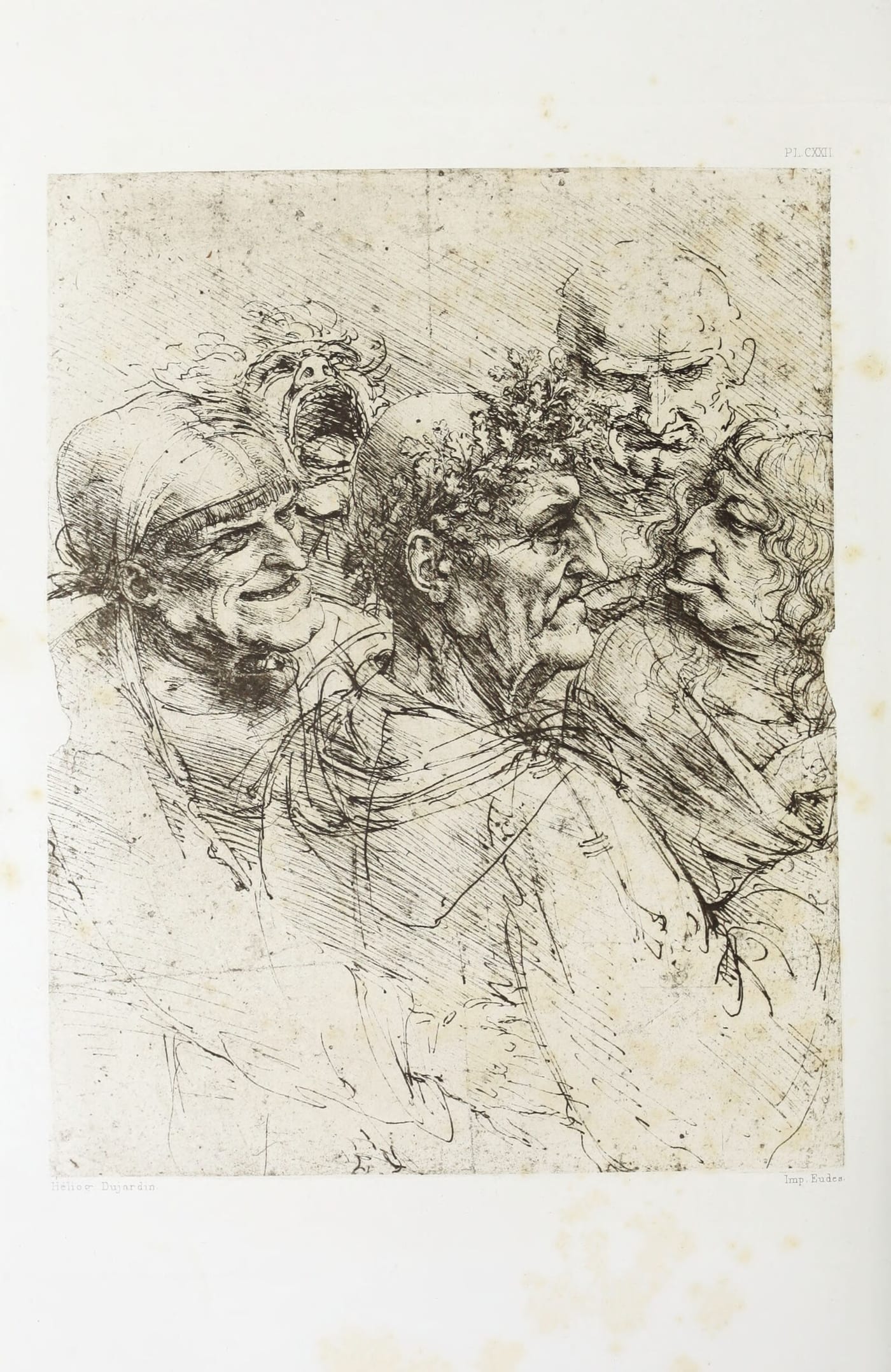
Plate CXXII: Drawing of Caricatures; from the Royal Library, Windsor Castle
Plate CXXII. Drawing of Caricatures; from the Royal Library, Windsor Castle

W. XXXI · Pl. CXXII

Miscellaneous drafts of letters and personal records (1356–1368)

§ 1356

All the ills that are or ever were, if they could be set to work by him, would not satisfy the desires of his iniquitous soul; and I could not in any length of time describe his nature to you, but I conclude...

H.3 89a

§ 1357

I know one who, having promised me much, less than my due, being disappointed of his presumptuous desires, has tried to deprive me of all my friends; and as he has found them wise and not pliable to his will, he has menaced me that, having found means of denouncing me, he would deprive me of my benefactors. Hence I have informed your Lordship of this, to the end [that this man who wishes to sow the usual scandals, may find no soil fit for sowing the thoughts and deeds of his evil nature] so that he, trying to make your Lordship, the instrument of his iniquitous and maliceous nature may be disappointed of his desire.

C. A. 380a; 1179b

§ 1358

And in this case I know that I shall make few enemies seeing that no one will believe what I can say of him; for they are but few whom his vices have disgusted, and he only dislikes those men whose natures are contrary to those vices. And many hate their fathers, and break off friendship with those who reprove their vices; and he will not permit any examples against them, nor any advice.

If you meet with any one who is virtuous do not drive him from you; do him honour, so that he may not have to flee from you and be reduced to hiding in hermitages, or caves or other solitary places to escape from your treachery; if there is such an one among you do him honour, for these are our Saints upon earth; these are they who deserve statues from us, and images; but remember that their images are not to be eaten by you, as is still done in some parts of India where, when the images have according to them, performed some miracle, the priests cut them in pieces, being of wood, and give them to all the people of the country, not without payment; and each one grates his portion very fine, and puts it upon the first food he eats; and thus believes that by faith he has eaten his saint who then preserves him from all perils. What do you think here, Man, of your own species? Are you so wise as you believe yourselves to be? Are these things to be done by men?

W. An. III. 241a

§ 1359

As I told you in past days, you know that I am without any.... Francesco d'Antonio. Bernardo di Maestro Jacopo.

C. A. 4b; 11b

§ 1360

Tell me how the things happened.

C. A. 38b; 124a

§ 1361

j lorezo ... inbiadali ... inferri de ... in lorezo ... 5[inno abuil] ... in acocatu ... per la sella ... colte di lor ... v cavallott ... el uiagg ... al ... a lurez ... in biada ... inferri ... abuss ... in viagg ... alorz ...

[This seems to be the beginning of a letter, but only the first words of the lines have been preserved, the leaf being torn down the middle. No translation is possible.]

C. A. 17b; 67b

§ 1362

And so may it please our great Author that I may demonstrate the nature of man and his customs, in the way I describe his figure.

W. 174a

§ 1363

This writing distinctly about the kite seems to be my destiny, because among the first recollections of my infancy, it seemed to me that, as I was in my cradle, a kite came to me and opened my mouth with its tail, and struck me several times with its tail inside my lips.

C. A. 65b; 199b

§ 1364

[When I did well, as a boy you used to put me in prison. Now if I do it being grown up, you will do worse to me.]

C. A. 248a; 737a

§ 1365

Tell me if anything was ever done.

Br. M. 251b

§ 1366

Tell me if ever I did a thing which me ....

Br. M. 253a

§ 1367

Do not reveal, if liberty is precious to you; my face is the prison of love.

S. K. M. III. 85a

§ 1368

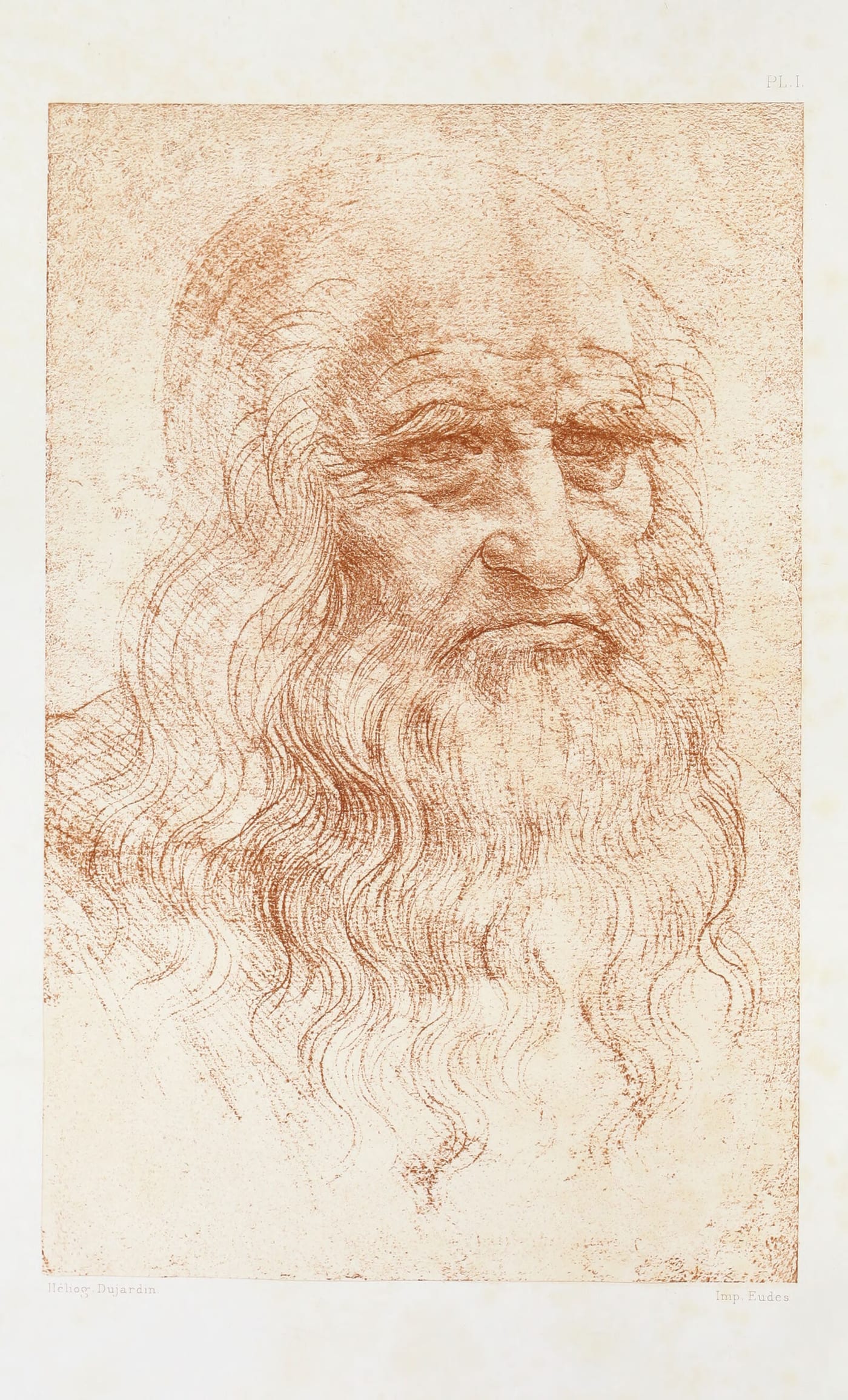
Maestro Leonardo of Florence.

Plate I: Portrait of Leonardo, by himself, reproduced from the original drawing in red chalk in the Royal Library, Turin—see No. 1368, Note
Plate I. Portrait of Leonardo, by himself, reproduced from the original drawing in red chalk in the Royal Library, Turin—see No. 1368, Note

C. A. 188b; 564b · Pl. I

Notes bearing Dates (1369–1378)

§ 1369

The day of Santa Maria della Neve [of the Snows] August the 2nd 1473.

F. U.

§ 1370

On the 2nd of April 1489, book entitled 'Of the human figure'.

W. An. I. 1a · Pl. CXVI and CXIX · C. A. 103a; 325a

Compare Plate LXII, shown with § 664

Compare Plate CXV, shown with § 1074

Compare Plate CXVI, shown with § 1294

Compare Plate CXIX, shown with § 1336

§ 1371

On the ist of August 1499, I wrote here of motion and of weight.

C. A. 103a; 325a

§ 1372

On the 9th of July 1504, Wednesday, at seven o'clock, died Ser Piero da Vinci, notary at the Palazzo del Podestà, my father, —at seven o'clock, being eighty years old, leaving behind ten sons and two daughters.

Br. M. 272a

§ 1373

On Wednesday at seven o'clock died Ser Piero da Vinci on the 9th of July 1504.

C. A. 70b; 208b

§ 1374

Begun by me, Leonardo da Vinci, on the l2th of July 1505.

S. K. M. I. 1b

§ 1375

Begun at Milan on the l2th of September 1508.

F. 1a

§ 1376

On the 9th of January 1513.

W. An. III. 217a

§ 1377

The Magnifico Giuliano de' Medici left Rome on the 9th of January 1515, just at daybreak, to take a wife in Savoy; and on the same day fell the death of the king of France.

G. o'

§ 1378

On the 24th of June, St John's day, 1518 at Amboise, in the palace of...

C. A. 245a; 731a